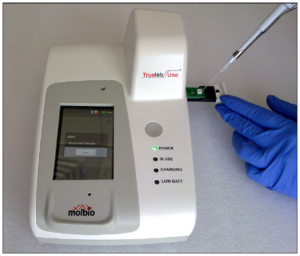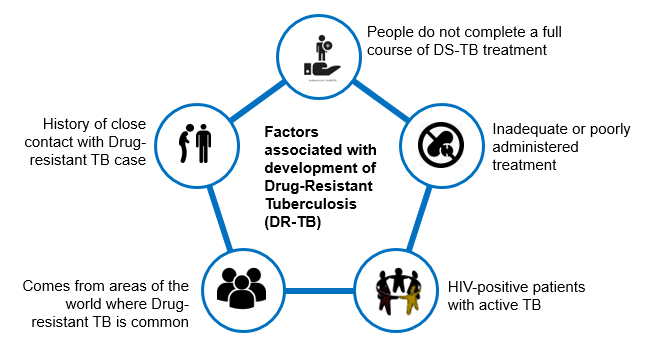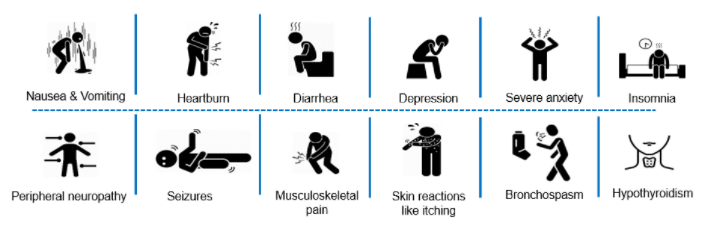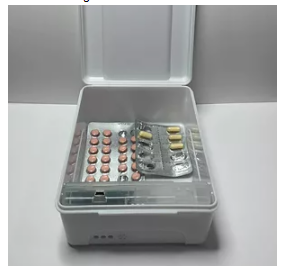

-
DR-TB HIV Coordinator: Basics of TB and NTEP
Fullscreen-
DR-TB HIV Coordinator: TB & TB Epidemiology
FullscreenTuberculosis
Content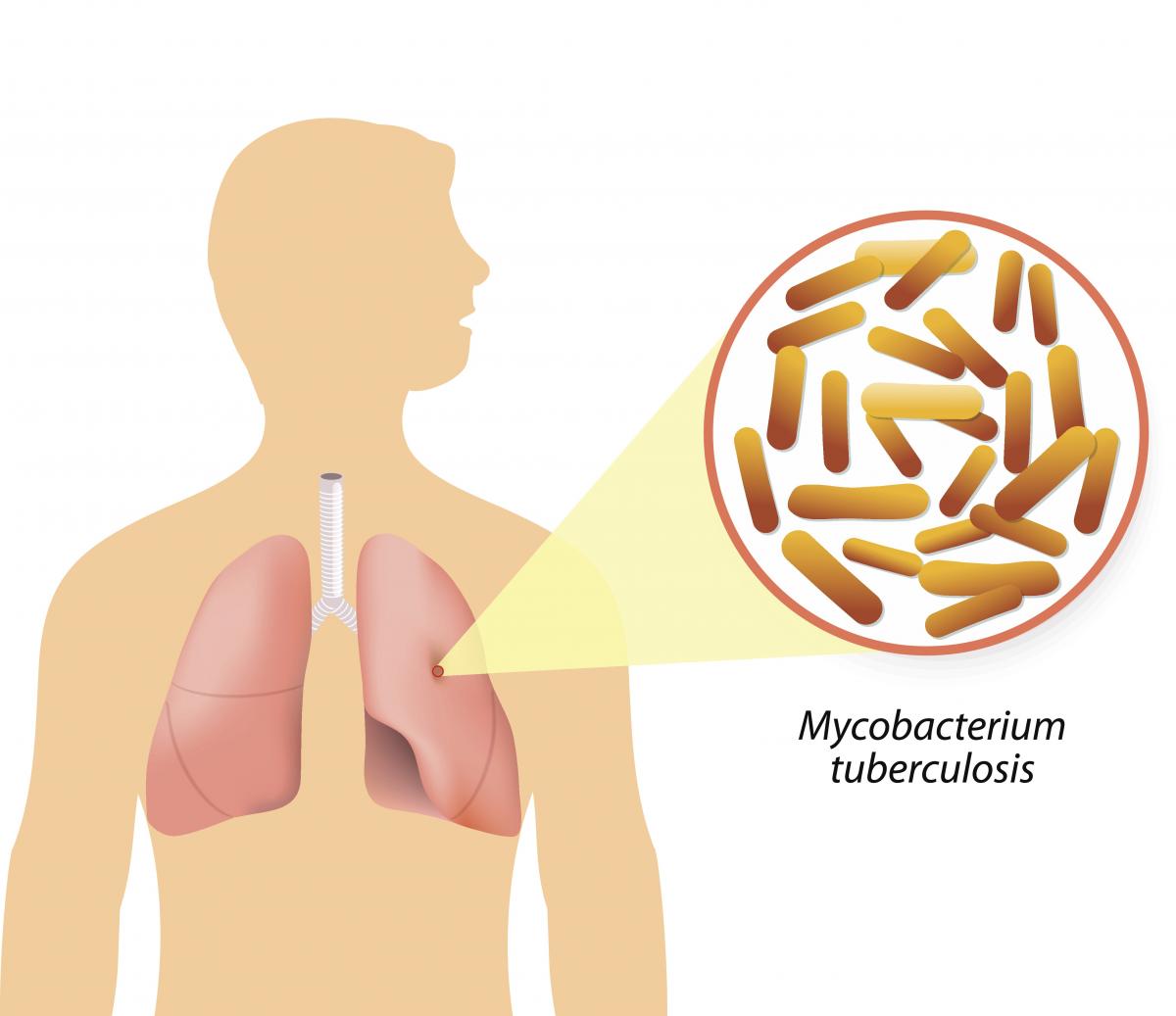
Figure: Causative agent for Tuberculosis is Bacillus: Mycobacterium tuberculosis (M.tb)
-
Tuberculosis (TB) is a communicable disease that is a major cause of ill health.
-
TB is caused by the bacillus Mycobacterium tuberculosis (M.tb)
-
TB disease typically affects the lungs (pulmonary TB) (80%) but can also affect other parts of the body (extra pulmonary TB) (20%)
-
It spreads when people who are sick with TB expel bacteria into the air (for example by coughing, sneezing, shouting or singing)
-
It is one of the top 10 causes of death worldwide and the leading cause of death from a single infectious agent
Resources
- Global Tuberculosis Report, 2020; Geneva: World Health Organization, 2020
- Training Modules (1-4) for Programme Managers and Medical Officers India: Central TB Division, MoHFW, Government of India,July 2020
-
Global Burden of TB
Content- Globally, an estimated 11 million people fell ill with TB (incidence) in 2021.
- Historically, it has been the top infectious disease killer. In 2021, there were an estimated 1.4 million TB deaths and an additional 187 000 deaths among HIV-positive people.
- Three countries accounted for 42% of global cases in 2021: India (26%), the Russian Federation (8.5%) and Pakistan (7.9%).
Image
Figure: Estimated TB incidence in 2021, for countries with at least 100 000 incident cases; Source: Global TB Report, 2022.
Resources
Burden of TB in India
ContentTB is one of the top burdensome infectious diseases in India. It is estimated that, around 1/4th (26%) of the world's TB cases are in India, translating to about 30 Lakhs new TB cases emerging each year (TB incidence). Against this estimated incidence the National TB Elimination program reported around 19 lakh new and relapse cases in the year 2021.
An estimated 5 Lakhs deaths occur due to TB each year in the country, translating to about 1 case of TB death every one-two minutes. Compared to this, there are only about 60 thousand deaths due to HIV and about 77 deaths due to Malaria each year.
TB diagnosis and treatment services although provided free of cost in the public sector, the cost of accessing these services and related loss of wages drive the affected people with poverty (catastrophic costs). TB also has a huge impact on the world's and the country's economy because of loss of workdays (100 million workdays per year).
Assessment
Question Answer 1 Answer 2 Answer 3 Answer 4 Correct answer Correct explanation Page id Part of Pre-test Part of Post-test What is the estimated number of incident TB cases that emerge each year in India? 35 Lakh cases 26 Lakh Cases 26% of the Global Burden 19 Lakh Cases 2 The estimated number of new and relapse (incident) cases in India that emerge each year is about 26 Lakh Yes Yes How many cases of deaths are estimated to be caused by TB in India Approximately One death every 2-3 minutes Approximately 5 Lakh deaths 60 Thousand deaths each year 1 and 2 4 In India it is estimated that there is around one death caused due to TB every one to two minutes, translating to about 5Lakh deaths each year in India Yes Yes Resources:
TB Causative organism
Content
Figure Mycobacterium tuberculosis
TB is caused due to the infection by a bacterium called Mycobacterium tuberculosis.

Figure: Extra-Pulmonary Tuberculosis
It often affects the lungs, and in such cases it is called Pulmonary Tuberculosis. But, it can affect almost any part of the body (except the hair and the nails), in which it is known as Extra-Pulmonary Tuberculosis.
Resources:
Mode of TB Transmission
ContentTuberculosis is transmitted mainly through the air via droplet nuclei generated when a TB patient coughs or sneezes.
It is estimated that every sputum smear-positive patient spreads the infection to 10 – 15 persons annually, if untreated..

Figure: Transmission of TB bacteria through air via droplet
Resources:
- Technical and Operational Guidelines for TB Control in India 2016
- WHO - Fact sheet details on Tuberculosis
Kindly provide your valuable feedback on the page to the link provided HERE
Pathogenesis of TB
ContentTuberculosis (TB) is an infectious, chronic, granulomatous disease caused by Mycobacterium tuberculosis. It usually involves the lungs but may affect any organ or tissue in the body.
The pathogenesis of TB in a previously unexposed immunocompetent individual is centred on the development of cell-mediated immunity. This confers resistance to the organism and results in the development of tissue hypersensitivity to tubercular antigens.
The pathologic features of TB, such as caseating granulomas and cavitation, result from the destructive tissue hypersensitivity that is part and parcel of the host immune response.
The sequence of events from inhalation of the infectious droplets to the containment of the primary focus of infection is as follows:

Figure: Pathogenesis of Tuberculosis
In many individuals, the stage 5 response (from above) halts the infection before significant tissue destruction or illness occur (Latent TB Infection). In other individuals with immune deficits due to age or immunosuppression, the infection progresses to stage 5, and the ongoing immune response results in caseation necrosis (Active TB Disease). The figure above provides more details on the progression of TB disease.
Resources
Kindly provide your valuable feedback on the page to the link provided HERE
Epidemiological Triad of TB
ContentThe Epidemiologic Triad is a model used in the field of epidemiology to study diseases and how they are spread. It consists of a triangle with three vertices or corners.
The three vertices for infectious diseases consist of:
1. Agent, or microbe that is the factor causing the disease.
2. Host, or organism harbouring the disease.
3. Environment, or those external factors that cause or allow disease transmission.
In the Epidemiological Triad of TB (Figure), the agent is the TB causing bacteria Mycobacterium tuberculosis; the host refers to humans that are susceptible to TB. Susceptibility or the risk factors for acquiring TB can be:
- Close contact with a person having TB disease
- Nutritional status of the host
- Existing co-morbidities
- Low immunity.
Susceptibility of the host can also vary due to age, gender, genetic composition, race, ethnicity, etc.
As TB is an airborne disease, environmental factors come into play for the transmission of TB. These include crowding, poor ventilation, bad sanitation, indoor air pollution, etc.
The understanding between the interplay of agent, host and environment is essential to understanding the epidemiology of TB and taking measures to control it. The risk of TB due to environmental factors can be reduced by practising airborne infection prevention measures like good ventilation, hand hygiene and cough etiquette.

Figure: Epidemiological Triad of TB
Resources
Assessment
Question Answer 1 Answer 2 Answer 3 Answer 4 Correct answer Correct explanation Page id Part of Pre-test Part of Post-test The three vertices of the Epidemiological Triad are agent, host and environment.
TRUE FALSE 1 The three vertices of the Epidemiological Triad are agent, host and environment.
Yes Yes Agent in TB
ContentMycobacterium tuberculosis (M. tuberculosis) belonging to the family Mycobacteriaceae cause Tuberculosis (TB).
These are rod shaped bacilli and require oxygen to survive (aerobic bacteria).
The following characteristics of these bacilli help them to survive in human body for a long time and resist the action of drugs:
- Slow growing bacteria (replicates every 12-24 hours)
- Tough, hydrophobic cell wall rich in mycolic acid that resists action of many drugs including antibiotics.
- Ability to remain in dormant stage inside host tissues for many years in conditions with limited oxygen and nutrition (facultative anaerobes). They can revert to active state when favourable conditions (reduced host immune response, undernutrition etc.) ensue. The persistence of the bacteria in the host tissue for long duration of time is responsible for prolonged incubation period and re-activation of infection.
- The multiple mechanisms of drug resistance by the bacteria give rise to multi-drug resistant and extensively drug-resistant tuberculosis.
These characteristics make tuberculosis a chronic granulomatous disease that requires special antibiotics for treatment.
Resources
- Antimicrobial Resistance in Mycobacterium tuberculosis: Mechanistic and Evolutionary Perspectives, FEMS Microbiology Reviews, May 2017.
- The Biology of Mycobacterium tuberculosis Infection, Mediterranean Journal of Hematology and Infectious Diseases, 2013.
Assessment
Question Answer 1 Answer 2 Answer 3 Answer 4 Correct Answer Correct Explanation PageID Part of pre-test Part of post test M. tuberculosis bacilli can survive conditions with limited oxygen. This means they are: Strict aerobes Strict anaerobes Facultative anaerobes None of the above 3 M. tuberculosis requires oxygen. However, they can survive in limited oxygen conditions also and can enter a dormant stage. They revert to active state when favourable conditions ensue. Thus, they are facultative anaerobes. Yes Yes Host factors in TB
ContentHost factors in TB disease are various factors/attributes of the host(person who is developing TB disease/infection).
The various host factors are as follows:
- Age: TB can affect people of any age. Young adults (15-30 years of age) are seen to have high rates of disease in India. Children and the elderly are also high-risk groups for the contraction of the disease.
- Gender: TB affects all genders, but males have higher disease rates, probably owing to higher levels of exposure to the bacteria in occupational settings.
- Immunity status: Individuals with compromised immunity status, like those on corticosteroid therapy/ immunosuppressants after organ transplant, HIV infection, diabetes mellitus etc., are more prone to TB infection and disease.
- Nutritional status: Undernutrition causes weakening of the immune system and hence predisposes to TB. Risk of TB increases by about 14% with each unit reduction in Body Mass Index (BMI).
- Previous TB infection: Individuals who are close/ household contacts of confirmed pulmonary TB patients; individuals residing in TB high-prevalence regions; high-risk groups like healthcare workers, homeless people, HIV infected etc., have high chances of being already infected with TB and hence, would progress to disease.
Resources
- India TB Report 2021, Central TB Division, MoHFW, Government of India.
- TB Risk Factors, Centers for Disease Control and Prevention.
Assessment
Question Answer 1 Answer 2 Answer 3 Answer 4 Correct answer Correct explanation Page id Part of Pre-test Part of Post-test Pick the correct statement for the causation of TB disease. Undernutrition causes TB disease. HIV infection compromises the immune system and may lead to TB disease. Children do not develop TB disease. The elderly are not at high risk for developing TB disease. 2 - HIV infection weakens the immune system of an individual and predisposes him/her to TB infection and disease.
- Undernutrition, as such, is not a causative factor for TB, but it weakens the immune system and predisposes to the infection/ disease.
- Children and the elderly are at high risk for TB.
Yes Yes Environmental influences in TB
ContentEnvironmental conditions have a huge role in the development of TB disease and are an important component of the epidemiological triad for TB disease.
The various environmental factors influencing TB are:
- Poor housing and ventilation: Damp homes, often resulting from condensation due to inadequate ventilation, allow the growth of mold, fungi, and other microorganisms. This adversely affects the respiratory health of individuals and increases the chances of the spread of TB from a patient to his/her household contacts.
- Overcrowding: More people living within a single space restricts movement, gives scope for lack of privacy and limits hygiene. The extent and persistence of contact with an infected person increases. The droplet nuclei (due to coughing) from infected individuals can stay in the air for a long time and transmit the disease easily to contacts.
- Indoor air pollution: The use of traditional biomass fuels like cow dung, wood etc. for energy generation (especially for cooking) in poorly ventilated households pose serious risks to the lung health of individuals. Damaged lungs are more susceptible to TB infection/ disease.
- Occupational environment: Healthcare workers, miners etc. are at a high risk of TB. Inadequate air change rates, negative airflow and recirculation of air have been identified as occupational hazards in hospitals with respect to TB transmission.
Resources
- Role of Environmental Factors in Transmission of Tuberculosis, Dynamics of Human Health, 2015.
- Housing and Public Health, Annual Review of Public Health, 2004.
Assessment:
Answer 1
Answer 2
Answer 3
Answer 4
Correct answer
Correct explanation
Page id
Part of Pre-test
Part of Post-test
How does poor housing contribute to TB transmission?
Poor ventilation measures
Increased dampness in the ambient air
Indoor air pollution
All of the above
4
Poor housing usually arises as a result of poverty, wherein the nutritional status and hence immunity of inhabitants are already low, which predisposes them to TB. Adding to it, structural faults like poor ventilation, the resultant increase in droplets in the air and poor smoke escape from the burning of solid fuels also contribute to TB transmission.
Yes Yes TB Infection
Content-
TB Infection (or previously known as Latent TB infection) is a stage in between uninfected and having active TB. In this stage the person has no symptoms and can only be identified using laboratory tests.
-
The vast majority of infected people may never develop TB disease. However, to achieve TB elimination, it is important to treat TB infection in people at risk of developing active TB disease.
-
It is a state of persistent immune response to stimulation by Mycobacterium tuberculosis antigens with no evidence of clinically manifested active TB.
-
There is no single acceptable/reliable test for direct identification of Mycobacterium tuberculosis infection in humans. Tuberculin Skin Test (TST) and Interferon-gamma release assay (IGRA) are commonly used tests for identifying TB infection.
Resources:
-
Natural History of TB
Progression to TB Disease
ContentAfter exposure to infective droplets containing M.TB, only a small proportion gets infected and further progresses to active TB disease.
- Majority of those that get infected persist in a stage of clinical latency known as TB infection (previously known as Latent TB infection). They do not have TB disease and do not show any symptoms of TB and no evidence of any TB related changes on chest X-ray.
- A small proportion of those with prior infection may progress to active TB disease due to various environmental/ agent/ host factors.

Figure: Flow chart for TB disease progression
Resources:
Kindly provide your valuable feedback on the page to the link provided HERE
TB Infection Vs Active TB Disease
ContentTB Infection Active TB Disease May not have any signs & symptoms Has sign and symptoms such as cough for more than two weeks, fever, weight loss and blood in sputum Has dormant, contained bacteria is the body Has active, multiplying bacteria in the body Doesn't spread TB bacteria to others May spread TB bacteria to others Chest X-ray usually normal Lesion in Chest X- ray (usually) May advance to active TB. It is estimated that the lifetime risk of an individual with TB infection for progression to active TB is 5–10%. Needs treatment for TB disease Resources:
Determinants of TB Disease
ContentDeterminants are any characteristics that affect the health of a patient.
Biological Determinants Behavioral Determinants Socio Economic Determinants Occupational Determinants - People living with HIV(PL HIV)
- History of contact with a case of TB
- People with underlying medical conditions like Diabetes, Kidney disease, Cancer etc.
- Existing lung disease
- Old age
- Use of tobacco and alcohol
- Malnutrition
- Person in contact with TB infected patient
- Person living in areas with poor ventilation & over crowding
- Poverty and Malnutrition
- Homeless
- Mining work
- Quarry work(Silicosis)
- Construction work
- Migrant worker
- Daily wagers
Socio-Economic Determinants for Tuberculosis
ContentSocioeconomic determinants of health include the conditions in which people are born, grow, live, work, and age. These determinants play an important role in increasing the risk of acquiring TB infection, its progression into active TB disease and further transmission to contacts.
Socio-economic factors affect health-seeking behaviour and access to TB services
Figure: Socioeconomic factors that are affecting the health of TB patients
There may be difficulties in transportation to health facilities and lack of social support to seek care when they fall sick. This delays the contact with health systems for appropriate diagnosis and initiation of treatment.
Vulnerable Population for Tuberculosis
ContentTB can affect anyone but it is more prevalent in some communities which are vulnerable to TB disease due to various factors which are mentioned below:
Increased exposure of TB due to where they live or work
- prisoners
- slum dwellers
- miners
- hospital visitors
- healthcare workers
Limited access to Quality TB services
- Migrant workers
- Women in settings with gender disparity,
- Children
- Physically challenged
- Transgender population
- Tribal and population living in hard to reach areas
- Refugees or internally displaced people
- Illegal miners and undocumented migrants
Increased risk because of biological or behavioural factors that compromise immune functions in people who:
- People who live with HIV
- have diabetes or silicosis
- undergo immunosuppressive therapy
- are undernourished
- use tobacco
- suffer from alcohol use disorders.
- inject drugs
Prevention of TB
ContentAs TB is an airborne infection, TB bacteria are released into the air when someone with infectious TB coughs or sneezes. The risk of infection can be reduced by taking simple precautions:
Figure: Measures for control and prevention of tuberculosis
TB Preventive Treatment(TPT) also has a very important role in prevention of TB. Presently, household contacts of sputum-positive TB patients are given TPT upon confirmation of TB infection and ruling our active Tuberculosis.
Resources:
Development of Drug Resistance in Mtb.
ContentDrug resistance in Mycobacterium tuberculosis occurs when there is acquisition of mutations in genes that code for anti-TB drug targets or drug-activating enzymes.
Drug resistance in Tuberculosis (TB) occurs through two main mechanisms shown in the figure below.
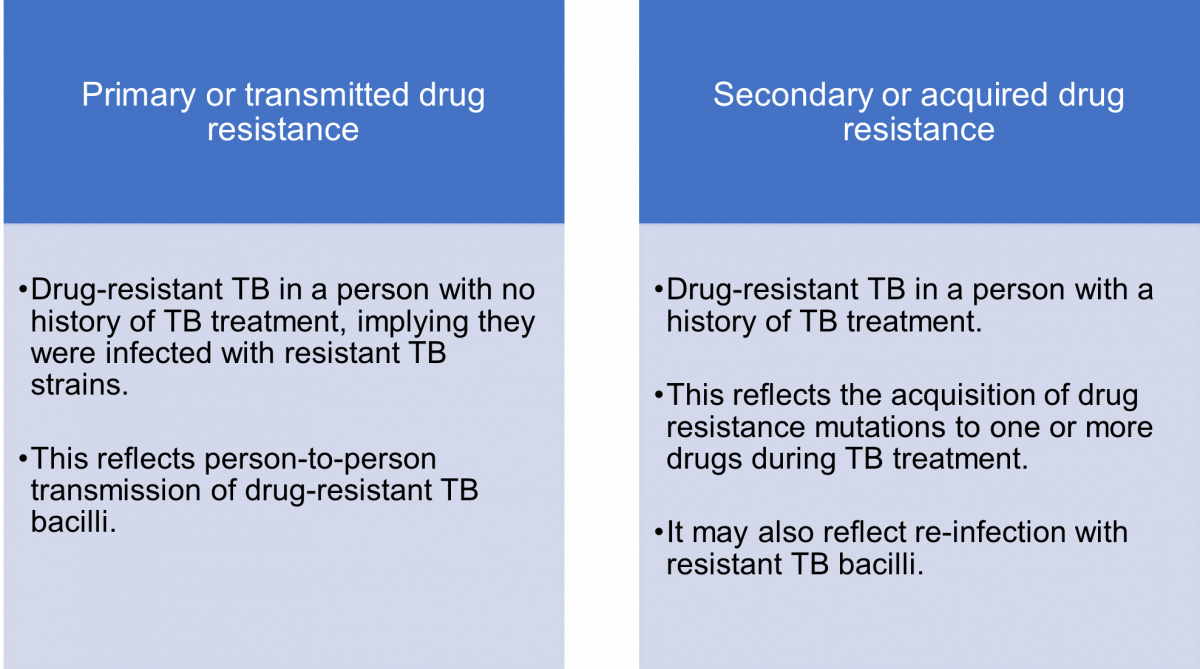
Figure: Mechanisms or Types of Drug Resistance in TB
The mechanism of transmission of drug-resistant (DR) and drug-sensitive (DS) TB is the same i.e., via infectious aerosols.
Acquired drug resistance is multi-factorial, and may be due to:
- Lack of access to quality-assured anti-TB drugs for proper treatment
- Lack of adherence to the regimen or interrupted therapy which could be due to complex dosing strategies, serious adverse drug reactions and drug–drug interactions
- Inappropriate regimens
- Sub-therapeutic dosing
- Use of expired or substandard anti-TB drugs
- Malabsorption of oral anti-TB drugs which can be seen, for example, in HIV patients.
Resources
- Navisha Dookie et al. Evolution of Drug Resistance in Mycobacterium tuberculosis: A Review on the Molecular Determinants of Resistance and Implications for Personalized Care, Journal of Antimicrobial Chemotherapy, Volume 73, Issue 5, May 2018.
- Bento J, Duarte R, Brito MC, et al. Malabsorption of Antimycobacterial Drugs as a Cause of Treatment Failure in Tuberculosis, BMJ, September 2010.
- Biadglegne F, Sack U, Rodloff A. Multidrug-resistant Tuberculosis in Ethiopia: Efforts to Expand Diagnostic Services, Treatment and Care. Antimicrobial Resistance Infection Control, 2014.
Causes for Drug-resistant Tuberculosis
ContentDrug resistance is caused by a genetic mutation that makes the drug ineffective against the mutant bacilli.
The causes of drug-resistant TB can be enumerated as follows:
1. Providers/ Programme Related Causes:
- Inadequate or poorly administered TB treatment regimen
- Unavailability or poor quality of anti-TB drugs
- Poor monitoring of TB treatment
- Delay in detection and management of DR-TB
2. TB Patient/ Host Related Causes:
- Clinical characteristics of TB patients leading to suboptimal drug levels in blood (e.g. Malabsorption syndrome)
- Irregular anti-TB treatment due to any reason (e.g. socio-economic barriers, substance abuse, Adverse Drug Reactions (ADRs), psychological and other factors)
There are two principal causal pathways leading to the development of drug-resistant TB:
- Primary drug resistance: It means that a person has been infected with a drug-resistant TB strain.
-
Acquired (Secondary) drug resistance: It is the result of inadequate, incomplete or poor treatment quality that allows the selection of mutant resistant strains.
Resources
- Guidelines for PMDT in India, 2021.
- Companion Handbook to the WHO Guidelines for the Programmatic Management of Drug-resistant Tuberculosis.
Kindly provide your valuable feedback on the page to the link provided HERE
Prevention of Drug Resistance
ContentThere are five principal ways to prevent Drug-resistant Tuberculosis (DR-TB), as given in the figure below.
Image
Figure: Five Principal Ways to Prevent DR-TB; Source: Guideline for PMDT in India, 2021.
- Drug resistance cannot be prevented by mere diagnosis and treatment of DR-TB.
- Basic TB diagnostic and treatment services should receive priority for the prevention of drug resistance.
- Systems for early detection and treatment of DR-TB should be integrated into the existing TB services and the general health system.
- Healthcare facilities and congregate settings should be provided with proper infection control measures.
- Transmission should be prevented by addressing non-specific determinants like access to care, comorbidities and awareness.
Resources
- Guidelines for PMDT in India, 2021.
- Companion Handbook to the WHO Guidelines for the Programmatic Management of Drug-resistant Tuberculosis.
Kindly provide your valuable feedback on the page to the link provided HERE
Chemotherapy and its implication in TB control
ContentChemotherapy for TB is the use of an anti-TB drugs to kill, or prevent the replication of, TB mycobacteria in the patient’s body. Effective anti-TB chemotherapy renders the patient non-contagious and cures the patient, thereby interrupting the chain of transmission. Mortality rates of TB range from 50-80% in untreated smear-positive individuals and drop to lower than 5% under chemotherapy.
Most of the bacteria are killed during the first 8 weeks of treatment; however, there are persistent organisms that require longer treatment. TB disease must be treated for at least 6 months and in some cases even longer. The use of multi-drug therapy reduces the incidence of drug-resistant cases and increases the overall effectiveness of treatment.
If treatment is interrupted, any surviving bacteria may cause the patient to later become ill and infectious again, potentially with drug-resistant disease.
How infectious are tuberculosis patients under chemotherapy?
Under effective chemotherapy, there is a substantial decline in infectiousness in two weeks time, and may not be a major source of risk to any contacts. This decline is indicated by the rapid fall in the number of viable organisms in the sputum, and reduced frequency of coughing.
Types of Chemotherapy in TB
- Preventive Chemotherapy: Regimen for healthy but TB infected persons with a high risk of developing TB, in order to prevent them from developing TB.
- Standard Chemotherapy: Two-phased chemotherapy for an average of 6-8 months based on the combination of at least four major drugs (HRZE) given for 2 months during the initial intensive phase of treatment and followed by a combination of at least 2 drugs given for at least 4 months during the continuation phase of treatment.
- Chemotherapy for Drug-resistant TB: Two-phased chemotherapy varying from 9 - 24 months in patients having demonstrated resistance to drugs used in standard chemotherapy. The regimen varies with the drug to which the resistance is present, however, each regimen contains a mix of second-line anti-TB drugs including injectables.
Resources
- Training Modules (1-4) for Programme Managers and Medical Officers, 2020.
- Tuberculosis Infectiousness and Host Susceptibility, The Journal of Infectious Diseases, Vol. 216, suppl_6, 2017.
- Tuberculosis chemotherapy: Current Drug Delivery Approaches, Respiratory Research 7, Article no. 118, 2006.
- Tuberculosis Case-finding and Chemotherapy: Questions and Answers, K. Toman.
Assessment
Question Answer 1 Answer 2 Answer 3 Answer 4 Correct answer Correct explanation Page id Part of Pre-test Part of Post-test Which type of chemotherapy regimen of anti-TB drugs is used for infected persons with a high risk of developing TB who have no signs or symptoms of active disease, in order to prevent them from developing TB? First-line anti-TB drugs Preventive Chemotherapy Standard Chemotherapy Chemotherapy for Drug Resistant-TB 2 Preventive chemotherapy regimen of anti-TB drugs is used for infected persons with a high risk of developing TB who have no signs or symptoms of active disease, in order to prevent them from developing TB. Yes Yes Incidence of TB Disease
ContentIncidence is an epidemiological measure of the occurrence of new cases of a disease in a population over a specified period of time. Tuberculosis (TB) incidence is the number of new cases of active TB disease during a certain time period (usually a year), and is better expressed as a rate, as shown in the figure below.


Figure: Deriving the Incidence of TB Disease for a Given Population
Tuberculosis incidence varies considerably in different populations and population segments.
In 2021, the Global TB incidence was 134 (125-143) per 100,000. The TB Incidence rate of India is - 210 (178-244) per 100,000 in 2021 according to WHO Global TB Report 2022.
Resources
- India TB Report, 2022.
- Epidemiologic Basis of Tuberculosis Control, Hans L. Rieder, 1999.
- Morbidity Frequency Measures, Centers for Disease Control and Prevention.
- Global Tuberculosis Report 2022.
Prevalence of TB Disease
ContentPrevalence is an epidemiological measure of the proportion of a population with a disease or a particular health condition at a specific point in time (point prevalence) or over a specified period of time (period prevalence).
Tuberculosis (TB) prevalence refers to the number of people with TB that are present in a particular population at a given time. Calculation of the TB prevalence rate is shown in the figure below.

Figure: Deriving the Prevalence of TB Disease for a Given Population
TB prevalence rate is derived by adding the number of persons that develop new TB disease (i.e., incident cases) and those who already have the disease (i.e., existing cases), and dividing the sum by the total population from which the cases arose.
TB prevalence varies widely and is affected by a number of factors such as age, gender, population density, rural/urban settings, as well as socioeconomic factors.
Resources
Kindly provide your valuable feedback on the page to the link provided HERE
TB Notification rate
ContentTB notification rate is the number of TB cases notified over a specified time period for a specified population, usually per lakh. It indicates how many cases have been diagnosed and informed to the National TB Elimination Program.
It is mostly calculated annually, and the calculation formula is as follows:

Figure: Deriving the Annualized TB Case Notification Rate
The National TB Elimination Program calculates TB notification rates based on TB cases notified using the digital surveillance system called Nikshay. Each state/district is provided with an annual target for TB case notification, the progress of which is measured periodically to understand efforts taken for the detection of TB cases.
Example
If the number of TB patients diagnosed in District X one year is 1000, and the mid-year population of District X is 10,00,000, then the annualized TB case notification rate is calculated as follows:
100 cases/100 000/year
Resources
TB deaths
ContentWhen an HIV-positive person dies from TB, the underlying cause is classified as HIV with TB as a contributory cause. However, the milestones and targets for reductions in TB deaths set at the End TB Strategy are for the combined total of deaths in HIV-positive and HIV-negative people.
Estimates of TB deaths in India:
Estimates of TB burden, 2020 Number (Rate per 100 000 population) HIV-negative TB mortality 493 000 (453 000-536 000) 36 (33-39) HIV-positive TB mortality 11 000 (9 800-12 000) 0.78 (0.71-0.84) In 2020, India accounted for 38% of global TB deaths among HIV-negative people, and for 34% of the combined total number of TB deaths in HIV-negative and HIV-positive people.
Note: The International Classification of Diseases (ICD) defines TB deaths as ‘death from TB among HIV-negative people'.
Resource
Assessment
Question
Answer 1
Answer 2
Answer 3
Answer 4
Correct answer
Correct explanation
Page id
Part of Pre-test
Part of Post-test
What is the definition of TB mortality rate?
Number of TB deaths per one thousand population per month
Number of TB deaths per 10 thousand population per year
Number of TB deaths per one lakh population per year
Number of TB deaths per one crore population per year
3
TB mortality rate is defined as the number of TB deaths per one lakh population per year.
Yes
Yes
-
DR-TB HIV Coordinator: NTEP
FullscreenEnd TB strategy
ContentThe World Health Organisation End TB Strategy, adopted by the World Health Assembly in 2014, aims to end the global TB epidemic. The strategy draws on the opportunities presented by the Sustainable Development Goals (SDGs), especially those goals aimed at achieving universal health coverage and social protection from disease.
The table given below provides information on the vision, goal, milestones and targets for the End TB Strategy.
Table: Details on the End TB Strategy; Source: The End TB Strategy, World Health Organisation, 2015, p2. Vision of the End TB Strategy A world free of TB:
- Zero TB deaths
- Zero TB disease cases
- Zero suffering due to TB
Goal of the End TB Strategy To end the global TB epidemic by 2035 End TB Milestones for 2025 - 75% reduction in tuberculosis deaths (compared with 2015)
- 50% reduction in tuberculosis incidence rate (less than 55 tuberculosis cases per 100 000 population)
- No affected families facing catastrophic costs due to tuberculosis
End TB Targets for 2035 - 95% reduction in tuberculosis deaths (compared with 2015)
- 90% reduction in tuberculosis incidence rate (less than 10 tuberculosis cases per 100 000 population)
- No affected families facing catastrophic costs due to tuberculosis
The National Strategic Plan (2017-2025) proposes bold strategies with commensurate resources to rapidly decline TB in the country by 2030 in line with the global End TB targets to attain the vision of a TB-free India.
Resources
- National Strategic Plan for Tuberculosis Elimination 2017–2025.
- The End TB Strategy, World Health Organisation, 2015.
Sustainable Development Goals [SDGs] related to TB
Content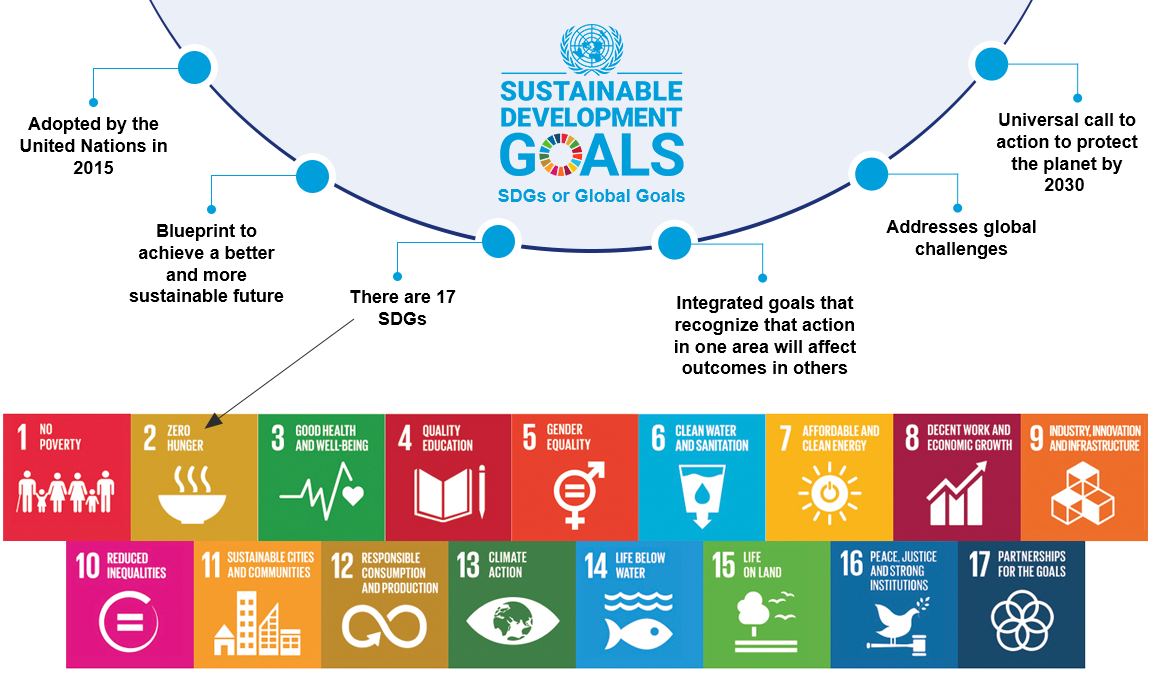
Figure: Summary of the Sustainable Development Goals
- Goal 3 is related to Good Health and Well-being. It mentions that 'Each nation needs to ensure healthy lives and promote the well-being of all ages'.
- The United Nations Sustainable Development Goals (SDGs) include ending the TB epidemic by 2030 under Goal 3.
- Goal 3.3: By 2030, end the epidemics of AIDS, tuberculosis, malaria and neglected tropical diseases and combat hepatitis, water-borne diseases and other communicable diseases.
India is a signatory of the United Nations Sustainable Development Goals and has targeted TB elimination by 2025, five years ahead of the SDG timeline.
Resources
Evolution of TB Elimination Programme in India
ContentThe National Tuberculosis Control Program (NTP) of India was launched in 1962. It relied on BCG, X-ray based diagnosis and Streptomycin and INH based treatment centralized at district level.
Based on a review of the NTP, and WHO recommendations of the DOTS Strategy, Government of India then revised the NTP and launched new program with the title Revised National Tuberculosis Control Program (RNTCP) in 1997. It used Sputum microscopy at DMC(Designated Microscopy Centres) for diagnosis, and multi-drug Short Course Anti-TB Therapy, decentralized to the TU (TB Unit) level.
In recognition of the rising drug resistance problem the DOTS Plus/ PMDT (Programmatic Management of Drug Resistant TB) was launched in 2006 and scaled up to the entire country by 2012.
Further to strengthen the monitoring and supervision system - a case based notification system - Nikshay was introduced in 2012. The same year Tuberculosis was added as a notifiable disease at the point of diagnosis by all health care providers.
Other key milestones from 2012 to 2020 were the availability of the Standards of TB Care in India (STCI) in 2014, introduction of the Daily weight band wise Fixed Dose combination (FDC) in 2016 and new drugs like Bedaquilline and Delaminid were started in 2017 and 2018 respectively.
To emphasise the commitment of the Government of India and to accelerate the efforts towards TB elimination, RNTCP was renamed as "National Tuberculosis Elimination Programme (NTEP)" in 2020.

Figure: Key milestones under NTEP
Resources:
India's commitment to End TB
ContentThe Government of India has committed to achieving the Sustainable Development Goals(SDG) targets related to ending TB by 2025 (5 years ahead of the global target). This would mean that in 2025, the 2030 target of achieving 80% reduction in incidence, 90% reduction in deaths due to TB compared to that of 2015, is to be achieved.
Parameter 2015 Value SDG 2030 Target Commitment for 2025 Estimated annual Incidence 217 cases/Lakh 80% reduction 44 cases/lakh Estimated annual Mortality 4.5 lakh 90% reduction 45,000 Table: India's commitment to End TB by 2025.
Resources:
National Strategic Plan [NSP] for TB Elimination 2017-25
ContentThe National Strategic Plan (NSP) for TB elimination 2017–25 is a bold strategic framework to drive the acceleration of progress toward TB Elimination, and achieving the Sustainable Development Goal (SDG) and End TB targets for India. It expects to guide the activities of all stakeholders including the national and state governments, development partners, civil society organizations, international agencies, research institutions, private sector, and many others whose work is relevant to TB elimination in India. It is adopts strategies under four groups DETECT, TREAT, PREVENT, BUILD.
VISION: TB-Free India with zero deaths, disease and poverty due to tuberculosis
GOAL: To achieve a rapid decline in burden of TB, morbidity and mortality while working towards elimination of TB in India by 2025.The results framework of the NSP outlines the various targets (impact and outcomes) to be achieved.
IMPACT INDICATORS 2015
(Baseline)2020 2023 2025 1. To reduce estimated TB Incidence rate (per 100,000) 217
(112-355)142
(76-255)77
(49-185)44
(36-158)2. To reduce estimated TB prevalence rate (per 100,000)
320
(280-380)170
(159-217)90
(81-125)65
(56-93)3. To reduce estimated mortality due to TB (per 100,000)
32 (29-35) 15 (13-16) 6 (5-7) 3 (3-4) 4. To achieve zero catastrophic cost for affected families due to TB 35% 0% 0% 0% Resources
Assessment Questions
Question Answer 1 Answer 2 Answer 3 Answer 4 Correct Answer Explanation Part of pre-test Part of post-test Which are the groups under which strategies for National Strategic Plan (NSP) for TB elimination 2017–25 were developed? DETECT, TREAT, PREVENT DETECT, TREAT, PREVENT, BUILD DETECT, TREAT, PREVENT, REHABILITATE DETECT, TREAT, REHABILITATE DETECT, TREAT, PREVENT, BUILD The National Strategic Plan (NSP) for TB elimination 2017–25 adopts strategies under four groups: DETECT, TREAT, PREVENT, BUILD. Yes Yes Which of the following does the National Strategic Plan (NSP) for TB elimination 2017–25 aim to bring down to 0% by 2025? Incidence rate Prevalence rate Mortality rate Catastrophic cost for affected families Catastrophic cost for affected families The target of the National Strategic Plan (NSP) for TB elimination 2017–25 is to achieve zero catastrophic cost for affected families due to TB Yes Yes NTEP Objectives- in relation to NSP 2017-2025
ContentNSP 2012 - 2017 had the aim of achieving universal access to quality diagnosis and treatment. The NSP 2017-2025 which builds on the success and learnings of the last NSP, and articulates the bold and innovative steps required to move towards TB elimination. In 2020, RNTCP was renamed to "National Tuberculosis Elimination Programme" with the following objectives:

Figure: Objectives of NTEP
Resources:
Standards of TB Care in India
ContentThe Standards for TB Care in India (STCI), which is a locally customized version of the International Standards of Tuberculosis Care, mentions 26 standards that every citizen of India should receive irrespective of the sector of treatment.
STCI were developed based on a series of discussions involving various stakeholders including clinicians, public health specialists, community workers and patient advocates.
STCI represent what is expected for quality TB care from the Indian healthcare system including both public and private systems.
It was first published in 2014 and outlines standards across the four themes of TB diagnosis, TB treatment, public health action and social inclusion.
Following are the list of the 26 Standards:

Table 1: Categorisation of the Standards for TB Care in India, Source: Standards for TB Care in India, World Health Organisation, pp. 13-23
Resources
Assessment
Question Answer 1 Answer 2 Answer 3 Answer 4 Correct answer Correct explanation Page id Part of Pre-test Part of Post-test How many standards in TB care are described in the Standards of TB Care in India (STCI) 2014? 4 15 26 32 3 There are 26 standards for TB care under four major categories: diagnosis, treatment, public health actions and social inclusion. Yes Yes History of Programmatic Management of Drug Resistant TB in India
Content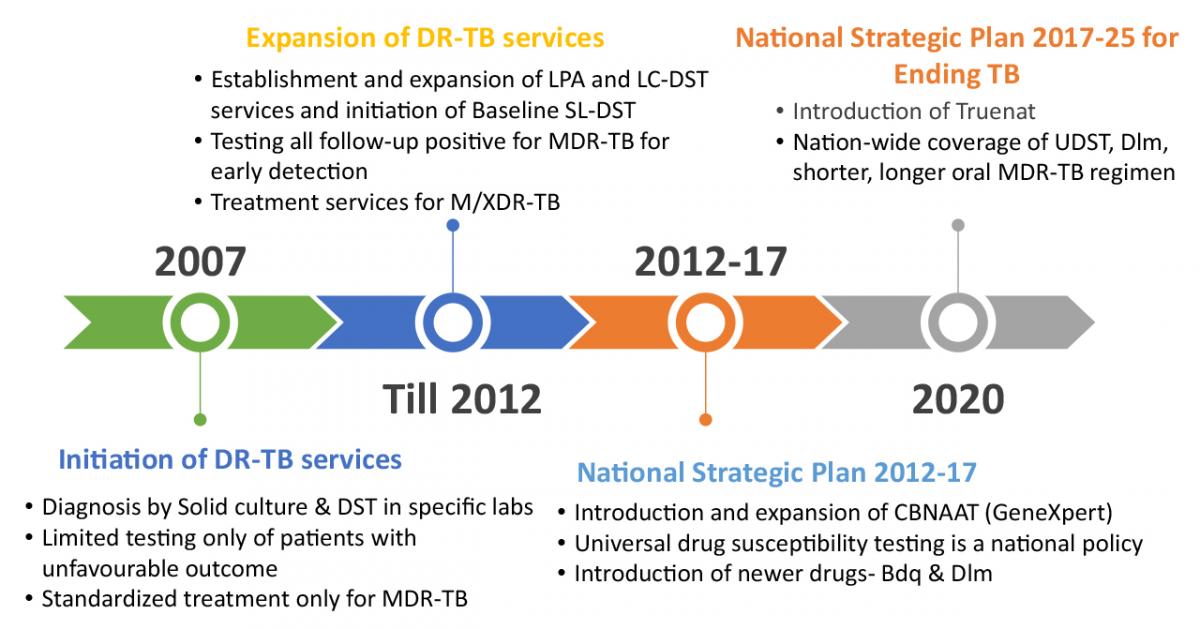
Figure 1: History of PMDT in India (2007 to 2020).; Source: Guidelines for PMDT in India, 2021 p.02
- Programmatic Management of Drug-resistant Tuberculosis (PMDT) services were rolled out in India in 2007.
- From 2007 to 2012, services were expanded in terms of diagnostic and treatment facilities.
- Country-wide geographical coverage of PMDT services was achieved in 2013.
- From 2012 to 2017, major policy shifts under PMDT were observed like introduction and expansion of Cartridge Based Nucleic Acid Amplification Test (CBNAAT), Universal Drug Susceptibility Testing (UDST), and introduction of newer drugs.
- In 2017 to 2020, introduction and expansion of Truenat till sub-district level, national-wise coverage of UDST, shorter and longer oral multi-drug resistant tuberculosis (MDR-TB) regimen were achieved.
Resources
Kindly provide your valuable feedback on the page to the link provided HERE
Organizational Structure of NTEP
ContentNational Tuberculosis Elimination Programme (NTEP) is a centrally sponsored programme being implemented under the aegis of National Health Mission.
National Level: Managed by Central TB Division (CTD), the technical arm of the Ministry of Health and Family Welfare (MOHFW)
State Level: State TB Cell coordinates the overall TB elimination programme in state under the guidance of State Health Society. The training ,supervision, monitoring and evaluation NTEP at state level are looked after by STDC (State TB Training and Demonstration Centre).
District TB Centre (DTC) is the nodal point for all TB elimination activities in the district under the guidance of the District Health Society.
Tuberculosis Unit (TU) Level: NTEP activities at block/sub-district level are implemented through TU which comprises Designated Medical Officer (MO) supported by two full-time NTEP staff - STS (Senior Treatment Supervisor) & STLS (Senior TB Lab Supervisor).
PHI (Peripheral Health Institute): PHI is a health facility manned by a Medical Officer (MO). Some of the PHIs are also the Tuberculosis Diagnostic Centres, which are the most peripheral level laboratories in the NTEP structure. All the Private Health Facilities like Private Practitioners / Private Hospitals / Clinics / Nursing Homes are also PHI.

Figure: Organisational structure of NTEP
Resources:
District TB Centre [DTC]
ContentThe key level for the management of public health services is the district level. The District Tuberculosis Centre (DTC) is the nodal point for tuberculosis (TB) control activities in the district.
Functions of the DTC
The primary role of the DTC is a managerial one. The DTC is the central program management unit of the district responsible for all activities related to National TB Elimination Programme (NTEP) implementation such as:
- Advocacy
- Active case finding
- Diagnosis, treatment (both for drug-susceptible and drug-resistant TB cases) and follow up
- Managing comorbidities
- Service delivery
- Maintaining diagnostic and treatment infrastructure
- Setting up Drug-resistant TB (DR-TB) centres
- Ensuring community engagement and TB forums
- Multi-sectorial involvement for drug management, and supervision and monitoring
- Financial management
- Drugs, logistics and supply chain management.
Components of the DTC
- District Drug Store (DDS)
- Nucleic Acid Amplification Test machine (Cartridge Based NAAT or TrueNAT)
- Designated Microscopic Center (DMC)
- Treatment Support Center
- Drug Resistant TB (DR-TB) Center
- X-Ray Unit
With expansion of TB services and ongoing collaboration with various national programs, the structure of DTC is highly integrated as part of general health system and some components may cater to non-TB patients as well e.g., the DMC may be a part of general laboratory, and X-ray unit can be functional for all departments and not just chest/TB section.
Human Resources Deployed at the DTC
The Chief District Health Officer (CDHO) / Chief District Medical Officer (CDMO) / Civil Surgeon or an equivalent functionary in the district is responsible for all medical and public health activities including control of TB.
A full-time District TB Officer (DTO), trained at the national level and based at the DTC, is responsible for planning, training, supervising and monitoring the programme in the district. The DTO is assisted by other technical and secretarial staff:
- Medical Officer- District TB Center
- District DR-TB-HIV Coordinator
- District Public Private Mix Coordinator
- District Program Coordinator
- District Drug Store Pharmacist
- District Data Entry Operator-Nikshay
- District Accountant
- Senior TB laboratory Supervisor
- Senior Treatment Supervisor
- Laboratory Technicians for DMC and NAAT site
- Counsellor for District DR-TB center
- TB Health Visitors
While the National TB Elimination Program (NTEP) approves the above positions through National Health Mission NTEP Project Implementation Plan, the district always has the flexibility for additional resource deployment based on the need and existing epidemic. The DTO and his/her team are supported by various other program officers/staff and non-governmental organizations working in the field for Tuberculosis and Health.
Resources
- NTEP Training Modules 1-4 for Programme Managers & Medical Officers, 2020.
- NTEP Training Modules 5-9 for Programme Managers & Medical Officers, 2020.
Kindly provide your valuable feedback on the page to the link provided HERE
Tuberculosis Unit
Peripheral Health Institutions [PHI] and Health Facilities
ContentUnder the National Tuberculosis Elimination Programme (NTEP), a Peripheral Health Institute (PHI) is a health facility that is manned by at least a Medical Officer (MO), where diagnosis and management of Tuberculosis (TB) are done.
At this level, there are dispensaries, Primary Health Centres (PHCs), Community Health Centres (CHCs), referral hospitals, major hospitals, speciality clinics or hospitals (including other health facilities), TB hospitals, Anti-retroviral Treatment (ART) centres and medical colleges within the respective district.
All health facilities in the private and Non-government Organisation (NGO) sectors participating in NTEP are also considered PHIs. Some of these PHIs also function as Designated Microscopy Centres (DMCs).
Role of PHIs in Program Management for TB Elimination
- PHIs undertake tuberculosis case-finding and treatment activities as a part of the general health services.
- In situations where more than one MO is posted in any of the PHC, one of them may be identified and entrusted with the responsibilities of the NTEP.
- Additionally, NTEP provides 1 TB Health Visitor (TBHV) per one lakh urban population to support the urban TB control activities in urban settings/ medical colleges.
Resources
TB Arogya Saathi Application
ContentTB Aarogya Sathi empowers Citizens (including TB Patients under NTEP) and to serve as a Direct interface with the national TB program.
Citizen: The App is aimed at increasing awareness among the citizens. It is available for all Citizens using the App (no login required to access this content)
- Information on TB (Symptoms, Side Effects)
- Health Facility Search
- BMI Assessment
- Nikshay Sampark Helpline
- Nutritional Advice
Patient: Patients registered with Nikshay will have access to the Adherence, Treatment Progress and DBT Details.
- Patients registered under Nikshay get access to their TB health record additional information (after login)
- Adherence Details
- Treatment Progress Details
- DBT Details
TB Aarogya Sathi App is available in Google play store and can be download using this QR Code


Figure: TB Aarogya Sathi Application snapshot
Resources:
-
DR-TB HIV Coordinator: DR-TB Management under NTEP
FullscreenDR-TB Services and Functions of Stakeholders
ContentEach of the stakeholder plays important role in DR-TB service delivery and has specific responsibility which is being monitored.
The flow diagram below depicts the processes involved in the delivery of drug-resistant tuberculosis (DR-TB) services and specific functions of various stakeholders.
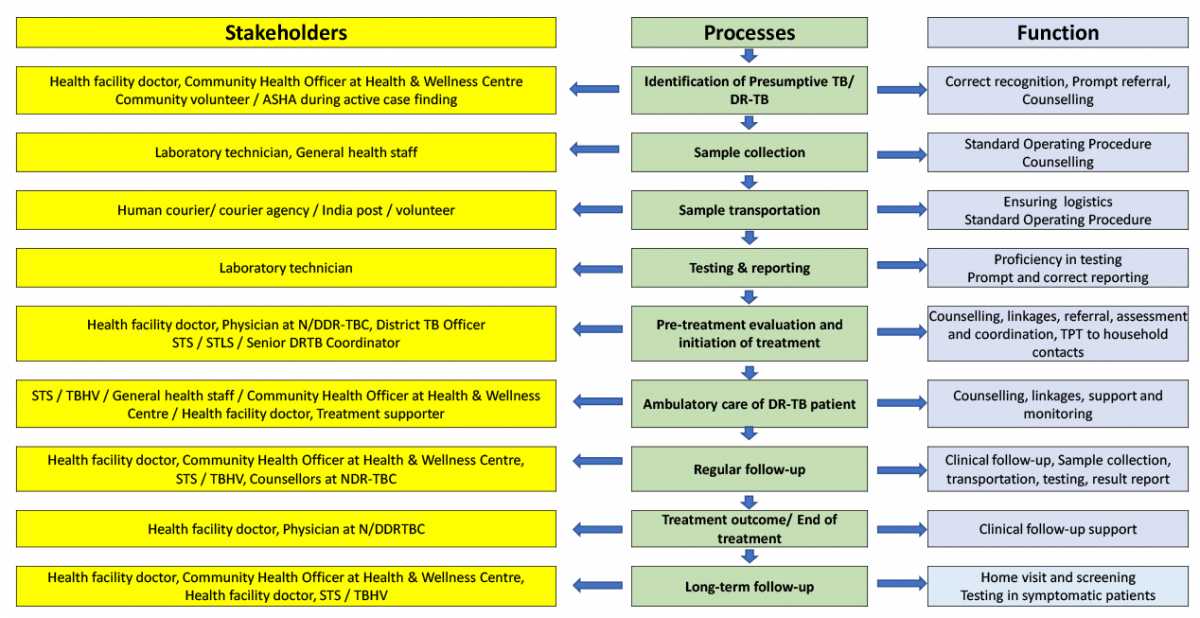
Figure 1: Cascade of DR-TB services and functions of various stakeholders
Source: Guidelines for PMDT in India, 2021, p.8
Resources
Kindly provide your valuable feedback on the page to the link provided HERE
PMDT structure and roles
ContentThe National TB Elimination Programme (NTEP) in India has established well-organised Drug-resistant TB (DR-TB) management structures at the national, state and district level.
Image
Figure: Diagrammatic representation of the organisational structure of Programmatic Management of DR-TB (PMDT)
Abbr: NDR-TB: Nodal Drug-resistant TB; NAAT: Nucleic Acid Amplification Test; LPA: Line Probe Assay; CDST: Culture and Drug Sensitivity Test; DDR-TB: District DR-TB
The organisational structure and functions at different levels are described in the table below.
Level Organisational Structure Type of Organisation Function National-level Central TB Division (CTD), Ministry of Health and Family Welfare (MoHFW), Government of India (GoI) Administrative Providing resources/ devising policies/ issuing guidelines/ monitoring and evaluation/overall administration of the programme National Technical Expert Group Advisory Reviewing evidence Recommendation in guidelines National Reference Laboratory (NRL) Operational Providing laboratory-related expertise, External Quality Assurance (EQA) guidelines, Accreditations, a centre of excellence in diagnostics State-level State TB Cell, Health Department Administrative Providing resources, implementing guidelines, monitoring and evaluation/ overall administration of the programme State PMDT Committee Advisory Overseeing implementation as per guideline, taking strategic decisions, reviewing the progress in implementation and feedback/ suggestion to NTEP Nodal DR-TB Committee Advisory Guiding treatment of difficult to treat DR-TB cases, reviewing the progress of treatment and Adverse Drug Reaction (ADR) management, providing technical expertise for decisions at the State PMDT Committee, etc. Intermediate Reference Laboratory (IRL) Operational Providing laboratory-related services and expertise at the State level, EQA, and capacity building for diagnostic services Nodal DR-TB Centres Operational Providing treatment services to difficult-to-treat DR-TB cases, a centre of excellence in DR-TB treatment District-level District TB Cell Administrative Providing resources, implementing guidelines, monitoring and evaluation/ overall administration of the programme District TB Forum Advisory Overseeing implementation as per guideline, reviewing the progress in implementation, facilitating and monitoring the involvement of communities District Comorbidity Committee Advisory Review and rectify TB-comorbidity components with regard to HIV, diabetes, addiction and other review coordination with other health programmes like Rashtriya Bal Swasthya Karyakram (RBSK), Rashtriya Kishorethe Swasthya Karyakram (RKSK), Reproductive Maternal Newborn Child plus Adolescent Health (RMNCH+A) etc. District DR-TB Committee Advisory Guiding treatment of DR-TB cases, reviewing progress of treatment and ADR management, etc. NAAT/ LPA/ CDST Laboratories Operational Providing diagnostic services to detect DR-TB in the district (at more than one district) District DR-TB Centre Operational Providing treatment services to DR TB cases, ADR management etc. DR-TB services integration into the general health system
Block-level/ Ward-level Block Medical Officer/ Medical officer in office Operational Implementation of guidelines/ monitoring and evaluation of feedback Health facility-level Health facility doctor, Master in Public Health Skills (MPHS), Multipurpose Health Worker (MPHW), Accredited Social Health Activist (ASHA) Operational Implementation and review Health & Wellness Centre, Sub-Centre Community Health Officer (CHO) Operational TB screening and community intervention, coordination amongst various health programmes for TB-related activities Community ASHA, Panchayati Raj Institutions (PRI), Anganwadi Workers (AWW), other volunteers and community leaders Operational Implementation , community engagement through PRI, Village Health and Nutrition Day (VHND) , Community meetings, peer educators/TB champions/adolescent groups and Anganwadi sessions The organisational structure based on functional roles can be classified into diagnosis, treatment and drugs.
Diagnosis:
Name of Facility
Functions
Health Facility
- To identify presumptive cases/collect and transport specimen
- To communicate results to patients
- Collect and refer follow-up specimen
NAAT Site
- Diagnose TB and Rifampicin-resistant (RR) patients at district/ sub-district level
- Maintain records for Ni-kshay
- Transport the second sample to C&DST lab for First-line Line Probe Assay (FL-LPA) and Second-line Line probe Assay (SL-LPA)
C&DST Lab
- Receive diagnosis and follow-up samples
- Performs FL-LPA, SL-LPA, Liquid Culture (LC) and LC-DST
- Maintain records for Ni-kshay (LIMS)
- Provide rapid results to district , field and DR-TB centre
Treatment:
Name of Facility
Functions
Health Facility
- Identify treatment supporter
- To support and supervise DR-TB patients during treatment
- Manage Minor side effects
- Refer patients for treatment initiation
District DR-TB Centre
- Initiate DR-TB regimen
- Manage and record ADR
- Consult for complications
- Maintain records and Ni-kshay
- Coordinated with Nodal DR-TB centre/Field
- Monitor DR-TB treatment
Nodal DR-TB Centre
- Maintain ward and Airborne Infection Control (AIC)
- Undertake pretreatment evaluation and initiate treatment
- Manage major ADR
- Mentor and supervise concerned DDR-TBC
Drugs:
Name of Facility
Functions
District Drug
Store
- Coordinate test results.
- Refer patients to N/DDR-TBC
- Coordinate the drug flow from the district drug store to the field level
- Maintain records, Ni-kshay, monitor and supervision
State Drug Store
- Prepare and ship drug boxes to the district level
- Manage supply chain for diagnostics and drugs
- Maintain records in Ni-kshay Aushadhi
Resources
Assessment
Question Answer 1 Answer 2 Answer 3 Answer 4 Correct Answer Correct Explanation Page id Part of Pre-Test Part of Post-Test Which of the following is part of the PMDT structure under NTEP? NACP NACO District Comorbidity Committee None of the above 3 The district comorbidity committee is part of the PMDT district-level structure. The committee reviews and rectifies TB-comorbidity components with regard to HIV, diabetes, addiction and other review coordination with other health programmes like RBSK. Yes Yes The PMDT organisational structure is based on functional roles that can be classified into diagnosis, treatment and drugs. True False 1 The PMDT organisational structure is based on functional roles that can be classified into diagnosis, treatment and drugs. Yes Yes - To identify presumptive cases/collect and transport specimen
DR-TB Centres and Network
ContentDrug-resistant Tuberculosis Centres (DR-TBCs) are specialized centres for the clinical management of Drug-resistant TB (DR-TB).
Each DR-TBC needs to have established a DR-TB committee to carry out the clinical management of DR-TB patients.
DR-TBCs can be established in the public sector where appropriate facilities are available.
- The DR-TBC can also be established in the private sector on mutually agreeable terms and conditions based on the Guidance Document on Partnerships, 2019.
District level: There are District Drug-resistant TB Centres (DDR-TBCs) to manage DR-TB cases. These centres will function under the guidance of Nodal Drug-resistant TB Centres (NDR-TBCs). Almost every district has a mandate to establish a DDR-TBC in India. There are around 620 DDR-TBCs established in the country.
State/ Regional level: At the state/ regional/ division level, there are NDR-TBCs to manage seriously ill DR-TB cases. There are 173 NDR-TBCs established in India.
Decentralized DR-TB services through an expanded network of DR-TB centres has helped the National TB Elimination Program in improving access to DR-TB services and has also resulted in improved DR-TB treatment linkage and better management of DR-TB patients.
Resources
Nodal DR-TB Centre
ContentNodal Drug-resistant Tuberculosis Centres (NDR-TBCs) are established to manage all forms of DR-TB, including complicated cases. Therefore, the centre should have:
- Advanced general laboratory
- Allied investigation facilities for Pre-treatment Evaluation (PTE)
- Intensive Care Unit (ICU)
- Ventilator backup
- In-house lab/ linkages for PTE laboratory tests
The NDR-TBC is established as per the need and is generally in a tertiary care setting where expertise and facilities for the management of DR-TB are available.
The figure below shows an overview of services offered at the NDR-TBC.
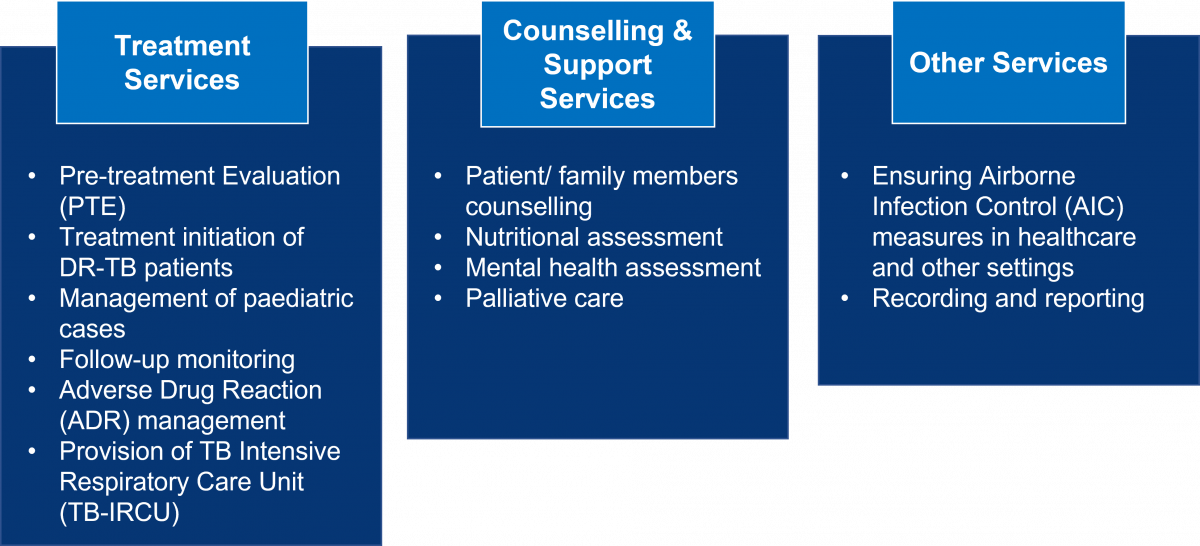
Figure: Range of Services Available at NDR-TBCs
District DR-TB Centres (DDR-TBCs) are linked with the NDR-TBC for the referral and management of complicated DR-TB patients like those who have:
- Additional resistance to second-line drugs, drug intolerance, serious adverse drug reactions, and contraindications
- Failing regimen, or patients returning after treatment interruption of more than 1 month
- The emergence of any exclusion criteria for a standard regimen for rifampicin-resistant TB or H mono/ poly DR-TB regimen
- Non-TB mycobacterial infections
- Need for palliative care or surgical interventions
Resources
Kindly provide your valuable feedback on the page to the link provided HERE
Requirements from Institutions for the Establishment of Nodal DR-TB Centre
ContentThe requirements from institutions for establishing Nodal Drug-resistant Tuberculosis Centres (NDR-TBCs) are as follows:
- It should preferably be a tertiary care institute.
- Separate wards for male and female patients (including children) should be available with at least 10 beds in each NDR-TBC.
- An outpatient clinic and a separate well-ventilated waiting area in an open-air, shaded area should be made available as per the Airborne Infection Control (AIC) guidelines.
- Administrative, environmental, and personal protective measures for airborne infection control should be placed in all indoor and outdoor facilities.
- All investigations under Pre-treatment Evaluation (PTE) and other Programmatic Management of Drug-resistant Tuberculosis (PMDT) services should be provided free of cost to the patient.
- Ancillary drugs should be provided for the management of Adverse Drug Reactions (ADRs) as per the NDR-TBC committee`s advice at no cost to patients.
- Oxygen and ventilators should be available for patients needing critical care support.
- The NDR-TBC committee should be formally established with the required set of experts as per the guidelines.
- All experts at NDR-TBC must be trained in the latest PMDT guidelines.
- Doctors, nursing and support staff should be available from the institute.
- Records and reports should be maintained for PMDT. Nikshay entries must be done on a real-time basis with regular electronic updates.
- Financial requirements must be availed through the institute/ state budgets or under National Health Mission (NHM).
Resources
Kindly provide your valuable feedback on the page to the link provided HERE
Mandatory Establishment of DR-TB Centres in All Medical Colleges
ContentIn view of the availability of expertise in medical colleges, there is a felt need to leverage their strength to improve clinical, Adverse Drug Reactions (ADRs) and comorbidity management of patients with Drug-resistant Tuberculosis (DR-TB) across India.
- Expansion of DR-TB services in the medical colleges will be helpful for enhancing the quality of care, treatment success and survival of these difficult-to-treat patients.
- National Medical Commission (NMC) issued a gazette notification in October 2020, mandating all medical colleges to establish a facility for the management of DR-TB by the time of 3rd renewal (admission of 4th batch of MBBS students).
- Private and Non-government Organisation (NGO) medical college hospitals are considered to serve as Nodal (N)/ District DR-TB Centre (DDR-TBC) at places where there is a need, either due to additional workload, non-availability of an appropriate public facility or preference of patients in the area.
- Terms and conditions for establishing that centre may be arrived at the local level as per the prevailing market rates in concurrence of the state/ district health society of the National Health Mission (NHM).
Resources
- Guidelines for Programmatic Management of Drug Resistant TB in India, 2021.
- Guidance Document of Partnerships, 2019.
- National Medical Commission, Gazette Notification, Government of India, 2020.
Kindly provide your valuable feedback on the page to the link provided HERE
District DR-TB Centre
ContentDistrict Drug-resistant TB Centres (DDR-TBCs) are dedicated centres for providing DR-TB services for patients and can be established at the district or sub-district level.
- It may be established in institutes like medical colleges, district hospitals, TB hospitals and private or corporate institutes, trust hospitals or other sector hospitals, with the availability of required clinical expertise.
- There should be at least one DDR-TBC available in each district. However, more than one DDR-TBC can be established to improve the access and preference of patients to seek care.
- DDR-TBC can be established on an Outpatient Department (OPD) basis as well.
- Central TB Division (CTD) should be informed about the up-gradation of any institute to a DDR-TBC.
- Requirements for infrastructure and Human Resources (HR) may be proposed in the annual Programme Implementation Plan (PIP).
TB Services Available at the DDR-TB Centre
Pre-treatment Evaluation (PTE): Basic investigations required for initiating DR-TB regimens, examples include:
- Complete Blood Count (CBC)
- Thyroid-stimulating Hormone (TSH) tests
- Renal function tests
- Liver function tests
- Electrocardiogram, etc.
Treatment Services: Trained experts can initiate all DR-TB regimens at the DDR-TBC.
Resources
Functions of District DR-TB Centre
ContentThe following functions and package of services should be offered at each District Drug-resistant Tuberculosis Centre (DDR-TBC):

Figure: Functions of DDR-TBCs
Abbr: NDR-TBC: National Drug-resistant TB Centre; AIC: Airborne Infection Control
Resources
Kindly provide your valuable feedback on the page to the link provided HERE
Requirements for Establishing District DR-TB Centres
ContentThe following are requirements from institutions for establishing the district Drug-resistant Tuberculosis Centre (DDR-TBC):
Structural requirements:
- It should preferably be a secondary care institute.
- Separate wards for male and female patients (including children) should be available with at least two beds in each for DDR-TBC.
- An outpatient clinic and a separated well-ventilated waiting area in an open-air, shaded area to be made available as per the Airborne Infection Control (AIC) guidelines.
- Administrative, environmental and personal protective measures for airborne infection control should be placed in all indoor and outdoor facilities.
Infrastructure requirements:
- All investigations under Pre-treatment Evaluation (PTE) and other Programmatic Management of Drug-resistant Tuberculosis (PMDT) services should be provided free of cost to the patient.
- Availability of oxygen and ventilators for patients needing critical care support.
- Ancillary drugs must be provided for the management of Adverse Drug Reactions (ADRs) at no cost to patients, as per the DDR-TBC committee's advice.
Human resource requirements:
- The DDR-TBC committee should be formally established with the required set of experts as per guidelines.
- Services of specialists, if not available in the public facility, may be hired from the private sector under National Health Mission (NHM).
- All experts at DDR-TBC must be trained in the latest PMDT guidelines.
- Doctors, nursing and support staff should be available from the institute.
- Records and reports to be maintained for PMDT. Nikshay entries must be done on a real-time basis with regular electronic updates.
- Financial requirements should be availed through institute/ state budgets or under the NHM.
Resources
Kindly provide your valuable feedback on the page to the link provided HERE
Nodal DR-TB Centre Committee
ContentThe Nodal Drug-resistant Tuberculosis Centre (NDR-TBC) committee is a clinical committee that is responsible for taking decisions regarding the management of DR-TB patients at the NDR-TBC.
The composition of the NDR-TBC committee is provided in the table below.
Table: Composition of the NDR-TBC Committee; Source: PMDT Guidelines for India, p205.
TITLE DESIGNATED OFFICIALS Chairperson Medical Superintendent or Director of the institute Vice-chairperson HoD Respiratory Medicine or General Medicine Nodal officer Senior Doctor from the department hosting the NDR-TBC Member secretary Senior Medical Officer- DR-TB centre Member HoD Microbiology or IRL Microbiologist Member HoD Psychiatry* Member HoD Ob&Gy* Member HoD ENT* Member HoD Dermatology* Member HoD Pharmacology Member Cardiologist* or Physician Member 1 Eminent Pulmonologist from NGO/ private sector Member WHO NTEP Consultant Member DTO of the district where NDR-TBC is located Special invitees DTOs of the districts linked (as and when needed) *To be consulted physically or virtually as and when required.
Abbr: HoD: Head of Department; IRL: Intermediate Reference Laboratory; Ob&Gy: Obstetrics and Gynaecology; ENT: Ear, Nose and Throat surgeon; NGO: Non-governmental Organisation, WHO: World Health Organisation, NTEP: National TB Elimination Programme, DTO: District TB Officer
Note: The chairperson can co-opt other specialists as required. The routine clinical decisions can be taken by the available doctor and informed to the NDR-TBC in subsequent meetings.
Functions of Nodal DR-TBC
- Periodically review the implementation status of PMDT in the respective nodal DR-TB centre to ensure that NTEP PMDT policies and guidelines are being followed.
- Coordinate with the IRL/ Culture and Drug Susceptibility Testing (C&DST) labs for Drug Susceptibility Testing (DST)/ Drug Resistance Testing (DRT) results and enter the details in Nikshay.
- Arrange for examination of DR-TB patients referred for their treatment eligibility, open treatment book and start PMDT regimen for all eligible patients.
- Admit DR-TB patients who may require the indoor facilities of the DR-TB centre.
- Arrange tele/ video consultation with relevant specialists on a case-to-case basis as well as with linked DDR-TBC to provide required clinical decision support.
- Empanel the private practitioners of various disciplines if the required specialist is not available in the public sector. In coordination with the respective State TB Officer (STO) and DTOs, ensure that drug ordering and distribution is managed in a timely and appropriate manner.
- Account for the review of record, report, Nikshay data entry.
- Monitor performance of DR-TB and PMDT in catchment geography using analysis of data from downloadable Nikshay reports and dashboard.
Resources
Kindly provide your valuable feedback on the page to the link provided HERE
District DR-TB Centre Committee Composition and Functions
ContentThe district drug-resistant tuberculosis centre (DDR-TBC) committee is a clinical committee where the dean/principal/ director of the institute is the chairperson.
- The Head of the Department (HoD) or a senior faculty member from the department of pulmonary medicine/general medicine is the nodal officer of the committee.
- The HoDs or senior faculty members of other specialties are the members of the committee.
- The clinical function of these committees must be adequately supported by the administrative or management committees of the institution in which district TB officer (DTO) is an ex-officio member.
- The composition of the DDR-TBC committee is shown in Figure 1.
Table 1: Composition of DDR-TBC committee; Source: Guidelines for PMDT, India 2021, p. 206 TITLE DESIGNATED OFFICIALS Chairperson Chief Medical Officer Co-chairperson Medical Superintendent/Director/Head of the institute Nodal person Physician in-charge of DDR-TBC Member Secretary DTO of the district Members Specialists* from pulmonologist, microbiologist, psychiatrist, Ob & Gy, cardiologist, ENT, dermatologist, pharmacologist etc. Member MO medical college, if placed Member Medical consultant (concerned), WHO NTEP TSN Member Any other invited member, if required *specialist available in-house, outsourced from private sector or linked with NDR-TBC Ob&Gy: Obstetrics and Gynaecology, ENT: Ear, nose and throat surgeon; MO: Medical Officer, WHO: World Health Organisation, NTEP: National TB Elimination Programme, TSN: Technical Support Network
Resources
District DR-TB Centre Committee: Terms of Reference [ToR]
ContentThe Terms of Reference (ToR) for the District DR-TB Centre (DDR-TBC) committee are:
- Ensure arrangements for patient treatment initiation as per the Programmatic Management of Drug-resistant Tuberculosis (PMDT) guidelines.
- Periodic review of treatment initiation, active Drug Safety Monitoring and Management (aDSM) and patient monitoring activities carried out at the DDR-TBC.
- Coordinate with the District TB Officer (DTO), TB Unit (TU), Health Facility (HF), other departments and Non-governmental Organisations (NGOs) to ensure the patient is linked with all essential services required.
- Empanel the private practitioners of various disciplines which are not available in the committee and are required for the management of DR-TB.
- Arrange tele/ video consultation with a relevant specialist on a case-to-case basis as well as with the linked nodal DR-TB centre to seek guidance required for clinical decision support. The DDR-TBC should also arrange tele/ video consultation with HFs on a case-to-case basis to provide required clinical decision support.
- Account for review of record, report, and Nikshay data entry.
- Monitor performance of DR-TB and PMDT in the catchment geography using analysis of data from downloadable Nikshay reports and dashboard.
Resources
Kindly provide your valuable feedback on the page to the link provided HERE
Referral mechanisms for DR-TB services
ContentPresumptive Drug-resistant TB (DR-TB) is identified by the health facility doctor during passive screening or by health staff/ community volunteers during Active Case Finding (ACF).
Prompt referral and sample collection is an important step after identifying presumptive TB/ DR-TB.
After detection, referrals should be made promptly by the Community Health Officer (CHO) at Health and Wellness Centre (HWC)/ Senior Treatment Supervisor (STS)/ Tuberculosis Health Visitor (TBHV) to the health facility or Nodal/ District DR-TB Centre (N/DDR-TBC) for pre-treatment evaluation and treatment initiation. Every district has DDR-TBC for the treatment of DR-TB cases. However, for complicated DR-TB cases,that need either super-speciality or complex medical equipment and intensive care (like invasive ventilators), such patients are referred to Nodal DDR-TBCs.
Referral linkages for further domiciliary treatment are to be ensured by health facility doctor, N/DDR-TBC, senior DR-TB TB-HIV supervisor, STS, TBHV, CHO and general health staff.
Identification of suitable treatment supporters by CHO/ STS/ TBHV is essential, and the periodic follow-up of clinical/ bacteriological examination is to be managed.
The cascade of referral mechanism and function of various stakeholders is described below.
Image
Figure: Cascade of referral mechanism and function of various stakeholders; Source: Guidelines for Programmatic Management of Drug-resistant Tuberculosis in India, NTEP, CTD, WHO, MoHFW, 2021, p48.
Resources
Assessment
Question 1 Answer 1 Answer 2 Answer 3 Answer 4 Correct Answer Correct Explanation Page id Part of Pre-Test Part of Post-Test The patients are referred to N/DDR-TBC for pre-treatment evaluation. True False 1 After detection of DR-TB, referrals should be made promptly by the CHO at HWC/ STS/ TBHV to the health facility or N/DDR-TBC. Yes Yes Who ensures referral linkages for domiciliary treatment of patients? Senior DR-TB coordinator TB Health Visitor Community health officers All of the above 4 Referral linkages for domiciliary treatment are to be ensured by the health facility doctor, N/DDR-TBC, senior DR-TB coordinator, TB-HIV supervisor, STS, TBHV, CHO and general health staff. Yes Yes Difficult-to-Treat TB Clinic [DT3C]
ContentThe Difficult-to-treat TB clinic (DT3C) is an initiative to support Drug-resistant TB Centres (DR-TBCs) for better patient management.
The DT3C structure is intended to handhold and mentor District DR-TB centres (DDR-TBCs) for the effective management of Drug-resistant TB (DR-TB) cases.
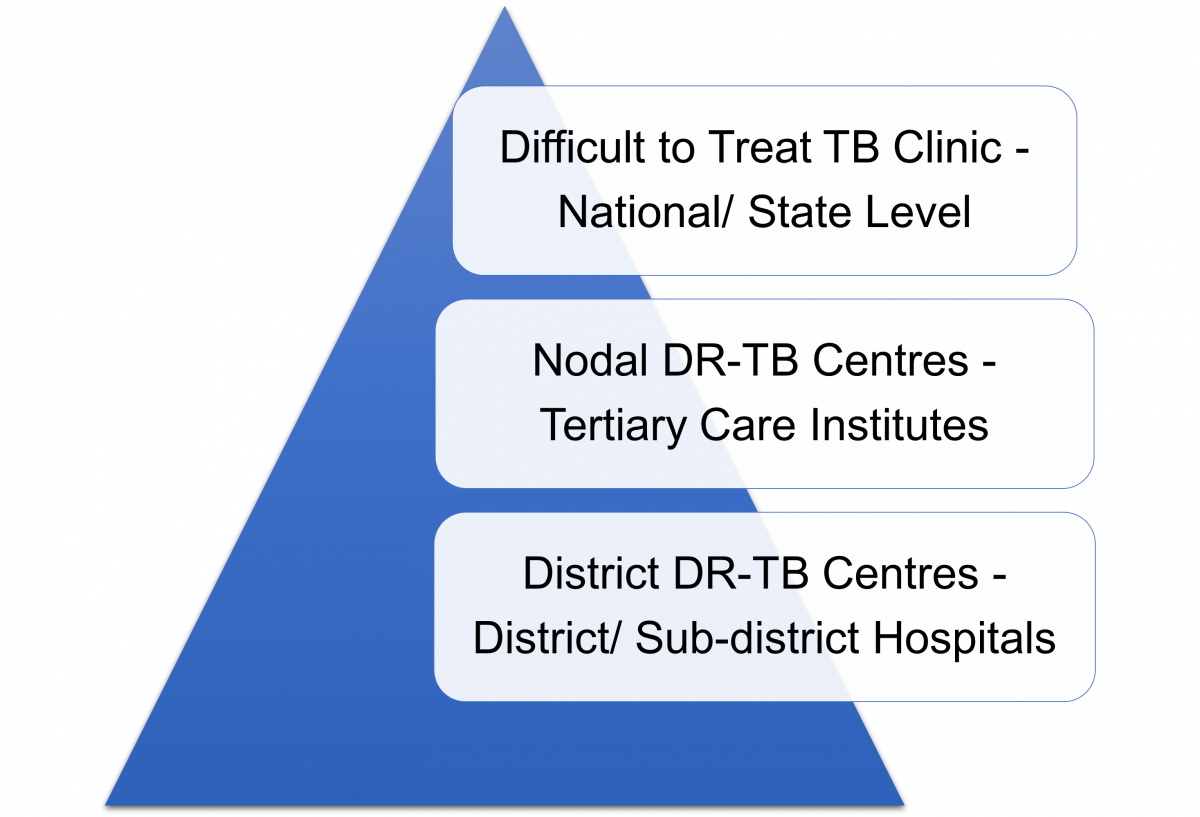
Figure: Difficult-to-treat TB Clinic: Three-tier Structure
The DT3C operates via a three-tier structure which is intended to improve the quality of DR-TB care:
- The DT3C is functional at the national level through the collaboration of the National Institute for Tuberculosis and Respiratory Diseases (NITRD), Central TB Division (CTD) and the National Task Force (NTF).
- Experts involving various specialties are included in the team as mentors at state-level D3TC.
- Information/ queries regarding the patient are shared in a standardized format by the DDR-TBC beforehand to facilitate discussions through the state nodal officer.
All states should have at least one (more than one in larger states) DT3C established.
Resources
Stages in TB Patient's Lifecycle
ContentThose who are suspected of having TB disease are first screened for symptoms like cough and fever for more than 2 weeks, blood stained sputum and weight-loss. If found positive on screening, then TB patients are referred for testing to the nearest health facility. If diagnosed with TB, then they are subsequently initiated on treatment. The TB patients initiated on treatment are regularly monitored with the help of field staff or digital interventions like 99DOTS and MERM (Medication Event Reminder Monitor) technology. NTEP staff also ensures that the TB patients are regularly followed up on monthly basis till their treatment completion.

Figure: Patient Flow
Kindly provide your valuable feedback on the page to the link provided HERE
DR-TB HIV Coordinator and their role
ContentThe roles of the Drug-resistant TB (DR-TB) HIV Coordinator are:
1. Providing technical assistance to District TB Officer (DTO) for:
- Organising Programmatic Management of Drug-resistant TB (PMDT) services in the district
- Supporting District DR-TB Centre (DDR-TBC) for data management in Ni-kshay and their coordination with Anti-retroviral Therapy (ART) centre in the districts
- Organising TB-HIV coordination activities in the district
- Providing training to the staff of health facilities (public and private) under his/her jurisdiction to carry out PMDT and TB-comorbidity-related activities
- Conducting monthly reviews with TB Unit, National AIDS Control Programme (NACP), and Health and Wellness Centre (HWC) staff using dashboards and analysis of data from Ni-kshay periodically to address implementation and management gaps
- Activities related to drug and logistics supply chain management of drugs for PMDT, Cotrimoxazole Preventive Therapy (CPT) and Isoniazid Preventive Therapy (IPT) and modified TB regimen for People Living with HIV/AIDS (PLHA) with TB on second-line ART
- Coordinating regular sharing of the information related to TB-HIV coordination by assisting the nodal officer
- Mapping, prioritising, and engaging health facilities and laboratories in the private sector, Non-government Organisations (NGOs) and other sectors to improve access and quality of DR-TB care for all as per guidelines
- Preparing and maintaining a directory of Integrated Counselling and Testing Centres (ICTCs), ART centres/ Link ART Centres (LACs), community care centres, Non-communicable Disease (NCD) clinics, private health facilities and NGOs working for HIV, NCD in the district and the collaborating National TB ELimination Programme (NTEP) centres
- Providing a monthly activity report to the DDR-TBC committee and DTO.
2. Coordinating for smooth programme implementation
- Coordinate with all health staff and facilitate to subject all TB patients to universal Drug Susceptibility Testing (DST) at the linked decentralised Nucleic Acid Amplification (NAAT) sites and NTEP certified laboratories in the public and private sectors.
- Ensure that initial home visits are conducted by health workers to all newly diagnosed DR-TB patients of the district.
- Ensure that staff organises treatment support, all public health actions, follow-up reminders and transportation support for DR-TB patients.
- Help staff in proactive reach out to patients for follow-up cultures/ investigations as per schedule for every patient.
- Coordinate with and support TB Units, HWCs staff and private doctors to regularly update the directory of treatment supporters for DR-TB patients at the district level and facilitate their training.
- Facilitate the DR-TB treatment initiation at DDR-TBC.
- Ensure PMDT treatment books are updated for all patients at DDR-TBC, TB Units (TUs) and HWCs.
- Ensure and monitor the PMDT data completion in Ni-kshay and give periodic TU/ Peripheral Health Institute (PHI)-wise feedback to the DTO about the same.
- Liaise with respective Nodal Drug-resistant TB Centres (NDR-TBCs) for updating information on Ni-kshay and patient care.
- Ensure complete, correct and timely compilation and transmission of PMDT/ TB- HIV information.
- Establish linkages with the District TB Centre (DTC), District AIDS Prevention Control Unit (DAPCU), collaborating NGOs and hospitals of the district.
- Facilitate change management with respect to the use of Information, Communication and Technology (ICT) tools, Ni-kshay, Ni-kshay-Aushadhi for concerned data entry, validation & its use for public health action.
- Support DDR-TBC in updating the template with information to be shared with difficult-to-treat TB clinic for selected patients as per directions from the DDR-TBC committee and management of the patient based on recommended actions from the clinic.
3. Supervising and monitoring
- Monitor time to treatment of DR-TB patients and provide feedback on a periodic basis.
- Supervise all DR-TB patients and treatment support centres along with concerned TB Units, HWCs staff and private providers.
- Evaluate referral systems between ICTCs, ART centres, NCD, and NTEP and promote providing feedback to the referring centre.
- Field visits in the districts for at least 15 days a month, including Joint TB-Comorbidity visits on a tour programme approved by DTO.
4. Capacity building and imparting skills
- Train and supervise the pharmacists/ responsible staff of district/ TB Unit/ HWC drug stores in maintaining adequate stock of second-line drugs.
- Train staff for preparation of monthly patient-wise boxes by regimen and weight band as well as initialisation of Medication Event Reminder Monitor (MERM) devices, as available, for every patient initiated on DR-TB treatment at the NDR-TBC as per guidelines.
Resources
DO Letter - TOR and Needs Norms for NTEP Staff, 2021.
Assessment
Question
Answer 1
Answer 2
Answer 3
Answer 4
Correct Answer
Correct Explanation
Page id
Part of pre-test
Part of post-test
DR-TB HIV coordinator should coordinate with all health staff and facilitate to subject all TB patients to universal DST.
True
False
1
DR-TB HIV coordinator should coordinate with all health staff and facilitate to subject all TB patients to universal DST at the linked decentralised NAAT sites and NTEP-certified laboratories in public and private sector treatment.
Interaction of DR-TB Coordinator with the TB Patient Care Ecosystem
ContentThe DR-TB HIV coordinator interacts with the TB patient care ecosystem as follows:
Patients: UDST at linked NAAT sites, treatment initiation, adherence monitoring and follow-up, ADR identification and management, contact tracing, linking with welfare schemes, linkage with the TB care ecosystem.
Treatment supporters: To ensure initial home visits, treatment support, and all public health actions.
STLS: To subject all TB patients to universal DST at the NAAT sites, to ensure complete DST and the laboratory follow-up of all the patients.
STS: Treatment initiation of DR-TB patients, necessary treatment support, Public health actions, and coordinate for follow-up cultures and investigations.
Medical officers: Facilitating DR-TB treatment initiation and management of ADR.
DR-TB Committee: Support DDR-TBC in providing the information about the DR-TB patients, and coordinate with the different staff to execute the decision of N/DDR-TBC. Updating the template with the information to be shared with difficult-to-treat TB clinic for supported patients.
Pharmacists/responsible staff of district/TB Unit/HWC drug stores: Maintaining adequate stock of second line drugs, preparation of monthly patient wise boxes by regimen and weight bands initialization of MERM devices.
Ni-kshay and Ni-kshayAushadhi: Use of ICT tools, Ni-kshay, Ni-kshay-Aushadhi for concerned data entry, validation and its use for public health action and monitoring the PMDT data completion in Ni-kshay and give periodic TU/PHI-wise feedback to the DTO about the same.
DTO/ Programme Managers: Seek overall guidance from DTO/Program managers for executing their duties and responsibilities. They also provide with necessary data and information about the PMDT facilitating supervision and monitoring and discuss and implement various solutions for the identified issues.
Resources
Assessment
Question 1
Answer 1
Answer 2
Answer 3
Answer 4
Correct Answer
Correct Explanation
Page id
Part of Pre-Test
Part of Post-Test
DR-TB HIV coordinator should coordinate with all health staff and facilitate subjecting all TB patients to universal DST.
True
False
1
DR-TB HIV coordinator should coordinate with all health staff and facilitate subjecting all TB patients to universal DST at the linked decentralised NAAT sites and NTEP-certified laboratories in public and private sector treatment.
Yes
Yes
-
DR-TB HIV Coordinator: Integration of NTEP with the Health System
FullscreenOrganisational Structure of Health System
ContentOverview of the organisational structure of the health system in relation to the National TB Elimination Programme (NTEP) is shown in the figure below.
Image
- Sub-centre: Most peripheral units under the public health system are designed to bring about behavioural change and provide preventive health care services.
- Primary Health Centre (PHC): First contact point between the village, community and the medical officer envisaged to provide integrated, curative and preventive health care.
- Community Health Centre/ Sub-district Hospitals: Serve as a referral centre for four PHCs and provides facilities for obstetric care and specialist consultations.
- Peripheral Health Institute (PHI): Most Peripheral Unit under the NTEP provides TB treatment and diagnostic services to the population.
- Tuberculosis Units: Nodal point for TB elimination activities in the sub-district level and are also responsible for stacking and supply of drugs to the PHI.
Resources
- Operational Guidelines for TB Services at Ayushman Bharat Health and Wellness Centres, CTD, MoHFW, India, 2020.
- National Strategic Plan 2017-2025 for TB Elimination in India, CTD.
Assessment
Question Answer 1 Answer 2 Answer 3 Answer 4 Correct answer Correct explanation Page id Part of Pre-test Part of Post-test Where are Tuberculosis Units present under the NTEP? At the central level At the state level At the district level At the sub-district/ block level 4 Tuberculosis Units are present at the sub-district level under the NTEP. Yes Yes Need for integration of NTEP with Health System
Content-
The public health system in India through the National Health Mission (NHM) visualises the attainment of Universal Health Coverage (UHC) for all its citizens, which provides access to equitable, affordable and quality health care services, which is also accountable and responsive to the needs of the people.
-
Under the umbrella of NHM, the National TB Elimination Programme (NTEP) ensures the provision of free TB services (diagnostics and drugs) and management of TB as per the Standards for TB Care in India (STCI).
-
Furthermore, the NHM, under the Ayushman Bharat initiative has taken measures to strengthen the primary care facilities including Primary Health Centres (PHCs) and Sub Health Centres (SHCs) in the Ayushman Bharat Health & Wellness Centres (AB-HWCs).
Need for integration of NTEP with the Health System at Different Levels
- Closer to community TB Services: The integration of TB services with the health system provides an opportunity for the TB programme to leverage the resources under the Ayushman Bharat initiative to take TB interventions closer to the community which were otherwise provided at the primary care level.
- Improved population coverage: Active empanelment and HWC database will help to monitor and identify the left-out population and contribute significantly to the NTEPs case finding activity coverage.
- Improved population health outcomes: Improved availability, access and utilisation of advanced TB treatment services under the ambit of UHC is essential in reducing morbidity and mortality from TB which may in turn also contribute to overall equitable health outcomes.
- Reduced out-of-pocket expenditure: The integration will improve the access to TB services, assure within-reach TB medicines and diagnostic services, provide linkages for care coordination with Medical Officers/ specialists across various levels of care, etc., all of which will reduce the catastrophic expenditures faced by the patients and their families.
- Decreased crowding at the secondary and tertiary health facilities: A strong network of peripheral level TB care services would facilitate in reduction of the overcrowding and the case burden at the secondary and tertiary facilities, which could be utilised for cases with follow-up referral to higher level facilities.
- Increased responsiveness and addressal of social determinants of TB: Provision of TB treatment at the nearest point of care for the communities and engaging the most peripheral workers from the health system like the Accredited Social Health Activists (ASHA) in the TB programme may lead to comfort in accessing the care by the patients and also enable addressing psycho-social determinants of TB.
Resources
- Operational Guidelines for TB Services at Ayushman Bharat Health and Wellness Centres, CTD, MoHFW, India, 2020.
- National Strategic Plan 2017-2025 for TB Elimination in India, CTD.
Assessment
Question Answer 1 Answer 2 Answer 3 Answer 4 Correct answer Correct explanation Page id Part of Pre-test Part of Post-test Under the umbrella of NHM, the NTEP ensures the provision of free TB services (diagnostics and drugs) and management of TB as per the Standards for TB Care in India (STCI). True False 1 Under the umbrella of NHM, the NTEP ensures the provision of free TB services (diagnostics and drugs) and management of TB as per the Standards for TB Care in India (STCI). Yes Yes -
National Health Mission [NHM]
ContentThe National Health Mission (NHM) was launched by the Government of India in 2013, subsuming the National Rural Health Mission (NRHM) and National Urban Health Mission (NUHM). Figure 1 shows the history of the NHM.
The vision of NHM is “Attainment of Universal Access to Equitable, Affordable and Quality health care services, accountable and responsive to people's needs, with effective intersectoral convergent action to address the wider social determinants of health.”
Image
Figure 1: History and Make-up of the NHM; Source: Annual Report 2015-16, Ministry of Health and Family Welfare (MoHFW)
NHM further aims to support the existing national programmes of health and family welfare (Figure 2) including reproductive and child health, malaria, blindness control, iodine deficiency, filariasis, kala-azar, tuberculosis (TB), leprosy, and integrated disease surveillance.
Image
Figure 2: Health Programs Supported by NHM NHM and the National Tuberculosis Elimination Program (NTEP)
Integrating the NTEP with the health system increases the effectiveness and efficiency of TB care and control. India's TB control programme has been mainstreamed efficiently with the NHM.
The overall responsibility for the financial management of the NTEP is with the MoHFW, Director General of Health Services (DGHS) through the NHM.
At the state level, the State Health Society or its equivalent under the NHM of the state manages the financing of the TB Control Programme.
At the sub-district level, the TB Unit (TU) is the nodal point for TB control activities. TUs are based mainly in NHM health blocks with the aim of aligning with the NHM Block Programme Management Unit (BPMU) for optimum resource utilization and appropriate monitoring.
Resources
Delivery of TB Care in Private Sector
ContentThe private sector for tuberculosis (TB) care is everything outside the ambit of government-run public health initiatives. It consists of a wide range of providers from individual medical practitioners of many different systems of medicine, including:
- Modern medicine
- Indian systems of medicine
- Homeopathy
- Paramedics
- Traditional healers
- Private hospitals and nursing homes
- Non-governmental organization-run hospitals
- Corporate sector health care institutions
As per the National Sample Survey Organization report of the 75th round, more than 70% of patients seek care in private clinics or hospitals.
Challenges with TB care in the private sector:
- Delays in diagnosis
- Over-diagnosis of TB due to an over-dependence on X-rays
- Use of multiple non-standard regimens for inappropriate durations
- Lack of a mechanism to ensure the full course of treatment and to record treatment outcomes
Regulatory tools to improve TB care services: The following are existing regulatory tools to improve TB care services in the private sector:
- Standards for TB care in India
- Mandatory TB notification on Nikshay
- Ban on sero-diagnostics
- Amendments in H1 schedule
Regulatory tools, however, are limited, and partnership is preferred.
Steps/approaches to strengthen private sector engagement:
Partnership approaches include:
- An expanded acceptance by National TB Elimination Program (NTEP) of internationally approved diagnostic and treatment protocols
- Reliance on market forces rather than normative exhortation, that is, engaging and prioritising health care providers that offer the highest market value
- Increased use of accreditation and contracting
Other NTEP initiatives include:
- Outreach to private laboratories
- Increased control of TB drugs
- Innovative use of information and communication technologies for TB notification and treatment adherence monitoring
NTEP has systematically mapped private healthcare providers (single and multispecialty hospitals), private laboratories and chemists in the Nikshay online portal through which these health facilities can notify TB patients.
Resources
- Training Modules (1-4) for Programme Managers & Medical Officers, 2020.
- Key Indicators of Social Consumption in India: Health, NSS 75th Round Report, Ministry of Statistics and Programme Implementation, 2019.
- JEET Brochure.
Kindly provide your valuable feedback on the page to the link provided HERE
NTEP Integration into Public Health System
ContentIntegrated patient-centred care and prevention are one of the pillars of the End TB strategy. This requires TB services to be made affordable and accessible by integrating them with the general health system.
In 2005, the National Rural Health Mission (NRHM) was established and was merged with the National Urban Health Mission (NUHM) in 2013, to form the National Health Mission (NHM).The National TB Elimination Programme (NTEP) is a flagship programme under the NHM and fund allocation to NTEP occurs through the NHM.
NTEP integrates with the public healthcare system at various levels as follows:
- Community level – Accredited Social Health Activists (ASHA)/ Community Health Volunteers (CHVs)/ Multipurpose Workers (MPWs)
- Ayushman Bharath Health and Wellness Centre - Sub Health Centre (ABHWC - SHC)
- Ayushman Bharath Health and Wellness Centre - Primary Health Centre (ABHWC - PHC)
- Community Health Centre (CHC)
- District/ Taluka hospital
- Medical Colleges
- Other health institutions in the public sector – ESI, railways, ports and the ministries of mines, steel, coal, etc.
Note: As far as NTEP is concerned, a Peripheral Health Institution (PHI) is a health facility headed by a Medical Officer
TB services are provided free of cost through the public health system.
Services provided include:
- Advocacy, Communication and Social Mobilisation (ACSM) and Information Education and Communication (IEC)
- Screening for TB – Active Case Finding (ACF), Passive Case Finding (PCF), Intensified Case finding (ICF)
- Diagnosis of TB and drug resistance – Designated Microscopy Centre (DMC) or TB diagnostic centres. Some of the PHIs themselves act as DMCs or Sputum Collection Centres
- Treatment for DS-TB and H Mono/Poly DR-TB through PHIs
- Treatment for DR-TB through District/Nodal DR-TB Centres
- Treatment Support through out treatment course
- Clinical follow-up and comorbidity management
- Referral services for those with Adverse Drug Reactions (ADRs)
- Screening for Tobacco and Alcohol addiction and linkage to de-addiction services
- TB preventive therapy
- Data management in Ni-kshay
References
- Technical and Operational Guidelines for Tuberculosis, 2016.
- National Strategic Plan 2017-2025 for TB Elimination in India, CTD.
- Detect-Treat-Prevent-Build: Strategy for TB Elimination in India by 2025, Indian J Community Med., 2018.
Assessment
Question
Answer 1
Answer 2
Answer 3
Answer 4
Correct answer
Correct explanation
Page id
Part of Pre-test
Part of Post-test
Which of these is included in the TB services available at sub- centre level?
Providing treatment support and follow-up of TB cases in the sub- centre area
Conducting ACSM and IEC activities
Refering TB symptomatics to the nearby DMC/ TDC
All of the above
4
Services at ABHWC – SHC level include:
- Conduct ACSM and IEC activities
- Conduct case-finding activities in the catchment area of the centre – Active/ Passive/ Intensified
- Refer TB symptomatics to the nearby DMC/ TDC
- Linkage of positive DS-TB cases to the nearest PHC for initiation of TB treatment
- Referral of DR-TB cases to the nearest Nodal DR-TB Centre for treatment
- Treatment support and follow-up of TB cases in the sub- centre area
- Liasoning with the STS and MOTC for TB control activities in the area
- Facilitates data entry in Ni-kshay.
Yes
Yes
Ayushman Bharat Health and Wellness Centres
ContentAyushman Bharat (AB) is an attempt to move from a selective approach to health care to deliver comprehensive range of services spanning from preventive, promotive, curative, rehabilitative and palliative care. AB-HWCs are envisaged to deliver expanded range services that go beyond maternal and child health care services to include care for non-communicable diseases, palliative and rehabilitative care, oral, eye and ear nose and throat care, mental health and first level care for emergencies and trauma, including free essential drugs and diagnostic services.
It has two components which are complementary to each other.
- Under its first component, 1,50,000 Health and Wellness Centres (HWCs) will be created to deliver Comprehensive Primary Health Care, which is universal and free to users, with a focus on wellness and the delivery of an expanded range of services closer to the community.
- The second component is the Pradhan Mantri Jan Arogya Yojana (PM-JAY) which provides health insurance cover of Rs. 5 lakhs per year to over 10 crore poor and vulnerable families for seeking secondary and tertiary care.
On 14th April 2018, the Honorable Prime Minister of India launched the first Health and Wellness Centre at Jangla, Bijapur, Chhattisgarh. Health Sub-Center (HSC), PHC (Primary Health Center) and Urban PHCs are currently being upgraded to reach a goal of 1.5 lakhs AB-HWC by 2022.
The National TB Elimination Program (NTEP) has also integrated TB services as part of the health and wellness center service delivery package.
Resources
- Operational Guidelines for TB Services at Ayushman Bharat Health and Wellness Centres, MoHFW, 2021.
- Ayushman Bharat - Health and Wellness Centre Website, Government of India.
Kindly provide your valuable feedback on the page to the link provided HERE
Medical Colleges
ContentMedical colleges in the country are integrated with the National TB Elimination Programme (NTEP) to widen access and improve the quality of TB services. Medical colleges provide specialized services for seriously ill TB patients.
The integration of medical colleges in the program is in a structured task force mechanism at different levels:
- National
- Zonal
- State
One national and six zonal task forces have been formed under the programme along with task forces for all states. A core committee is also formed in each medical college. These task forces are created with defined roles and responsibilities for the effective involvement of medical colleges in the programme.

Core Committee
Every medical college will have core committees representing various hospital departments and NTEP nodal officers. These committees meet quarterly and review the implementation of the program in the medical college.
Functions of the core committee:
- They organise sensitisation workshops and training for faculty members, postgraduates, undergraduates, interns, paramedical staff, etc.
- Ensure that teachings on TB/ NTEP form part of the curriculum for all medical colleges.
- Coordinate between various departments so that patients get the services under one roof.
- Coordinate with the district TB programme.
Role of Medical College in NTEP
- Medical colleges coordinate with the district TB programme for participation in quality assurance, supervision, monitoring, review and evaluation.
- Operational research is one of the important activities of medical colleges.
- Every medical college should have TB detection facility and treatment support centres. These centres are equipped with trained additional human resources such as medical officers, laboratory technicians and TB health visitors.
- The National Medical Commission insists that all Medical Colleges should also have facilities to manage DR-TB patients.
- Medical colleges undertake advocacy for the programme.
- Medical colleges also functions as peripheral health institutes (PHI), maintain TB notification registers and submit monthly PHI reports: They have Nikshay user access and need to enter TB-related data on a real-time basis.
Resources
RNTCP Technical and Operational Guidelines for Tuberculosis Control in India, 2016.
Assessment
Question Answer 1 Answer 2 Answer 3 Answer 4 Correct answer Correct explanation Every medical college should have a DR-TB facility? True False 1 National Medical Commission insists that all Medical Colleges should also have facilities to manage DR-TB patients. ICTC
ContentIntegrated Counselling and Testing Centre (ICTC) is a hub where HIV Counselling and Testing Services (HCTS) are offered to an individual of his/her own will or as suggested by a medical care provider.
Types of ICTC
1. Standalone ICTC (SA - ICTC)
2. Facility integrated ICTC (F - ICTC)
The SA-ICTC facility is a confirmatory facility and it should be located at an easily accessible place with proper signages to direct and guide people to the location.
The SA-ICTC facility should consist of at least two rooms, one for counselling and the other for testing.
ICTC Type
Location Staff Pattern Services Standalone ICTC - Government medical colleges under centre, state and corporation
- General hospital
- District hospital
- Sub-district hospital and
- Community health centre
- Health facilities under public sector undertakings - Private medical colleges - Public-private partnership facilities
- Mobile SA-ICTC
- Targeted intervention (TI) -based SA-ICTC
- Medical Officer in charge
- Counsellor- One counsellor is appointed on a contractual basis. An additional counsellor may be appointed if there are more than 500 counsellings in a month
- Lab Technician (LT) - One LT appointed on a contractual basis, with less than 10,000 annual test load, every additional 5,000 annual tests, one additional LT and a maximum of up to 3.
- Pre-test counselling and informed consent
- HIV testing and sharing of test results
- Post-test counselling & disclosure
- Early Infant Diagnosis (EID)
- Testing of sexual partner/ spouse
- Screening for Sexually Transmitted Infections (STI)/ Respiratory Tract Infection (RTI), TB and other co-infections
- Linkages to care and treatment and other health services
- Linkage to social welfare schemes
- Outreach activity
- Follow-up testing and counselling
- Follow up of discordant couple
- Act as a nodal point for coordination, supportive supervision, capacity building and supply chain management of all F-ICTC
ICTCs are aligned to the National TB Elimination Programme (NTEP) diagnostic facilities.
- All individuals attending the ICTC are screened for the four symptoms of fever, cough, night sweats, and weight loss.
- Presumptive TB cases are referred for TB diagnosis to TB Detection centres(TDCs).
- Link the referred individual to the NTEP centre by providing a linkage form in Triplicate.
- Provide them with a duly filled NTEP referral form for diagnosis to fast track.
- Line list of all the Presumptive TB should be maintained and should be reviewed with NTEP monthly to ensure that all the cases have undergone testing.
Resources
Assessment
Question Option 1 Option 2 Option 3 Option 4 Correct Answer Explanation Page ID Pre-test Post-test Which of the following statement about ICTC is false? TB screening is done for all individuals at ICTC. Standalone ICTC is an HIV confirmatory facility.
ICTC has a medical officer, a lab technician, and a counsellor. TB screening for HIV-positive cases is done at ICTC. 4 TB screening is done for all individuals at ICTC irrespective of their HIV status. F-ICTC
ContentFacility-integrated Integrated Counselling and Testing Centre (F-ICTC) takes HIV Counselling and Testing Services (HCTS ) closer to the people, increasing the uptake of services while reducing transportation costs and waiting times. F-ICTC s can be mobile or fixed.
Location Staff Pattern Services - 24-hour Primary Health Centres (PHCs)
- Private sector/ not-for-profit hospitals
- Private laboratories
- Public sector organisation-run hospitals or facilities
- In the NGO sector
- Existing staff of the institution is sensitised and trained to offer counselling and testing.
- The medical officer of the institution is in charge.
- Pre-test counselling and informed consent
- HIV screening
- Screening for Sexually Transmitted Infection (STI)/ Respiratory Tract Infection (RTI), TB and other co-infections
- Post-test counselling
- Linkages to Standalone ICTC (SA-ICTC) for confirmation of diagnosis and care and treatment
- Linkage to other health services
Proper signage should direct and guide people to reach the F- ICTC.
The health facility should earmark a suitable room to ensure privacy and confidentiality and with good cross-ventilation to prevent air-borne infection.
Any positive HIV results at F-ICTC are only provisional - The facility uses whole blood finger-prick test kits for HIV screening.
If found reactive on HIV screening, link the individual to the linked SA-ICTC for confirmation of HIV diagnosis and further necessary action, using the Linkage Form.
If found non-reactive on HIV screening, the laboratory report duly signed by the medical officer should be given to the individual during post-test counselling on the same day as the screening.
Verbal screening for the four symptom complex of TB is done for all the clients and appropriate referral to NTEP diagnostic facilities if indicated. The provisions for Presumptive TB testing is applicable for ICTCs too.
Resources
Assessment
Question Option 1 Option 2 Option 3 Option 4 Correct Answer Explanation Page id Pre-test Post-test Which of the following is a false statement related to F- ICTC? It can be a mobile F-ICTC or a fixed facility. It is an HIV confirmatory facility. No special staff recruitment for F-ICTC.
Verbal screening for TB symptoms is done here. 2 It's a screening facility. Those who tested positive are sent to SA-ICTC. ART Centre
ContentAnti-retroviral Therapy (ART) Centre is a facility to provide a comprehensive package of care, support and treatment services to persons living with HIV/AIDS (PLHIV).
Location Staff Pattern Services - Medical colleges
- District hospitals
- Non-profit charitable institutions providing care, support and treatment services to PLHIV
- Should ideally be located near Medicine OPD
- A minimum of 1000 square feet area for ART centre expecting on an average 500 patients on ART with an adequate number of rooms.
- Nodal officer
- Senior medical officer (postgraduate in medicine)
- Medical Officer (MBBS)
- Counsellors
- Staff nurse
- Data manager
- Lab technician
- Care coordinator
- Register and provide care, support and treatment services to all PLHIV and monitor patients in HIV care (Pre-ART) regularly
- Identify eligible PLHIV requiring ART and initiate them on ART in a timely manner as per the National AIDS Control Organisation (NACO) guidelines
- Provide ART & treatment of opportunistic infections to eligible PLHIV
- Provide Isoniazid (INH) prophylaxis for PLHIV for TB prevention
- Provide treatment adherence and counselling services before and during treatment to ensure drug adherence
- Counsel and educate PLHIV, caregivers, guardians and family members on nutritional requirements, hygiene, positive living and also on measures to prevent further transmission of infection
- Refer patients requiring specialised services (including admission) to other departments/ higher facilities/ centre of excellence
- Provide a comprehensive package of services including condoms and prevention education with a view towards “Positive Prevention”
ART Centre - TB Diagnosis and Treatment
Image
DR TB cases are referred to DR TB centre.
Referrals for TB diagnosis are documented in the HIV TB line list which will be updated with the help of Senior Treatment Supervisor (STS) according to the test reports.
TB HIV registers are maintained in the ART centres to document TB cases.
INH preventive Therapy (IPT) - is initiated for all eligible PLHIV at ART centre
Resources
- Operational Guidelines for ART Services, NACO, GoI, 2012.
- TB/ HIV Module for ART Centre Staff National AIDS Control Organisation and Central TB Division, Ministry of Health & Family Welfare, GoI, 2010.
Assessment
Question Option 1 Option 2 Option 3 Option 4 Correct answer Explanation Page ID Pre-test Post-test Which of the following is false with regard to the ART Centre? It is an HIV diagnostic facility. It provides treatment for PLHIV. It treats opportunistic Infection. It has TB screening facilities. 1 ICTC is the diagnostic facility. Link ART Centre
ContentLink ART Centre (LAC) aims for easy accessibility of treatment services for People Living with HIV (PLHIV) by reducing the distance, cost, and waiting hours for Anti-retroviral Treatment (ART) and thereby increasing treatment adherence. They are linked to a Nodal ART centre.
Link ART Centre Plus (LAC Plus) is LAC which performs pre-ART management also. This will help to bridge the gap between Integrated Counselling and Testing Centre (ICTC) and Care, Support & Treatment (CST) services. These patients shall be followed up at LAC plus till they become eligible for ART or are referred to the ART centre for any other reason.
In addition to the existing infrastructure of ICTC where LAC is being established, at least one additional room is required for the nurse provided by the institution, for record keeping and other LAC functions.
Facility Location Staff Pattern Services LAC ICTCs of:
- District hospital (which does not have ART)
- Subdistrict hospital
- CHCs
No new recruitment for LAC
Responsibilities are allotted to the existing staff of the institution with training in ART services
The team comprises:
- Medical officer (MBBS/ MD medicine)
- Counsellor- ICTC Counsellor
- Staff nurse
- Pharmacist
- Anti-retroviral (ARV) drug dispensing
- Monitoring of PLHIV on ART
- Counselling on adherence, nutrition & positive prevention
- Treatment of minor Opportunistic Infections (OIs)
- Identification of side–effects of ARVs
- Tracing of Missing (MIS)/ Lost to follow-up (LFU) cases
- Screening for TB symptoms on every visit
- Psychosocial support to PLHIV
- Back referral to nodal ART centre as per specified criteria
LAC Plus Selected LAC are upgraded to LAC plus - One additional staff nurse can be recruited for LAC
plus
The team comprises of existing:
- Medical officer
- Counsellor
- Pharmacist
- Lab Technician
- Staff nurse (newly recruited)
- All the services at LAC are offered
plus
- Enrolment of PLHIV in HIV care and treatment (Pre-ART care)
- Pre-ART management - basic investigations and CD4 testing through linkage
- Regular follow-up of pre-ART patients not eligible for ART
- Referral of eligible patients to nodal ART centre for ART initiation
- Line listing and reporting of HIV-TB cases to nodal ART centre
Only patients from the designated nodal ART centre shall be linked to the attached LAC/ LAC plus.
Patients satisfying all of the following conditions shall be linked out to Link ART centres:
1. PLHIV on ART for a minimum of six months at the nodal ART centre
2. Those who have exhibited an increase in CD4 count and clinical improvement after 6 months of initiating ART
3. Do not have any active OI
4. The patient is a resident of an area closer to the LAC than to the nodal ART centre
5. Those who are willing to be linked out and collect their ARV drugs from the LAC, once the above conditions are fulfilled
Copy of Link out/in format to be exchanged between nodal ART centre and LAC while linking out or linking in the patients and a soft copy of these are to be maintained by both nodal ART centre & LAC/ LAC plus in a separate folder.
LAC/ LAC plus shall not initiate/ modify ART in any patient at any time.
Resources
Assessment
Question Option1 Option2 Option3 Option4 Answer Explanation Page id Pre-test Post-test Which of the following is false regarding Link ART Centre (LAC)? Link ART centre increases the accessibility to care for PLHIV. It helps in treatment adherence. TB screening is done for PLHIV attending LAC. Can initiate ART. 4 LAC/ LAC plus cannot initiate ART.
ART Centre of Excellence
ContentCentres of Excellence (CoE) in HIV care were established with an objective to set up model treatment centres, impart high-quality training, and undertake operational and clinical research about HIV/ AIDS on a larger scale.
Structure and Activities of Centre of Excellence
Image
The Anti-retroviral Treatment (ART) CoE are located in medical colleges and tertiary care centres of high technical repute. The CoE ideally should have an environment that is comfortable for the care provider as well as the beneficiary to obtain optimal results.
- The ART centre of the institution should be an integral part of the CoE as the key centre providing clinical HIV care for persons infected/ affected by HIV.
- There should be a functional integration of the ART centre with CoE.
- Paediatric CoE/ paediatric department, Prevention of Parent to Child Child Transmission (PPTCT) services, laboratory services and inpatient care in the institution should be linked to the CoE to ensure comprehensive HIV care.
Manpower in CoE
- Programme Director - Faculty of the institution associated with the National AIDS Control Organisation (NACO) programme
- Deputy Programme Director- identified from the institution
Additionally recruited staff on a contract basis include:
- Research Fellow (Clinical) - 1
- Research Fellow (Non-clinical) - 1
- SACEP Coordinator -1
- Data Analyst – 1
- Training and Mentoring Coordinator – 1
- Laboratory Technician – 1
- Nutritionist – 1
- Outreach Workers/ Social Workers- 2
CoE Team - Multidisciplinary team headed by the Head of the institution. It should consist of trained faculty from the departments of Medicine, Microbiology, Obstetrics & Gynaecology, Paediatrics, Community Medicine, Dermatology and Venereology. This team reviews the functioning of the CoE. Members of this team will also be engaged as resource persons in various training programmes organised by NACO/ State AIDS Prevention and Control Societies (SACS) after their certification as national trainers.
Steering Committee - Headed by the head of the institution. Members of this Committee should include the Programme Director, Deputy Programme Director, Director of concerned SACS and a NACO representative. This committee should meet once in 3 months to review of the functioning of CoE and to sort out any issues related to its functioning.
State AIDS Clinical Expert Panel (SACEP ) consists of - 1) Programme Director of CoE/ Deputy Programme Director/ Nodal Officer of ART centre 2) External ART expert 3) Regional Coordinator/ Joint Director (Care Support and Treatment)/ Consultant (CST) at SACS.
Treatment Linkage to CoE
Patients from ART centres experiencing treatment failure with first-line ART or drug toxicity are referred to the CoE for further evaluation and second-line treatment/ Alternate first-line treatment as per the linkage plan.
Resources
Assessment
Question Option 1 Option 2 Option 3 Option 4 Answer Explanation Page id Pre-test Post-test Which of the following statement is false in relation to the Centre of Excellence ART centre? Has research facilities Has an expert panel to discuss referred cases Does not have a basic ART centre Located in a medical college 3 The ART centre of the institution should be an integral part of the CoE.
-
-
DR-TB HIV Coordinator: TB Diagnosis and Case Finding
Fullscreen-
DR-TB HIV Coordinator: Diagnostic Technologies
FullscreenTesting for TB diagnosis
ContentNational Tuberculosis Elimination Programme (NTEP) strives for all presumptive TB patients to be microbiologically confirmed. Under NTEP, the acceptable methods for microbiological diagnosis of TB are:
Sputum Smear Microscopy (for Acid Fast Bacilli - AFB): Sputum Smear microscopy is the primary tool which is reliable, inexpensive, easily accessible and rapid method of diagnosing PTB, where in the bacilli are demonstrated in the sputum. Two types:
-
Ziehl-Neelsen Staining
-
Fluorescence staining
Rapid diagnostic molecular test: Rapid molecular tests that use techniques like NAAT are very specific. They amplify the genomic material in the patient sample and hence enhances detection
-
Nucleic Acid Amplification Test (NAAT) e.g., GeneXpert, TrueNat
Figure: Genxpert Machine for CBNAAT
Figure: Truenat Machine
- Line Probe Assay
Culture and DST: A culture test involves studying bacteria by growing the bacteria on different substances. This is to find out if particular bacteria are present. In the case of the TB culture test, the test is to see if the TB bacteria Mycobacterium tuberculosis, are present.
Two types:
-
Solid (Lowenstein Jensen) media
-
Liquid media (Middlebrook) e.g., Bactec MGIT etc.
-
Laboratory Diagnosis of Drug-resistant TB
ContentThe two methods available for laboratory diagnosis of drug resistance/ susceptibility are as follows:
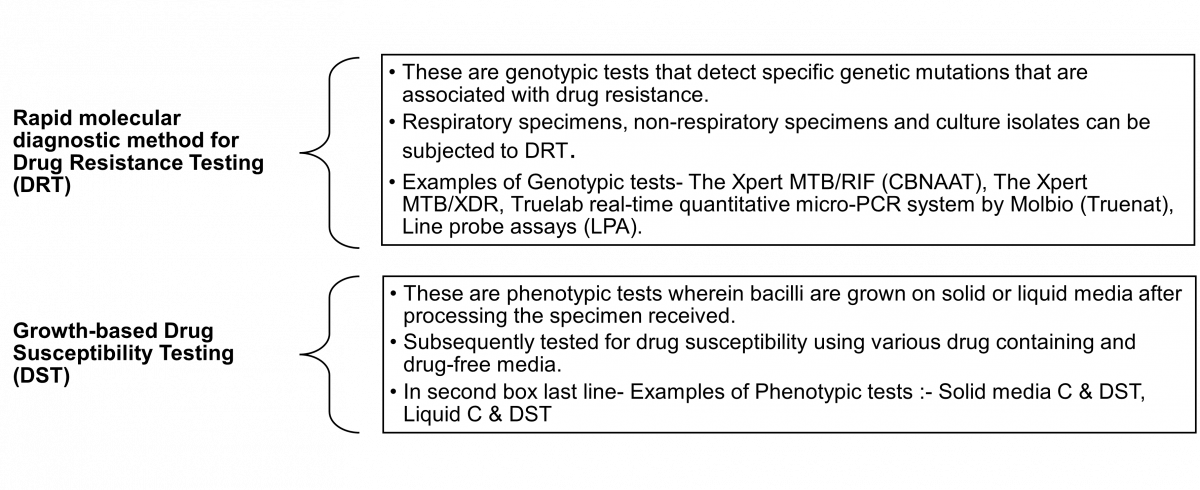
Figure: Laboratory Diagnosis Methods: Drug Resistance Testing (DRT) and Drug Susceptibility Test (DST)
Resources
Cartridge Based Nucleic Acid Amplification Test [CBNAAT]
ContentCartridge Based Nucleic Acid Amplification Test (CBNAAT) is a rapid molecular diagnostic test. It is used for diagnosis of Tuberculosis (TB) and Rif-resistant Tuberculosis (RR-TB) in NTEP. Results are obtained from unprocessed sputum samples in about 2hours which helps in early detection and treatment of TB patients.
India has vast number of CBNAAT laboratories which are utilized for TB/RR-TB detection and Universal Drug Susceptibility Testing (UDST) under the National TB Elimination Program (NTEP).
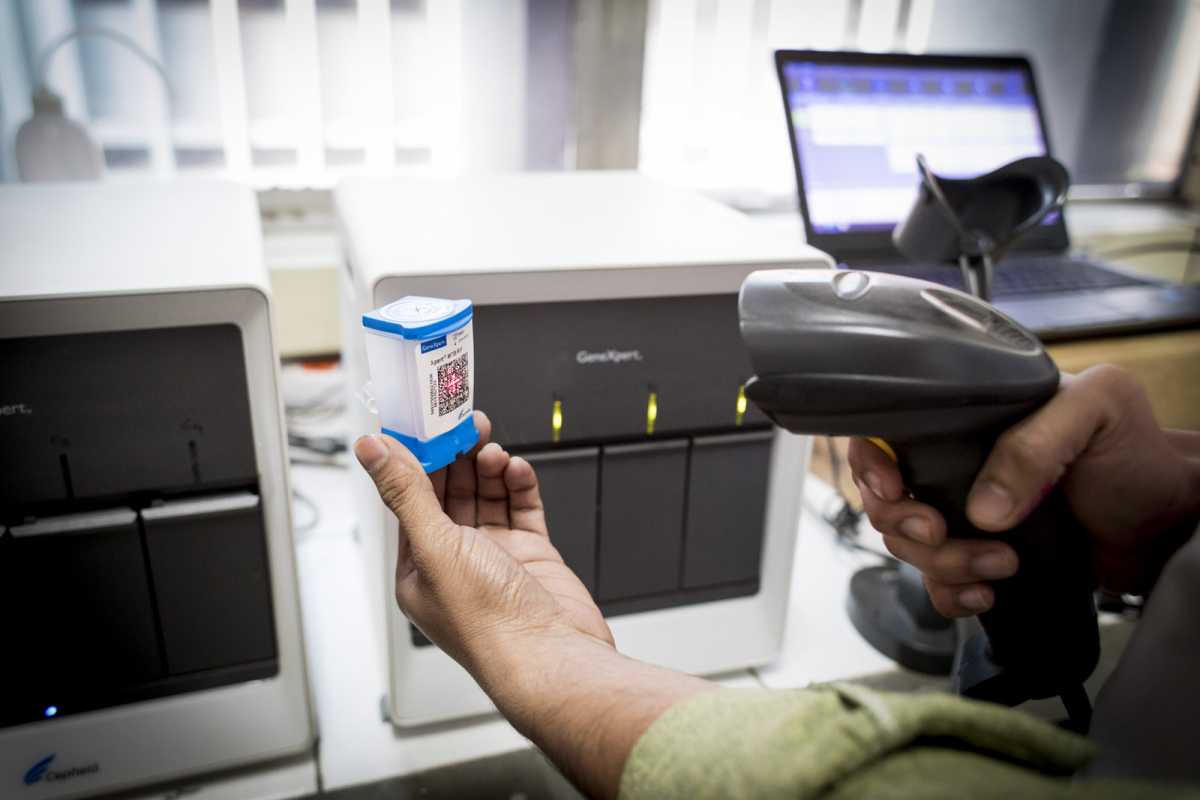
Figure: CBNAAT Cartridge and Machine in Use (Image courtesy: USAID supported Challenge TB Project)
The CB-NAAT system detects DNA sequences specific for Mycobacterium tuberculosis complex and rifampicin resistance by Polymerase Chain Reaction (PCR). It concentrates Mycobacterium tuberculosis bacilli from sputum samples, isolates genomic material from the captured bacteria by sonication and subsequently amplifies the genomic DNA by PCR. The process identifies clinically relevant rifampicin resistance-inducing mutations in the RNA polymerase beta (rpoB) gene in the Mycobacterium tuberculosis genome in a real-time format using fluorescent probes called molecular beacons.
Video fileVideo: Cartridge-Based Nucleic Acid Amplification Test [CBNAAT] - GeneXpert Technology
Resources
- Training Module (1-4) for Program Managers and Medical Officers, NTEP, MoHFW, 2020.
- India TB Report 2021, National TB Elimination Program (NTEP), MoHFW, 2021.
Assessment Questions
Question
Answer 1
Answer 2
Answer3
Answer 4
Correct Answer
Correct explanation
Part of pre-test
Part of post-test
Under NTEP, CBNAAT is offered upfront for which of these categories?
PLHIV
Paediatric presumptive TB
Presumptive DR-TB
All of the above
4
Under NTEP, CBNAAT is recommended upfront for People living with HIV, Paediatric Presumptive TB patients, Presumptive DR-TB patients and patients notified from the Private sector.
Yes
Yes
CBNAAT requires the processing of sputum samples before testing
True
False
2
Results are obtained from unprocessed sputum samples in about 2hours from a CBNAAT machine
Yes
Yes
Truenat
ContentTruenat is an indigenous rapid molecular test platform that is currently under use in NTEP for diagnosis of TB and Rif Resistance. It is a platform utilising real-time Polymerase Chain Reaction (PCR) technology built into micro-PCR chips.
Testing on Truenat involves three components:
- Workstation (consisting of 2 devices)
- Trueprep AUTO Universal Cartridge-based Sample Prep Device for the automated extraction and purification of DNA
- Truelab Real-time micro PCR Analyzer for performing real-time PCR. It is available as 1 (Uno), 2 (Duo) or 4 (Quattro) chip ports.
- Cartridge and Chip
- Reagent kits (Sample Pre-treatment and Prep kits)

Figure: Truenat Source: MolBio Products.
Test results for MTB detection and Rif Resistance has a turn around time of 1-2 hours. Depending on the micro-PCR chips used various tests can be performed using Truenat. Truenat MTB micro-PCR chips detect Mycobacterium tuberculosis bacteria for TB diagnosis. Truenat MTB RIF micro-PCR chip is used as a reflex test to detect resistance to Rifampicin (RIF), the first-line drug for TB treatment
Truenat has many advantages. Truenat is designed to be mobile and is battery operated (~8 hours on full charge). It can be deployed in peripheral laboratories and microscopy centres with minimal or no added facilities and hence it is more point-of-care. Biosafety requirements are similar to smear microscopy. However, it is multi staged and partially automated, requiring the presence of a Lab Technician through out the test.
Resources
- Truenat MTB Kit Insert.
- Trueprep AUTO Universal Cartridge-based Sample Prep Device.
- Practical Guide to Implementation of Truenat Tests for the Detection of TB and Rifampicin-resistance, 2021.
Assessment
Question
Answer 1
Answer 2
Answer 3
Answer 4
Correct answer
Correct explanation
Page id
Part of Pre-test
Part of Post-test
Truenat is used in NTEP for: MTB detection Rif Resistance Detection INH resistance Detection MTB and Rif Resistance Detection 4 Truenat is used for MTB and Rif Resistance detection in NTEP Yes Yes The Truelab Analyzer is available in how many chip ports?
2 (Duo)
1 (Uno), 2 (Duo) and 4 (Quattro)
1 (Uno)
4 (Quattro)
2
The Truelab Analyzer is available as 1 (Uno), 2 (Duo) and 4 (Quattro) chip ports.
Yes Yes - Workstation (consisting of 2 devices)
Line Probe Assay [LPA]
ContentLine Probe Assay (LPA) is a rapid molecular test available at centralised laboratories.
The assay is based on Polymerase Chain Reaction (PCR) that can simultaneously detect Mycobacterium tuberculosis complex as well as drug sensitivity to anti-TB drugs.

Figure 1: The GenoType MTBDRplus Molecular LPA Procedure; Source: Molecular Detection of Drug-resistant Tuberculosis by Line Probe Assay.
Advantages of LPA
- Rapid molecular test. (Turnaround time: 3-5 days)
- Highly sensitive and specific.
- Performed directly from sputum smear-positive specimens and on isolates of M. tuberculosis complex grown from smear-negative and smear-positive specimens.
- Detects multiple gene mutations in anti-TB drugs.
- First-line LPA detects mutations to rifampicin and isoniazid
- Second-line LPA detects mutations to fluoroquinolones and aminoglycosides.
- Suitable for low and high-throughput labs.
Disadvantages of LPA
- Cannot be used as a point-of-care test.
- Requires appropriate laboratory infrastructure, equipment and biosafety precautions.
- Different rooms (DNA extraction, pre-amplification, amplification, post-amplification/ hybridization) are required to perform different steps (Figure 2).
- Requires trained manpower to perform tests and interpret test results.
- Stringent internal quality control is required to prevent contamination.

Figure 2: Amplification (A) and Post-amplification Laboratory (B) for LPA; Source: Molecular Detection of Drug-resistant Tuberculosis by Line Probe Assay.
Resources
- Guidelines for PMDT in India, 2021.
- Molecular Detection of Drug-resistant Tuberculosis by Line Probe Assay.
Assessment
Question Answer 1 Answer 2 Answer 3 Answer 4 Correct answer Correct explanation Page id Part of Pre-test Part of Post-test LPA can be used as a point-of-care test. True False 2 LPA cannot be used as a point-of-care test. Yes Yes Solid and Liquid Culture in TB
ContentCulturing TB Bacilli is well known and historic method for detection/ confirmation of Tuberculosis. It is a highly sensitive and specific phenotypic test; it can detect even a few viable bacilli in the sample (Upto 10 Colony Forming Units- CFUs). TB bacilli multiply in the culture and form colonies of TB bacilli which can are easily be identified.
Based on the growth media used Culture is divided in to two types, Solid and Liquid Culture methods. Types Culture:
- Solid Culture on Lowenstein Jensen media : Historic gold standard culture test. Results take usually upto 2 months (60 days).
- Modern Liquid culture systems: (e.g. BACTEC MGIT 960, BacT Alert or Versatrek etc.) Results take usually up to 42 days.
Uses
- Solid culture is the gold standard diagnostic test for TB. But it is not used for the purpose of TB diagnosis due to the long turn around time of 2 months. It is largely used for research purposes where it is used as the baseline test on which the sensitivity and specificity of other tests are calculated.
- Liquid Culture is being used for follow-up monitoring of patients on drug resistant TB treatment to detect treatment failure. Liquid culture is also used for long term follow up patients who have successfully completed treatment to detect recurrence.
- Liquid culture is used as a previous step to grow bacilli and obtain isolates prior to Drug Susceptibility Testing.
- Liquid cultures are also used in TB prevalence surveys for its high sensitivity and specificity
Resources
Kindly provide your valuable feedback on the page to the link provided HERE
Culture Drug Susceptibility Testing [CDST]
ContentCulture Drug Susceptibility Testing (CDST) is a growth-based phenotypic method used to check the susceptibility of Mycobacterium tuberculosis strains to various first and second line anti-TB drugs. Mycobacterial resistance to a particular drug is identified if there is growth observed in culture in presence of that drug.

In NTEP CDST is the standard method to detect resistance in samples of patients who have tested positive on followup. While CDST is possible on both Solid and Liquid culture, currently, the NTEP utilizes only liquid culture as a method for DST, due to faster Turn around times.
CDST testing services are available under NTEP in designated, specialized laboratories called CDST Labs both in public and private sector. Currently there are 80 such laboratories (60 certified for First Line and 49 for Second line drugs). Such designated laboratories are subject to regular external quality assessment, often by the National Reference Laboratory at that region.
Quality assured DST to R, H, Z, Mfx, Lfx, Lzd, Am, Km and Cm are available across the country.
Resources
Patient Turnaround Time from Identification to Treatment Initiation Relative to the Laboratory Technology Used in DR-TB
ContentThe concept of Patient Turnaround Time (P-TAT) is to find out how much time was taken from the identification of the patient for a test to getting the result of that test and initiation of patient's treatment based on the test result.
The National TB Elimination Programme (NTEP) have set benchmarks to monitor the P-TAT as provided in the table below.
Programme officers/ staff needs to ensure that the P-TAT relative to the laboratory technology used, should be well within the minimum acceptable timeline as detailed in this table to improve patient treatment outcomes.
Table: P-TAT from identification to treatment initiation relative to the laboratory technology used; Source: Guidelines for PMDT, India 2021, p103.
TECHNOLOGY PRE-LAB TAT IN DAYS* LAB TAT IN DAYS** POST-LAB TAT IN DAYS*** TOTAL PATIENT TAT IN DAYS NAAT 1-2 1-2 2-3 4-7 LPA 1-3 2-3 2-3 5-9 LC-DST# NA Time till LPA testing – 5-7 days + @22-48 (in most cases 30 days)
2-3 29-58 (in most cases 40 days) LC for follow up 2-3 days (for tracing patient and collecting specimen) 8-42 1-2 11-45 * Pre-lab TAT for Nucleic Acid Amplification Test (NAAT) includes time from patient identification, counselling, collection and transport of 2 specimens to NAAT facility. Pre-lab TAT for Line Probe Assay (LPA) and Liquid Culture - Drug Susceptibility Testing (LC-DST) includes time from collection to NAAT and further transport of the second specimen to Culture and Drug Susceptibility Testing (C&DST) labs.
** Lab TAT includes the time from specimen receipt to results by technology.
***Post-lab TAT includes time from accessing test results, pre-treatment evaluation to treatment initiation.
# For Pyrazinamide DST, additional 7 days will be needed.
@ Includes culture and growth days for DST set-up.
Fresh samples are collected from the patient and transported for follow-up on liquid culture.
Resources
Kindly provide your valuable feedback on the page to the link provided HERE
-
DR-TB HIV Coordinator: Diagnostic Network and Hierarchy
FullscreenLaboratory Hierarchy and Network
ContentNTEP laboratory network is comprising of National Reference Laboratories (NRLs), state level Intermediate reference laboratories (IRLs), Culture & Drug Susceptibility Testing (C & DST) laboratories and peripheral level laboratories. Peripheral level laboratories consist of designated microscopy centres (DMCs) and NAAT labs.
NTEP has a quality assured laboratory network for bacteriological examination of sputum in a 3-tiered system.
Figure: Laboratory network of NTEP
Resources:
Kindly provide your valuable feedback on the page to the link provided HERE
CDST labs and their role
ContentUnder the National Tuberculosis Elimination Programme (NTEP), many labs are established at the regional level within states for providing Culture and Drug Susceptibility Testing (C&DST) facilities for presumptive TB/DRTB and for TB/DRTB patients.
- C&DST laboratories are mostly located in intermediate reference laboratories (IRLs) or medical colleges.
- There are 42 C&DST laboratories established under the programme in different geographies.
- Dedicated human resources are provided for the laboratories under the programme.
- Districts are linked with laboratories for providing facilities for Culture and DST using:
- Phenotypic Methods (Solid – Lowenstein Jensen (LJ), and Liquid Culture – Mycobacteria Growth Indicator Tube (MGIT))
- Genotypic technology (Line Probe Assay (LPA) and Cartridge Based Nucleic Acid Amplification Test (CBNAAT))

Figure: Culture and Drug Susceptibility Testing (C&DST) facility,
Source: The Foundation For Innovative New Diagnostics (FIND)Resources
- Guidelines for Programmatic Management of Drug Resistant TB in India, 2021
- Training Modules (1-4) for Programme Managers and Medical Officers; New Delhi, India: Central TB Division, July 2020
Kindly provide your valuable feedback on the page to the link provided HERE
NAAT Labs and their role
ContentThe National Tuberculosis (TB) Elimination Program (NTEP) has a network of Nucleic Acid Amplification Tests (NAAT) laboratories coupled with Designated Microscopy Centers (DMCs) to form the backbone of the diagnostic component of TB services.
Nucleic Acid Amplification Tests (NAAT) laboratories includes Cartridge-based NAAT (CBNAAT) and TrueNat tests. These tests detect tuberculosis as well as rifampicin resistance and are more sensitive than smear microscopy.
Functions of Nucleic Acid Amplification Test (NAAT) Laboratories:
- Acting as a hub for collection of samples from public and private health facilities (spokes)
- Universal Drug Susceptibility Testing (UDST) to rule out rifampicin resistance among confirmed TB patients
- Timely provision of NAAT test result to the TB patient, medical officer of the concerned health facility and NTEP staff for related actions
- Acting as a sample dispatch center for the Culture DST laboratory for subsequent processing of samples for first-line line probe assay (LPA) and second-line drug resistance testing utilizing second line LPA and liquid culture DST
- Recording and reporting including digitization of diagnostic process from collection to test result in NTEP Nikshay portal and Laboratory Information Management System
- Management of supplies and logistic associated with laboratory logistic (CBNAAT cartridges and TrueNAT chips) and reporting any additional requirement thereof
- Supporting the quality assurance activities undertaken by District or Intermediate Reference Laboratory under NTEP
- Support health system in carrying out special drives for vulnerable and at-risk population and their testing directly by CBNAAT (slum population, diabetic population, smoker, malnourished people, patients of silicosis and kidney dialysis etc.)
Resources
- RNTCP Technical and Operational Guidelines for TB Control in India, 2016.
- Guidelines for Programmatic Management of Drug Resistant Tuberculosis in India, 2021.
Kindly provide your valuable feedback on the page to the link provided HERE
Initiative for Promoting Affordable and Quality Tuberculosis Tests [IPAQT]
ContentDiagnostic services are provided free of cost at all public health laboratories, for patient referrals from the private sector. Laboratory services are also purchased from certified private sector laboratories through partnership schemes.
- The Initiative for Promoting Affordable and Quality TB Tests (IPAQT) was initiated in 2013 to bring World Health Organization (WHO)-approved tuberculosis tests at affordable prices to patients in the private sector.
- IPAQT is an initiative of not-for-profit stakeholders and private sector labs/ hospitals (collection centres) with a pan-India presence. IPAQT brought together various private laboratories with the support of test manufacturers and other major stakeholders to:
- Bring down the price for quality TB tests by up to 50% in the private sector (see table below)
- Promote the use of these tests by building awareness among health providers, laboratories and patients
Table: Ceiling Price for Four WHO-endorsed Tests as Set by IPAQT; Source: IPAQT.com
Cartridge-based Nucleic Acid Amplification Test (CBNAAT) Rs.2200 Hain genotype test Rs.1800 Mycobacteria Growth Indicator Tube (MGIT) Acid-fast Bacilli (AFB) culture Rs.900 BacT/ ALERT AFB culture Rs.900 It's the responsibility of District TB Officers (DTOs) to ensure that, patients diagnosed through IPAQT laboratories are notified in the National TB Elimination Programme (NTEP) surveillance system and appropriate public health actions are initiated.
Resources
Kindly provide your valuable feedback on the page to the link provided HERE
Designated Microscopy Centre [DMC]
ContentSputum microscopy diagnostic services under the National TB Elimination Programme (NTEP) are provided by the Designated Microscopy Centres (DMCs) established at the Peripheral Health Institution (PHI) level, where a functional binocular microscope and a trained Laboratory Technician (LT) is available. Light Emission Diode Fluorescent microscopes are provided to high-load PHI-DMCs such as that of the medical colleges.
Based on latest directives, a DMCs may be established at all PHIs (Public and Private) of the country as needed. It is mandatory to have a DMC at all medical colleges in the country.
As molecular technologies like Truenat are also used in DMCs, NTEP has planned to rename DMCs as TB Diagnosis Centres (TDCs).
Criteria to be a DMC
The DMCs should satisfy the following criteria:
- NTEP-trained Laboratory Technician (LT) should be present.
- A functional binocular microscope should be present in the laboratory.
- Physical infrastructure in the laboratory should meet NTEP guidelines.
- Daily new adult outpatient cases of at least 60-100 and/or workload of at least 3-5 sputum smears per day for the LT in the laboratory.
DMCs in the public sector, at the onset of the programme, are provided with funds to undertake minor civil works to build up their physical infrastructure and are provided with binocular microscopes.
Human Resources Norms
- For the purpose of NTEP, a PHI is a health facility which is manned by at least a Medical Officer (MO).
- In addition to the MO and LT, there is 1 TB Health Visitor (TBHV) per one lakh urban population to support the urban TB control activities.
Other Criteria
Microscopy Centres may be established beyond population norms in medical colleges, corporate hospitals, Employee State Insurance Corporation (ESIC), railways, Non-government organisations (NGOs), private hospitals, Ayushman Bharat - Health and Wellness Centres (AB-HWCs), etc.
Before designating a DMC in other sectors, there should be a formal agreement by the hospital/ laboratory to take part in the External Quality Assurance (EQA) and to allow the concerned NTEP staff to supervise as per the NTEP guidelines.
If the above criteria are met by any private laboratory, the lab is considered for establishing a DMC.
- To provide better access for diagnosis of TB, all PHIs, wherever LTs and binocular microscopes are available, can be upgraded to a DMC irrespective of the population norms or OPD attendance.
- All DMCs should comply with the Quality Assurance (QA) mechanisms as per the EQA guidelines.
Resources
- NTEP Training Modules 1-4 for Programme Managers & Medical Officers, 2020.
- Operational Guidelines for TB Services at Ayushman Bharat Health and Wellness Centres.
Assessment Questions
Question
Answer 1
Answer 2
Answer3
Answer 4
Correct Answer
Correct explanation
Part of pre-test
Part of post-test
The DMC is an NTEP diagnostic facility at the PHI level
TRUE
FALSE
1
The DMC is an NTEP diagnostic facility at the PHI level
Yes
Yes
DMCs are established only in a public sector facility
True
False
2
If a lab/facility meets the criteria of DMC, the facility is considered for establishing a DMC
Yes
Yes
Kindly provide your valuable feedback on the page to the link provided HERE
Sputum Collection centres
ContentTo increase access to diagnostic services, NTEP has a provision for sputum collection centres in areas where the health facility is not equipped with key requirements to conduct sputum microscopy, molecular tests, drug susceptibility testing or follow up examinations.
Sputum collection centres are dedicated locations where sputum samples are collected, packaged and then transported to nearby TB diagnostic centres. It could be attached to any near-by health-facility as well.
Requirements of a Sputum Collection Centre
To function as sputum collection centres, the following is essential:
- Linkage/ mapping (time and distance) to testing laboratory
- Availability of adequate number of sputum cups and falcon tubes, logistics for sample packaging and transport
- Identification of open areas for sputum collection
- Staff trained in NTEP guidelines on sputum collection, sample packaging and transport, complete and correct documentation of laboratory request form, and infection control practices
- Feasibility and financial measures required for sample transport
- Inclusion of local volunteers, courier services, sample transportation under National Health Mission Free Diagnostic Services or other mechanisms as decided by the state/district
- Availability of Information, Education and Communication (IEC) material, training modules, and job-aids
Sputum collection centres are established in:
- Ayushman Bharat Health and Wellness Centres/Sub-centres
- Urban primary health centres
- Tribal, hilly, desert and difficult-to-reach areas of the country
Resources
- Training Modules for Programme Managers and Medical Officers
- Operational Guidelines for TB Services at Ayushman Bharat Health and Wellness Centres
- Mycobacteriology Laboratory Manual, GLI Initiative, 2014
Assessment:
Question Answer 1 Answer 2 Answer 3 Answer 4 Correct answer Correct explanation Page id Part of Pre-test Part of Post-test Under NTEP, where are sputum collection centres established to increase access to diagnostic services? Tribal areas Ayushman Bharat health and wellness centres Difficult-to-reach areas All of the above 4 To increase access to diagnostic services, sputum collection centres are established in Ayushman Bharat health and wellness centres, Urban health centres, tribal, hilly, desert and difficult-to-reach areas of the country. Yes Yes Process of SCT
Content- Good quality sputum collection is of paramount importance in tuberculosis diagnosis.
- Once a person is identified as presumptive TB, s/he is referred to the Designated Microscopy Centre (DMC) for sputum collection.
- For TB diagnosis two sputum samples are collected - one is the supervised ‘spot’ sample collected at the DMC (labelled Specimen A) and the other is the early morning sample collected by patient themselves at his/her home (labelled Specimen B).
- If the patient is coming from a long distance or s/he is unlikely to return to give the second specimen, two spot specimens may be collected with a gap of at least one hour.

Figure: Flowchart for Sputum Collection and Transport
Sputum Collection
- The (NTEP) request form required for the biological specimen examination need to be filled.
- The Lab Technician (LT) should instruct the patient to thoroughly rinse the mouth with clean water and demonstrate to inhale deeply 2-3 times and cough out the sputum from the depth of the chest into a sterile 50 ml sputum container, in a well-ventilated space.
- After collecting the sputum, close the lid of the containers and wipe the surface of the tube with 5% phenol to disinfect and allow it to air dry.
- Label the tubes with patient details, date and time of collection, specimen identification, lab no. using a permanent marker.
Sputum Transport
- The sputum collected should be transported immediately to the Nucleic Acid Amplification Testing (NAAT)/ Culture and Drug Susceptibility Testing (C&DST) laboratory. In case of any unavoidable delays, the sample should be refrigerated.
- The programme mandates triple layer packaging for the transport of the sputum specimens.
- Firstly, seal the joint between the cap and neck of the sputum containers with a parafilm strip (primary receptacle package).
- Wrap the sputum containers individually in absorbent cotton, place them in a zip lock pouch and secure them with a rubber band (secondary receptacle package).
- Fold and place the NTEP request form in another zip lock pouch.
- Place the zip lock pouch with sputum containers in a thermocol box along with two pre-frozen coolant gel packs and the zip lock pouch with the NTEP request form is placed on top.
- The dimensions of the thermocol box used for sputum transport are: thickness - 2.5 cm; Outer dimensions: length - 18.5 cm, breadth - 13 cm, height - 12 cm (without lid), height -14 cm (with lid); Inner dimensions: length - 14.5 cm, breadth - 8 cm, height - 12 cm (without lid), height - 13 cm (with inner part of lid).
- The coolant gel packs should be conditioned in the deep freezer in a temperature between -20 to -15o C for a minimum 48 hours to a maximum 72 hours before use so that they can maintain a temperature between 12-20o C for up to approximately 48 hours in tightly packed thermocol boxes while the average outside temperature is 35o C.
- Seal the thermocol box with duct tape and affix ‘To’ and ‘From’ address, biohazard sticker on the box (tertiary receptacle package).
- Weight of the fully packed consignment box should be up to 400 grams and the thermocol boxes and gel packs should not be reused.
- Transport the box through NTEP identified courier/ speed post service.
Resources
- Training Module (1-4) for Programme Managers and Medical Officers, NTEP, MoHFW, 2020.
- Guidelines for Programmatic Management of Drug-resistant TB in India, 2021.
- Module for Laboratory Technician, CTD, MoHFW, India, 2005.
Assessment
Question Answer 1 Answer 2 Answer 3 Answer 4 Correct answer Correct explanation Page id Part of Pre-test Part of Post-test After collecting the specimen, the falcon tubes should be wiped and disinfected with which solution? 5% Iodine 5% Glycerine 5% Phenol 5% Sodium 3 After collecting the specimen, the falcon tubes should be wiped and disinfected with 5% phenol solution. Yes Yes NTEP mandates triple layer packaging for the transport of the sputum specimens
True False 1 Triple layer packaging prevents spills and leakages during transportation of sample. Yes Yes
-
DR-TB HIV Coordinator: Approaches to TB Case Finding
FullscreenScreening For Tuberculosis Disease
ContentScreening for active tuberculosis (TB) a process to filter out people who are less likely to have TB, from a group. Screened positive people are likely to have TB and are confirmed subsequently using a TB diagnostic test. This will allow finite diagnostic testing resources to be used on the remaining.
Screening in TB may be performed using simple field tools (4 Symptom complex) and tests such as Chest X-ray, or a combination of both. Combination of both is the most effective, but is often not applied due to the practical difficulties in making a chest X-ray conveniently available.
Screening is an integral part of any general case finding effort. It is also applied systematically in specific situations.
- At health care facilities (intensified case finding): Here those visiting are screened using the 4 symptom complex, often at the point of entry to the facility. Those screened positive may be fast-tracked to TB Diagnostic testing.
- In vulnerable populations in active case finding efforts: Here the entire population identified for active case finding are screened using the pre-decided protocols by going door to door.
Resources
Universal Drug-susceptibility Testing for TB
ContentDrug Susceptibility Testing (DST) refers to in-vitro testing using either of the phenotypic methods to determine susceptibility. Drug Resistance Testing (DRT) refers to in-vitro testing using genotypic methods (molecular techniques) to determine resistance.
- Universal Drug Susceptibility Testing (UDST) refers to universal access to rapid DST for at least Rifampicin (R), and further DST for at least Fluoroquinolones (FQs) among all TB patients with rifampicin-resistance.
- UDST is essential to identify patients who can be initiated on Drug-resistant TB (DR-TB) treatment instead of Drug-sensitive TB (DS-TB) treatment, especially in a situation where the drug-resistance level is high.
- It should be done preferably before initiation of treatment to a maximum within 15 days of diagnosis.
- UDST is a part of national policy under the National TB Elimination Programme (NTEP).
- NTEP has undertaken decentralization of quality assured diagnostics for scale up of UDST across the country which has helped in early detection of DR-TB treatment and reducing associated morbidity and mortality.
Resources
Kindly provide your valuable feedback on the page to the link provided HERE
UDST Report
ContentVideo fileVideo: UDST Report
Approaches to TB Case Finding
ContentPeople who have been exposed to patients with infectious TB are known as TB contacts; they constitute a high-risk group for TB. Case finding investigation contributes to the early detection of TB cases, and results in identifying a significant number of additional patients.
Figure: Approaches to Tuberculosis Case Finding
Active case-finding requires systematic screening and clinical evaluation of populations who are at high risk of developing TB, such as people living in slums, tribal areas, congregate settings, persons who are household contacts of TB cases
Resources:
Kindly provide your valuable feedback on the page to the link provided HERE
Active Case Finding
ContentSystematic screening of all individuals of a defined population is known as active case finding. It is applied outside of health facilities at the community level by the health system.
Objective of ACF is to:
- identify cases early, initiate prompt treatment, reduce risk of poor treatment outcomes and reduce risk of further transmission of TB
- to provide access to diagnosis services to populations that would have been otherwise unreached
It is effort intensive and is recommended only in population groups where there is estimated high case load. In NTEP, ACF is recommended only to be performed in Key / vulnerable population.
ACF can also be clubbed with suitable ACSM campaigns to create awareness about the signs and symptoms and about TB in the target population/ community. It can also be combined with other health activities/ campaigns (such as Pulse Polio/ Leprosy screening/ population based screening for NCDs) for increased efficiency.
Resources
- Training Modules for Programme Managers and Medical Officers.
- Active TB Case Finding, Guidance Document.
- WHO recommendations for Systematic Screening for Active Tuberculosis
Assessment
Question Answer 1 Answer 2 Answer 3 Answer 4 Correct answer Correct explanation Page id Part of Pre-test Part of Post-test Which of the following is not a primary objective of ACF? Increase TB notification Early identification of cases. Reduce the risk of transmission of TB. Reduce the risk of poor treatment outcomes. 1 Notification is not a primary objective of ACF. Yes Yes Passive Case Finding
ContentPassive case finding is essentially where the patient self reports to the health care provider with symptoms. This requires that affected individuals are aware of their symptoms, have access to health facilities, and are evaluated by health workers or volunteers who recognise the symptoms of TB and link those individuals for TB testing services.
This approach to case finding has the least effort and cost and is a minimum expectation. In a Peripheral Health Institution (PHI), it is estimated that about 2-3% of new adult outpatients are symptomatic that require referral for TB diagnosis (presumptive TB cases).
Passive case finding may miss TB patients if :
- The disease is mild/ transient.
- Access to healthcare is poor.
- Health providers do not have an adequate index of suspicion and are unable to reliably link respiratory symptoms to TB.
Resources
Assessment
Question Answer 1 Answer 2 Answer 3 Answer 4 Correct answer Correct explanation Page id Part of Pre-test Part of Post-test Which of the following can be considered a passive case finding? TB case finding for all patients attending an HIV clinic. TB case finding in all inmates of an elderly home. Patients attending a PHC with symptoms are referred for testing by the doctor. TB case finding among household contacts of a TB case. 3 All other examples except those attending PHC referred for TB testing are cases of active or intensified case finding effort. Yes Yes What may cause a passive case finding to miss cases? Healthcare providers fail to notify the case. Healthcare providers do not refer cases for TB testing. There are no health facilities in the area. Both 2 and 3 4 Healthcare providers failing to notify cases is missing notification and not related to passive case finding. Yes Yes Intensified Case Finding
ContentIntensified Case Finding (ICF) is a case finding approach between Active and Passive approaches. Here individuals coming in contact with the health system through any activity are screened actively for symptoms of TB and referred for testing.
This approach brings the benefit of active case finding approach by active screening for TB symptoms, but does limit the extensive effort required by restricting to only those people who has some or the other healthcare problem. This approach is considered for people attending a healthcare facility.
Some examples of ICF are screening for TB symptoms and referral for testing in:
- all cases attending an HIV clinic.
- among children with malnourishment who attend a nutrition clinic.
- all mothers attending the antenatal clinics
Resources
Assessment
Question Answer 1 Answer 2 Answer 3 Answer 4 Correct answer Correct explanation Page id Part of Pre-test Part of Post-test Which of the following is an example of an intensified case finding?
Systematic screening for TB of all contacts of TB cases. Screening all cases attending an OPD with respiratory symptoms for TB testing. Referring cases that report more than 2 weeks of cough from an OPD for TB testing. Screening all people belonging to a slum for TB symptoms. 2 Systematic screening of TB contacts and those belonging to a slum population are examples of active case finding.
Referring to cases that report TB symptoms is a passive case finding.
Yes Yes Bidirectional Screening
ContentBidirectional screening is a method to identify cases in diseases which have predisposition to each other or has a significant influence on each other. For example TB and HIV, where having HIV increases risk of developing TB and cases with TB would have poor outcomes if co-infected with HIV.
Screening for TB is done through four-symptoms complex based screening or through Chest X-ray. Screening for the linked disease is carried out as per the policies of the corresponding health program.
Bi-directional screening policies are implemented by various disease control programs. For example, with NTEP the following disease control efforts implement a bidirectional screening policy:
- HIV through NACO
- COVID19
- Diabetes Mellitus (DM) through NPCDCS
- Tobacco through National Tobacco Control Program
Both programs monitor bidirectional screening, referral and testing as per their own policies.
Resources
Assessment
Question Answer 1 Answer 2 Answer 3 Answer 4 Correct answer Correct explanation Page id Part of Pre-test Part of Post-test Bidirectional screening for TB is not done in which of the following conditions? Diabetes Tobacco abuse/ addiction Pregnancy COVID-19 3 Although pregnant mothers may be screened for TB as a part of intensified case finding, all TB cases are not actively/ routinely screened for pregnancy. Yes Yes TB-Diabetes Bidirectional Screening
TB-Tobacco Bidirectional Screening
ContentWhy important, how is it done,
TB-COVID Bidirectional Screening
-
DR-TB HIV Coordinator: TB Case Finding in NTEP
FullscreenDiagnostic Algorithm for TB Disease in NTEP
ContentPersons with cough of more than 2 weeks, with or without other symptoms suggestive of TB, should be promptly identified as presumptive pulmonary TB patients.
Under NTEP, they are to be referred to the designated microscopy centre (DMC) for sputum examination using the Request form for examination of biological specimen.
Patients belonging to the key population EPTB, HIV and Paediatrics groups (after X-ray screening in case of children) can be directly referred for NAAT.
All presumptive TB patients in the public and private sector must be evaluated for TB based on the diagnostic algorithm for pulmonary and extra-pulmonary TB (EPTB) and the following points must be considered:
- All presumptive pulmonary TB patients must be subjected to sputum smear examination. In places where TB diagnostic laboratories are upgraded to NAAT testing, NAAT can be offered for all presumptive TB patients upfront
- If both the chest X-ray and sputum smear (NAAT in integrated places) results are negative, but the physician considers the patient as presumptive TB, the patient needs to be referred to a chest physician for further evaluation
- NAAT testing will be performed to rule out Rif. resistance before treatment initiation (In places where transition has not yet been happened to NAAT for diagnosis)
- NAAT results will decide if the patient is MTB detected with either Rif. Resistance or Rif. Sensitive
- Upfront NAAT is offered for key populations like PLHIV/children/EPTB
- M.TB detected on NAAT will be further subjected for FL–LPA, SL-LPA, LC DST and based on the results DR-TB regimen may be initiated

Resources
- Technical and Operational Guidelines for TB Control in India 2016
- Revised PMDT Guidelines in India 2021
Kindly provide your valuable feedback on the page to the link provided HERE
Diagnostic Algorithm for EPTB
ContentIt is crucial to make an effort for microbiological confirmation in presumptive Extrapulmonary Tuberculosis (EPTB) cases. Appropriate specimens from the Extrapulmonary (EP) site are collected and, depending on the specimen type and availability of facilities, the specimens are sent for:
- Cartridge-based Nucleic Acid Amplification Testing (CBNAAT)
- Culture and Drug Susceptibility Testing (C&DST) for M. tuberculosis
- Histopathological examination
The diagnostic algorithm (see the figure below) to be followed for EPTB cases depends on 2 main factors:
- Availability of appropriate specimens from the EP site
- Availability of CBNAAT (preferred test)

Figure: Diagnostic Algorithm of EPTB
- If an appropriate specimen from the EP site is available, specimens from the presumed sites of involvement must be tested with CBNAAT.
- CBNAAT detects MTB and RIF status and helps to identify microbiologically confirmed EPTB cases.
- If CBNAAT is not available, the specimen is sent for Liquid Culture (LC) at the C&DST lab. If the LC is positive, it is identified as a microbiologically confirmed EPTB case.
- If there is high clinical suspicion of TB even after a negative culture result, other diagnostic tools are used to clinically diagnose EPTB (usually with a specialist). If these tests indicate TB, they may be treated as clinically diagnosed EPTB or else arrive at an alternate diagnosis.
Clinical Diagnosis of EP-TB
If an appropriate specimen from the EP site is not available, in the presence of high clinical suspicion of TB, other modalities of diagnosis are used in consultation with a specialist. If with other diagnostic modalities, TB diagnosis still cannot be established, the specialist may explore an alternate diagnosis.
A clinical diagnosis of EPTB is made if a consultative decision is made to treat with a full course of anti-TB drugs in spite of the situations listed above. Chest X-ray (CXR), ultrasonography, Computerised Tomography (CT) scan, Magnetic Resonance Imaging (MRI) and biochemical examinations are supporting tests that can be used to help arrive at a diagnosis.
Resources
- Training Modules (1-4) for Programme Managers and Medical Officers, 2020.
- Technical Operational Guidelines, Chapter 3: Case Finding and Diagnosis Strategy, NTEP.
Assessment
Question
Answer 1
Answer 2
Answer 3
Answer 4
Correct answer
Correct explanation
Page id
Part of Pre-test
Part of Post-test
Which of the following statements are correct?
We must try our utmost best to get a microbiological confirmation in presumptive extrapulmonary tuberculosis cases.
If the extrapulmonary specimen is not available, then consult with a clinician if there is a high suspicion of TB to diagnose the case.
Wherever possible, all extrapulmonary specimens must be subjected to CBNAAT.
All of the above
4
Microbiological confirmation is crucial for EPTB cases, and CBNAAT is the preferred test. If specimens are not available, but TB is highly suspected, then a clinical diagnosis can be sought in consultation with a specialist.
Yes Yes Diagnostic Algorithm for Pediatric TB
ContentAll children with persistent fever with/without cough for two or more weeks; close contact with TB patients in the last 2 years; unexplained sudden weight loss or signs of malnutrition despite good nutrition, should be subjected to Chest X-ray (CXR).
1) If the CXR is normal, the child should be checked for signs of Extrapulmonary TB (EPTB) and referred for detailed investigations to higher centres in case of any symptoms.
2) If the CXR is suggestive of TB, the child should be subjected to a sputum test/ gastric aspiration / induced sputum for Mycobacterium tb (MTB) testing.
- If the report is MTB positive, the child is microbiologically confirmed for TB and should be further tested for Rifampicin (Rif)-resistance and treated accordingly for Drug-sensitive (DS)/ Drug-resistant (DR) TB, based on Rif results.
- If the report is MTB negative, look for significantly enlarged peripheral lymph nodes and also repeat the sputum test with a good sample and refer to a higher centre if required.
3) If the CXR displays non-specific shadows prescribe antibiotics (amoxiclav/ amoxicillin) if not already taken. Do not prescribe quinolones or linezolid and review the shadow and symptoms.
4) If CXR displays pleural effusion send the pleural fluid for examination at Nucleic Acid Amplification Testing (NAAT) lab as well for cytology and biochemical examinations.
- If pleural fluid turns out MTB positive at the NAAT, treat as per guidelines
- If the pleural fluid is MTB negative, but is a straw-coloured exudative effusion, treat the child as clinically diagnosed probable TB.
Image
Figure: Diagnostic Algorithm for Paediatric TB; Source:
Resources
- Standard Treatment Workflows of India: Special Edition on Paediatric and Extrapulmonary Tuberculosis, ICMR, MoHFW, GoI, CTD, 2022.
- Guidelines on Programmatic Management of Drug Resistant TB (PMDT) in India, CTD, MoHFW, GoI, 2021.
Assessment
Question
Answer 1
Answer 2
Answer 3
Answer 4
Correct answer
Correct explanation
Page id
Part of Pre-test
Part of Post-test
What should be the next step in the case where a child’s sputum examination report comes out as MTB negative?
Look for significantly enlarged peripheral lymph nodes if any
Repeat the sputum test with a good sample
All of the above
None of the Above
3
If the sputum test report turns out to be MTB negative, look for significantly enlarged peripheral lymph nodes in the child and also repeat the sputum test with a good sample and refer to a higher centre if required.
Yes
Yes
- Standard Treatment Workflows of India: Special Edition on Paediatric and Extrapulmonary Tuberculosis, ICMR, MoHFW, GoI, CTD, 2022.
Screening and diagnosis for DRTB
ContentDrug-resistant TB (DR-TB) diagnosis is predominantly based on laboratory diagnosis. Presumptive-TB/ DR-TB is identified by the health facility doctor during passive screening or by health staff/ community volunteers during Active Case Finding (ACF).
The vision of National TB Elimination Programme (NTEP) is to provide early diagnosis to all persons with any form of DR-TB through Universal Drug Susceptibility Testing (UDST).
All diagnosed TB patients are eligible for a NAAT test to know their Rifampicin sensitivity status. The integrated diagnostic algorithm for diagnosis of TB offers upfront Nucliec Acid Amplification Test (NAAT) for diagnosis of TB to vulnerable population. Among other eligible groups for NAAT are: non-responders to treatment and contacts of DR-TB patients are also offered upfront NAAT.
Rapid identification of DR-TB is achieved by using a combination of NAAT (CBNAAT/ Truenat) followed by sequential testing by first- and second-line Line Probe Assay (LPA) and Liquid Culture (LC) and Drug Susceptibility Testing (DST) for specific drugs as described below:
- When Rifampicin resistance is not detected by NAAT, the patient is offered First-line (FL) LPA.FL-LPA provides information on Isoniazid resistance.
- For Rif resistance/Inh resistance cases, SL-LPA is done and it provides information on resistance to Levofloxacin, Moxifloxacin and Amikacin.
- For all Rif resistance cases, LC and DST is done for Pyrazinamid, Moxifloxacin (if resistance detected by LPA), Linezolid, Clofazimine*, Bedaquiline* and Delamanid*.
(* when available)
Resources
Assessment
Question Answer 1 Answer 2 Answer 3 Answer 4 Correct answer Correct explanation Page id Part of Pre-test Part of Post-test Liquid Culture and DST is done before NAAT. True False 2 Rapid identification of DR-TB is achieved by using a combination of NAAT (CBNAAT/ Truenat) followed by sequential testing by first- and second-line LPA and then liquid culture and DST. Yes Yes Integrated DR-TB Algorithm
ContentCheck
Diagnosis of DR-TB in Children
ContentPresumptive Drug-resistant TB (DR-TB) in Children
It occurs mostly in children who:
- Are contacts of adults with Multidrug-resistant (MDR)/ DR-TB
- Are lost to follow-up after initiating treatment
- Present with recurrence of disease after previous treatment
- Do not respond to treatment with first-line drugs
- Are Children Living with HIV (CLHIV).
All efforts must be taken to ensure microbiological confirmation of DR-TB diagnosis among children through getting an appropriate body fluid sample for both pulmonary or extrapulmonary-TB cases.
Sputum (or other relevant samples, e.g., gastric aspirate, induced sputum, bronchoscopic lavage, lymph node aspiration, Cerebro Spinal Fluid (CSF), tissue biopsies) needs to be collected in all children with presumed DR-TB for diagnosis.
The diagnosis of DR-TB in children is done based on Nucleic Acid Amplification Test (NAAT) or Line Probe Assay (LPA) results. If these are invalid, Culture and Drug Susceptibility Testing (C&DST) will be carried out to establish the diagnosis.
In a presumptive DR-TB patient, if there is no bacteriological confirmation, bacteriologically negative clinically diagnosed probable DR-TB can be considered after ruling out alternative diagnosis.
Resources
Kindly provide your valuable feedback on the page to the link provided HERE
Diagnostic Algorithm for Paediatric DR-TB
ContentAll childhood TB patients’ sputum and other relevant samples (e.g. gastric aspirate, induced sputum, bronchoscopic lavage, lymph node aspiration, CSF, tissue biopsies etc.) should be subjected to genotypic or the phenotypic Drug Susceptibility Tests (DSTs). Based on the bacteriological confirmation, the child should be treated for DS/DR TB as required.
But in cases where the child’s DST is unknown, the source patient’s DST should be considered.
If the source is a known DS TB, treat the child for DS TB. If the child responds poorly to the DS TB treatment consult the pediatrician and re attempt the necessary investigations.
If the source patient is a known DR TB patient, consult with the pediatrician and re-attempt DST on an appropriate specimen from the child and treat as per the child’s DST (if the report is conclusive), if not then treat the child as DR TB after the source patient.
If the source patient’s DST status is not known perform DST on the child’s and the source patient’s specimen and treat the child as per the DST of the child or the source patient, whichever report is conclusive.
Pediatric TB patients should be presented to and discussed with a DR-TBC Committee (including the pediatrician) to decide the treatment.
Image
Figure: Diagnostic Algorithm for Paediatric DR-TB; Source: Guidelines on Programmatic Management of Drug-resistant TB (PMDT) in India,2021, CTD, MoHFW, India, p39.
Abbr: DR-TB: Drug-resistant TB; DS-TB: Drug-sensitive TB; NAAT: Nucleic Acid Amplification Test; MGIT: Mycobacterium Growth Indicator Tube; DST: Drug Susceptibility Testing; DRT: Drug Resistance Testing; BAL: Bronchoalveolar Lavage.
Resources
- Guidelines on Programmatic Management of Drug Resistant TB (PMDT) in India, 2021, CTD, MoHFW, India.
Assessment
Question
Answer 1
Answer 2
Answer 3
Answer 4
Correct answer
Correct explanation
Page id
Part of Pre-test
Part of Post-test
Whose DST report should be considered if the child's DST is not known? Source Patient's DST Any other patient's DST No other patient's DST None of the Above 1 If the child's DST is not known, source patient's DST should be considered. Yes Yes Classification of TB on the basis of Site of disease
ContentBased on the site of disease, Tuberculosis can be classified as-
- Pulmonary tuberculosis (PTB) refers to any microbiologically confirmed or clinically diagnosed TB involving the lung parenchyma or the tracheo-bronchial tree.
- Extra Pulmonary tuberculosis (EPTB) refers to any microbiologically confirmed or clinically diagnosed TB involving organs other than the lungs such as pleura, lymph nodes, intestine, genitourinary tract, joint and bones, meninges of the brain etc.
Note: Miliary TB is classified as PTB because there are lesions in the lungs. A patient with both pulmonary and extra-pulmonary TB should be classied as a case of Pulmonary TB.
Classification of TB cases based on history of Previous TB treatment
Content- New case - A TB patient who has never had treatment for TB or has taken anti-TB drugs for less than one month is considered as a new case.
- Previously treated patients have received 1 month or more of anti-TB drugs in the past. They could be further classified as:
- Recurrent TB case - A TB patient previously declared as successfully treated(cured/treatment completed) and is subsequently found to be microbiologically confirmed TB case is a recurrent TB case.
- Treatment After failure patients are those who have previously been treated for TB and whose treatment failed at the end of their most recent course of treatment.
- Treatment after loss to follow-up A TB patient previously treated for TB for 1 month or more and was declared lost to follow-up in their most recent course of treatment and subsequently found microbiologically confirmed TB case
- Other previously treated patients are those who have previously been treated for TB but whose outcome after their most recent course of treatment is unknown or undocumented.
- Transferred In: A TB patient who is received for treatment in a Tuberculosis Unit, after registered for treatment in another TB unit is considered as a case of transfer in.
- Transferred Out : A patient who has been transferred to another recording and reporting unit and whose treatment outcome is unknown.
Classification of TB on the basis of Drug Resistance
ContentResistant Sensitive Unknown / Sensitive Types of Drug Resistance TB (DR TB) Resistant to Isoniazid (H) Rifampicin (R) Fluroquinolones (FQ) =
Ofloxacin, Levofloxacin,
MoxifloxacinGroup A Drugs =
Bedaquiline/ LinezolidH Mono / Poly Drug Resistance Resistant Sensitive Unknown/ Sensitive Unknown/ Sensitive Rifampicin Resistance (RR) Unknown/ Sensitive Resistant Unknown/ Sensitive Unknown/ Sensitive Multi Drug Resistance TB (MDR TB Resistant Resistant Unknown/ Sensitive Unknown/ Sensitive Pre-Extensive Drug Resistance (Pre -XDR) Resistant Resistant Resistant Unknown/ Sensitive Extensive Drug Resistance (XDR) Resistant
Resistant Resistant Resistant Resources:
Classification of TB on the basis of diagnosis
ContentOn the basis of diagnosis, Tuberculosis (TB) can be classified into 2 main types:
- Microbiologically confirmed TB
- Clinically diagnosed TB
Microbiologically Confirmed TB
- Microbiologically confirmed TB refers to a presumptive TB case from which a biological specimen is positive for acid-fast bacilli/ Mycobacterium tuberculosis on smear microscopy, culture, or on a rapid diagnostic molecular test (such as Cartridge-based Nucleic Acid Amplification Test (CBNAAT)/ Truenat).
- All such diagnosed cases should be notified at the source, regardless of whether TB treatment has started.
Clinically Diagnosed TB
- Clinically diagnosed TB refers to a presumptive TB case that is not microbiologically confirmed but has been diagnosed with active TB by a clinician who has decided to give the patient a full course of anti-TB treatment.
- This definition includes cases diagnosed on the basis of X-ray abnormalities or suggestive histology or extrapulmonary cases without laboratory confirmation.
- Clinically diagnosed cases subsequently found to be microbiologically positive (before or after starting treatment) should be reclassified as microbiologically confirmed.
Resources
- Training Modules (1-4) for Programme Managers and Medical Officers, 2020.
- Definitions and Reporting Framework for Tuberculosis, WHO, 2013.
Assessment
Question Answer 1 Answer 2 Answer 3 Answer 4 Correct answer Correct explanation Page id Part of Pre-test Part of Post-test TB is classified on the basis of diagnosis into which of the following? Microbiologically confirmed TB and clinically diagnosed TB Mono-resistant TB and poly-resistant TB Recurrent cases and previously treated cases None of the above 1 TB can be classified on the basis of diagnosis into 2 main types: Microbiologically confirmed TB and Clinically diagnosed TB.
-
-
DR-TB HIV Coordinator: TB Treatment and Care
Fullscreen-
DR-TB HIV Coordinator: General concepts in TB Treatment
FullscreenGoals of treatment
ContentThe goals of tuberculosis treatment are:
-
Rendering the patient non-infectious, breaking the chain of transmission and decreasing the infection pool
-
Decreasing case fatality and morbidity by ensuring relapse-free cure
-
Minimising and preventing the development of drug resistance.
To meet the goals of treatment, the regimens should be:
- Safe, easy to administer and aid treatment adherence
- Long enough to achieve the long-term cure of the disease, and short enough to increase patient compliance.
Any treatment regimen which reduces the pill count but increases the overall treatment success is an ideal regimen to meet the goals of tuberculosis treatment.
Resources
Assessment
Question
Answer 1
Answer 2
Answer 3
Answer 4
Correct answer
Correct explanation
Page id
Part of Pre-test
Part of Post-test
In what scenarios is a TB treatment regimen considered efficient?
High sputum conversion
High treatment success
Low emergence of drug resistance
All of the above
4
The goal of TB treatment ties in with how we consider a regimen efficient, and this occurs when the regimen results in high sputum conversion and treatment success, and low relapse rates and emergence of drug resistance.
-
Strategies for TB Treatment
ContentUnder the National TB Elimination Programme (NTEP), strategies adopted in the treatment of TB are based on the available scientific and operational researches. These strategies are combined to ensure better treatment outcomes for the TB patients. The main strategies include:
Domiciliary Treatment
- This is a strategy that allows for the treatment of TB in a patient’s home.
- Domiciliary chemotherapy proved to be as effective as sanatoria treatment (which was the historical way of treating TB) and achieved higher cure rates.
- The patients having the social benefits of being at home.
Short Course Chemotherapy (SCC)
- Chemotherapy of TB underwent revolutionary changes in the 70s owing to the availability of two well-tolerated and highly effective drugs – rifampicin and pyrazinamide.
- These drugs allowed for SCC and made it possible to simplify treatment and reduce its duration without reducing the therapeutic effect.
- Now with SCC regimens, it is possible to treat and cure TB patients in 6 months.
- When given daily, these regimens are effective, achieve high cure rates, prevent the emergence of drug resistance and minimize relapses.
- The shorter duration also contributes to improvement in treatment adherence.
Directly Observed Treatment (DOT)
DOT is a method whereby a trained healthcare worker or another trained designated person (treatment supporter) watches a patient swallow each dose of anti-TB drugs and document it.
- DOT can reduce the development of drug resistance, treatment failure, or relapse after the end of treatment.
- Many patients who do not receive directly observed treatment stop taking drugs once they feel better.
- Hence, by providing DOT, the NTEP ensures that patients receive the right drugs, in the right doses, at the right intervals and for the right duration.
The modern treatment strategy is based on standardized short-course chemotherapy regimens largely administered on a domiciliary basis, utilising the DOTS strategy and proper case management to ensure completion of treatment and cure.
Resources
- Training Modules (1-4) for Programme Managers and Medical Officers, 2020.
- Treatment of Tuberculosis Disease, CDC, 2006.
- Guide on Tuberculosis Control for Primary Health Care Providers, WHO, 2015.
- Treatment of Tuberculosis: Guidelines for National Programmes, WHO, 2003.
Assessment
Question
Answer 1
Answer 2
Answer 3
Answer 4
Correct answer
Correct explanation
Page id
Part of Pre-test
Part of Post-test
Which of these treatment strategies are adopted by NTEP?
Domiciliary treatment
Use of short-course chemotherapy
Directly observed treatment
All of the above
4
Strategies utilized by NTEP in TB treatment are domiciliary, short-course chemotherapeutic short-course regimens that are directly observed.
Pharmacological Basis of treatment
ContentTuberculosis treatment and its different regimens have scientific backgrounds for their formulations. To understand this, we need to know about the mode of action of each anti-TB drug first.
Mode of Action of Anti-TB Drugs
Anti-TB drugs have the following three actions:
- Early bactericidal activity: Killing of actively growing bacilli (in the phase of rapid multiplication and uninhibited metabolic activity).
- Sterilizing activity of persisting bacilli, i.e., metabolically inhibited organisms in a quasi-dormant state.
- Ability to prevent the emergence of drug resistance.
The ranking of first-line drugs with respect to their type of activity is indicated in Table 1 below.
Table 1: Ranking of first-line anti-TB drugs used in the treatment of drug-sensitive TB, based on the mode of action and activity
First-line Drugs Early Bactericidal Sterilizing Prevention of emergence of drug resistance Isoniazid (H) ++++ ++ ++++ Rifampicin (R) +++ ++++ +++ Pyrazinamide (Z) ++ +++ + Ethambutol (E) + Nil ++ Thus, each drug has unique characteristics and drug combinations will make the regimen more effective.
Need for Long Duration of Treatment of TB
- Anti-TB drugs mostly kill actively multiplying tubercle bacilli.
- When bacilli have low metabolic activity, i.e., when bacterial growth has almost come to a standstill and the organisms are “dormant”, they are not killed by otherwise bactericidal drugs. Such organisms are referred to as persisters*.
- Though they may survive in the presence of drugs, behaving as if they were drug-resistant, they are in fact susceptible to the drugs.
- Thus, if for some reason these organisms regain their ability to multiply freely, they would be killed by the very drugs that had not harmed them before.
- When dormant bacilli again become metabolically active and start multiplying during effective chemotherapy, they are soon killed.
- Once chemotherapy has been completed, the revived bacilli may continue to multiply and thus cause relapse.
- This explains why conventional chemotherapy needs to be of long duration.
Resources
- Training Modules (1-4) for Programme Managers and Medical Officers, 2020.
- Tuberculosis Case-finding and Chemotherapy: Questions and Answers, K. Toman.
Assessment
Question Answer 1 Answer 2 Answer 3 Answer 4 Correct answer Correct explanation Page id Part of Pre-test Part of Post-test What is the role of the intensive phase of anti-TB treatment? To reduce adverse drug reactions in patients To achieve rapid killing of actively multiplying bacillary population
To prevent the emergence of drug-resistance Options 2 and 3 4 The role of IP is to achieve rapid killing of actively multiplying bacillary population and eliminate naturally occurring drug-resistant mutants and prevent the further emergence of drug resistance. Yes Yes Which of the following drugs is bacteriostatic? Isoniazid Ethambutol Pyrazinamide Rifampicin 2 Ethambutol is an effective bacteriostatic drug, helpful in preventing the emergence of resistance to other companion drugs. Yes Yes Treatment Phases
ContentStandard TB Treatment is divided into two phases
- Intensive Phase(IP): In this phase,
- Kills most of the TB bacteria during the first 8 weeks of treatment, but some bacteria can survive longer
- Therefore, more drugs are administered to kill the bacteria and reduce the severity of disease.
- Treatment in this phase usually is of short duration(2 to 6 Months or more) in comparison to Continuation Phase(CP)
- Continuation Phase(CP): In this phase,
- All the remaining TB bacteria are in the dormant stage i.e., stage when growth and development of bacteria are temporarily stopped.
- Therefore, fewer but powerful antibiotics are administered to kill those bacteria.
- Treatment in this phase usually lasts longer than Intensive Phase(IP)(4 to 18 Months or more)
Kindly provide your valuable feedback on the page to the link provided HERE
- Intensive Phase(IP): In this phase,
Fixed Dose Combinations [FDC]s
ContentFixed-dose combinations (FDCs) are drug formulations where two or more drugs are combined physically into one formulation such as a tablet or pill.
This is more convenient to the patients taking medicines and it also simplifies the supply chain.

Resources:
Kindly provide your valuable feedback on the page to the link provided HERE
Advantages of FDCs
ContentFixed-Dose Combination(FDC) provides a simple approach to deliver the correct number of drugs at the right dosage as all the necessary drugs are combined in a single tablet. By altering the number of pills according to the patient’s body weight, complete treatment is delivered without the need for calculation of dose
Figure: Advantages of Fixed Dose Combination(FDC)
FDCs used in NTEP
ContentImage
TB Drug Regimen
ContentA regimen means a prescribed systematic form of treatment for a course of drug(s). For TB treatment, Multi drug combination of regimen is followed.
All TB drug regimens have an initial intensive phase(IP) followed by a continuation phase(CP).
Following are some of the main TB drug regimens used based on the drug resistance pattern detected for TB patients.
- First-Line Anti TB Drugs(Prescribed for Drug Sensitive TB DS-TB)
- Daily weight band wise FDC
- Second-Line Anti TB Drugs (Prescribed for Drug Resistance TB - DR-TB)
- H Mono Poly Regimen
- Shorter oral Bedaquiline containing MDR-TB regimen
- Longer oral Bedaquiline containing regimen
- Shorter injectable containing MDR-TB regimen
- First-Line Anti TB Drugs(Prescribed for Drug Sensitive TB DS-TB)
TB Treatment Initiation
ContentIt is extremely important for any type of TB patient to be initiated on the right treatment at the earliest in order to have better treatment outcomes. Therefore as soon as the patient is diagnosed, s/he should immediately be traced with the help of the Community Health Officer (CHO) of the Health and Wellness Centres (HWC), TB Health Visitors (TBHV) / Senior Treatment Supervisor(STS) and the health facility doctors and initiated on the appropriate treatment regimen.
Steps in TB Treatment Initiation
Image
Figure: Flowchart-Treatment Initiation
Resources
- Guidelines on Programmatic Management of Drug-resistant TB (PMDT) in India, CTD, MoHFW, India, 2021.
- Training Modules (1-4) for Programme Managers and Medical Officers, CTD, MoHFW, India.
Assessment
Question
Answer 1 Answer 2 Answer 3 Answer 4 Correct answer Correct explanation Page id Part of Pre-test Part of Post-test The ultimate goal of the initial counselling session should be to empower the patient and their caregiver to make informed decisions regarding the treatment initiation. True False 1 The ultimate goal of the initial counselling session should be to empower the patient and their caregiver to make informed decisions regarding the treatment initiation. Yes Yes As soon as the patient is diagnosed, s/he should immediately be traced with the help of the Community Health Officer (CHO) of the Health and Wellness Centres (HWC), TB Health Visitors (TBHV) / Senior Treatment Supervisor(STS) and the health facility doctors and initiated on the appropriate treatment regimen
True False 1 Soon after identification pre treatment counselling is given to patient and caregivers followed by pre treatment evaluation and treatment initiation. Yes Yes Follow-up of TB patient
ContentTo know the TB treatment response and to determine that if patient is cured, TB patients are clinically evaluated at the end of every four weeks of treatment, and they are also followed up by performing sputum test at end of each treatment phase (i.e. Intensive phase and Continuation phase)
TB patients during clinical evaluations are assessed to
- Identify possible adverse reactions to medications;
- Check for any comorbid conditions;
- Weight change;
- monitor adherence; and determine treatment efficacy by observing their symptoms
Although each patient responds to treatment at a different pace, all TB symptoms should gradually improve and eventually go away.
Patients whose symptoms do not improve during the first 2 months of treatment, or whose symptoms worsen after improving initially, should be re-evaluated for adherence issues and development of drug resistance.
TB Treatment Outcome
ContentWhen a TB patient consumes all the doses under the prescribed regimen, then Treatment Outcome is declared for a Patient.
Treatment Outcome
Description
Cured
A TB patient who was microbiologically confirmed for TB at the beginning of treatment but who is smear or culture negative at the end of complete treatment
Treatment Complete
A TB patient who completed treatment without evidence of failure or clinical deterioration BUT with no record to show that the smear or culture results of biological specimen in the last month of treatment was negative, either because the test was not done or because the result is unavailable
Treatment Failure
A TB patient whose biological specimen is positive by smear or culture at the end of treatment
A case of paediatric TB who fails to have microbiological conversion to negative status or fails to respond clinically/or deteriorates after 4 weeks of compliant intensive phase shall be deemed to have failed response provided alternative diagnoses/reasons for non-response have been ruled out.
Loss to Follow up
A TB patient whose treatment was interrupted continuously for one month or more
Not Evaluated
A TB patient for whom no treatment outcome is assigned
Treatment Regimen Changed
A TB patient who is on first line regimen and has been diagnosed as having TB(DR-TB) and switched to DR-TB regimen prior to being declared as failed
Died
A patient who has died during anti-TB treatment(due to any reason)
Treatment success is considered when a TB patient either Cured or Treatment completed is accounted in treatment success
Adverse Event Definitions and Classifications
ContentAdverse Drug Reaction (ADR): An unwanted or harmful reaction experienced following the administration of a drug or a combination of drugs, under normal conditions of use, and is suspected to be related to the drug.
Adverse Event (AE): Any unfavourable and unintended sign (including an abnormal laboratory finding), symptom, or disease that presents in a patient during the course of treatment or the procedure, regardless of whether it is considered related to the medical treatment or procedure.
- An AE does not necessarily have a causal relationship with the treatment.
- Suspected ADR and actual ADRs are a subset of AEs, as can be seen in the figure below.
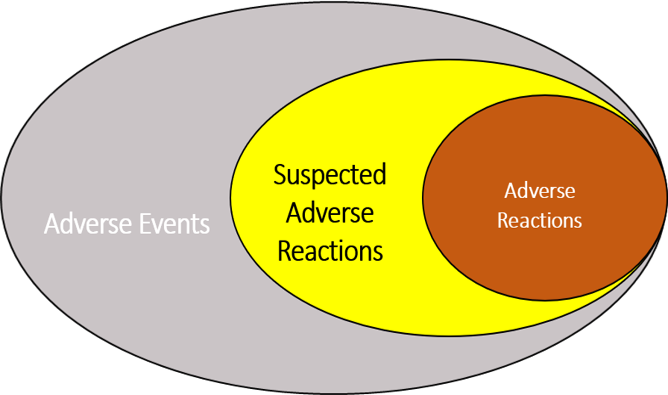
Figure: Relationship between adverse events, suspected adverse reactions and adverse reactions
The table below highlights the difference between an ADR and an AE.
Table: Difference between an adverse drug reaction and an adverse event
ADVERSE DRUG REACTION (ADR)
ADVERSE EVENT
World Health Organization (WHO) defines an ADR as “Any response to a drug which is noxious, unintended and occurs at doses used in man for prophylaxis, diagnosis or therapy.” i.e it necessarily has a causal relationship.
Any untoward medical occurrence during treatment, which does not necessarily have a causal relationship with this treatment.
Resources
- Guidelines for Programmatic Management of Drug-resistant Tuberculosis in India, March 2021.
- Ready Reckoner for Medical Officer - Adverse Drug Reactions Associated with Anti-TB Drugs Identification and Management, 2019.
- WHO - A Practical Handbook on the Pharmacovigilance of Medicines Used in the Treatment of Tuberculosis, 2012.
- Technical and Operational Guidelines for TB in India, 2016.
Kindly provide your valuable feedback on the page to the link provided HERE
Classification of Adverse Drug Events
ContentAdverse Drug Events are classified on the basis of severity:
1. Serious Adverse Event (SAE) is any untoward medical occurrence that at any dose:
- Results in death
- Is life-threatening (subject was at risk of death at the time of the event. It does not refer to an event that hypothetically might have caused death if it is more severe)
- Requires inpatient hospitalization or prolongation of existing hospitalization
- Results in persistent or significant disability/incapacity
- Results in a congenital anomaly/birth defect
- Results in suspected transmission of any infectious agent via the medicinal product
- Is medically important
2. Non-serious Adverse Drug Reaction (ADR) Associated with the Use of Drugs: Any adverse drug reaction that does not meet the above criteria to be a serious AE and is considered associated with the use of the drug .
4. Life-threatening: Any event in which the patient was at risk of death at the time of the event; but does not refer to an event, which hypothetically might have caused death if it were more severe.
5. Associated with Use of the Drug: An adverse event is considered associated with use of the drug if the attribution is possible, probable or very likely.
Resources
- Guidelines for Programmatic Management of Drug Resistant Tuberculosis in India, March 2021
- Ready Reckoner for Medical Officer - Adverse Drug Reactions Associated with Anti-TB Drugs Identification and Management, 2019
- WHO - A Practical Handbook on the Pharmacovigilance of Medicines Used in the Treatment of Tuberculosis, 2012
- Technical and Operational Guidelines for TB in India, 2016
Kindly provide your valuable feedback on the page to the link provided HERE
Types of ADR of TB Treatment
ContentAdverse Drug Reactions(ADR) are classified into serious and non-serious ADR depending upon the intensity of symptoms experienced by the patient. Below is the brief overview
Common ADRs
Non-serious ADR
Serious ADR
(Refer to the nearest health facility)
Nausea and Vomiting
Symptoms of dehydration like thirst, dizziness, tiredness, dry mouth and eyes
- Extreme vomiting,
- Signs and symptoms of severe dehydration
- Blood in vomit
- Electrolyte imbalance and
- Altered level of consciousness
Gastritis and Pain in abdomen
- Occasional Discomfort
- Sour taste in mouth with acid reflux
- Burning sensation in upper abdominal region
- Severe pain in abdomen
- Acidity, Burping, Flatulence, Vomiting
- Blood in vomit
- Electrolyte imbalance and
- Altered level of consciousness.
Diarrhoea
2-3 /3-10 loose liquid stools with signs and symptoms of dehydration.
- More than 10 watery stools
- Signs and symptoms of dehydration
- Blood in stool
- Fever
- Intense abdominal pain
- Electrolyte imbalance and
- Altered level of consciousness
Tingling, Burning, Numbness in hands and feet
- Mild numbness and weakness in hands and feet.
- Prickling, stabbing, burning or tingling along with gradual increase in severity of numbness and weakness.
- Signs and symptoms of moderate neuropathy
- Extreme sensitivity to touch,
- Lack of coordination and balance
- Muscle Weakness
- Poor control of bowel and bladder
Pain in Joints
- Pain on touching joints
- Pain on walking, swelling and redness
- Warmth in and around joints
- Stiffness and signs of increased tenderness
- Severe weakness and restricted joint movement
Skin rashes, itchiness, and allergic reactions
•Itching and skin rashes with tingling and burning sensations
- Itching with increased size and raised wheels
- Swelling of lips and tongue
- Severe allergic reactions /Serious disorder of the skin with painful rashes /Shredding of skin.
Management of Adverse Drug Reactions(ADRs) of TB Treatment
Content- Counsel and reassure the patient as the common occurring adverse effects usually resolve with time.
- Advise the patient to take all the drugs together.
- Advise patient to take light meal (biscuits, bread, rice etc.) before taking drugs.
- Inform patients that they may take drugs embedded in banana or at the bedtime to reduce their associated side effects.
- Encourage patients to keep themselves hydrated by increasing fluid intake.
- Provide ORS (Oral Rehydration Solution) to counter dehydration due to loose motion and vomiting.
Figure: Referral to PHI for ADR
Resources:
Kindly provide your valuable feedback on the page to the link provided HERE
Follow up sputum examination
ContentFollow-up Sputum Examination is useful for the clinical follow-up which helps in assessing the response to treatment, and to establish cure or failure at the end of treatment.
Significance:
The most important tool in the diagnosis of tuberculosis is direct microscopic examination of appropriately stained sputum specimens for acid-fast bacilli (AFB). The technique is simple and inexpensive, and used in the detection of tuberculosis. Sputum microscopy is also useful for the clinical follow up which helps in assessing the response to treatment, and to establish cure or failure at the end of treatment.
Schedule
In case of Drug-sensitive Tuberculosis (DS-TB), the follow-up is done at the end of Intensive Phase (IP) and at the end of Continuation Phase (CP).
In case of Drug-resistant Tuberculosis (DR-TB), the follow up schedule is different for all the three regimen described below:
Isoniazid (H) mono/ poly DR-TB regimen
- Monthly from month 3 onwards, till the end of treatment
- Conduct sputum microscopy within 7 days, if the smear at month 4 or later is positive to rapidly ascertain bacteriological conversion/ reversion.
Shorter oral Bedaquiline-containing Multidrug-Resistant (MDR)/ Rifampicin-Resistant (RR)-TB regimen
- Monthly from 3rd month onwards, till end of IP
- Monthly in extended IP, only if previous month S+ve
- Conduct sputum microscopy within 7 days, if the smear at 6 months is positive to rapidly ascertain bacteriological conversion/ reversion.
Longer oral M/ XDR-TB regimen
- With culture at Culture and Drug Susceptibility (C&DST) lab
- Conduct sputum microscopy within 7 days if any smear at 6 month or later is positive to rapidly ascertain bacteriological conversion/ reversion.
After completion of treatment, the patients should be followed-up at the end of 6, 12, 18 & 24 months for detecting recurrence of TB at the earliest. In presence of any clinical symptoms and/or cough, sputum microscopy and/or culture should be considered. This is important in detecting recurrence of TB at the earliest.
Implications
The sputum follow-up examination is a quick and reliable method which helps in monitoring the progress of the treatment and gives an early indication of any recurrence.
ResourcesAssessment
TB Treatment Card
ContentThe Tuberculosis Treatment Card is a paper-based recording form that is kept in the institution treating the TB patient under the National TB Elimination Programme (NTEP). It is a pre-requisite documentation related to treatment services offered to TB patients under NTEP.
Uses of the TB Treatment Card
The TB treatment card is primarily used for:
- Documenting administered drugs with their dosages
- Documenting follow-up investigation results
- Monitoring adherence to treatment
- Recording adverse events
- Recording treatment outcomes
There are two pages in the TB treatment card and details in each page is delineated in the table below.
Table: Parts of the Treatment Card; Source: NTEP Training Module 2 for Programme Managers & Medical Officers, p. 105
PAGE
DETAILS CONTAINED IN PAGE
The First Page
Patient details such as name, age, sex and address of the patient
Type of disease History of anti-TB treatment Regimen prescribed and duration of treatment Results of investigation before and during treatment Comorbidity-related information Contact tracing and chemoprophylaxis details Social habits such as tobacco and alcohol use The Back Page
Details of intensive and continuation phases of treatment including drug details and adherence monitoring
Retrieval actions for missing doses Adverse events Post treatment follow-up, nutritional support details and remarks Treatment outcome Important Points to Note
- The TB treatment card is filled at the Peripheral Health Institution (PHI) when a patient is initiated on treatment.
- The original TB treatment card is kept at the PHI and updated fortnightly.
- A duplicate treatment card is to be given to the treatment supporter for documentation of daily events.
- The treatment supporter should be trained on how to record the treatment card.
- Details on the patient’s HIV status are not included in the treatment supporter’s copy to maintain confidentiality.
The figure below shows the 1st page of the TB treatment card. Click here to access the full form in the NTEP Training Modules 1-4 for Programme Managers & Medical Officers, p. 223.
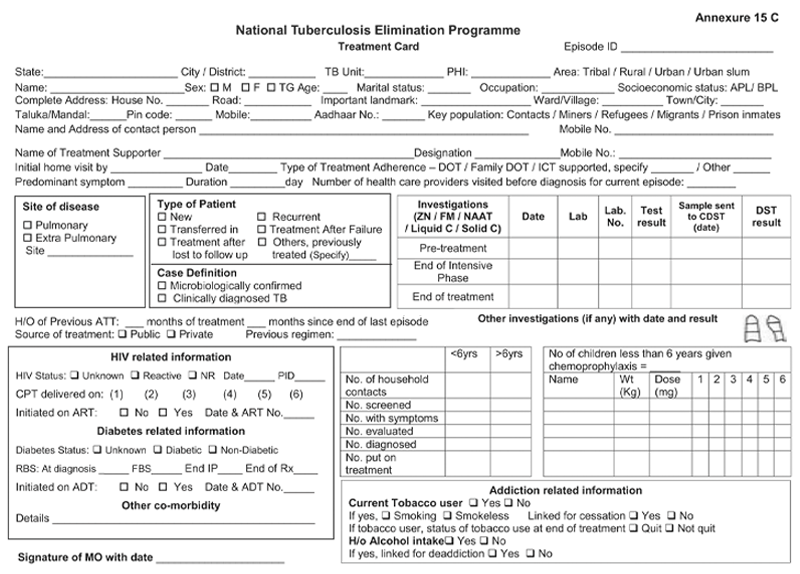
Figure: First Page of the TB Treatment Card; Source: NTEP Training Modules 1-4 for Programme Managers & Medical Officers, p. 223
Resources
Kindly provide your valuable feedback on the page to the link provided HERE
NTEP TB ID Card
ContentIn the National TB Elimination Programme (NTEP), the ‘NTEP TB identity card’ is provided for their identification and record of clinical follow-ups.
The identity card is completed for each patient who has a Tuberculosis (TB) Treatment Card, and it is kept with the patient. Information from the TB Treatment Card is used to complete the identity card.
There are 3 parts in the NTEP TB identity card and details in each part is delineated in Table 1.
Table 1: Parts of the NTEP TB identity card; Source: NTEP Training Module 2 for Programme Managers & Medical Officers, p. 105
PART
DETAILS CONTAINED IN THE SECTION
The First and Second Part
Patient information
Name and address of the TB unit/ district
Treatment details of the patient including:
- Disease classification
- Type of patient
- Treatment provider
- Case definition
- Weight bands
- Dosage
- Sputum results
- Culture results
- Results of follow-up smear examinations
- Results of follow-up cultures
- Information on the date of treatment initiation
- Treatment outcome
The Back Part
Appointment dates for visits to NTEP facilities
Contact details of NTEP staff in case of side events/queries
The information contained in this card will help to continue treatment in case the patient is transferred or admitted to any other health facility any time during the treatment period. The TB identity card is shown in Figure 1.
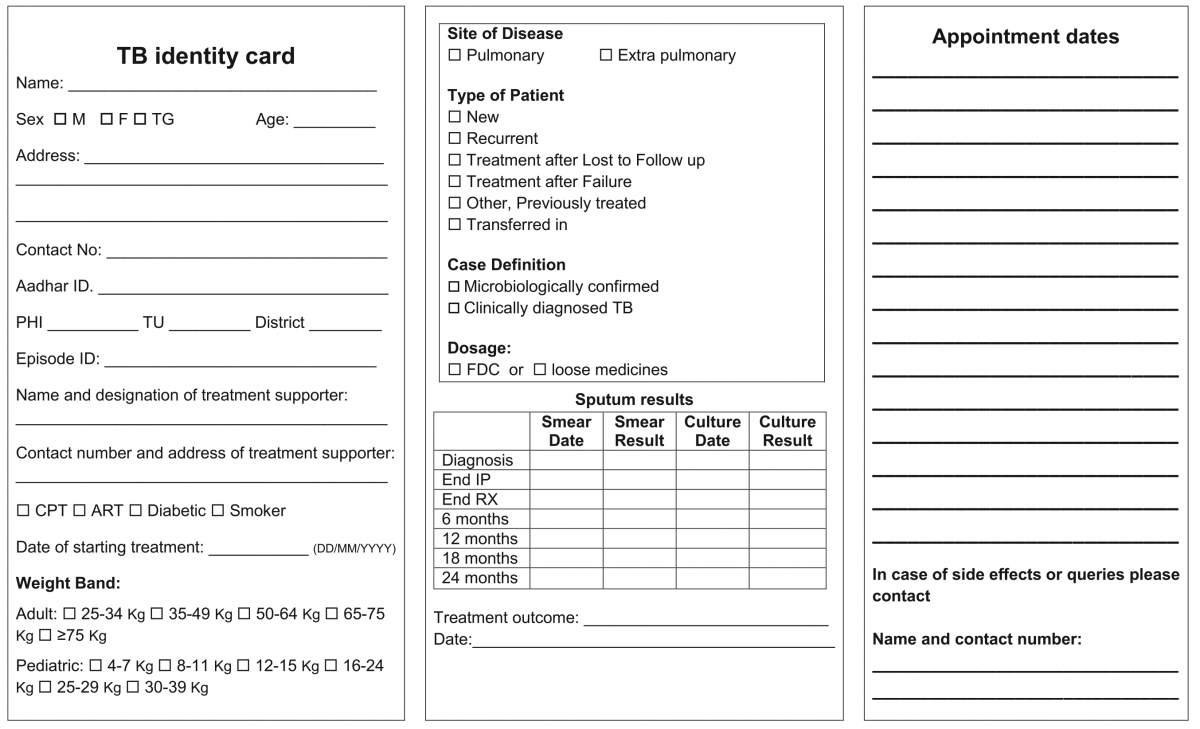
Figure 1: NTEP TB Identity Card; Source: NTEP Training Modules 1-4 for Programme Managers & Medical Officers, 2020

Figure 2: Sample of a patient’s TB identity card


Resources
Kindly provide your valuable feedback on the page to the link provided HERE
PMDT Treatment Book
ContentThe Programmatic Management of Drug-resistant Tuberculosis (PMDT) treatment book is a document that is issued to all patients who are diagnosed with DR-TB and are placed on a regimen for DR-TB. It is given in annexure 31 under the PMDT guidelines 2021.
The PMDT treatment book is to be kept with the patient and should be brought along whenever s/he comes to Drug-resistant TB Centre (DR-TBC) or District TB Centre (DTC) or Health Facility (HF) for clinical follow-up or for Adverse Drug Reaction (ADR) management and should be filled out by the healthcare provider.
The PMDT treatment book contains the following sections:
- Details about the patient, treatment supporter, TB unit from where the patient is availing treatment
- Reason for testing, previous TB treatment history, type of TB, current TB treatment regimen with the date of diagnosis and treatment initiation
- Information on an initial home visit, Drug Susceptibility Test (DST) results for different anti-TB drugs, contact investigation, DR-TB committee meetings
- Information about weight and height of the patient, different weight bands for DR-TB regimen, different types of anti-TB drugs prescribed to patients and their dosages, eligibility and consent of patient if a new drug has been prescribed
- Information on investigations, follow-up results, details about monthly administration of drugs with the weight of patient for the full duration of treatment
- Information on retrieval action taken for a patient who has missed doses, any ADR reported and their management
- Detailed clinical notes written by the treating physician during each visit
- Information about treatment outcome and post-treatment periodic follow-up
- General information about the TB disease, mode of transmission, treatment, drugs in the regimen, side effects of drugs, and a few important do’s and don’ts for the patient.
Image Image
Image Image
Image Image
Image Image
Image
Figure: PMDT Treatment Book; Source: Guidelines on Programmatic Management of Drug-resistant TB (PMDT) in India, 2021, CTD, MoHFW, India.
Resources
- Guidelines on Programmatic Management of Drug-resistant TB (PMDT) in India, CTD, MoHFW, India, 2021.
- Guidelines on Programmatic Management of Drug-resistant TB (PMDT) in India, CTD, MoHFW, India, 2017.
Assessment
Question Answer 1 Answer 2 Answer 3 Answer 4 Correct answer Correct explanation Page id Part of Pre-test Part of Post-test When is the PMDT treatment book issued to a patient? When a patient is diagnosed with DR-TB When a patient is transferred out When a patient is lost to follow-up When a patient has completed treatment 1 The Programmatic Management of Drug-resistant Tuberculosis (PMDT) treatment book is a document that is issued to all patients who are diagnosed with DR-TB and are placed on a regimen for DR-TB. Yes Yes DRTB Treatment Register
ContentThis is a line list of confirmed DRTB cases on treatment based on current health facilities.
Description: This register gives details about the tests and final interpretation based on the treatment start date and notification date:
- Health Facility ( Diagnosing & current facility details, ie.. State/District/ TU/PHI).
- Date of diagnosis and basis of diagnosis.
- Date of TB treatment initiation and regimen type.
- CBNAAT and Truenat Details - CBNAAT MTB Result, Rif Resistance, final interpretation and date reported.
- F line LPA and S line LPA Final interpretation.
Video fileVideo: DRTB Treatment Register
Transfer of TB Patient
ContentTB patients may not stay in one place throughout the treatment duration. When they move from one place to other, there should be a mechanism to hand over the responsibility of continuing the patient's treatment in a facility near the new place of the patient. This is the concept of patient transfer and can be easily managed in Nikshay portal.
- The transfer module in Nikshay enables transfer requests of patients between Health Facilities (HFs) across the country.
- Provision of shifting of patient from one HF to another is possible if the patient changes his/her residence for the purpose of treatment.
- The requests are of two types: “Transfer In” and “Transfer Out”.
- All transfer requests needs to be accepted by the “District/ TB Unit (TU)/ Peripheral Health Institute (PHI)” where the transfer request is made in order for it to take effect.
- Transfer requests can be made to even the District/ TU level. However, it can be completed only once the “Transferred to PHI” has been assigned.

Figure: Transfer Management in Nikshay; Source: Nikshay Zendesk, Nikshay Knowledge Base, Advanced Transfer in Web.
Steps in Transfer of TB Patient
1. In Nikshay, the referring HF updates details from the current HF of patient to the HF where patient is being transferred.
2. The receiving HF gets the intimation about the transfer.
The patient transfer module also provides the provision to pull the patient belonging to another HF to the recipient HF. The accountability of the transferred patients is now with the receiving HF and the treatment initiating facility.
A separate transfer register is also available to get details about various transfers from and to a given district, which can be downloaded from Nikshay reports.
Resources
- Nikshay Zendesk, Nikshay Knowledge Base, Advanced Transfer in Web.
- Guidelines for PMDT in India, 2021.
Assessment
Question
Answer 1
Answer 2
Answer 3
Answer 4
Correct answer
Correct explanation
Page id
Part of Pre-test
Part of Post-test
Transfer requests include "Transfer In" and "Transfer Out".
True
False
1
Transfer requests include "Transfer In" and "Transfer Out".
Yes
Yes
Treatment Support Plan
ContentIn order to achieve TB treatment success, a good treatment support plan for the patients is essential. The National TB Elimination Programme (NTEP) recommends developing a treatment support plan for each patient at the time of treatment initiation. A holistic Treatment Support Plan (TSP) must include the following:
1) Treatment Supporter (TS) for each patient
- A Treatment Supporter (TS) who is acceptable and accessible to the patient and accountable to the health system (healthcare worker/ community volunteer/ private practitioner/ family member) identified in mutual consultation with the patient and provider during pre-treatment evaluation.
- The assigned TS should be able to receive training on drug administration, adherence monitoring, Adverse Drug Reaction (ADR) referrals etc., and perform these functions.
2) Periodic review of patient’s treatment
- Treatment Initiation counselling and monthly or need-based (in high TB burden areas) follow-up counselling to all TB patients and their family members must be included through staff who have expertise in the same, to address both bio-medical and psycho-social issues that could impact treatment.
- The TSP must also include a protocol for the field monitoring staff to capture each instance of treatment interruption and Adverse Drug Reactions, so that they can be effectively addressed before the patient turns lost to follow-up.
3) Psychosocial Support to TB patients and their families
- Counselling to the patients experiencing stigma, discrimination, marital/family discords, substance users etc. by the trained staff, and appropriate referrals for psychiatric ,de-addiction support etc. should be offered whenever required.
- The focus should be on observing, identifying and capturing above mentioned factors during treatment initiation as well as in each follow up visit.
- Home visit follow ups with consent from the patients must also be included in the TSP which may allow for better understanding and management of psycho-social issues.
- As an extension of TSP, community engagement activities which includes key persons such as politicians, religious leaders, self-help groups, TB champions etc by the TB staff is recommended to raise awareness and sensitise the communities about TB and also articulate a whole-of-society approach to ending TB.
4) Referral linkages for needy TB patients - to central and state government’s various social welfare and protection schemes and additional nutrition support services
- With the aim to eliminate catastrophic expenditure due to TB, the Government of India (GoI) has insisted on linking TB patients and households to the applicable government social welfare and protection schemes.
- The treatment supporters and the health systems staff who are in regular contact with the patients (Senior Treatment Supervisors, TB Health Visitors, District Programme Supervisors) should be trained in referral linkages so as to enable further support to the patients and their family members to avail the benefits under schemes.
- The GoI has rolled out a Direct Beneficiary Transfer (DBT) mechanism to support TB patients' nutrition (Ni-kshay Poshan Yojana) and travel during treatment whereas several state governments have also initiated certain state-specific schemes for TB patients across the country.
- Further as a part of patients treatment support, the GoI has initiated the ‘Nikshay Mitra’ campaign under the ‘Pradhan Mantri TB Mukth Bharat Abhiyan’ where in persons/companies/societies can adopt an entire block/ward to provide nutrition support to TB patients for a specific treatment period.
5) Treatment Completion Counselling
The TSP must include an end of treatment counselling for all patients, on the importance of post treatment follow ups and holistic self-care approach for leading an overall healthy life and also the ability to focus on life after TB treatment completion.
Resource- Training Modules (1-4) for Programme Managers & Medical Officers, NTEP, 2020.
- National Strategic Plan for Tuberculosis Elimination 2017-2025, RNTCP, 2017.
- Pradhan Mantri TB Mukt Bharat Abhiyaan - Guidance Document, CTD, India, 2022.
Assessment
Question Answer 1 Answer 2 Answer3 Answer 4 Correct Answer Correct explanation Only health workers can become treatment supporters for a TB patient. True False 2 Factors like acceptability, accessibility to the patient, and accountability to the health are taken into consideration when a treatment supporter is identified, and family members can also be treatment supporters and provided training by a health worker. Referral linkages for needy TB patients - to central and state government’s various social welfare and protection schemes and additional nutrition support services is part of holistic Treatment Support Plan (TSP)
True False 1 With the aim to eliminate catastrophic expenditure due to TB, the Government of India (GoI) has insisted on linking TB patients and households to the applicable government social welfare and protection schemes. Management of EPTB
ContentThe management principles of Extrapulmonary Tuberculosis (EPTB) are shown in the figure below.

Figure: Ten principles about what every EPTB patient in India needs as a basic standard of care
Abbr: CBNAAT:Cartridge-based Nucleic Acid AMplification Test; PTB: Pulmonary TB; NTEP: National TB Elimination Programme
Diagnosis of EP-TB
- All efforts need to be made to get a microbiological confirmation whenever a sample is available.
- Clinical diagnosis can be made by treating physician based on the clinical features, lab investigations, imaging studies and by ruling out other causes
Treatment Regimen and Duration for EPTB
The treatment regimen and schedule for EPTB cases will remain the same as for pulmonary TB (2HRZE/ 4HRE). However, the duration of the continuation phase in EPTB may be extended in special situations such as TB Meningitis, bone and spine TB etc.
Role of Surgery in EPTB Cases
- Surgery is sometimes required for the diagnosis of EPTB. It is reserved for management of late complications of the disease.
Monitoring Treatment Response
- Response to treatment in EPTB may be best assessed clinically. Clinical follow-up is the most important criterion for the follow-up of EPTB patients. The clinician can assess the patient’s condition by checking weight gain and a decrease/ increase in presenting clinical symptoms.
- Investigations such as Acid-fast Bacilli (AFB) microscopy, chest X-ray, liver function tests, serum creatinine, and USG-abdomen can be used to monitor the treatment status.
The treatment support and other monitoring activities remain the same as for pulmonary TB.
Resources
- Training Modules (1-4) for Programme Managers and Medical Officers, 2020.
- Index TB Guidelines on Extra-pulmonary Tuberculosis for India, Central TB Division, 2016.
Assessment
Question
Answer 1
Answer 2
Answer 3
Answer 4
Correct answer
Correct explanation
Page id
Part of Pre-test
Part of Post-test
What is the standard treatment duration for most EPTB cases?
2 weeks
1 month
6 months
3 years
3
The treatment regimen and schedule for EPTB cases will remain the same as for pulmonary TB (2HRZE/ 4HRE).
Yes Yes In which cases can the treatment duration exceed 6 months in EPTB?
TB meningitis
TB of the bone and joint
Depending on the clinician’s decision
All of the above
4
EPTB treatment duration can be extended beyond 6 months in TB meningitis, TB of bone and joint (including TB otitis media), and if recommended by the clinician.
Yes
Yes
Management of Patients with Treatment Interruptions
ContentTreatment interruption is defined as a patient-initiated episode in which the patient discontinues TB treatment. All efforts must be made to ensure that TB patients do not interrupt treatment or are not lost to follow-up. Action should be taken to promptly retrieve patients who fail to come for their daily dose by the treatment supporter
The management of treatment interruptions is made based on the following criteria:
i. Type of case: Whether new, relapse or failure
ii. Duration of treatment taken: Less than one month/ more than one month. This helps in assessing the risk of the presence of drug resistance.
iii. Duration of Interruption: Less than one month/ more than a month.
If treatment interruption is more than one month, the outcome is declared as ‘lost to follow up’.
If a patient returns to the health facility after interrupting treatment for more than one month, the patient sample needs to be subjected to Drug Susceptibility Testing (DST) to determine resistance/ sensitivity status to anti-TB drugs.
In case the interruption is for less than one month, the same treatment regimen is completed to complete all doses.
Modes of Retrieval
TB treatment is supervised by a trained treatment supporter (a health worker, family member or community volunteer). The residential address is verified for all TB patients by home visits. However, in case of treatment interruption, patient retrieval action is required.
Retrieval can be done by the following modes:
1. Retrieval of patients interrupting treatment within 24 hours of discontinuation is done by the Treatment Supporter (TS) or Accredited Social Health Activist (ASHA)/ Auxilliary Nurse Midwife (ANM)/ Multipurpose Worker (MPW). The reason for interruptions should be reviewed carefully and efforts made to counsel and bring the patient back for treatment.
2. If the TS is not successful in retrieving such patients, it should be reported to the next higher level of supervisors, like Senior Treatment Supervisor (STS), and they should take all efforts to counsel and retrieve the patient.
3. If the patient interrupts treatment on more than one occasion, the Medical Officer of the Peripheral Health Institute (MO-PHI) should visit the patient’s home. The MO-PHI should give intensive counselling to the patient and may provide additional support to continue the treatment without interruption.
4. Innovative use of information and communication technologies for treatment adherence monitoring through 99 DOTS, Medication Event Reminder Monitor (MERM), etc. are also beneficial in finding missed doses and initiating retrieval action by the health staff.
Resources
1. Training Modules (1-4) for Programme Managers and Medical Officers.
2. Guidelines for PMDT in India, 2021.
Assessment
Question Answer 1 Answer 2 Answer 3 Answer 4 Correct answer Correct explanation Page id Part of Pre-test Part of Post-test If treatment interruption is more than one month, the outcome is declared as ‘lost to follow-up'. True False 1 If treatment interruption is more than one month, the outcome is declared as ‘lost to follow-up'. Yes Yes Management of TB in special situations
ContentThe treatment for TB is demanding in terms of duration of treatment, adverse drug reactions, the requirement of prolonged adherence by patients and catastrophic expenditures. The presence of a special condition added on by a TB diagnosis makes it even more challenging.
To improve the outcomes for such challenging situations, the programme recommends certain modifications in the regimen, which are listed in the table below.
Table: Management of TB in Special Situations
Pregnancy and lactation Pregnant women with TB should be jointly managed by an obstetrician/ gynaecologist and pulmonologist/ physician. The shorter oral Bedaquiline-containing Multidrug-resistant (MDR)/Rifampicin-resistant (RR)-TB regimen should not be administered in pregnant women before 32 weeks due to Ethionamide (Eto) led to potential teratogenicity in first trimester and risk of hypothyroidism in the infant in second trimester. Beyond 32 weeks, the choice of regimen needs to be a consultative decision between the obstetrician and physician at the Nodal/District Drug-resistant TB Centre (N/DDR-TBC). In pregnant women diagnosed with DR-TB, if the duration of pregnancy is <20 weeks*, the patient should be advised to opt for Medical Termination of Pregnancy (MTP) in view of the potential severe risk to both mother and foetus. Bedaquiline (Bdq) and Delamanid (Dlm) both should not be recommended during the lactating period unless the mother is willing to replace breastfeeding with formula feed. Breastfeeding must be continued and after ruling out active TB, the baby should be given 6 months of isoniazid preventive therapy, The mother should be advised about cough hygiene measures such as covering the nose and mouth while coughing, sneezing or any act which can produce sputum droplets. Mothers receiving INH and their breastfed infants should be supplemented with vitamin B6 (pyridoxine), recommended dose of Pyridoxine in infants is 5 mg/day and for mother is 10mg/day. Renal impairment In the presence of mild to moderate renal impairment dosage of Ethambutol (E) and Levofloxacin (Lfx) should be adjusted. In the presence of severe renal impairment, Lfx can be replaced with a normal dose of Moxifloxacin (Mfx) (200/400 mg based on the patients’ weight). In case of patients undergoing dialysis, medicine should be given either 4-6 hours before dialysis or immediately after dialysis Pre-existing liver disease MDR/ RR-TB patients having deranged Liver Function Test (LFT) during pre-treatment evaluation should be strictly monitored as clinically indicated while on treatment. In patients with pre-existing liver disease with persistently abnormal liver function tests, a shorter oral MDR/ RR-TB regimen should be avoided due to presence of High-dose Isoniazid (H(h)), Eto and Pyrazinamide (Z). If the serum alanine aminotransferase level is more than 3 times normal before the initiation of treatment, the following regimens should be considered: –
- Containing two hepatotoxic drugs:
- 9 months of isoniazid and rifampicin, plus ethambutol (until or unless isoniazid susceptibility is documented) - 9HRE
- 2 months of isoniazid, rifampicin, streptomycin and ethambutol, followed by 7 months of isoniazid and rifampicin-2SHR/ 7HR
- 6–9 months of rifampicin, pyrazinamide and ethambutol-(6-9 RZE)
- Containing one hepatotoxic drug: 2 months of isoniazid, ethambutol and streptomycin, followed by 10 months of isoniazid and ethambutol (2SHE/10 HE)
- Containing no hepatotoxic drugs: 18–24 months of streptomycin, ethambutol and fluoroquinolone. (18-24 SLE)
Seizure disorders Patients should be evaluated to check if seizures are under control and verify if the patient is taking anti-seizure medication. Since Eto, Fluoroquinolones (FQ), and high dose Isoniazid are associated with seizures they should be used carefully/ avoided amongst MDR/RR-TB patients with a history of seizures. Though the seizure is not common with Bdq, it should also be considered while assessing the causality assessment. The prophylactic use of oral pyridoxine (vitamin B6) up to 5-25 mg/day can be used in patients with seizure disorders to protect against the neurological adverse effects of isoniazid or cycloserine. Serum levels of anti-epileptic drugs should be monitored closely to identify any drug interactions. Management of Adverse Drug Reactions (ADRs) in Special Situations
- The actual management of ADR begins during the treatment initiation counselling, where the patient should be instructed in detail about potential adverse effects due to the prescribed drug regimen and when they occur, to notify a healthcare provider.
- Treatment Supporter (TS) should be trained to closely monitor the patient for any signs of ADR (especially, since drug-drug interaction could happen) daily so that they can be recognized and managed quickly.
- The TS should also be trained to identify ADR as major and minor.
- A symptom-based approach should be followed to manage minor ADR where the patient is usually able to tolerate anti-TB drugs and continue medication with symptomatic treatment. Appropriate referrals should be made for all major ADRs that may require hospitalization of the patient.
- If the adverse effect is mild and not serious the treatment regimen must be continued with the help of ancillary drugs, if needed.
- For most second-line drugs related ADR, reducing the dosage/ terminating the offending drug can be considered and should be decided by the Nodal/District Drug-resistant TB Centre (N/DD- TBC) committee.
- Psychosocial support, patient education and motivation through TS and other patient support groups are also effective ways to manage the ADRs.
Resources
- Guidelines on Programmatic Management of Drug Resistant TB (PMDT) in India, CTD, MoHFW, India, 2021.
- Training Modules (1-4) for Programme Managers and Medical Officers, CTD, MoHFW, India.
Assessment
Question Answer 1 Answer 2 Answer 3 Answer 4 Correct answer Correct explanation Page id Part of Pre-test Part of Post-test The shorter oral Bdq-containing regimen should not be administered to pregnant women until how many weeks? 20 22 30 32 4 The shorter oral Bedaquiline-containing MDR/RR-TB regimen should not be administered in pregnant women before 32 weeks as it can cause Ethionamide (Eto)-led potential teratogenicity in the first trimester and risk of hypothyroidism in infants in the second trimester. Yes Yes Death Audit
ContentA death review or mortality audit is a means of documenting the causes of death and the factors that contributed to it, identifying factors that could be modified and actions that could prevent future deaths, putting the actions into place and reviewing the outcomes.
The aims of the audit or review of deaths in hospitals and health services are to:
- Ensure that all deaths are identified and discussed, and confidentiality is maintained.
- Assign a cause or causes to each death.
- Determine whether the care given was consistent with evidence-based clinical practice, standards of care or the care desired by professionals.
- Determine the social, environmental and nutritional risk factors for any death.
- Determine possible modifiable factors in the care of each person who dies.
- Change modifiable factors to improve the quality of care and avoid similar deaths in the future.
- Improve the quality and completeness of patient documentation.
- Provide an opportunity for reflection and support to HCWs.
- Let families know that their relative’s life was valued, the death is being taken seriously and HCWs are committed to learning and improving their practice.
Under the National TB Elimination Programme (NTEP), death audits provide insights into the chain of social, economic and clinical events leading to TB deaths and guide the programme in taking appropriate actions to prevent them.
Process for Undertaking Death Audits
An overview of the process for undertaking a TB death audit is shown in the figure below. Under NTEP, the following stakeholders are involved in the process:
- The medical officer should conduct an in-depth audit of all the deaths occurring amongst TB patients irrespective of initiation of treatment.
- Similarly, the District TB Officer (DTO) should conduct the death review of all Multidrug-resistant TB (MDR-TB) patients who died.

Figure: Overview of the process for undertaking a TB death audit
Resources
- Training Modules (1-4) for Programme Managers and Medical Officers, 2020.
- A Guide to Conducting TB Patient Mortality Audits using a Patient-centered Approach, KNCV, USAID and MSH, 2012.
- Operational Guide for Facility-based Audit and Review of Paediatric Mortality, WHO, 2018.
Assessment
Question
Answer 1
Answer 2
Answer 3
Answer 4
Correct answer
Correct explanation
Page id
Part of Pre-test
Part of Post-test
Which of the following is true about death audits?
A death audit is a means of documenting the causes of death and the factors that contributed to it.
It helps in identifying factors that could be modified and actions that could prevent future deaths.
It can be conducted via a community-based death review
All of the above
4
A death review or mortality audit is a means of documenting the causes of death and the factors that contributed to it, identifying factors that could be modified and actions that could prevent future deaths, putting the actions into place and reviewing the outcomes. It is conducted via two main methods: Community-based Death Review and Facility-based Mortality Audit.
Yes Yes Which of the following stakeholders are responsible for conducting death reviews under NTEP?
Treatment supporters
Medical officers
State TB officers
None of the above
2
The medical officer should conduct an in-depth audit of all the deaths occurring amongst TB patients irrespective of initiation of treatment.
Yes
Yes
-
DR-TB HIV Coordinator: TB and Comorbidities
FullscreenComorbidity & special situation with TB
ContentSeveral medical conditions are risk factors for TB and poor TB treatment outcomes. Similarly, TB can complicate the course of some diseases. Therefore, it is important to identify these comorbidities in people diagnosed with TB to ensure early diagnosis and improved outcomes. When these conditions are highly prevalent in the general population, they can significantly contribute to the TB burden. Consequently, reducing the prevalence of these conditions can help prevent TB.
TB shares underlying social determinants with many of these conditions. Addressing the social determinants of health is a shared responsibility across disease programmes and other stakeholders within and beyond the health sector.
Figure: Various comorbid and special situation related with tuberculosis
Pregnancy and Lactation in TB Patients
ContentThe presence of tuberculosis disease during pregnancy, delivery, and postpartum is known to result in unfavourable outcomes for both pregnant women and their infants. These outcomes include a roughly two-fold increased risk of preterm birth, low birth weight, intrauterine growth restriction, and a six-fold increase in perinatal death.
Screen TB patients in Pregnancy & Lactating Patients
Figure: Screening Steps in special situation - Pregnancy and Lactating TB Patients
Treatment for TB - Pregnant & Lactating Patients
- Cases of pregnant/lactating women with active TB should be referred to the nearest health facility of NTEP for further management.
- They should be continued on iron and folic acid and other vitamins and minerals to complement their maternal micronutrient needs.
- In situations when calcium intake is low, calcium supplementation is recommended as part of antenatal care.
Diabetes in TB Patients
ContentAs a consequence of urbanization as well as social and economic development, there has been a rapidly growing epidemic of Diabetes Mellitus(DM). India has the second largest number of diabetic people in the world.
Screen TB patients for symptoms of diabetes
Figure: Screening steps for TB - Diabetic Patients
Treatment for TB Diabetes Patients
- All TB patients who have been diagnosed and registered under NTEP will be referred for screening for Diabetes.
- Referral of TB patients for screening for DM and its recording & reporting is the responsibility of the Peripheral Health Institutions(PHI) where TB treatment is initiated.
- TB patients diagnosed with diabetes will receive the same duration of TB treatment with daily regimen as non-diabetic TB patients.
- TB patients must be referred to the nearest healthcare facility for management of DM.
- Regular monitoring of blood sugar levels is advised.
Malnutrition in TB Patients
ContentMalnutrition refers to deficiencies, excesses or imbalances in a person’s intake of energy and/or nutrients. The term malnutrition covers 2 broad groups of conditions.
- One is ‘undernutrition’—which includes stunting(low height for age), wasting(low weight for height), underweight(low weight for age) and micronutrient deficiencies or insufficiencies(a lack of important vitamins and minerals).
- The other is overweight, obesity and diet-related non communicable diseases (such as heart disease, stroke, diabetes, and cancer).
Screen TB Malnutrition patients for nutritional needs
Figure: Screening Steps for TB - Malnutrition patients
Treatment for TB Malnutrition Patients
Cases of TB with SAM and moderate undernutrition should be referred to the nearest health facility of NTEP for further management. Special focus should be given to the following categories:
- Children below five years
- School-age children and adolescents(Up to age 18 years)
- Adults, including pregnant and lactating women, with active TB and SAM
Alcoholism in TB Patients
ContentAbout 10% TB deaths globally have been attributed to alcohol as a risk factor(WHO, Global TB Report 2017). Alcohol abuse is associated with threefold increase in risk of contracting tuberculosis.
Side effects of anti TB drugs in this situation might get aggravated.
Figure: Impact of Alcoholism on TB patients
Treatment for Alcoholic TB Patients:
- Patients with TB and a history of alcohol use should be referred to the nearest health facility of NTEP to manage TB and alcoholism.
- While registering as a TB case, the status of alcohol use should be recorded in the patient records. If the TB patient is an alcohol user, he/she should be counselled to quit it. If the patient doesn't quit alcohol, s/he may be referred to the nearest alcohol de-addiction facility.
- The patient should be assessed at every follow-up visit for TB and the status of use of alcohol.
- At the end of treatment, his/her status of alcohol use should be recorded on the treatment card. If the patient has not quit alcohol, he/she should be referred to the nearest alcohol de-addiction facility and Alcohol Anonymous wherever available.
Tobacco in TB Patients
ContentAlmost 38% of TB deaths are associated with the use of tobacco. The prevalence of TB is three times higher among ever-smokers as compared to that of never-smokers. Mortality from TB is three to four times higher among ever-smokers as compared to never-smokers. Smoking contributes to 50% of male deaths in the 25-69 age group from TB in India.
Figure: Impact of Tobacco on TB patients
Treatment for TB - Tobacco Patients:
- While registering as a TB case, the status of tobacco use is recorded on the TB treatment card.
- If the TB patient is a smoker or tobacco user, he/she is counselled to quit tobacco use. The patient is assessed at every visit for follow up for TB and the status of tobacco use.
- At the end of treatment, his/her status of tobacco use is recorded in the treatment card. If the patient has not quit tobacco use, he/she will be referred to the nearest Tobacco Cessation Clinic(TCC) or Quit Line or M-Cessation Initiative.
Silicosis in TB Patients
ContentSilicosis is a progressive and disabling interstitial lung disease caused by inhalation and deposition in the lungs of particles of free silica.
Mutual Risk of TB and Silicosis
- TB is a clinical complication of silicosis, called silico-tuberculosis. Silica-exposed workers with or without silicosis are at increased risk for TB. There is also an increased risk of extrapulmonary TB in individuals exposed to silica.
- The risk of a patient with silicosis developing TB is 2.8 – 3.9 times higher than a healthy individual.
- The risk of TB relapse in patients with silicosis is approximately 1.5 times higher than in patients without silicosis.
The presence of silica particles in the lung and silicosis may:
- Facilitate initiation of TB infection and progression to active TB
- Exacerbate the course and outcome of TB, including prognosis and survival
Diagnosis
The diagnosis of silicosis is made based on a history of exposure to silica accompanied by a clinical and radiological profile consistent with the disease.
Under the Integrated Management Algorithm for TB disease and TB infection released by the National TB Elimination Programme (NTEP), patients with silicosis are first screened according to the four-symptom complex to rule out/in active TB and tested for TB accordingly.
If active TB is ruled out >> Refer for Tuberculin Skin Test (TST)/ Interferon Gamma Release Assay (IGRA) >> Positive test >> Evaluate with Chest X-ray (CXR) >> Commence TB Preventive Therapy (TPT) irrespective of CXR results.
CXR often indicates TB in silicosis patients earlier than the clinical symptoms, and regular radiographic screening is required for early TB detection. Radiographic comparison of serial films is done with particular attention to:
- Rapid appearance of new opacities, symmetric nodules or consolidation and the finding of pleural effusion or excavations.
- Cavitation is the strongest indicator of probable silico-tuberculosis.
Other diagnostic tools that can help in diagnosis are:
- Chest Computed Tomography (CT) scan
- Bronchoscopy with bronchoalveolar lavage in conjunction with transbronchial biopsy
- Spirometry
Treatment and Follow-up
To keep the disease from getting worse, all silicosis patients need to eliminate any more exposure to silica. Supportive measures include the use of cough medicines, bronchodilators, oxygen therapy and pulmonary rehabilitation.
TB treatment in patients with silicosis is challenging, perhaps due to impairment of macrophage function by free silica and/or poor drug penetration into fibrotic nodules. Usual anti-TB drugs with directly observed therapy are recommended but for an extended duration of at least 8 months, to reduce the chances of relapse.
Follow-up of patients with silicosis and TB follow the same schedule as is in prevailing guidelines.
Prevention
TB prevention in silicosis patients is essential and includes:
- Active surveillance of vulnerable groups including workers
- Adoption of measures to reduce exposure to silica dust
- Patients with silicosis are eligible for TPT after ruling out active TB
NTEP is in the process of engaging with the Ministry of Labour and Mining to identify high priority districts with stone crushing units/ mining industry. Specific guidelines will be developed to support persons with an occupational risk for TB and provide access, diagnosis and treatment services from the programme.
Resources
- NTEP at a Glance; Comprehensive Clinical Management Protocol of Tuberculosis, 2022.
- Training Modules (1-4) for Programme Managers and Medical Officers, 2020.
- Silico-tuberculosis, Silicosis and Other Respiratory Morbidities Among Sandstone Mine-workers in Rajasthan - A Cross-sectional Study, Saranya Rajavel et al., 2020.
- Mini-review: Silico-tuberculosis; Massimiliano Lanzafame et al, 2021.
- Immunity to the Dual Threat of Silica Exposure and Mycobacterium tuberculosis, Petr Konečný et al., 2019.
Assessment
Question
Answer 1
Answer 2
Answer 3
Answer 4
Correct answer
Correct explanation
Page id
Part of Pre-test
Part of Post-test
Which of the following statement/s about silicosis and TB is/are incorrect?
TB is a clinical complication of silicosis, called silico-tuberculosis.
Silica-exposed workers with or without silicosis are at increased risk for TB and EPTB.
TB in patients with silicosis is easily diagnosed clinically as the patient coughs up silica particles.
TB treatment in patients with silicosis is often of extended duration to prevent relapse.
3
Clinical diagnosis of active TB superimposed on silicosis is often difficult, particularly in the initial phases, when clinical manifestations may not be indicative and radiological alterations can be indistinguishable from those due to the pre-existing silicosis.
Yes Yes Cancer in TB patients
ContentRelationship between Cancer and Tuberculosis (TB)
TB and malignancy may be related in the following four ways:
- TB as a marker for occult cancer: Occult cancer may lead to locally-reduced infection barriers and/or generalised immunosuppression, rendering a cancer patient susceptible to TB infection/ reactivation.
- TB as a risk factor for cancer: TB may increase the risk of cancer locally and systemically through chronic inflammation, fibrosis and production of carcinogenic molecules.
- Shared risk factors for TB and some cancers: Shared risk factors such as smoking, alcoholism, Chronic Obstructive Pulmonary Disease (COPD) and immunosuppression, including HIV, may lead to both TB and cancer, affecting both prevalent and subsequent cancer risk.
- Treatment of cancer-fueling TB: Many cancers are treated with immunosuppressants or steroids. These drugs might induce immunosuppression in the patients undergoing treatment for cancer and hence, a flare-up of TB.
Mutual Risk of Cancer and TB
- TB patients are 2-11 times more likely than non-TB patients to develop lung cancer, according to studies.
- After cancer diagnosis, the incidence of TB also increases, both in the short term and long-term.
- All types of cancer increase the risk of the development of active TB, but with varying degrees. Haematologic cancer patients had the highest rates of active TB, followed by head and neck cancers, lung cancer and breast cancer patients.
There is intrinsic immunosuppression due to the cancer itself, immunosuppressive effects of chemotherapy, or other host factors (e.g., smoking, malnutrition) that may increase the susceptibility to both cancer and TB. Thus, there is increased incidence of TB in cancer patients, and vice-versa.
Diagnosis of TB in Cancer Patients: Under the Integrated Management Algorithm for TB disease and TB infection released by the National TB Elimination Programme (NTEP), cancer patients are first screened according to the four-symptom complex to rule out/in active TB and all presumptive TB cases need to undergo testing for TB.
Co-existence of TB and cancer poses a diagnostic challenge since clinical and radiological presentations between TB and cancers are similar, hence the need for bidirectional screening. E.g., if biopsy specimens reveal infiltration by malignant cells, still send sample for microbiological confirmation of M. tuberculosis. Thus, allowing for accurate diagnosis and initiation of anti-TB treatment instead of attributing clinical deterioration to chemotherapy complications and progression of underlying malignancy.
Diagnosis of lung cancer in TB patients is usually done in consultation with a clinical specialist and can include examination of induced sputum specimens for malignant cells, as well as use of other diagnostic tools such as Computed Tomography (CT) scans, bronchoscopy, Positron Emission Tomography (PET) scans, Magnetic Resonance Imaging (MRI), histopathology and the use of biological markers.
Treatment
TB treatment in cancer patients uses the standard DS-TB/DR-TB regimens and course, except that the treating physician should assess the drug interactions between anti-TB and anti-cancer drugs. For cancer treatment, drugs may have to be modified to accommodate anti-TB treatment and to aid better prognosis of the TB outcome. However, all decisions must be taken by a competent specialist after examining the individual case.
Curative resection, chemotherapy and radiation therapy are the mainstay treatment options for cancer in TB patients. Co-existence of TB in cancer patients necessitates anti-TB treatment with extended duration, if required. Follow-up during and after treatment also follows prevailing guidelines.
Prevention
Under the NTEP, TB prevention in cancer patients is essential and includes:
- Regular screening for signs and symptoms of TB infection among all patients on immunosuppressive therapy and anti-Tumour Necrosis Factor (TNF) medicines.
- Education and referral of patients who do not have TB symptoms for TB infection testing/assessment of their eligibility for TPT.
Resources
- NTEP at a Glance; Comprehensive Clinical Management Protocol of Tuberculosis, 2022.
- Training Modules (1-4) for Programme Managers and Medical Officers, 2020.
- Tuberculosis and Risk of Cancer: A Danish Nationwide Cohort Study, D. F. Simonsen et al., International Journal of Tuberculosis and Lung Diseases, The Union, 2014.
- Increased Risk of Active Tuberculosis after Cancer Diagnosis, Dennis F. Simonsen et al., Journal of Infection, 2017.
- Pulmonary Tuberculosis as Differential Diagnosis of Lung Cancer; MLB Bhatt et al., South Asian Journal of Cancer, 2012.
Assessment
Question
Answer 1
Answer 2
Answer 3
Answer 4
Correct answer
Correct explanation
Page id
Part of Pre-test
Part of Post-test
Which of the following statement/s about cancer and TB is/are incorrect?
Under NTEP, regular screening for signs and symptoms of TB infection among all patients on immunosuppressive therapy and anti-TNF medicines is done.
TB increases the risk of developing cancer, but cancer patients do not usually get TB.
Sputum smear microscopy is important when diagnosing TB in cancer patients.
All of the above
2
There is mutual risk between cancer and TB. TB increases the risk of developing cancer, and cancer patients are more likely to develop TB.
Yes Yes COVID-19 in TB patients
ContentTuberculosis and COVID-19 are infectious diseases which primarily attack the lungs. They present with similar symptoms of cough, fever and difficulty in breathing, although TB disease has a longer incubation period and a slower onset of disease.
Screen patients for symptoms of TB and COVID-19
Figure: Screening steps for TB - COVID 19 Patients
Management of TB & COVID-19 Patients
People with TB are likely to be at increased risk of COVID-19 infection, illness and death. So, TB patients should take precautions as advised by health authorities to be protected from COVID-19 and continue their TB treatment as prescribed.
Prevention: While both TB and COVID-19 are spread by close contact between people, the exact mode of transmission differs. Thus, the patient should be explained the following measures to control disease spread.
- Apart from that keeping rooms well ventilated, avoiding crowds and Respiratory precautions are thus important in the control of COVID-19 and TB Disease
TB Comorbidity Committee
ContentIn order to ensure screening for comorbidity, appropriate management of comorbidity and periodic clinical review of TB patients a coordination mechanism is essential. Adapting the learnings from the TB-HIV collaborative framework, the National Strategic Plan (NSP) 2017-2025 recommended the setting up of the National TB Comorbidity Coordination Committee to address various comorbidities affecting the TB treatment. Subsequently, the State and District TB comorbidity Coordination Committees (DTCCs) were established.
Terms of Reference (ToR) and Agenda for the TB Comorbidity Committee (TCC)
- To strengthen joint planning, recording, reporting and monitoring, and review activities between National TB Elimination Programme (NTEP) and the other programmes at the national, state and district levels
- To review and adopt policies for strengthening the implementation of joint TB–comorbidity activities
- To suggest strategies for roll-out and scale-up of activities aimed at minimising mortality and morbidity associated with TB and respective comorbidities
- To provide guidance for the implementation of joint TB–comorbidity activities and identify key areas for strengthening
- To support supervision and planning of TB–comorbidity activities, including joint field visits, joint monitoring, joint reviews, etc.
- To facilitate operational research to improve programme implementation and assess the impact of joint TB–comorbidity activities
- To support the development of normative tools and training material for TB and the comorbidities
- To review, optimise and plan for future collaborative activities between NTEP and the other comorbidity programmes
- To develop and share Information, Education, Communication (IEC) prototype with states/ UTs
Operation and Stakeholders of TCCs
TCC
Meeting Frequency
Stakeholders
National
Biannual
Deputy Director General TB (DDG TB, Head) and DDG's of all other comorbidity programmes, Addl. DDG TB and other programmes, World Health Organisation (WHO) representatives from TB and the comorbidity programmes, Representatives from national TB institutes, Experts from academic and research institutions, Representatives from civil society organisations, Programme managers, and TB patients.
State
Quarterly
Managing Director National Health Mission (NHM-Head), State TB Officer (STO), State nodal officers for the comorbidity programmes, Research and academic experts in TB and comorbidities, representatives from civil society organisations, programme officers from state cells, and TB patients.
District
Quarterly
District Collector-NHM (Head), District TB Officer, District Nodal Officers for the comorbidity programmes, Experts from research and academic institutes, Representatives from civil societies, professional bodies, and TB patients.
Resources
- Guidelines on Programmatic Management of Drug-resistant TB (PMDT) in India, CTD, MoHFW, India, 2021.
- National Framework For Joint HIV/TB Collaborative Activities, NACO and CTD, MoHFW, India, 2009.
- National framework for joint TB-Diabetes collaborative activities, NPCDCS and NTEP, MoHFW, India, 2017
- National Framework for Joint TB-Tobacco Collaborative Activities, NTCP and NTEP, MoHFW, India, 2017.
Assessment
Question
Answer 1
Answer 2
Answer 3
Answer 4
Correct answer
Correct explanation
Page id
Part of Pre-test
Part of Post-test
The TB Comorbidity Committee should review and adopt policies for strengthening the implementation of joint TB–comorbidity activities.
True
False
1
The TB Comorbidity Committee should review and adopt policies for strengthening the implementation of joint TB–comorbidity activities.
Yes
Yes
District TB-comorbidity Coordination Committees [DTCC]
ContentAlong with the early diagnosis of all TB cases and appropriate treatment, screening for comorbidity, appropriate management of comorbidity and periodic clinical review of TB patients is of utmost importance in order to improve TB treatment outcomes.
Adapting the learnings from the TB-HIV collaborative framework, the National Strategic Plan (NSP) 2017-2025 recommended the setting up of the National TB Comorbidity Coordination Committee to address various comorbidities affecting the TB treatment. Subsequently, the State and District TB comorbidity Coordination Committees (DTCCs) were established.
Constitution of DTCC
The DTCC consist of:
- Head: District Collector (District Magistrate/ Deputy Commissioner)
- Members:
- Joint Director of Medical and Health Services (CMHO/ DHO)
- City TB officers (wherever applicable)
- District TB Officer (DTO)
- Deputy Director of Health Services (wherever applicable)
- District Nodal Officers – District AIDS Prevention and Control Unit, National Programme for Prevention and Control of Cancer, Diabetes, Cardiovascular diseases and Stroke (NPCDCS), Maternal and Child Health (MCH), National Tobacco Control Programme (NTCP), Health and Wellness Centres
- TB and comorbidity experts from academic institutes
- Representatives from partner organisations involved in TB elimination activities in the district
Objectives of the DTCC
- To ensure smooth implementation and regular review of collaborative activities with all the other comorbidities (i.e., HIV, AIDS, diabetes, non-communicable diseases, tobacco, maternal and child health) affecting TB treatment
- To improve screening and detection of active TB in patients with other conditions
- To intensify early screening and diagnosis of comorbidities in registered TB patients in TB clinics.
- To strengthen referral mechanisms across National TB Elimination Programme (NTEP) and other programmes.
- To strengthen the management of TB–comorbidities in patients across NTEP and other programmes.
- To establish surveillance and Monitoring and Evaluation (M&E) mechanisms for collaborative activity
Overall mandates of the DTCC
- Strengthen coordination between the NTEP and the other programme staff in the district
- Address issues related to training of key programme staff and general health staff
- Promote participation of Non-government Organisations (NGOs)/ Community Based organisations (CBOs) and other private practitioners
- Ensure timeliness of reports from peripheral health institutions
- Review availability of TB elimination facilities in the other programme set-ups
- Review performance indicators mentioned under the collaborative activity
- Review outcomes of joint monitoring of the collaborative activity
Operation of DTCC
- The DTCC should meet on a quarterly basis, preferably within 15 days of submitting the NTEP quarterly reports.
- The DTO should be responsible for organising the DTCC meetings.
- The nodal officers of all participating programmes under the DTCC should actively participate during the meetings and ensure harmonious collaborative activities.
- Minutes of these meetings should be sent to State TB Cell as well as to the state cells of the other programmes involved.
Resources
- Guidelines on Programmatic Management of Drug-resistant TB (PMDT) in India, CTD, MoHFW, India, 2021.
- National Framework for Joint HIV/TB Collaborative Activities, NACO and CTD, MoHFW, India, 2009.
- National Framework for Joint TB-Diabetes Collaborative Activities, NPCDCS and NTEP, MoHFW, India, 2017.
- National Framework for Joint TB-Tobacco Collaborative Activities, NTCP and NTEP, MoHFW, India, 2017.
Assessment
Question
Answer 1
Answer 2
Answer 3
Answer 4
Correct answer
Correct explanation
Page id
Part of Pre-test
Part of Post-test
How often should the DTCCs meet?
Annually
Bi-annually
Quarterly
Monthly
3
The DTCCs should meet on a quarterly basis, preferably within 15 days of submitting the NTEP quarterly reports.
Yes
Yes
-
DR-TB HIV Coordinator: DS-TB Treatment and care
FullscreenCategorization of DSTB Treatment Regimen
ContentDaily Regimen is prescribed for Drug Sensitive TB patients (DSTB), where the patient needs to consume the FDC formulation daily.
Daily Regimen comprises the first line Anti TB drugs based on
- Age: Adult/ Pediatric
- Weight of the patient: Weight Bands
Age: Based on age, patients are categorized into
- Adults: The patient's age should be greater than 19 years
- Paediatrics: Patient's age up to 19 years and weight less than 39 Kgs
Weight Bands:
- Treatment dosages are based on TB patients’ weight.
- A weight band category is defined for Adults and Pediatric patients separately, and FDC are issued based on that weight category.
Treatment Regimen for DSTB – Adult
ContentIntensive Phase(IP): Consists of eight weeks (56 doses) of HRZE in daily dosages as per weight of patient.
Continuation Phase(CP): Consists of 16 weeks (112 doses) of HRE in daily dosages as per weight of patient.
For adults, there are five weight bands, as shown in the table below. The table also indicates the number of FDC tablets that have to be consumed in each weight band
Weight band category
Intensive phase(IP)
(HRZE - 75/150/400/275)
Continuation phase(CP)
(HRE - 75/150/275)
25–34 kgs
2
2
35–49 kgs
3
3
50–64 kgs
4
4
65–75 kgs
5
5
>=75 kgs
6
6
Regular monthly follow up of the patient needs to be done and if patient loses or gains approx. 5 kg weight and if weight band changes during the treatment, then the dose of the patient needs to be recalculated.
Treatment Regimen for DSTB - Pediatrics
ContentIntensive Phase (IP)
Consists of eight weeks (56 doses) of HRZ in daily dosages as per weight of patient.
Ethambutol (E) is given separately for children to monitor ophthalmic side effects.
Continuous Phase (CP)
Consists of 16 weeks (112 doses) of HRE in daily dosages as per the weight of the patient.
In Pediatric, there are six weight bands’s as shown in the table below. The table also indicates the number of FDC tablets that has to be consumed in each weight band
Weight Band category
Fixed-Dose Combinations (FDCs)
Intensive phase (IP)
(HRZE - 75/150/400/275)
Continuation phase (CP)
(HRE - 75/150/275)
4-7 kgs
1 1 8-11 kgs
2 2 12-15 kgs
3 3 16-24 Kgs
4 4 25-29 Kgs
3 + 1A 3 + 1A 30-39 Kgs
2 + 2A 2 + 2A Regular monthly follow-up of the paediatric patient needs to be done and if the patient weight crosses the range of the weight band during the treatment, then the weight band of the patient should be changed immediately.
Children above 39 kg shall usually be adolescents, the drug dosage requirement for them would be similar to adults
Resources:
Kindly provide your valuable feedback on the page to the link provided HERE
DS-TB Treatment – Patient Flow
ContentCommunity Health Volunteers(CHVs) have to refer the presumptive cases identified based on the r symptom screening to the nearest NTEP health facility for further investigation. Once Diagnosed with TB, the TB patients are initiated on the first-line TB treatment. Patients are also offered NAAT within a maximum of 15 days to rule out any drug resistance. If no drug resistance is detected, then the patient continues on the first-line TB treatment. TB patients are then clinically evaluated every month to check the progress of TB treatment.
The treatment duration of TB is divided into two phases - The Intensive Phase(IP) and the Continuation Phase(CP). Post-treatment completion, patients are then evaluated at intervals of 6,12,18 and 24 Months to ensure a relapse-free TB cure for the patient.
Figure: DSTB Treatment Flow
Adverse Drug Reactions(ADRs) to First Line Treatment
ContentSymptoms
Drug Responsible
Action to be taken by Community Health Volunteers
Gastrointestinal Symptoms
Any Oral Medications
-
Reassure patient.
-
Give TB Drugs with less water at a longer interval.
-
If symptom persists, refer to the nearest health facility
Itching/Rashes
Isoniazid
-
Reassure patient.
-
In case of severe itching, refer the patient to the nearest health facility
Tingling/ burning/ numbness in the hands & feet
Isoniazid
-
Refer the patient to the nearest health facility
Joint Pains
Pyrazinamide
-
Reassure patient.
-
Increase intake of liquids.
-
If severe, refer the patient to the nearest health facility
Impaired Vision
Ethambutol
-
Refer the patient to the nearest health facility
Ringing in the ears, Loss of hearing, Dizziness and loss of balance
Isoniazid, Rifampicin or Pyrazinamide
-
Refer the patient to the nearest health facility
Hepatitis: Anorexia/ nausea/ vomiting/ jaundice
Isoniazid, Ethambutol, Rifampicin or Pyrazinamide
-
If patient detected with signs of jaundice, refer the patient to the nearest health facility
-
-
DR-TB HIV Coordinator: DR-TB Treatment and care
FullscreenDrug-Resistant Tuberculosis(DR-TB)
ContentWhat is Drug-Resistant Tuberculosis?
-
Drug-Resistant TB occurs when bacteria become resistant to the drugs used to treat TB. This means that the drug can no longer kill the TB bacteria.
-
Multidrug-resistant TB (MDR TB) is a type of DR-TB where TB bacteria is resistant to both Isoniazid and Rifampicin, the two most potent anti-TB drugs.
Figure: High Risk for Drug-Resistant Tuberculosis (DRTB)
Resources:
-
Types of Drug Resistance Tuberculosis -DRTB
ContentResistant Sensitive
Unknown / Sensitive Types of Drug Resistance TB (DR TB) Resistance to Isoniazid (H) Resistance to Rifampicin (R) Resistance to Fluroquinolone (FQ)
- Ofloxacin,
- Levofloxacin,
- Moxifloxacin
Resistance to Group A Drugs
- Bedaquiline or
- Linezolid
H Mono / Poly Drug Resistance
- Resistant to Isoniazid (H)
- Sensitive to Rifampicin (R)
- Unknown / Sensitive to Fluoroquinolone (FQ) or Group A Drugs - Bedaquiline or Linezolid
Rifampicin Resistance (RR)
- Resistant to Rifampicin (R)
- Unknown / Sensitive to other drugs
Multi Drug Resistance TB (MDR TB)
- Resistant to Isoniazid (H) and Rifampicin (R)
- Unknown / Sensitive to Fluoroquinolone (FQ) or Group A Drugs - Bedaquiline or Linezolid
Pre-Extensive Drug Resistance (Pre -XDR)
-
Resistant to Isoniazid (H), Rifampicin (R) and any Fluroquinolone (FQ)
- Sensitive/ Unknown to Group A Drugs - Bedaquiline or Linezolid
Extensive Drug Resistance (XDR)
- Resistant to Isoniazid (H) , Rifampicin (R) and any Fluoroquinolone (FQ) and at least one additional Group A Drugs - (presently to either Bedaquiline or linezolid [or both])
Resources:
Goals of DR-TB Treatment
ContentGoals of Drug-resistant Tuberculosis (DR-TB) treatment under the National Tuberculosis Elimination Program (NTEP) are as follows:
Image

Figure: Goals of DR-TB Treatment; Source: Guidelines for PMDT in India, March 2021, p41.
Resources
- Guidelines for Programmatic Management of Drug-resistant Tuberculosis in India, March 2021.
- Technical and Operational Guidelines for TB in India, 2016.
Kindly provide your valuable feedback on the page to the link provided HERE
Newer Anti-TB Drugs
Content
Figure: Sirturo 100 mg Bedaquiline Tablets
- Newer anti-TB drugs are needed to improve the treatment outcomes of DR-TB, shorten the duration of treatment, address the problem of drug resistance, and have less toxic drugs.
- Five decades after the discovery of Rifampicin, two newer drugs with anti-TB effects were approved for the treatment of multidrug-resistant tuberculosis (MDR-TB) by the Central Drugs Standard Control Organization (CDSCO). These are:
- Bedaquiline (Bdq)
- Delamanid (Dlm)
- In July 2020, the Drug Controller General of India (DCGI) also approved a third newer drug - Pretomanid (Pa) to use under the Conditional Access Programme (CAP) under the National Tuberculosis Elimination Program (NTEP).
Resources
- The Use of Bedaquiline in the Treatment of Multidrug-resistant Tuberculosis, Interim Policy Guidance, WHO, 2013.
- The Use of Delamanid in the Treatment of Multidrug-resistant Tuberculosis in Children and Adolescents, Interim Policy Guidance, WHO, 2016.
- WHO Consolidated Guidelines on Tuberculosis, Module 4: Treatment- Drug-resistant TB Treatment.
- Guidelines for Programmatic Management of Drug-resistant Tuberculosis in India, March 2021.
Kindly provide your valuable feedback on the page to the link provided HERE
Weight Band-wise Dosages of DR-TB Drugs for Adults
ContentThe dosage for Drug-resistant TB (DR-TB) drugs used in the regimen by weight bands for adults are enumerated in the table below.
Table: Weight Band-wise Drug Dosage of DR-TB Drugs for Adults; Source: Guidelines for PMDT, India 2021, pp.51,64. SR NO
DRUGS 16-29 KG 30-45 KG 46-70 KG >70 KG 1 Levofloxacin (Lfx) 250 mg 750 mg 1000 mg 1000 mg 2 Moxifloxacin (Mfx) 200 mg 400 mg 400 mg 400 mg 3 High dose Mfx (Mfxh) 400 mg 600 mg 600 mg 600 mg 4 Bedaquiline (Bdq) Week 0–2: Bdq 400 mg daily
Week 3–24: Bdq 200 mg 3 times per week
5 Clofazimine (Cfz) 50 mg 100 mg 100 mg 200 mg 6 Cycloserine (Cs)3 250 mg 500 mg 750 mg 1000 mg 7 Linezolid (Lzd) 300 mg 600 mg 600 mg 600 mg 8 Delamanid (Dlm) 50 mg twice daily (100 mg) for 24 weeks in 6-11 years of age
100 mg twice daily (200 mg) for 24 weeks for ≥12 years of age
9 Amikacin (Am)1 500 m 750 mg 750 mg 1000 mg 10 Pyrazinamide (Z) 750 mg 1250 mg 1750 mg 2000 mg 11 Ethionamide (Eto)3 375 mg 500 mg 750 mg 1000 mg 12 Na - PAS (60% weight/ vol)2,3 10 gm 14 gm 16 gm 22 gm 13 Ethambutol (E) 400 mg 800 mg 1200 mg 1600 mg 14 Imipenem - Cilastatin (Imp-Cln)3 2 vials (1 g + 1 g) bd (to be used with Clavulanic acid) 15 Meropenems (Mpm)3 1000 mg three times daily (alternative dosing is 2000 mg twice daily 16 Amoxicillin-Clavulanate (Amx-Clv) (to be given with Carbapenems only) 875/125 mg bd 875/125 mg bd 875/125 mg bd 875/125 mg bd 17 High-dose H (Hh) 300 mg 600 mg 900 mg 900 mg 18 Rifampicin (R) 300 mg 450 mg 600 mg 750 mg 19 Pyridoxine (Pdx) 50 mg 100 mg 100 mg 100 mg 1For adults more than 60 yrs of age, dose of Second Line Injectable (SLI) should be reduced to 10 mg/kg (max up to 750 mg)
2In patients on Para-aminosalicylic Acid (PAS) with 80% weight/volume the dose will be changed to 7.5 gm (16-29 kg); 10 gm (30- 45 kg); 12 gm (46-70 kg) and 16 gm (>70 kg)
3Drugs can be given in divided doses in a day in the event of intolerance
Resources
- Guidelines for Programmatic Management of Drug-resistant Tuberculosis in India, March 2021.
- Companion Handbook to the WHO Guidelines for the Programmatic Management of Drug-resistant Tuberculosis, 2014.
Kindly provide your valuable feedback on the page to the link provided HERE
Treatment of DR-TB in Children
ContentThe principles of designing Drug-resistant TB (DR-TB) treatment regimens (Shorter or longer oral Multi (M)/ Extensively Drug-resistant TB (XDR-TB), and H mono/ poly DR-TB regimens in children are similar to adults:
- Children, aged 5 years to less than 18 years of age and weighing at least 15 kg, are eligible for both longer oral and shorter oral Bedaquiline-containing Multidrug-resistant (MDR)/ Rifampicin-resistant TB (RR-TB) regimens.
- Management of H mono/ poly DR-TB in children will be the same as in adults and child-friendly formulations can be used.
- The drug doses should be used as per paediatric weight bands.
- Bedaquiline (Bdq) tablets suspended in water have been shown to have the same bioavailability as tablets swallowed whole and therefore, should be used to treat DR-TB in children until a child-friendly formulation becomes available.
- Delamanid (Dlm) is already approved for treating M/XDR-TB under the National TB Elimination Programme (NTEP) for children from 6 years onwards.
- As in adults, the extension of Bdq beyond 6 months and concomitant use of Bdq and Dlm in special situations will apply to children as well.
- Treatment can be directly extended to 9 months in certain conditions like extensive disease, extrapulmonary TB, uncontrolled comorbidity, smear-positive cases at the end of the 4th month and when the regimen is modified.
- Shortening the total treatment duration to less than 18 months may be considered in children without the extensive disease.
- For children under 5 years of age, where neither Bdq nor Dlm is approved yet, the longer oral M/XDR-TB regimen should be suitably modified as per the replacement drug. A suitable regimen can be designed considering child-friendly formulations where Bdq can be replaced with Amikacin (Am), Pyrazinamide (Z) or Ethionamide (Eto) in the initial phase.
- Children below 5 years are not excluded from short-course regimens, instead receive short course injectables till further evidence on the use of Bdq is available.
- The use of injectable agents in children should be exceptional and limited to salvage treatment and be monitored for early detection of ototoxicity.
- Meropenem is the preferred drug over imipenem in TB meningitis considering the risk of seizures in children due to Imipenem.
Additional Information
- Achieving an appropriate dose in children aged 3-5 years will be easier when the special formulation dispersible 25 mg tablet used in trials in these age groups becomes available.
- The recent data review for the World Health Organization (WHO) guidelines suggested that there are no additional safety concerns for concurrent use of Dlm with Bdq.
- For treatment and management of adverse drug reactions in children, there should be provision for treatment in consultation with a specialist.
Resources
- Guidelines for Programmatic Management of Drug-resistant Tuberculosis in India, March 2021.
- Consolidated Guidelines on Tuberculosis: Module 4 - Treatment: Drug-resistant TB Treatment, 2020.
Kindly provide your valuable feedback on the page to the link provided HERE
DR-TB Treatment Care Cascade
ContentThe Drug-resistant TB (DR-TB) treatment process for all DR-TB patients follows a care cascade.
- DR-TB patient tracing by health staff
- Referral for treatment initiation to health facility/ district or nodal DR-TB site
- Pre-treatment evaluation
- Decision on patient’s treatment regimen by DR-TB committee
- DR-TB treatment initiation*
- Counselling of patient and his/her family
- Treatment supporter identification in consultation with the patient
- Active Drug Safety Monitoring (aDSM) form filling
- Adverse Drug Reaction (ADR) Management (as and when needed)
- Follow up visits to the nearest Health Facility (HF)
- Adverse Drug Reaction (ADR) Management (as and when needed)
- Active Drug Safety Monitoring (aDSM) form filling
- Treatment supporter identification in consultation with the patient
- Counselling of patient and his/her family
- DR-TB treatment initiation*
- Referral for treatment initiation to health facility/ district or nodal DR-TB site
*(H Mono/ Poly DR-TB Patient - Any health facility; Multidrug/ Extensively DR-TB (M/ XDR-TB) Patient - Nodal/ District DR-TB Centre (N/DDR-TBC); Contact of MDR/ DD-TB with FQ-susceptibility - TB Preventive Therapy after ruling out active disease)
HFs are responsible for updating the information of DR-TB patients in Nikshay on a real-time basis.
This entire care cascade needs to be monitored by the Medical Officer of the TB Unit (MO-TU) and the senior DR-TB TB-HIV supervisor. The figure below elaborates on these processes that should be followed in the DR-TB treatment care cascade.
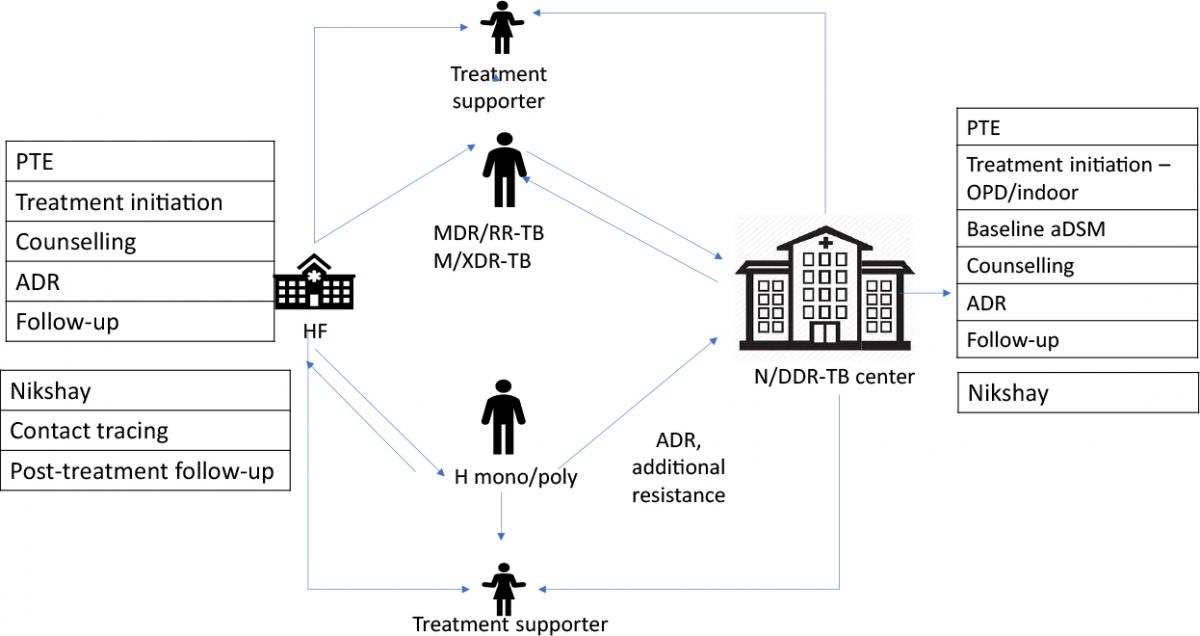
Figure: Processes for all DR-TB Patients in the Treatment Care Cascade; Source: PMDT Guidelines India, 2021, p43.
Abbr: PTE: Pre-treatment Evaluation; ADR: Adverse Drug Reaction; aDSM: Active Drug Safety Monitoring
Resources
- Guidelines for Programmatic Management of Drug-resistant Tuberculosis in India, March 2021.
- Companion Handbook to the WHO Guidelines for the Programmatic Management of Drug-resistant Tuberculosis, 2014.
- WHO Consolidated Guidelines on Tuberculosis, Module 4 - Treatment: Drug-resistant TB Treatment.
Kindly provide your valuable feedback on the page to the link provided HERE
- DR-TB patient tracing by health staff
Pre-treatment Counselling of DR-TB Patients
ContentPre-treatment counselling must serve as an informed decision-making process that enables patients to make a duly informed decision regarding the use of all anti-TB drugs and regimen, including newer drugs.
Written consent is not needed for any treatment regimen under National TB Elimination Programme (NTEP).
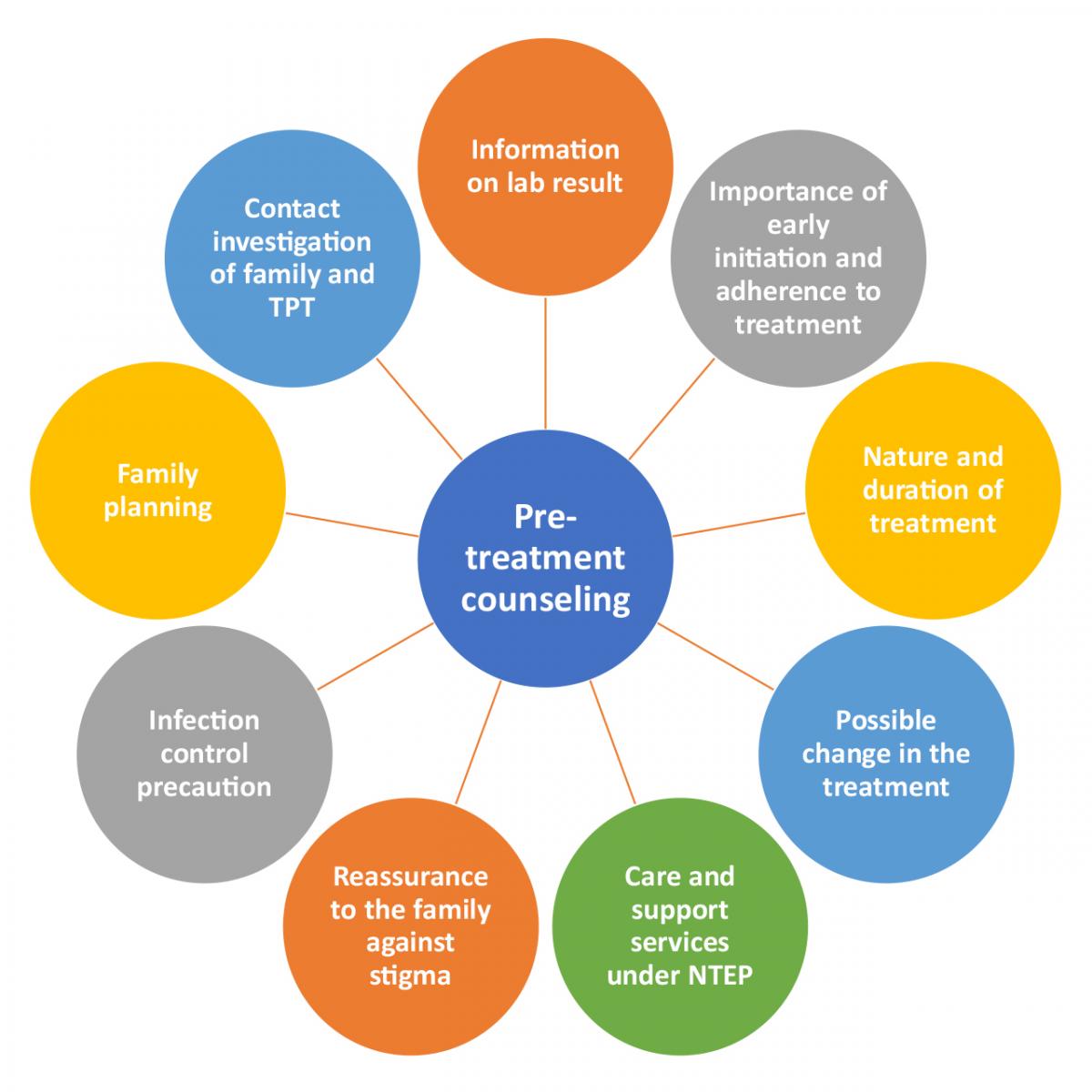
Figure: Key points to be covered during pre-treatment counselling; Source: PMDT Guidelines India, 2021, p45.
Abbr: TPT: TB Preventive Treatment
Training of counsellor:
- All key points depicted in the figure here should be covered.
- A counselling register must be maintained for all patients.
Resources
- Guidelines for Programmatic Management of Drug-resistant Tuberculosis in India, March 2021.
- Technical and Operational Guidelines for TB in India, 2016.
- Central TB Division, MoHFW GOI - Training Modules (1-4) For Programme Managers & Medical Officers (NTEP), 2020.
Kindly provide your valuable feedback on the page to the link provided HERE
Pre treatment evaluation of a DRTB cases
ContentLet us understand the objective and importance of Pre-treatment Evaluation (PTE) of Drug-resistant TB (DR-TB) patients.PTE ObjectiveDrugs used for the treatment of drug-resistant TB have significant adverse effects. Hence, there is a need for PTE to rule out any underlying condition at the baseline, like co-morbid conditions, radiological abnormalities, Electrocardiogram (ECG) changes, or biochemical derangements.PTE is essential to identify:- The patient's eligibility for initiation of a particular regimen
- Patients who require special attention during treatment
- Regimen modifications from the beginning of treatment
Important Points
- In the majority of Multidrug-resistant (MDR)/ Rifampicin-resistant Tuberculosis (RR-TB) patients, PTE can be done on an outpatient basis.
- The District TB Officer (DTO) and Medical Officer of the TB Unit (MO-TU) can arrange for PTE at the Nodal and District DR-TB Centre (N/DDR-TBC) or at the sub-district level health facility, wherever feasible.
- No additional investigations are required for H Mono/ Poly DR-TB patients unless clinically indicated.
- The PTE carried out at the time of treatment initiation can be considered valid for 1 month from the date of the test result and the patient can be re-initiated on a subsequent regimen considering the previously conducted PTEs.
- Active Drug Safety Management and Monitoring (aDSM) treatment initiation forms are required to be completed for all DR-TB patients at the time of initiation of each new episode of treatment.
- PTE should include a thorough clinical evaluation by a physician and expert consultation as per the need.
- Laboratory-based tests should be performed based on the drugs used in the treatment regimen.
- Pre-treatment evaluation should be made available free of charge to the patient.
Resources
- Guidelines for Programmatic Management of Drug-resistant Tuberculosis in India, March 2021.
- WHO Consolidated Guidelines on Tuberculosis: Module 4 -Treatment: Drug-resistant TB Treatment, 2020.
Kindly provide your valuable feedback on the page to the link provided HERE
DR-TB Treatment – Patient Flow
ContentAfter getting diagnosed with Drug-Resistant TB(DR-TB), the patient is referred to District DRTB Centre(DDR-TBC) for initiation of treatment. Few clinically complicated cases are referred to the Nodal DRTB Centre(NDR TBC). Since the drugs used for the treatment of DR-TB have significant adverse effects and to rule out any underlying comorbid conditions or radiological or ECG, or biochemical derangements, a Pre-treatment evaluation is done to check eligibility of patients for DR-TB regimen and to identify those patients requiring special attention and regimen modifications before initiating patients on TB treatment.
After initiation of treatment, patients are monitored every month. If the sputum test is positive during the follow-up, then the sputum sample is sent for further testing, and if needed, the regimen is changed. And if the sputum sample turns out to be negative during follow up sputum test, then the same treatment regimen is continued till treatment completion.
Post-treatment completion, patients are evaluated at the interval of 6, 12, 18 and 24 months, screened for any clinical signs and symptoms, and, if found suspected, then referred for sputum microscopy and /or culture test.
Figure: TB patient flow after being diagnosed with Multi Drug Resistance TB(MDR/RR TB)
Second Line anti TB drugs
ContentThe anti-TB drugs recommended for treatment of Multi- and Extensively Drug-resistant (M/XDR) TB patients are grouped into three groups – A, B and C (Figure below).
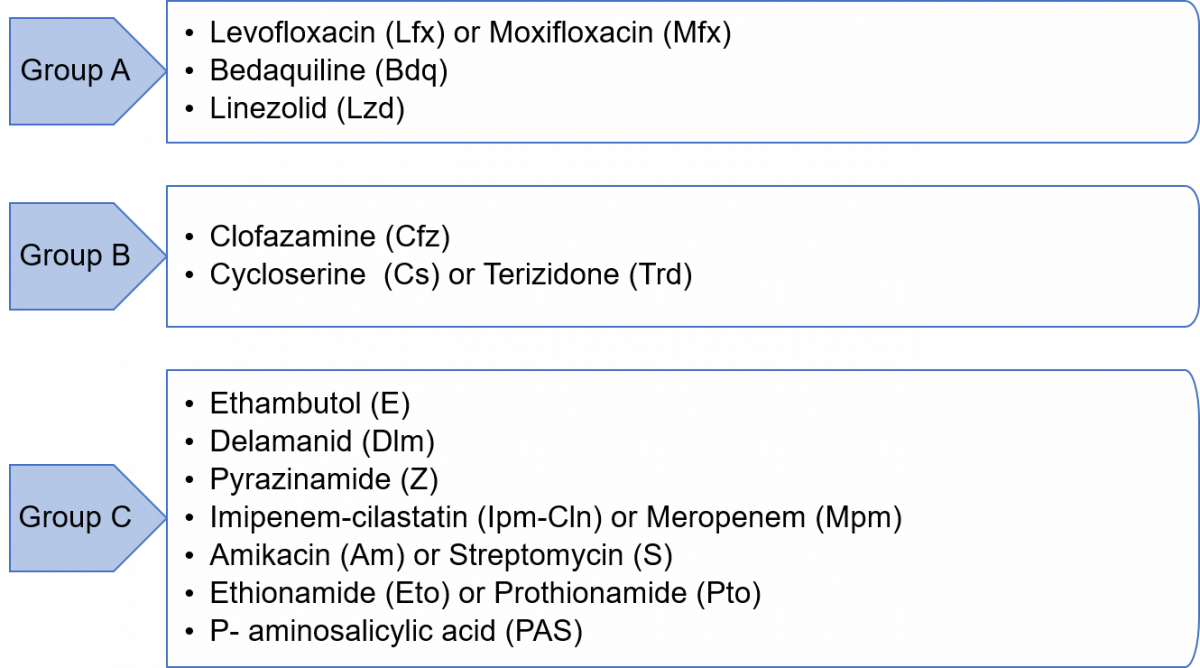
Figure: Groups A, B and C of Anti-TB Drugs used in Treatment of M/XDR-TB Patients
Grouping of drugs is done based on their efficacy, experience of use and drug class. This grouping is intended to guide the design of individualized, longer M/XDR-TB regimens (the composition of the recommended shorter MDR/RR-TB regimen is largely standardized).
Resources
- Guidelines for Programmatic Management of Tuberculosis in India, 2021.
- WHO Consolidated Guidelines on Tuberculosis, Module 4 - Treatment: Drug-resistant TB Treatment, 2020.
Kindly provide your valuable feedback on the page to the link provided HERE
DR-TB Treatment Regimens
ContentDepending upon type of drug resistance, there are four broad DRTB Treatment regimen.
- H Mono/Poly Treatment Regimen(6-9 months)
- Shorter oral Bedaquiline containing MDR/RR-TB regimen(9-11 months)
- Shorter injectable containing regimen(9-11 months)
- Longer oral M/XDR-TB regimen(18-20 months)
Drugs administered for DRTB Regimen:
- Drugs are decided based on the drug resistance detected for a patient and will be informed by the medical officer.
- Injections might also be administered to the admitted patient.
- H Mono/Poly Regimen can be initiated at any health facility, while the other two regimen need to be initiated at N/DDR-TB Centre
Figure: Patient wise boxes(PWB) for DRTB Treatment
Treatment Algorithm for MDR/RR-TB
ContentThe treatment algorithm for Multidrug-resistant/ Rifampicin-resistant TB (MDR/ RR-TB) patients is a part of an integrated diagnostic and treatment algorithm under Programmatic Management of Drug-resistant Tuberculosis (PMDT).
A shorter oral Bedaquiline (Bdq)-containing MDR/ RR-TB regimen is recommended for those MDR/ RR-TB patients in whom resistance to the component drugs has been excluded or those who have not been previously treated for more than one month with second-line drugs used in shorter oral Bdq - containing MDR/ RR-TB regimen and have no other exclusion criteria.
All those MDR/ RR-TB patients who are not eligible for a shorter Bdq - containing regimen, after careful evaluation, are considered for a longer M/ XDR-TB regimen.
The treatment algorithm for MDR/ RR-TB patients is shown below.
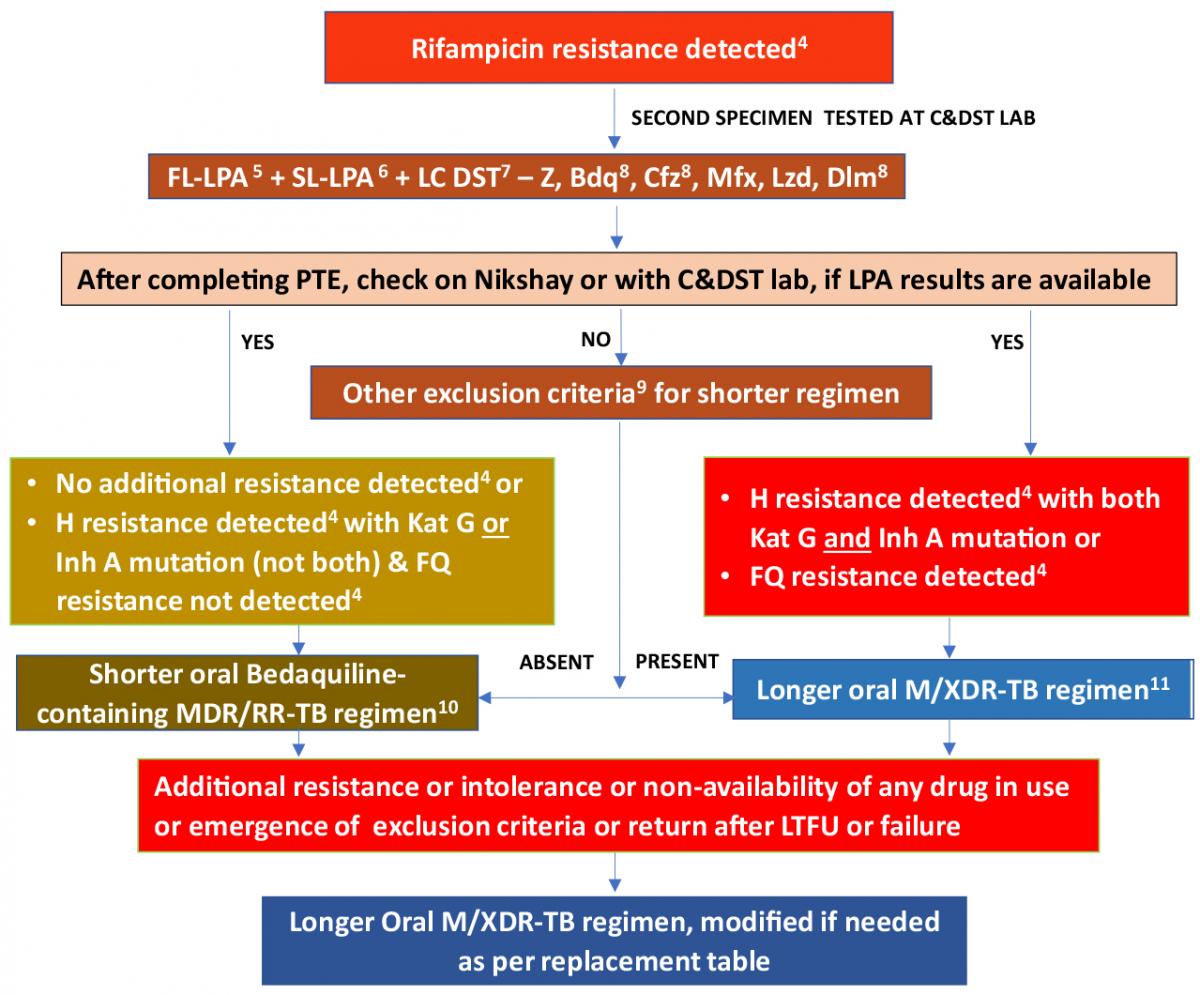
Figure: Treatment Algorithm for MDR/RR-TB; Source: PMDT Guidelines India, March 2021, p46.
Footnotes for the Algorithm
4 As per mutation pattern, includes resistance inferred.
5 Discordance in RR results between Nucleic Acid Amplification Tests (NAAT) & First-line Line Probe Assay (FL-LPA) to be resolved with a repeat NAAT at Culture and Drug Susceptibility Testing (C&DST) lab and microbiologists will provide the final decision. InhA mutation is associated with Eto resistance. Use other exclusion criteria to decide regimen if FL-LPA is done on culture isolates for patients with smear-negative specimens.
6 To assess Levofloxacin (Lfx), Moxifloxacin (Mfx) and Amikacin (Am) resistance.
7 Start treatment based on Line Probe Assay (LPA) results and modify based on Liquid Culture (LC) and DST results later.
8 Whenever DST is available.
9 Other exclusion criteria for shorter oral Bdq-containing MDR/ RR-TB regimen includes:
- History of exposure for > 1 month to Bdq, Lfx, Ethionamide (Eto), or Clofazimine (Cfz), if the result for DST (Bdq, Fluoroquinolone (FQ), Inh A mutation, Cfz & Pyrazinamide (Z)) is not available.
- Intolerance to any drug or risk of toxicity from a drug in the shorter oral Bdq-containing MDR/ RR-TB regimen (e.g. drug-drug interactions).
- Extensive TB disease – the presence of bilateral cavitary disease or extensive parenchymal damage on chest radiography. In children aged under 15 years, presence of cavities or bilateral disease on chest radiography.
- Severe Extrapulmonary TB (EP-TB) disease - the presence of miliary TB or TB meningitis or Central Nervous System (CNS) TB. In children aged under 15 years, extra-pulmonary forms of disease other than lymphadenopathy (peripheral nodes or isolated mediastinal mass without compression).
- Pregnant and lactating women (with conditional exceptions).
- Children below 5 years.
10 This portion applies as states move to a shorter oral Bdq-containing MDR/ RR-TB regimen under the guidance of the National TB Elimination Programme (NTEP).
11 Patients who were on a longer oral M/ XDR-TB regimen based on the history of exposure for >1 month and in whom resistance is not detected to Isoniazid (H) or FQ may be switched to shorter oral Bedaquiline containing MDR/ RR-TB regimen based on the FL and Second-line LPA (SL-LPA) results if the duration of longer oral M/ XDR-TB regimen drugs consumed is <1 month.
Resources
- Guidelines for Programmatic Management of Drug-resistant Tuberculosis in India, 2021.
- WHO Consolidated Guidelines on Tuberculosis: Module 4 – Treatment: Drug-resistant TB Treatment, 2020.
Kindly provide your valuable feedback on the page to the link provided HERE
Management of M/XDR-TB Treatment During Pregnancy
ContentIn pregnant women diagnosed with multi-drug resistant (MDR)/rifampicin-resistant TB (RR-TB), if the duration of pregnancy is <20 weeks*, the patient should be advised to opt for medical termination of pregnancy (MTP) in view of the potential severe risk to both the mother and the fetus. Figure 1 shows the management algorithm for pregnant patients based on their gestational age.
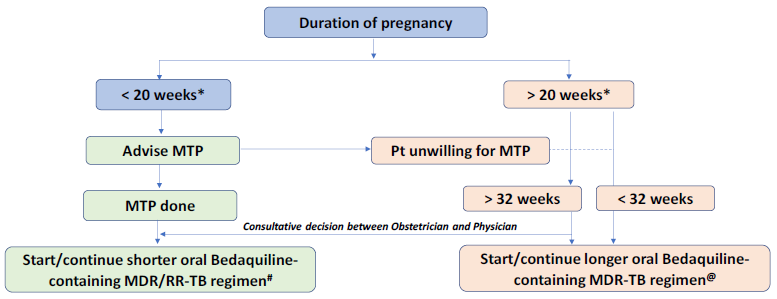
Figure 1: Management of M/XDR-TB patients during pregnancy based on gestation age; Source: Guidelines for PMDT, India 2021, p.71
* 24 weeks will apply wherever the bill is passed.
# Regimen: 4-6 Bdq (6m) Lfx, Cfz, Eto, Hh, Z, E / 5 Lfx, Cfz, Z, E. No modifications allowed.
@ Regimen:18-20 Lfx, Bdq(6m or longer) Lzd#, Cfz, Cs. Lzd dose to be tapered to half after 6-8 months based
on bacteriological response. Modify regimen if one or more drug cannot be used due to reasons of resistance,
tolerability, contraindication, availability etc.
• in the order of Z E PAS.
• Eto may be considered after 32 weeks’ gestation.
• Am may be considered in post-partum period only. Am will not be started in the final 12 months of treatment.- If the pregnancy is ≤ 20 weeks* and the patient is willing to opt for MTP, she should be referred to a gynecologist or obstetrician for MTP after which shorter oral Bedaquiline-containing MDR/RR-TB regimen can be initiated (if the patient has not started treatment) or continued (if the patient is already on treatment) by the DR-TB Centre committee.
- If she does not opt for MTP or has a pregnancy >20 weeks* duration, she will be shifted to a longer oral M/XDR-TB regimen.
- For patients who are unwilling for MTP or have a pregnancy of >20 weeks* (making them ineligible for MTP), the risk to the mother and the fetus should be explained clearly and the pregnant DR-TB patients need to be monitored carefully, both in relation to the treatment and progress of the pregnancy.
- Shorter oral Bedaquiline-containing MDR/RR-TB regimen cannot be administered in pregnant women before 32 weeks due to Ethionamide (Eto)-led potential teratogenicity in the first trimester and risk of hypothyroidism in the infant in the second trimester.
- Beyond 32 weeks, the choice of regimen (shorter/longer) needs to be a consultative decision between the obstetrician and physician at the nodal (N)/district DR-TB Centre (DDR-TBC). More compelling evidence on toxicity causes attributed to the use of specific anti-TB drugs during pregnancy and lactation is needed.
Resources
- Guidelines for Programmatic Management of Drug Resistant Tuberculosis in India, March 2021
- Consolidated Guidelines on Tuberculosis: Module 4- Treatment: Drug resistant TB Treatment , 2020
- Technical and Operational Guidelines for TB in India, 2016
- Companion Handbook to the WHO Guidelines for the Programmatic Management of Drug-Resistant Tuberculosis, 2014
Kindly provide your valuable feedback on the page to the link provided HERE
DR-TB Treatment in Pregnancy: Recommendation for the Use of Contraception
ContentAll women of childbearing age who are awaiting results of the Culture and Drug Susceptibility Test (C&DST), as well as those receiving Drug-resistant TB (DR-TB) treatment, should be advised and counselled intensively to use birth control measures because of the potential risk to both the mother and the foetus.
- It should be noted that oral contraceptives might have decreased efficacy due to vomiting and drug interactions with DR-TB drugs (use of Rifampicin in mono/poly resistant TB).
- Contraception methods that can be used during DR-TB treatment, based on individual preference and eligibility are:
- Barrier methods (e.g., condoms/ diaphragms), intrauterine devices (e.g., CuT), Depot medroxyprogesterone (Depo-provera).
- In women, the Isoniazid (H) mono/poly DR-TB regimen may be started or continued safely, except that care should be taken while using oral contraceptives.
- A woman on oral contraception, while receiving rifampicin treatment may choose between two options following consultation with a physician:
- Use of an oral contraceptive pill containing a higher dose of oestrogen (50 μg)
- Use of another form of contraception.
Resources
- Guidelines for Programmatic Management of Drug-resistant Tuberculosis in India, March 2021.
- Consolidated Guidelines on Tuberculosis: Module 4 - Treatment: Drug-resistant TB Treatment, 2020.
- Companion Handbook to the WHO Guidelines for the Programmatic Management of Drug-resistant Tuberculosis, 2014.
- Collaborative Framework for Management of Tuberculosis in Pregnant Women, 2021.
Kindly provide your valuable feedback on the page to the link provided HERE
Follow-up Monitoring of DR-TB Patients
ContentThe following points should be covered in follow-up monitoring of Drug-resistant TB (DR-TB) patients:
- Monitor DR-TB treatment progress and disease response.
- Monitor bacteriological and radiological improvements in DR-TB treatment.
- Identify derangements in bio-chemical results and on Electrocardiogram (ECG) which are indicative of systemic disorders that could result in drug-induced adverse events, or comorbidities that may require timely interventions to address and improve the probability of treatment success, survival and quality of life.
- Follow-up monitoring to be done periodically based on the type of TB/ severity of disease/ type of regimen used, etc.
Components of Follow-up Monitoring
- Clinical monitoring
- Follow-up evaluations
Resources
- Guidelines for Programmatic Management of Drug-resistant Tuberculosis in India, March 2021.
- WHO Consolidated Guidelines on Tuberculosis: Module 4 - Treatment: Drug-resistant TB Treatment, 2020.
Kindly provide your valuable feedback on the page to the link provided HERE
Rehabilitation service to TB patients
ContentThe holistic management of Tuberculosis (TB) patients can improve their life expectancy. The importance of addressing malnutrition, adverse drug reactions, psycho-social well-being, and catastrophic expenses correctly and in a timely fashion is essential in reducing morbidity and mortality.
Table: Rehabilitation services for TB patients Rehabilitation Services for TB Patients Care Providers Key Components Nutritional Rehabilitation 1. Senior Treatment Supervisor
2. TB Health Visitors
3. Accredited Social Health Activists (ASHAs)
4. Auxiliary Nurse Midwife (ANM)
5. TB treatment supporter
6. Medical officers at Peripheral Health Centre (PHC), Community Health Centre (CHC) level
-
Supporting nutritional needs of TB patients through Ni-kshay Poshan Yojana
-
Management of undernutrition in nutrition rehabilitation centres (NRCs)
-
Linkages for extra nutritional support for TB patients like the public distribution system (PDS) or food security act.
Pulmonary Rehabilitation
1.Physiotherapists (preferable one male and one female)
2. Nurses
3. Attendant
Management of physical and psychological impairment due to the disease to lower the handicap. Physical Rehabilitation -
therapists (preferable one male and one female)
-
Nurse Doctors
-
Surgeons
-
Physio
-
Attendant
-
Management of post-treatment sequelae by early identification and periodic assessment.
-
Comorbidity management
Social Rehabilitation 1. TB Health Visitors
2. Accredited Social
3. Health Activists (ASHAs)
4. Auxiliary Nurse Midwife (ANM)
5. TB treatment supporter
6. Medical officers at PHC, CHC level
7. Ni-kshay Mitra
-
Linkage for vocational rehabilitation e.g., Skill India
-
Synergy between social welfare support systems like:
-
Rashtriya Swasthya Bima Yojana (RSBY)
-
TB pension schemes
-
National rural employment guarantee scheme
-
National Health Protection Scheme (NHPS) for palliative care and rehabilitation
Mental Rehabilitation 1. Psychiatrist
2. Psychologists / Counsellors
3. TB Health Visitors
4. Accredited Social
5. Health Activists (ASHAs)
6. Auxiliary Nurse Midwife (ANM)
7. TB treatment supporter
8. Medical officers at PHC, CHC level
-
Psychological counselling to the patient and caregivers.
-
Assisting patients in the planning of decisions related to the end-of-life stage.
Patient rehabilitation is ensured by:
-
1. IT-based monitoring via Ni-kshay platform
-
2. Community-based monitoring
-
3. Surveillance: A comprehensive surveillance system for TB patients and their providers built into eNikshay. This is supported by a call centre for user-friendly private reporting and patient monitoring.
Resource
Assessment
Question
Answer 1
Answer 2
Answer 3
Answer 4
Correct answer
Correct explanation
Rehabilitation services to TB patients comprise Nutritional, Physical, Pulmonary, Social and Mental Rehabilitation.
False
True
2
The holistic management of tuberculosis (TB) patients can improve life expectancy. The importance of addressing malnutrition, adverse drug reactions, psycho-social well-being, and catastrophic expenses correctly and in a timely fashion is essential in reducing morbidity and mortality.
-
Palliative Care in DR-TB
ContentThe World Health Organization (WHO) defines palliative care as an approach that improves the quality of life of patients and their families facing the problems associated with life-threatening illnesses, through prevention and relief of suffering by means of early identification, impeccable assessment, and treatment of pain and other physical, psychosocial and spiritual problems.
The goal of such treatment is to improve the quality of life for both the patient and their family.
Drug-resistant TB (DR-TB) remains a life-threatening condition with high mortality and poor cure rates, considering this palliative care is more relevant in DR-TB patients. Palliative care is being considered under the National TB Elimination Programme (NTEP) for DR-TB patients who have advanced disease and reduced lung functions. The approach involves systematically engaging institutes with expertise in palliative care (public as well as private facilities) for providing such care to needy TB patients.
The benefits of DR-TB patients receiving palliative care are as follows:
- Provides relief from respiratory distress, pain and other symptoms.
- Affirms life and regards dying as a normal process and intends neither to hasten nor postpone death.
- Integrates the psychological and spiritual aspects of patient care.
- Offers a support system to help patients live as actively as possible until death.
- Offers a support system to help the family cope during the patient’s illness and in their bereavement.
- Enhances quality of life and may also positively influence the course of illness.
Resources
- Companion Handbook to the WHO Guidelines for the Programmatic Management Of Drug-resistant Tuberculosis, 2014.
- Guidelines for Programmatic Management of Drug-resistant Tuberculosis in India, 2021.
Kindly provide your valuable feedback on the page to the link provided HERE
Need for Palliative Care in DR-TB Patients
ContentThe current TB treatment strategy is based on a patient-centred approach to treatment and alleviation of patients' suffering that has been restricted mostly to its physical aspects. However, difficulties faced by patients and families affected by life-threatening diseases span across physical, psychological, social and spiritual aspects. Therefore, a more holistic approach to patient treatment requires broadening to a patient-centric care approach with palliative care services.
Palliative care would be necessary for the care of:
- Patients who are chronically ill with extensive drug resistance and extensive fibro-cavitary or disseminated bilateral lung disease
- Patients who have failed regimen for Extensively Drug-resistant Tuberculosis (XDR-TB) or mixed pattern resistance
- Patients for whom the World Health Organization (WHO)-recommended regimen cannot be designed even with new drugs.
There is significant suffering associated with Drug-resistant TB (DR-TB) illness and its treatment. This kind of burden increases the possibility of TB patients not being able to adhere to treatment which many times results in the treatment failing to cure them.
Delivering palliative care to alleviate the suffering of patients during Multidrug-resistant TB (MDR-TB) treatment, especially when all possibilities of treatment have failed, is an ethical imperative.
Thus, the need for palliative and end-of-life care is being increasingly recognized as an important part of the continuum of care for DR-TB patients.
Resources
- Guidelines for Programmatic Management of Drug-resistant Tuberculosis in India, 2021.
- Companion Handbook to the WHO Guidelines for the Programmatic Management of Drug-resistant Tuberculosis, 2014.
Kindly provide your valuable feedback on the page to the link provided HERE
Interim Treatment Outcomes of DR-TB Cases
ContentThere are two main interim treatment outcomes that can occur during Drug-resistant TB (DR-TB) treatment. These are:
Bacteriological Conversion: This occurs after bacteriological confirmation of TB in at least two consecutive cultures (applicable for DR-TB and Drug-sensitive (DS-TB)) or smears (applicable for DS-TB only), taken on different occasions, at least 7 days apart, are found to be negative.
Bacteriological Reversion: This occurs when at least two consecutive cultures (applicable for DR-TB and DS-TB) or smears (applicable for DS-TB only), taken on different occasions, at least 7 days apart, are found to be positive, either after the initial conversion or for patients without bacteriological confirmation of TB.
For defining treatment failed, bacteriological reversion is considered only when it occurs in the continuation phase.
Time-to-culture conversion is calculated as the interval between the date of DR-TB treatment initiation and the date of the first of these two negative consecutive cultures taken 7 days apart (date of sputum specimens collected for culture should be used).
Resources
- Guidelines for Programmatic Management of Drug-resistant Tuberculosis in India, March 2021.
- WHO Consolidated Guidelines on Tuberculosis: Module 4 – Treatment: Drug-resistant TB Treatment, 2020.
Kindly provide your valuable feedback on the page to the link provided HERE
Final Treatment Outcomes of DR-TB Cases
ContentUnder the National TB Elimination Programme (NTEP), the treatment outcome definitions of Drug-susceptible TB (DS-TB) and Drug-resistant TB (DR-TB) have been aligned in recent times. However, the treatment outcome is declared at different time points for certain outcomes (e.g., cured/ treatment completed) since the duration of DR-TB treatment is longer when compared to DS-TB treatment.
Table: Final DR-TB Treatment Outcomes
TREATMENT OUTCOMES
DEFINITION
REMARKS
Treatment failed
A patient whose treatment regimen needs to be terminated or permanently changed to a new regimen option or treatment strategy.
Reasons for the change include:
- No clinical and/or bacteriological response (a bacteriological conversion with no reversion)
- Adverse Drug Reactions (ADRs)
- Evidence of additional drug resistance to medicines in the regimen
Cured
A pulmonary TB patient with bacteriologically confirmed TB at the beginning of treatment who completed the treatment as recommended by the national policy with evidence of bacteriological response and no evidence of treatment failed.
Bacteriological response - bacteriological conversion with no reversion. Treatment completed
A patient who completed the treatment as recommended by the national policy whose outcome does not meet the definition for cured or treatment failed.
---
Died
A patient who died before starting or during the course of treatment.
Patient died of any reason.
Lost to follow-up
A patient who did not start the treatment or whose treatment was interrupted for 2 consecutive months or more.
---
Not evaluated
A patient for whom no treatment outcome was assigned.
This includes cases “transferred out” to another treatment unit and whose treatment outcome is unknown and excludes patients who lost to follow-up.
Points to Note
- In case of a change in the regimen within the scope of the guidelines, from shorter to longer or vice-versa in the initial months before any definitive treatment outcome applies, the outcome of only the changed regimen needs to be reported. The patient needs to be moved out of the denominator of the previous regimen.
- Patients who are still on treatment due to frequent short interruptions (less than 2 consecutive months) due to patient or provider requirements can be reported as not evaluated as an outcome is not assigned at the time of reporting, but the data can be cleaned and updated later when the outcome is available.
Resources
Kindly provide your valuable feedback on the page to the link provided HERE
Interim reports of DR-TB Treatment
ContentAs Drug-resistant TB (DR-TB) treatment is of relatively long duration, the interim treatment reports are prepared in Ni-kshay to assess the interim treatment outcomes in the programme.
Criteria
- The interim report assessment period is six calendar months, usually counted from January to the end of June and July to the end of December.
- All patients registered and starting treatment during the assessment period are included in the calculation.
Interpretation
- Interim results of DR-TB patients who started treatment during the first semester of a year (1 January to 30 June), should be calculated at the beginning of April of the following year.
- The interim report form should be completed 9 months after the closing day of the cohort so as to allow culture information at 6 months of treatment to be included for all patients in the cohort.
Sl. No.
DR-TB Regimen
Time point for interim reporting
Cohort for interim evaluation, reporting and monitoring (Here ‘X’ is the reporting month)
If reporting month
is X= April 2023,
following are the corresponding cohort for interim
report evaluation1
Isoniazid (H) - mono/ poly DR-TB regimen
4th month of treatment
X - 6 months
Cohort of October 2022 and previous
2
Shorter oral Bedaquiline-containing Multidrug-resistant (MDR)/ Rifampicin-resistant (RR)-TB regimen
4th month of treatment
X - 6 months
Cohort of October 2022 and previous
3
Longer oral Multidrug-resistant/ Extensively Drug-resistant TB (M/XDR-TB) regimen
6th month of treatment
X - 10 months
Cohort of June 2022 and previous
4
BPal (Bedaquiline, Pretomanid, Linezolid) regimen
4th month of treatment
X - 6 months
Cohort of October 2022 and previous
5
Prior longer M/XDR-TB regimen (Drug Susceptibility Testing (DST) guided regimen)
6th month of treatment
X - 10 months
Cohort of June 2022 and previous
Importance
- Culture conversion (for confirmed DR-TB cases) and death by six months are important predictors of final outcomes.
- It also provides early information on the number of patients initiated on second-line drugs for MDR-TB that turned out not to be XDR.
- Information on treatment interruption at the end of six months is important for programme review and implementing corrective actions.
- Overall interim reports are important for supervision, monitoring and evaluation at all programmatic levels.
Resources
- Guidelines on Programmatic Management of Drug-resistant TB (PMDT) in India, 2021, CTD, MoHFW, India.
Assessment
Question
Answer 1
Answer 2
Answer 3
Answer 4
Correct answer
Correct explanation
Page id
Part of Pre-test
Part of Post-test
What is the duration of the assessment of the interim report in NTEP?
2 Calendar months
3 Calendar months
6 Calendar months
12 Calendar months
3
The interim report assessment period is six calendar months, usually counted from January to the end of June and July to the end of December.
Yes
Yes
PMDT Report
ContentVideo fileVideo: PMDT Report
-
DR-TB HIV Coordinator: Shorter Oral Bedaquiline-containing MDR/RR-TB Regimen
FullscreenShorter oral Bedaquiline-containing MDR/RR-TB regimen
ContentBased on the World Health Organization (WHO) treatment guidelines, 2020 recommendations, the National TB Elimination Programme (NTEP) have decided to transition from the current shorter injectable-containing Multi-drug Resistant (MDR)/ Rifampicin-resistant TB (RR-TB) regimen to the shorter oral bedaquiline-containing MDR/RR-TB regimen in the year 2021.
Salient Features of the Shorter Oral Bedaquiline-containing MDR/RR-TB Regimen
- This regimen will be used in patients >5 years of age weighing 15 kg or more.
- The regimen will be expanded in a phased manner starting with selected states to gain programmatic experience to guide future expansion within 2021.
- The regimen consists of an initial phase of 4 months that may be extended up to 6 months and a continuation phase of 5 months, giving a total duration of 9-11 months. Bdq is used for a duration of 6 months.
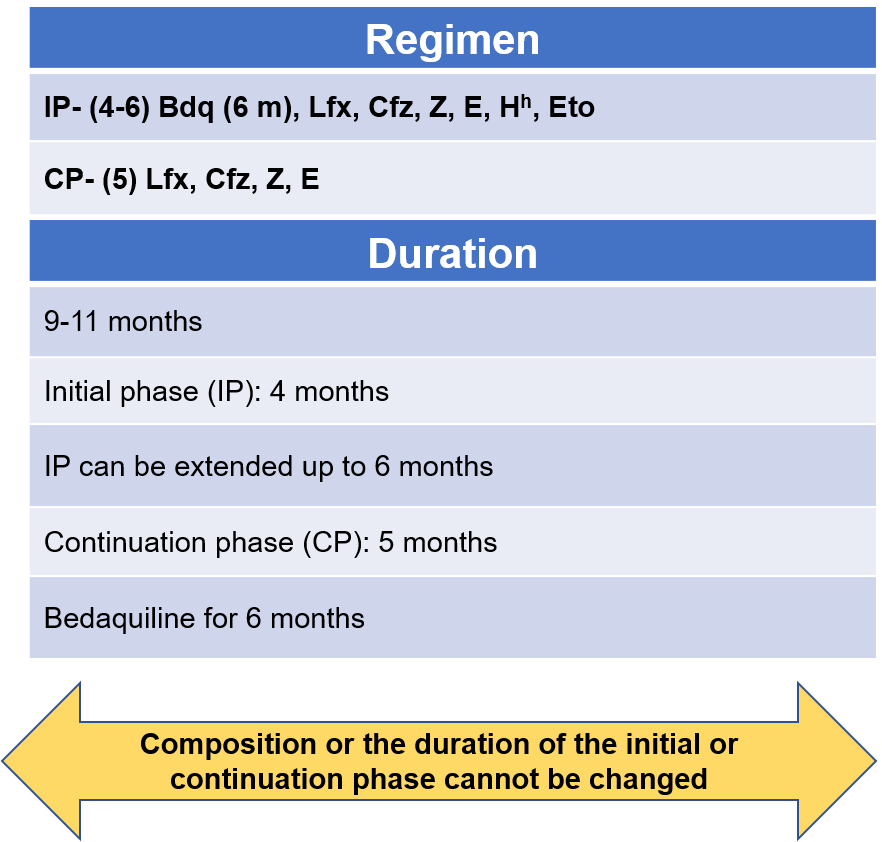
Figure 1: Regimen and duration of shorter oral Bdq-containing MDR/RR-TB regimen
Abbr: Bdq - Bedaquiline, Lfx- Levofloxacin, Cfz- Clofazamine, Z- Pyrazinamide, E- Ethambutol, Hh- High-dose Isoniazid, Eto- Ethionamide
Points to Note
- From the start to the end of 4 months these drugs are used: Bedaquiline, Levofloxacine, Clofazamine, Pyrazinamide, Ethambutol, high-dose Isoniazid, Ethionamide
- From the start of 5 months to the end of 6 months (If IP not extended): Bdq, Lfx, Cfz, Z, E
- From the start of 7 months to the end of 9 months: Lfx, Cfz, Z, E
If the IP is extended up to 6 months, then all 3 drugs Bdq, Hh and Eto are stopped together
Resources
- Guidelines for Programmatic Management of Drug-resistant Tuberculosis in India, March 2021.
- WHO Consolidated Guidelines on Tuberculosis, Module 4 - Treatment: Drug Resistant TB Treatment.
Kindly provide your valuable feedback on the page to the link provided HERE
Shorter Oral Bedaquiline-containing MDR/RR-TB Regimen: Pre-treatment Evaluation [PTE]
ContentThere are two main evaluations that must be conducted during pre-treatment evaluation to initiate patients on a shorter oral bedaquiline-containing MDR/RR-TB regimen. These evaluations are:
Clinical Evaluation
- History and physical examination
- Height check
- Weight check
- Psychiatric evaluation, if required
Laboratory-based Evaluation
- Random Blood Sugar (RBS)
- HIV testing following counselling
- Complete blood count (Haemoglobin (Hb), Total Leucocyte Count (TLC), Differential Leucocyte Count (DLC), platelet count)
- Liver function tests (including serum proteins Thyroid-stimulating Hormone (TSH) levels)
- Urine examination – routine and microscopic
- Serum electrolytes (Sodium (Na), Potassium (K), Magnesium (Mg), Calcium (Ca))
- Urine pregnancy test (in women of reproductive age)
- Chest X-ray
- Electrocardiogram (ECG)
Resources
- Guidelines for Programmatic Management of Drug-resistant Tuberculosis in India, March 2021.
- WHO Consolidated Guidelines on Tuberculosis: Module 4-Treatment: Drug-resistant TB Treatment, 2020.
Kindly provide your valuable feedback on the page to the link provided HERE
Shorter Oral Bedaquiline-containing MDR/RR-TB Regimen: Treatment Extension
ContentThe total duration of treatment in this regimen is 9-11 months with Intensive Phase (IP) at least 4 months and Continuation Phase (CP) for 5 months. Treatment extension of IP is done up to 2 months based on follow-up results and is indicated in the algorithm presented in the figure below.
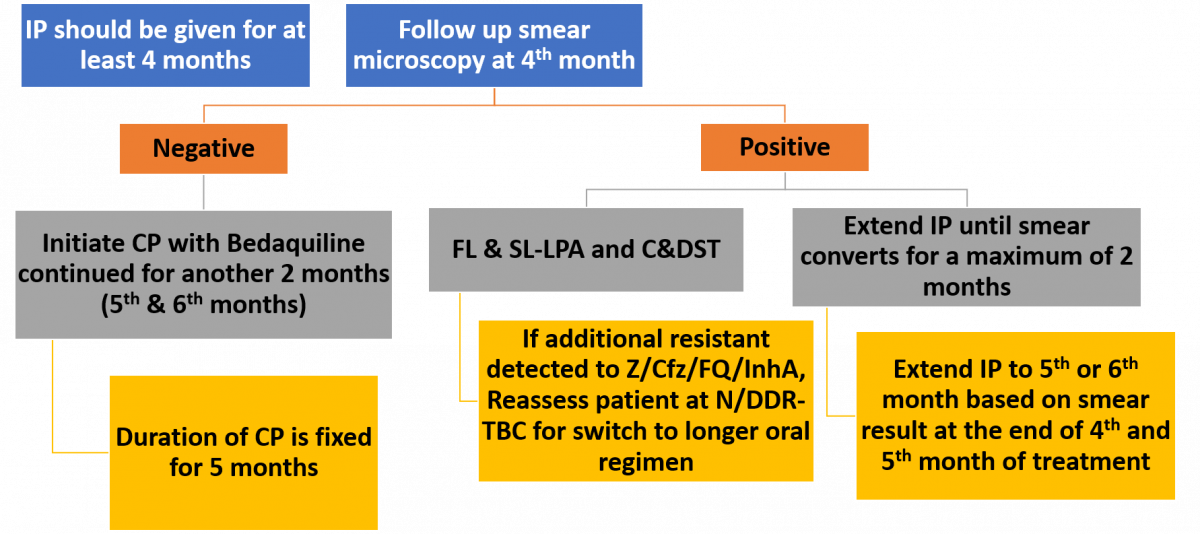
Figure: Treatment Extension/ Regimen Change Based on Follow up Smear/ Culture/ DST Results
Abbr: FL & SL- LPA- First Line & Second Line- Line Probe Assay, C&DST- Culture and Drug Susceptibility Test, Z- Pyrazinamide, Cfz- Clofazimine, FQ- Fluoroquinolone, N/DDR-TBC- Nodal/ District DR-TB Centre
Resources
- Guidelines for Programmatic Management of Tuberculosis in India, 2021.
- WHO Consolidated Guidelines on Tuberculosis: Module 4 – Treatment: Drug-resistant TB Treatment, 2020.
Shorter Oral Bedaquiline-containing MDR/RR-TB Regimen: Drug Dose Administration
ContentDrug dose administration for shorter/ longer oral Bedaquiline (Bdq)-containing Multidrug-resistant (MDR)/ Rifampicin-resistant (RR)-TB regimen depends on the factors described below.
- The dosage of second-line anti-TB drugs would vary as per the weight of the Drug-resistant TB (DR-TB) patients. There are five weight bands in adult patients (≥ 18 years): <16 kg, 16-29 kg, 30-45 kg, 46-70 kg and >70 kg. The weight bands of adult patients for Drug-sensitive TB (DS-TB) patients are different compared to DR-TB patients.
- All morning doses should be supervised by the treatment supporter via Directly Observed Treatment, Short-course (DOTS).
- In patients with drug intolerance, Cycloserine (Cs), Ethionamide (Eto) and Sodium (Na) Para Aminosalicylic Acid (PAS), can be given in two divided doses. Pyridoxine should be provided as part of the regimen till the end of treatment for all patients.
Change in Weight Bands during Treatment
- For adult DR-TB patients whose weight increases or decreases by 5 kg or more compared to baseline weight and crosses the current weight band during the course of the treatment, the weight band must be changed at the time of issuing next month's box to the treatment supporter of the patient.
- For paediatric patients, the drug dosage should be adjusted immediately once the weight of the patient crosses the range of the weight band. Counsel the patient about the change in dose.
Key Considerations for Newer Drugs
- Avoid milk-containing products with drugs: The calcium in the milk can decrease the absorption of Fluoroquinolones (FQs).
- Avoid large fatty meals: Fat impairs the absorption of anti-TB drugs (Cs, Isoniazid (H), etc.).
Resources
Shorter Oral Bedaquiline-containing MDR/RR-TB Regimen: Dosage of Drugs for Adults
ContentIn adults, the dosage of drugs for a shorter oral Bedaquiline (Bdq) - containing Multi-drug Resistant (MDR)/ Rifampicin-resistant Tuberculosis (RR-TB) regimen, varies according to their weight.
The table below provides drug dosages for adult patients, according to their weight bands, in a shorter oral Bedaquiline-containing MDR/RR-TB regimen.
Table: Weight-bandwise Dosages for Adult Patients on Shorter Oral Bdq-containing MDR/ RR-TB Regimen Sr No
Drugs
16-29 kg
30-45 kg
46-70 kg
>70 kg
1
High dose H (Hh)
300 mg
600 mg
900 mg
900 mg
2
Ethambutol (E)
400 mg
800 mg
1200 mg
1600 mg
3
Pyrazinamide (Z)
750 mg
1250 mg
1750 mg
2000 mg
4
Levofloxacin (Lfx)
250 mg
750 mg
1000 mg
1000 mg
5
Bedaquiline (Bdq)
Week 0–2: Bdq 400 mg daily
Week 3–24: Bdq 200 mg 3 times per week
6
Clofazimine (Cfz)
50 mg
100 mg
100 mg
200 mg
7
Ethionamide (Eto)*
375 mg
500 mg
750 mg
1000 mg
8
Pyridoxine (Pdx)
50 mg
100 mg
100 mg
100 mg
*Drugs can be given in divided doses in a day in the event of intolerance. Resources
- Guidelines for Programmatic Management of Drug-resistant Tuberculosis in India, March 2021.
- The Use of Bedaquiline in the Treatment of Multidrug-resistant Tuberculosis: Interim Policy Guidance, 2013.
Kindly provide your valuable feedback on the page to the link provided HERE
Possible Adverse Events Due to Drugs in Shorter Oral Bedaquiline-containing MDR/RR-TB Regimen
ContentDrugs that are part of the shorter Bedaquiline (Bdq)-containing regimen have some typical side effects which need close monitoring of Drug Resistant-TB (DR-TB) patients while providing the treatment.
Table: Possible adverse events due to drugs in the shorter oral Bedaquiline-containing MDR/RR-TB regimen; Source: Guidelines for PMDT in India, 2021.
Adverse Drug Events Causative Drugs QT prolongation Bdq, Fluoroquinolone (FQ), Clofazimine (Cfz) Rash, allergic reaction and anaphylaxis Any drug Gastrointestinal symptoms Ethionamide (Eto), Pyrazinamid (Z), Ethambutol (E), Bdq, Cfz, FQs, Isoniazid(H) Diarrhoea and/or flatulence Eto Hepatitis Z, H, Eto, Bdq Giddiness Eto, FQ, Z Hypothyroidism Eto Arthralgia Z, FQ, Bdq Peripheral neuropathy H, FQ, rarely Eto, E Headache Bdq Depression FQ, H, Eto Psychotic symptoms Isoniazid (H), FQ Suicidal ideation H, Eto Seizures H, FQ Tendonitis and tendon rupture FQ Vestibular toxicity (tinnitus and dizziness) FQs, H, Eto Optic neuritis E, Lzd, Eto, Cfz, H Metallic taste Eto, FQs Gynaecomastia Eto Alopecia H, Eto Superficial fungal Infection and thrush FQ Dysglycaemia and Hyperglycaemia Eto Resources
Kindly provide your valuable feedback on the page to the link provided HERE
Follow-up Evaluation of Patients on Shorter Oral Bedaquiline-containing MDR/RR-TB Regimen
ContentApart from clinical evaluation, the patients need to be closely assessed by various laboratory parameters to monitor the improvement on treatment, drug-induced adverse events or co-morbidities to enable timely interventions to address these and improve the probability of treatment success, survival and quality of life.
Table: Laboratory evaluations and follow-up schedule for patients on shorter oral Bdq containing Multidrug-resistant (MDR)/ Rifampicin-resistant (RR) TB regimen; Source: Guidelines for PMDT in India 2021, p54.
EVALUATION TEST
FOLLOW-UP SCHEDULE
Clinical + Weight (Wt.)
Monthly in Intensive Phase (IP) or extended IP if the previous month shows Smear-positive (S+ve), quarterly in Continuation Phase (CP)
Smear Microscopy (SM)
- Monthly from 3rd month onwards till end of IP
- Monthly in extended IP only if the previous month S+ve (IP extension up to a maximum of 6 months)
- Conduct SM within 7 days, if the smear at 6 months is positive to rapidly ascertain bacteriological conversion/ reversion.
Culture
- At the end of month 3, end of month 6 and/or end of treatment
- If the culture result of month 6 is positive, collect one repeat sample immediately to rapidly ascertain the bacteriological conversion/ reversion.
- If the repeat sample is culture-negative, then end of treatment specimen collection should be done.
Drug Susceptibility Testing
(DST)
First-line and Second-line Line Probe Assay (FL-SL LPA) (Levofloxacin (Lfx), Moxifloxacin (Mfx), Ethionamide (Eto)) and Liquid Culture and Drug Susceptibility Testing (LC&DST) (Pyrazinamide (Z), Bedaquiline (Bdq)*, Clofazimine (Cfz)*, Mfx, Linezolid (Lzd), Delamanid (Dlm)*) if any of the following:
- Culture +ve (end of month 3 or later and end of treatment)
- Smear +ve at end of IP, end of extended IP and end of treatment
Urine Pregnancy Test (UPT)
As and when clinically indicated
Complete Blood Count (CBC)
As and when clinically indicated
Thyroid Stimulating Hormone (TSH) and Liver Function Test (LFT)#
At end of IP, then as and when clinically indicated
Chest X-ray (CXR)
At end of IP, then as and when clinically indicated, end of treatment
Electrocardiogram (ECG)$
At 2 weeks, then monthly in the first 6 months, then as and when clinically indicated
Serum Electrolytes
(Na, K, Mg, Ca)
As and when indicated and in case of any QTcF prolongation
Specialist consultation
As and when clinically indicated
Colour vision test
Once in two months (in children)
# HBsAG and other viral markers (Hepatitis A, C & E) to be done in case of Jaundice.
$ In case of baseline ECG abnormality or QTcF ≥450ms with a shorter oral Bedaquiline-containing MDR/RR-TB regimen that contains Bdq and Cfz, ECG must be done on daily basis for initial 3 days or as suggested by a cardiologist. Repeat ECG with long II lead after an hour to reconfirm abnormal ECG.
DST whenever available.
Important Points
- The most important evidence of response to DR-TB treatment is the conversion of sputum smear and culture to negative.
- If no additional resistance is detected on follow-up after 3rd month, the IP will be extended on monthly basis up to a maximum of 6 months.
If bacteriological reversion is ascertained or if any resistance is detected by FL-LPA or SL-LPA or if found to be smear/ culture positive at the end of 6 months or later, the patient will be declared as ‘treatment failed’.
- The patient is then re-evaluated for a longer oral Multi (M)/ Extensively Drug-resistant TB (XDR-TB) regimen with appropriate modification if required.
- A patient once treated with the shorter oral Bedaquiline-containing MDR/RR-TB regimen for more than one month will never be reinitiated on it again.
Resources
- Guidelines for Programmatic Management of Drug-resistant Tuberculosis in India, March 2021.
- WHO Consolidated Guidelines on Tuberculosis: Module 4 - Treatment: Drug-resistant TB Treatment, 2020.
Kindly provide your valuable feedback on the page to the link provided HERE
-
DR-TB HIV Coordinator: Shorter injectable containing regimen
FullscreenShorter Injectable-containing MDR/RR-TB Regimen: Pre-treatment evaluation and follow-up
ContentThe table below provides the details about the clinical evaluation and laboratory tests that need to be done during Pre-treatment Evaluation (PTE) to initiate patients on shorter injectable-containing Multidrug-resistant (MDR)/ Rifampicin-resistant Tuberculosis (RR-TB) regimens.
Table: Clinical evaluation and laboratory tests to be done during PTE for initiation of shorter injectable-containing MDR/ RR-TB regimen; Source: Guidelines for PMDT in India-2021, p48 and 50. CLINICAL EVALUATION LABORATORY-BASED EVALUATION History and physical examination Random Blood Sugar (RBS) Height check HIV testing following counselling Weight check Complete blood count (haemoglobin (Hb), Total Leucocyte Count (TLC), Differential Leucocyte Count (DLC), platelet count) Psychiatric evaluation, if required Liver function tests (including serum proteins) Thyroid-stimulating Hormone (TSH) levels Urine examination – routine and microscopic Serum creatinine Audiometry Urine pregnancy test (in women of reproductive age) Chest X-ray Electrocardiogram (ECG) Follow-up Investigations
- Audiometry: Baseline and then every 2 months till Second-line Injectable (SLI) (Kanamycin (Km)/ Amikacin (Am)) course is completed and then, as and when clinically indicated
- Serum creatinine: Baseline and then monthly till SLI course is completed.
The rest of the management would be the same as for shorter all oral Bedaquiline (Bdq) - containing MDR/ RR-TB regimen.
Resources
Kindly provide your valuable feedback on the page to the link provided HERE
-
DR-TB HIV Coordinator: Longer Oral M/XDR-TB Regimen
FullscreenLonger Oral M/XDR-TB: Regimen and Duration
ContentLonger oral Multi (M)/ Extensive Drug-resistant (XDR) -TB treatment is specified with a definite regime and duration.
Regimen: (18-20) Levofloxacin (Lfx), Bedaquiline (Bdq) (6 months or longer), Linezolid# (Lzd), Clofazimine (Cfz), Cycloserine (Cs) (# dose of Lzd will be tapered to 300 mg after the initial 6–8 months of treatment)
- Duration: 18-20 months
- No separate Intensive Phase (IP) and Continuation Phase (CP).
- Bdq will be given for 6 months and extended beyond 6 months as an exception.
- Pyridoxine should be given to all Drug-resistant TB (DR-TB) patients as per the weight bands.
- For Extensively Drug-resistant TB (XDR-TB) patients, the duration of a longer oral XDR-TB regimen would be for 20 months.
Resources
- Guidelines for Programmatic Management of Drug-Resistant Tuberculosis in India, March 2021.
- WHO Consolidated Guidelines on Tuberculosis: Module 4 – Treatment: Drug-resistant TB Treatment, 2020.
Kindly provide your valuable feedback on the page to the link provided HERE
Pre-treatment Evaluation [PTE] in Longer Oral M/XDR-TB Regimen
ContentPre-treatment evaluation for patients on a longer oral Multi/ Extensively Drug-resistant TB (M/XDR-TB) regimen requires both clinical evaluation and laboratory-based evaluation as given below.
Clinical Evaluation
- Physical examination
- Height
- Weight
- Psychiatric evaluation if required
- Ophthalmologist opinion (for Linezolid)
- Surgical evaluation for consideration after culture conversion is achieved
Laboratory-based Evaluation
- Random Blood Sugar (RBS)
- HIV-testing following counselling
- Complete blood count (Hb, TLC, DLC, platelet count)
- Liver function tests (including serum proteins)
- Thyroid Stimulating Hormone (TSH) levels
- BUN and Sr Creatinine- If Amikacin needs to be added
- Urine examination- routine and microscopic
- Serum electrolytes (Na, K, Mg, Ca)
- Urine pregnancy test (in women of reproductive age)
- Chest X-ray
- Electrocardiogram (ECG)
Resources
- Guidelines for Programmatic Management of Drug-resistant Tuberculosis in India, March 2021.
- WHO Consolidated Guidelines on Tuberculosis: Module 4 – Treatment: Drug-resistant TB Treatment, 2020.
Kindly provide your valuable feedback on the page to the link provided HERE
Treatment Extension in Longer Oral M/XDR-TB Regimen
ContentThe total duration of a longer oral Multidrug/ Extensively drug-resistant TB (M/XDR-TB) regimen is 18–20 months.
Image
Figure: Protocol for Treatment Extension in Longer Oral M/XDR-TB Treatment Regimen
Extension of Bedaquiline (Bdq) beyond 6 months is to be considered in patients in whom an effective regimen cannot otherwise be designed.
- If any additional resistance to Group A, B or C drugs in use is detected, the patient needs to be reassessed at the Nodal/ District Drug-resistant Tuberculosis Centre (N/DDR-TBC) for modification of a longer oral M/XDR-TB regimen immediately on receiving the report.
- A treatment duration of 15–17 months after culture conversion is suggested for most patients. The duration may be modified according to the patient’s response to treatment.
Resources
- Guidelines for Programmatic Management of Drug-resistant Tuberculosis in India, March 2021.
- WHO Consolidated Guidelines on Tuberculosis: Module 4 – Treatment: Drug-resistant TB Treatment, 2020.
Kindly provide your valuable feedback on the page to the link provided HERE
Dosages of M/XDR-TB Drugs for Adult in Longer Oral M/XDR-TB Regimen
ContentIt is important to know the dosages of Multi (M)/ Extensively Drug-resistant TB (XDR-TB) drugs for adults on a longer oral M/XDR-TB regimen.
The table below shows the M/XDR-TB regimen drugs for adults weight band-wise, used in longer oral M/XDR-TB regimen customized for India by national experts.
Table: Dosages of M/XDR-TB Drugs for Adults in Longer Oral M/XDR-TB Regimen Sr.No
Drugs
16-29 kg
30-45 kg
46-70 kg
>70 kg
1
Levofloxacin (Lfx)
250 mg
750 mg
1000 mg
1000 mg
2
Moxifloxacin (Mfx)
200 mg
400 mg
400 mg
400 mg
3
High dose Mfx (Mfxh)
400 mg
600 mg
600 mg
600 mg
4
Bedaquiline (Bdq)
Week 0–2: Bdq 400 mg daily
Week 3–24: Bdq 200 mg 3 times per week
5
Clofazimine (Cfz)
50 mg
100 mg
100 mg
200 mg
6
Cycloserine (Cs)3
250 mg
500 mg
750 mg
1000 mg
7
Linezolid (Lzd)
300 mg
600 mg
600 mg
600 mg
8
Delamanid (Dlm)
50 mg twice daily (100 mg) for 24 weeks in 6-11 years of age
100 mg twice daily (200 mg) for 24 weeks for ≥12 years of age
9
Amikacin (Am)1
500 mg
750 mg
750 mg
1000 mg
10
Pyrazinamide (Z)
750 mg
1250 mg
1750 mg
2000 mg
11
Ethionamide (Eto)3
375 mg
500 mg
750 mg
1000 mg
12
Na - PAS (60% weight/ vol)2,3
10 gm
14 gm
16 gm
22 gm
13
Ethambutol (E)
400 mg
800 mg
1200 mg
1600 mg
14
Imipenem-Cilastatin (Imp-Cln)3
2 vials (1g + 1g) bd (to be used with Clavulanic acid)
15
Meropenems (Mpm)3
1000 mg three times daily (alternative dosing is 2000 mg twice daily) (to be used with Clavulanic acid)
16
Amoxicillin-Clavulanate (Amx-Clv) (to be given with Carbapenems only)
875/125 mg bd
875/125 mg bd
875/125 mg bd
875/125 mg bd
17
Pyridoxine (Pdx)
50 mg
100 mg
100 mg
100 mg
1For adults more than 60 years of age, the dose of Second-line Injectable (SLI) should be reduced to 10 mg/kg (max up to 750 mg).
2In patients of Para Amino Salicylic Acid (PAS) with 80% weight/ volume the dose will be changed to 7.5 gm (16-29 kg); 10 gm (30-45 Kg); 12 gm (46-70 kg) and 16 gm (>70 kg).
3Drugs can be given in divided doses in a day in the event of intolerance.
Resources
- Guidelines for Programmatic Management of Drug-resistant Tuberculosis in India, March 2021.
- WHO Consolidated Guidelines on Tuberculosis: Module 4 – Treatment: Drug-resistant TB Treatment, 2020.
Kindly provide your valuable feedback on the page to the link provided HERE
Adverse Drug Reactions due to Longer oral M/XDR-TB Regimen
ContentThe table below showcases the adverse drug events that may be caused by drugs used for longer oral Multi (M)/ Extensively Drug-resistant TB (XDR-TB) regimen. In these situations, replacement drugs are used instead of these drugs.
Table: Possible Adverse Drug Events in the Longer Oral M/XDR-TB Regimen
ADVERSE DRUG EVENTS
DRUGS
QT prolongation
Bedaquiline (Bdq), Fluoroquinolone (FQ), Clofazimine (Cfz) Rash, allergic reaction and anaphylaxis Any drug
Gastrointestinal symptoms
Ethionamide (Eto), P-Aminosalicylic Acid (PAS), Pyrazinamide (Z), Ethambutol (E), Bdq, Cfz, Linezolid (Lzd), FQs Diarrhoea and/or flatulence
PAS, Eto
Hepatitis
Z, Eto, PAS, Bdq
Giddiness
Amikacin (Am), Eto, FQ and/or Z
Haematological abnormalities
Lzd
Hypothyroidism
Eto, PAS
Arthralgia
Z, FQ, Bdq
Peripheral neuropathy
Lzd, Cycloserine (Cs), Am, FQ, rarely Eto, E
Headache
Bdq, Cs
Depression
Cs, FQ, Eto
Psychotic symptoms
Cs, Isoniazid (H), FQ
Suicidal ideation
Cs, Eto
Seizures
Cs, H, FQ
Tendonitis and tendon rupture
FQ
Nephrotoxicity (renal toxicity)
Am
Vestibular toxicity (tinnitus and dizziness
Am, Cs, FQs, Eto, Lzd
Hearing loss
Am Optic neuritis
E, Lzd, Eto, Cfz
Metallic taste
Eto, FQs
Electrolyte disturbances (Hypokalaemia and Hypomagnesaemia
Am
Gynaecomastia
Eto
Alopecia
Eto
Superficial fungal infection and thrush
FQ
Lactic acidosis
Lzd
Dysglycaemia and Hyperglycaemia
Eto
Resources
- Guidelines for Programmatic Management of Drug-resistant Tuberculosis in India, March 2021.
- WHO Consolidated Guidelines on Tuberculosis: Module 4 - Treatment: Drug Resistant TB Treatment, 2020.
Kindly provide your valuable feedback on the page to the link provided HERE
Details of Replacement Sequence of Drugs in Longer Oral M/XDR-TB Regimen
ContentReplacement of component(s) drug(s) is required in conditions like adverse drug reaction, poor tolerance, contraindication and resistance detected on baseline Liquid Culture (LC) Drug Susceptibility Testing (DST).
The replacement sequence of drugs is prepared according to their efficacy, no demonstrable resistance, prior use, side-effect profile and background resistance to replacement drug in the country.
In case of the need for replacement of any of the component(s) in the longer oral Multi (M)/ Extensively Drug-resistant TB (XDR-TB) regimen, the following broad principles apply:
- The regimen should preferably be fully oral. However, in certain circumstances, injectables may have to be used.
- At least 4-5 drugs are to be used in the initial 6 to 8 months and at least 3-4 drugs in the last 12 months.
- Replacement sequence of Group C drugs for longer oral M/XDR-TB regimen was recommended in the order of – Delamanid (Dlm), Amikacin (Am), Pyrazinamide (Z), Ethionamide (Eto), P-aminosalicylic acid (PAS), Ethambutol (E), Penems.
- The combined use of Bedaquiline (Bdq) and Dlm in the regimen is recommended in whom an appropriate regimen cannot be designed using all 5 drugs from Group A and B.
- Dlm and Am will not be initiated in the final 12 months of treatment.
- The duration of new drugs (Bdq or Dlm) is limited to 6 months. Extension beyond 6 months to be considered in patients with whom an effective regimen cannot be otherwise designed
- Imipenem-Cilastatin (Imp-Cln) will only be used as a last resort.
- In individual patients for whom the design of an effective regimen is not possible as per recommendations, BPaL regimen (Bedaquiline, Pretomanid, Linezolid regimen) can be considered as a last resort under prevailing ethical standards.
To modify the regimen, the Nodal and District Drug-resistant TB Centre (N/DDR-TBC) physician must review DST and patient profile and then suitable regimen to be designed based on the replacement sequence table given in the Programmatic Management of Drug-resistant TB (PMDT) guideline.
Resources
- Guidelines for Programmatic Management of Drug-resistant Tuberculosis in India, March 2021.
- WHO Consolidated Guidelines on Tuberculosis: Module 4 – Treatment: Drug-resistant TB Treatment, 2020.
Kindly provide your valuable feedback on the page to the link provided HERE
-
DR-TB HIV Coordinator: Isoniazid (H) Mono/Poly DR-TB Regimen
FullscreenRegimen, Duration and Dosage for Isoniazid [H] Mono/Poly DR-TB Regimen
ContentIsoniazid (H) mono/ poly Drug-resistant TB (DR-TB) regimen has the following regimen, duration and dosage of drugs.
Regimen: (6 or 9) Lfx R E Z
Dosage
- The dosage of drugs would vary as per the weight of the patients.
- Adult patients (≥ 18 years) would be classified in weight bands of <16 kg, 16-29 kg, 30-45 kg, 46-70 kg and 70 kg. The drug dosages by these weight bands are shown in the table below.
- All drugs in the regimen are to be given on a daily basis under observation.
Table: Drugs used in H Mono/ Poly DR-TB Regimen by Weight bands for Adults. Source: Guidelines for PMDT, India, 2021, p79.
SR. NO
DRUGS
16-29 KG
30-45 KG
46-70 KG
>70 KG
1
Rifampicin (R)
300 mg
450 mg
600 mg
750 mg
2
Ethambutol (E)
400 mg
800 mg
1200 mg
1600 mg
3
Pyrazinamide (Z)
750 mg
1250 mg
1750 mg
2000 mg
4
Levofloxacin (Lfx)
250 mg
750 mg
1000 mg
1000 mg
Duration
- H mono/ poly DR-TB regimen is for 6 or 9 months with no separate Intensive Phase (IP)/ Continuation Phase (CP).
- In exceptional situations of unavailability of loose drug R or E or Z, the use of 4 FDC (HREZ) with Levofloxacin (Lfx) loose tablets may be considered as an option rather than not starting the H mono/ poly DR-TB patients on treatment.
Resources
- Guidelines for Programmatic Management of Drug-resistant Tuberculosis in India, March 2021.
- WHO Consolidated Guidelines on Tuberculosis: Module 4 - Treatment: Drug-resistant TB Treatment, 2020.
Kindly provide your valuable feedback on the page to the link provided HERE
Isoniazid [H] Mono/Poly DR-TB Regimen: Pre-treatment Evaluation
ContentPre-treatment evaluation for any TB patient must include a thorough clinical evaluation by a doctor with:
- History and physical examination
- Height/ weight check
- Random Blood Sugar (RBS)
- Chest X-ray
- HIV test
No additional investigations (except the basic evaluations mentioned above) are required for Isoniazid (H) mono/ poly Drug-resistant TB (DR-TB) patients unless clinically indicated.
The pre-treatment evaluation carried out at the time of treatment initiation can be considered valid for 1 month from the date of the test result and the patient can be reinitiated on a subsequent regimen considering the previously conducted pre-treatment tests.
Active Drug Safety Management and Monitoring (aDSM) treatment initiation form needs to be completed for all DR-TB patients at the time of initiation of each new episode of the treatment.
Resources
- Guidelines for Programmatic Management of Drug-resistant Tuberculosis in India, March 2021.
- WHO Consolidated Guidelines on Tuberculosis: Module 4 - Treatment: Drug-resistant TB Treatment, 2020.
Kindly provide your valuable feedback on the page to the link provided HERE
Adverse Drug Events: H Mono/Poly DR-TB Regimen
Contenthe potential adverse drug events that can occur when using drugs in the H mono/ poly DR-TB regimen are tabulated below:
Table: Possible Adverse Events due to Drugs in H Mono/ Poly DR-TB Regimen; Source: Guidelines for PMDT, India, 2021, p83.
ADVERSE DRUG EVENTS SUSPECTED DRUG(S) Hepatitis Rifampicin (R), Pyrazinamide (Z) QT prolongation Fluoroquinolone (FQ), Clofazimine (Cfz) Rash, allergic reaction and anaphylaxis Any drug Gastrointestinal symptoms Z, Ethambutol (E), Cfz, FQs Giddiness FQ, Z Arthralgia Z, FQ Peripheral neuropathy FQ, E Depression FQ Psychotic symptoms FQ Seizures FQ Tendonitis and tendon rupture FQ Vestibular toxicity (tinnitus and dizziness) FQ Optic neuritis E, Linezolid (Lzd), Cfz Metallic taste FQ Superficial fungal infection and thrush FQ Resources
- Guidelines for Programmatic Management of Drug Resistant Tuberculosis in India, March 2021.
- WHO Consolidated Guidelines on Tuberculosis: Module 4 - Treatment: Drug resistant TB Treatment, 2020.
- Technical and Operational Guidelines for TB in India, 2016.
Kindly provide your valuable feedback on the page to the link provided HERE
Replacement Sequence in the H Mono/Poly DR-TB and Shorter Oral Bdq-containing MDR/RR-TB Regimens
ContentDifferent conditions may demand the replacement of Isoniazid (H) mono/ poly Drug-resistant TB (DR-TB) and shorter oral Bedaquiline (Bdq)-containing Multidrug-resistant (MDR)/ Rifampicin-resistant (RR) -TB regimens.
Replacement Sequence of Drugs in H Mono/ Poly DR-TB Regimen
Drugs of the H mono/ poly DR-TB regimen will be replaced in case of:
- Additional resistance to one of the drugs in the regimen
- Intolerance to any of the drug/s used in the regimen
- Unavailability of one of the drug
- Contraindication of the component drugs of the regimen
In such situations, modification of H mono/ poly DR-TB regimen may be done using the sequence of using replacement drugs as delineated in the table below.
Table: Replacement Sequence of Drugs to Modify the H mono/ poly DR-TB Regimen SITUATION SEQUENCE OF USING REPLACEMENT DRUGS If Levofloxacin (Lfx) can’t be used Replace with High dose Moxifloxacin (Mfxh) if second line-line probe assay pattern suggests.
Do liquid culture drug susceptibility testing for detection of resistance to Mfxh, Pyrazinamide (Z), Linezolid (Lzd) and Clofazimine (Cfz)
If Mfxh or Z can’t be used Replace with Lzd.
If Lzd also cannot be given, replace it with Cfz* + Cycloserine (Cs).If both Mfxh and Z can’t be used Add 2 drugs of the 3 – Lzd, Cfz*, Cs in order of preference based on resistance, tolerability & availability. If Rifampicin (R)-resistance exists Switch to an appropriate shorter or longer regimen. *whenever Drug Susceptibility Test (DST) is available. - In the first three situations above, treatment will continue for a total duration of 9 months.
- Treatment duration of H mono/ poly DR-TB regimen can be longer in extensive pulmonary TB diseases up to 9 months.
- The use of new drugs is not yet recommended in the treatment of H mono/ poly DR-TB cases due to lack of evidence.
.
Replacement Sequence of Drugs in Shorter Oral Bdq-containing MDR/RR-TB Regimen
- If there is a need for stopping/ replacing any drug in the shorter oral Bedaquiline-containing multi-drug resistant (MDR)/rifampicin-resistant tuberculosis (RR-TB) regimen then this regimen needs to be stopped.
- Evaluate the patient to switch to a longer oral Multi (M)/ Extensively Drug-resistant TB (XDR-TB) regimen.
- Replacement/ stopping any of the drugs in the regimen is not recommended.
Resources
- Guidelines for Programmatic Management of Drug-resistant Tuberculosis in India, March 2021.
- WHO Consolidated Guidelines on Tuberculosis: Module 4 - Treatment: Drug-resistant TB Treatment 2020.
Kindly provide your valuable feedback on the page to the link provided HERE
-
DR-TB HIV Coordinator: ADR Management
FullscreenActive TB Drug Safety Monitoring [aDSM]
ContentActive Drug Safety Monitoring (aDSM) is a proactive effort made to elicit adverse events from patients by directly asking the patient, screening records, and checking laboratory and clinical tests. All adverse events are captured systematically at all patient visits (during treatment initiation, treatment review and extra visits).
Drug-resistant Tuberculosis (DR-TB) management requires a robust system of monitoring and reporting Adverse Drug Reaction (ADR)-related information to build guidelines for the safe use of drugs, newer drugs, a newer combination of drugs in the regimen, high dose formulations etc. Hence, aDSM is essential.
The National Tuberculosis Elimination Programme (NTEP) in collaboration with PvPI (Pharmacovigilance Program of India) and with support from the World Health Organisation (WHO) India, developed the comprehensive aDSM system for monitoring the ADRs for all types of DR-TB patients.
- aDSM follows the patient pathway from registration to the treatment outcome.
- For every patient, an aDSM treatment initiation form needs to be filled out. For all patients with Serious Adverse Events (SAE), the aDSM treatment review form needs to be filled out.
- The aDSM mechanism was initially used only at the Nodal DR-TB Centre (NDR-TBC) involved in Bedaquiline (Bdq - new drug) - containing regimens, but now this mechanism has been expanded to all DR-TB centres.
- A drug safety monitoring committee periodically monitors the occurrence of Adverse Events (AEs) or SAEs, including deaths of patients while on new drugs containing regimens for necessary signalling and guidance to the program on their safety and efficacy.
- aDSM reports should be uploaded in a timely manner on Nikshay.
Resources
- Guidelines for Programmatic Management of Drug-resistant Tuberculosis in India, March 2021.
- Ready Reckoner for Medical Officer - Adverse Drug Reactions Associated with Anti-TB Drugs Identification and Management, 2019.
Kindly provide your valuable feedback on the page to the link provided HERE
Pharmacovigilance in NTEP
ContentPharmacovigilance is defined by the World Health Organisation (WHO) as the science and activities relating to the detection, assessment, understanding and prevention of adverse effects or any other drug-related problem.
- It is a fundamental public health surveillance activity to ensure patient safety measures in healthcare.
- Good pharmacovigilance will identify the risks within the shortest possible time after medicines have been marketed and help establish or identify risk factors.
Importance of Pharmacovigilance
Pharmacovigilance allows for intelligent, evidence-based prescribing with the potential for preventing many Adverse Drug Reactions (ADRs). Pharmacovigilance will help in:
- Improving patient care by assessing both the harms and benefits received from drugs (anti-tubercular treatment).
- Strengthening patient safety, safeguarding the patient’s interests and ensuring adherence to prescribed drug regimens.
- Preventing antimicrobial resistance.
Pharmacovigilance ultimately helps each patient in receiving optimum therapy at a lower cost to the health system.
Conducting Pharmacovigilance under the National TB Elimination Programme (NTEP)
The Pharmacovigilance Programme of India (PvPI) was set up by the Ministry of Health and Family Welfare, Govt. of India, in July 2010. PvPI is India’s national programme for surveillance of ADR-related information.
NTEP in collaboration with PvPI, and with support from WHO India, developed the comprehensive active Drug Safety Monitoring and Management (aDSM) system for ADR monitoring. Pharmacovigilance is prioritised in Drug-resistant TB (DR-TB) centres for drug-resistant cases.
Adverse events reporting for pharmacovigilance is done as follows:
- DR-TB centres are linked with ADR Monitoring Centres (AMC) established in medical colleges to initiate reporting of ADR in a systematic manner.
- Serious adverse events are reported to AMCs and Central TB Division (CTD) within 24 hours. This is done via a standardized suspected ADR reporting form (Annexure-11) which is filled by the treating doctor.
- The data is entered in Nikshay on a regular basis by statistical assistants at the nodal DR-TB centre and senior DR-TB TB-HIV supervisors at the district DR-TB centre.
- From Nikshay, the information is directly communicated to PvPI through a connecting bridge called Vigiflow.
- The ADR data submitted to Vigifloware is analysed by PvPI and shared with CTD on a regular basis.
Resources
- Training Modules (1-4) for Programme Managers and Medical Officers, 2020.
- Guidelines for Programmatic Management of Drug-resistant Tuberculosis in India, March 2021.
- Ready Reckoner for Medical Officer - Adverse Drug Reactions Associated with Anti-TB Drugs Identification and Management, 2019.
- Practical Handbook on the Pharmacovigilance of Medicines used in the Treatment of Tuberculosis, WHO, 2012.
Assessment
Question
Answer 1
Answer 2
Answer 3
Answer 4
Correct answer
Correct explanation
Page id
Part of Pre-test
Part of Post-test
Which of the following is true concerning pharmacovigilance in NTEP?
PvPI is India’s national programme for surveillance of ADR-related information.
ADR-related information flows between Nikshay and PvPI via Vigiflow.
Pharmacovigilance assesses both the harms and benefits received from anti-TB drugs.
All of the above
4
PvPI is India’s national programme for surveillance of ADR-related information, which flows between Nikshay and PvPI via Vigiflow. Pharmacovigilance assesses both the harms and benefits received from anti-TB drugs.
Yes Yes Adverse Drug Reactions(ADRs) to Second Line Treatment
ContentCommon Adverse events to second line treatment are as below
Figure: Adverse Drug Reaction to Second line drugs
Adverse events should be identified, monitored and be referred to
- Nearest treating doctor for minor symptoms or
- District DR-TB Centres for major symptoms
If required, hospitalization can be done at the District DR-TB Centers where inpatient facility is available or referred to a Nodal DRTB Centre for admission
Management of DR-TB ADR: Rash, Allergy and Anaphylaxis Reaction
ContentHypersensitivity reactions like rashes, allergies and anaphylactic reactions are common Adverse Drug Reactions (ADRs) to any of the second-line anti-TB drugs.
These ADRs are often reported by patients themselves.
Milder forms of this ADR present with a localised rash that is not associated with mucus membranes. In such cases, patients can be reassured and managed symptomatically at home or at the Peripheral Health Institution (PHI).
Serious cases might present with generalized patchy lesions and should be referred to the district/ nodal DR-TB centre.
Drugs that have been identified as the cause of these reactions must be noted in the Drug-resistant TB (DR-TB) treatment card.
Suspected Agent(s): Any second-line anti-TB drug
Management Strategies
- Eliminate other potential causes of allergic skin reactions (e.g., scabies or other environmental agents).
- Mild reaction: Reassure the patient and manage symptomatically with the doctor.
- Minor dermatologic reactions: Continue anti-TB medications and:
- Include antihistamines, hydrocortisone cream for localized rash
- Prednisone in a low dose of 10 to 20 mg per day for several weeks, if other measures are not helpful
- Use a moisturizing lotion for dry skin related itching (especially in diabetics)
- Serious allergic reactions: Stop all therapies pending resolution of reaction and refer the patient to a nodal DR-TB centre/ tertiary centre for further management.
- Anaphylaxis: Follow standard emergency protocols.
Points to Note
- History of previous drug allergies to be reviewed.
- Any known drug allergies are to be noted on the DR-TB treatment card.
- Flushing reaction to Pyrazinamide (Z) is usually mild and resolves with time.
- Hot flushes, itching, palpitations can be caused by Isoniazid (H) and tyramine-containing foods (cheese, red wine). If this occurs, advise patients to avoid foods that precipitate reactions.
- Any of the drugs can cause hives (urticaria). To identify the drug, introduce drugs one at a time and in case of hives, a desensitization attempt can be made.
Once the rash resolves, reintroduce the remaining drugs, one at a time with the one most likely to cause the reaction last. The order of reintroduction will be Isoniazid (H), Pyrazinamide (Z), Ethionamide (Eto), Ethambutol (E), Fluoroquinolone (FQ).
Consider not reintroducing, even as a challenge, any drug that is highly likely to be the cause of anaphylaxis or Stevens-Johnson syndrome and suspend any drug identified to be the cause of a serious reaction permanently.
Resources
- Guidelines for Programmatic Management of Drug-resistant Tuberculosis in India, March 2021.
- Technical and Operational Guidelines for TB in India, 2016.
Kindly provide your valuable feedback on the page to the link provided HERE
Management of DR-TB ADR: Diarrhoea and/or Flatulence
ContentAdverse Drug Reactions (ADRs), such as diarrhoea and/or flatulence, may occur from the Drug-resistant TB (DR-TB) treatment regimen.
Suspected agent(s): Para Aminosalicylic Acid (PAS), Ethionamide (Eto)
Suggested Management Strategies
- Motivate patients to tolerate some degree of loose stools and flatulence.
- Encourage fluid intake.
- Treat uncomplicated diarrhoea (no blood in stool and no fever) with Cap Racecadotril 1 stat followed after 8 hours.
- Check serum electrolytes (especially potassium) and dehydration status if diarrhoea is severe.
- Fever and diarrhoea and/or blood in the stools indicate that diarrhoea may be secondary to something other than a simple adverse effect of anti-TB drugs.
Points to Note
- Consider other causes of diarrhoea, such as:
- Pseudo-membranous colitis: It is related to broad-spectrum antibiotics (such as FQ), is a serious and even life-threatening condition, and shows warning signs such as fever, bloody diarrhoea, intense abdominal pain and increased white blood cells.
- Parasites and common waterborne pathogens in the area of the patient: Evaluate and treat these.
- Lactose intolerance: Especially if the patient has been exposed to new foods in the hospital which is not normally part of his/ her diet.
- Consider using Loperamide in children over two years of age.
Resources
- Guidelines for Programmatic Management of Drug-resistant Tuberculosis in India, March 2021.
- Ready Reckoner for Medical Officer- Adverse Drug Reactions Associated with Anti-TB Drugs Identification and Management, 2019.
- Technical and Operational Guidelines for TB in India, 2016.
Kindly provide your valuable feedback on the page to the link provided HERE
Management of DR-TB ADR: Hepatitis
ContentHepatitis is a common adverse drug reaction caused by some Drug-resistance TB (DR-TB) drugs. It is monitored by measuring the Alanine transaminase (ALT) and Aspartate aminotransferase (AST) levels.
If there is jaundice (yellowing of the skin or eyes), field-level health care workers must immediately refer the patient to the nearest higher health centres - District/ Nodal DR-TB Centre/ Sub-district or district hospital, medical college hospitals, etc.
Suspected agent(s): Pyrazinamide (Z), Isoniazid (H), Rifampicin (R), Ethionamide (Eto), P-aminosalicylic Acid (PAS), Bedaquiline (Bdq)
Suggested Management Strategies
- In cases where the patient is very sick, i.e., having meningitis and sputum smear is grade 3+, administer Anti-TB Treatment (ATT), e.g., Streptomycin, Fluoroquinolone (FQ) and Cycloserine (Cs).
- Where the patient is not seriously ill and one can wait, the introduction of ATT can be done once enzyme levels are near normal.
- If enzymes are more than five times the upper limit of normal, stop all hepatotoxic drugs and continue with at least three non-hepatotoxic medications (for example, the injectable agent, FQ and Cs). If hepatitis worsens or does not resolve with the three-drug regimen, then stop all drugs.
- If hepatitis worsens or does not resolve with the three-drug regimen, then stop all drugs.
- Eliminate other potential causes of hepatitis (viral hepatitis and alcohol-induced hepatitis being the two most common causes) and treat any that are identified.
- Once enzyme level improves, reintroduce remaining drugs, one at a time with the least hepatotoxic agents first, while monitoring liver function by testing enzymes every three days.
- If the most likely agent causing hepatitis is not essential, consider not reintroducing it.
Points to Note
- Any history of previous drug-induced hepatitis should be carefully analysed to determine the most likely causative agent(s); these drugs should be avoided in future regimens.
- Viral serology should be done to rule out other aetiologies of hepatitis if available, especially, for hepatitis A, B and C.
- Alcohol use should be investigated and addressed if found.
- Generally, hepatitis due to medications resolves upon discontinuation of the suspected drug.
Resources
- Guidelines for Programmatic Management of Drug-resistant Tuberculosis in India, March 2021.
- Technical and Operational Guidelines for TB in India, 2016.
Kindly provide your valuable feedback on the page to the link provided HERE
Management of DR-TB ADR: Giddiness
ContentAdverse Drug Reaction (ADR), such as giddiness, may occur from the Drug-resistant TB (DR-TB) treatment regimen.
Suspected agent(s) - Amikacin (Am), Ethionamide (Eto), Fluoroquinolone (FQ) and/or Pyrazinamide (Z)
Suggested Management Strategies
- Whenever a patient complains of giddiness, over-sleepiness or poor concentration, they should be provided counselling.
- If severe, the offending drug should be identified by administering drugs individually and observing the response.
- The dose of the offending drug identified may be adjusted or the offending drug terminated if required.
- Aminoglycosides, especially in the elderly age group must be kept in mind for giddiness as it may be an early sign of 8th nerve toxicity.
Point to Note: In cases of severe giddiness, the patient may be referred to the neurologist for further management as per the standard protocols.
Resources
Management of DR-TB ADR: QT Prolongation
ContentQT prolongation is a condition in which repolarization of the heart after a heartbeat is affected.
It results in an increased risk of an irregular heartbeat which can result in shortness of breath or chest pain, fainting, seizures or cardiac arrest.
If patients experience such signs or symptoms, health workers need to refer such patients to the nearest health facility where Electrocardiogram (ECG) can be done and further management initiated.
Suspected agent(s): Bedaquiline (Bdq), Fluoroquinolone (FQ), Clofazimine (Cfz)
Suggested Management Strategies
- Values above Corrected QT Interval by Fridericia (QTcF) 450 ms in males and 470 ms in females are referred to as prolonged. Patients with prolonged QTcF are at a risk for developing cardiac arrhythmias like Torsades de Pointes, which can be life-threatening.
- Fluoroquinolone (FQ) may cause prolongation of the QTcF; Moxifloxacin (Mfx) and Gatifloxacin (Gfx) cause the greatest QTcF prolongation, while Levofloxacin (Lfx) and Ofloxacin (Ofx) have a lower risk.
- Currently, ECG monitoring prior to initiation and during Drug-resistant TB (DR-TB) treatment is only required with the use of Bdq or when two drugs known to prolong QTcF (e.g., Mfx, Cfz) are combined in the same regimen.
- Low serum levels of potassium, calcium and magnesium are associated with QTc prolongation. Electrolyte levels should be maintained in the normal range in any patient with an elevated QT interval.
- Avoid other drugs that increase the QT interval.
- QT prolongation can result in ventricular arrhythmias (Torsades de Pointes) and sudden death. It is therefore imperative that ECGs be used to monitor the QT interval regularly during the use of the suspected drugs.
- QTcF value between 450-480 ms: Rule out other causes of prolonged QTc, before deciding to withhold the suspected agents.
- Management of increased QTcF entails looking at the algorithm for the reintroduction of anti-TB drugs (Bdq/ Delamanid (Dlm)/ FQ/ Cfz) once prolonged QTc has normalised.
Resources
- Guidelines for Programmatic Management of Drug-resistant Tuberculosis in India, March 2021.
- WHO Consolidated Guidelines on Tuberculosis: Module 4 – Treatment: Drug-resistant TB Treatment, 2020.
- Technical and Operational Guidelines for TB in India, 2016.
Kindly provide your valuable feedback on the page to the link provided HERE
Management of DR-TB ADR: Hematological Abnormalities
ContentAdverse Drug Reactions (ADRs), such as haematological abnormalities, may occur from the Drug-resistant TB (DR-TB) treatment regimen.
Suspected agent(s): Linezolid (Lzd)
Suggested Management Strategies
- Stop Linezolid (Lzd) if myelosuppression (suppression of white blood cells, red blood cells or platelets) occurs.
- Consider restarting with a lower dose of Lzd (300 mg, instead of 600 mg) if myelosuppression resolves and if Lzd is considered essential to the regimen.
- Consider non-drug-related causes of haematological abnormalities.
- Consider blood transfusion for severe anaemia.
Points to Note
- Haematological abnormalities (leukopenia, thrombocytopenia, anaemia, red cell aplasia, coagulation abnormalities and eosinophilia) can rarely occur with several other anti-TB drugs.
- There is little experience with prolonged use of Lzd.
Resources
- Guidelines for Programmatic Management of Drug-resistant Tuberculosis in India, March 2021.
- Ready Reckoner for Medical Officer - Adverse Drug Reactions Associated with Anti-TB Drugs Identification and Management, 2019.
- Technical and Operational Guidelines for TB in India, 2016.
- Kindly provide your valuable feedback on the page to the link provided HERE
Management of DR-TB ADR: Hypothyroidism
ContentAdverse Drug Reactions (ADRs), such as hypothyroidism, may occur from the Drug-resistant TB (DR-TB) treatment regimen.
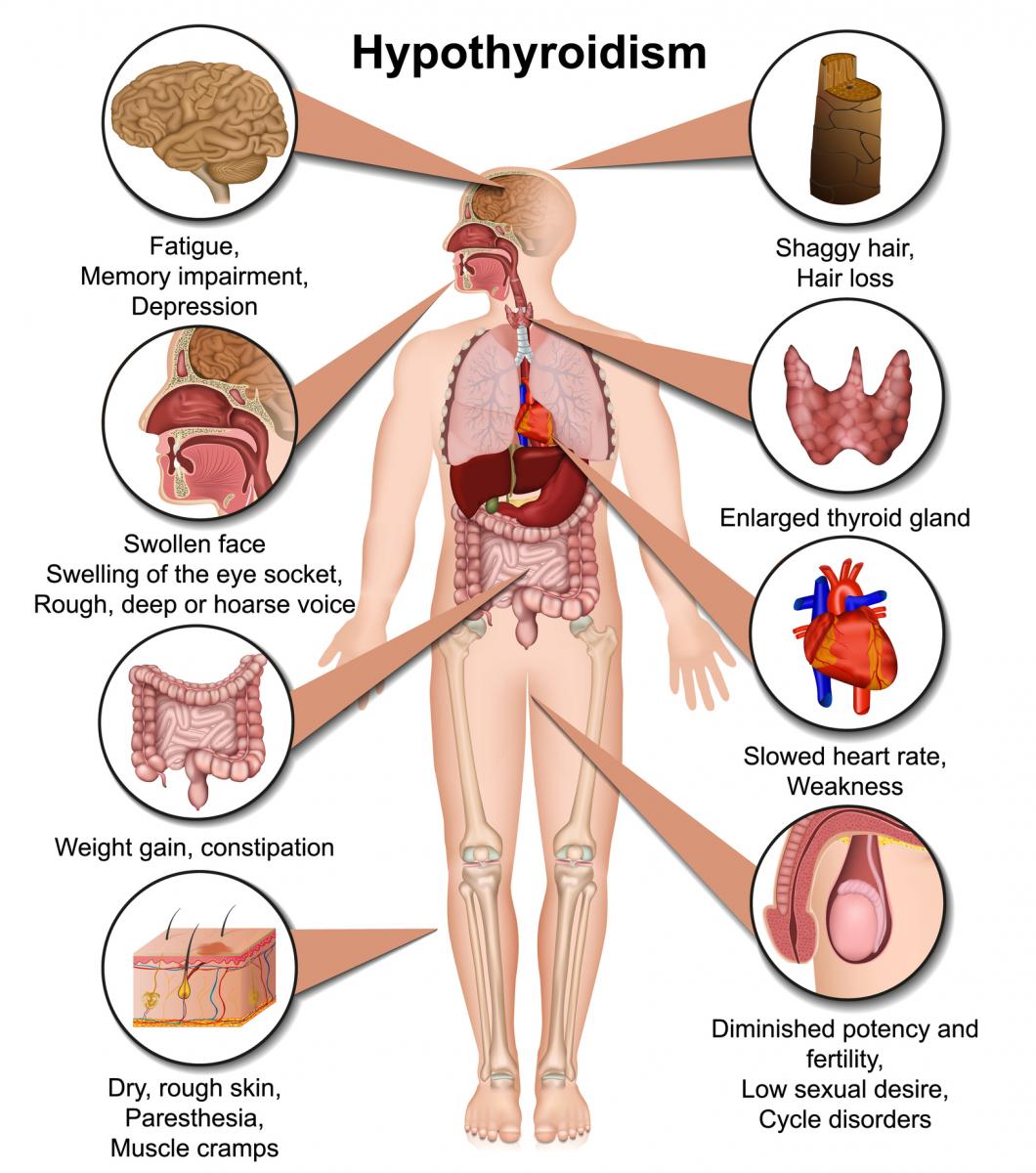
Figure: Symptoms of Hypothyroidism
Suspected agent(s): Ethionamide (Eto), Para Aminosalicylic Acid (PAS)
Suggested Management Strategies:
- In cases of hypothyroidism, the opinion of a general physician/ endocrinologist may be taken.
- Eto /PAS can be continued with the introduction of thyroxine.
Points to Note
- Symptoms of hypothyroidism include fatigue, somnolence, cold intolerance, dry skin, coarse hair and constipation, as well as occasional depression and inability to concentrate (Figure above).
- In cases with abnormal weight gain, hypothyroidism may be ruled out.
- It is completely reversible upon discontinuation of PAS and/or Eto.
- Combination of Eto with PAS is more frequently associated with hypothyroidism than when each individual drug is used.
Resources
- Guidelines for Programmatic Management of Drug-resistant Tuberculosis in India, March 2021.
- Ready Reckoner for Medical Officer - Adverse Drug Reactions Associated with Anti-TB Drugs Identification and Management, 2019.
- Technical and Operational Guidelines for TB in India, 2016.
Kindly provide your valuable feedback on the page to the link provided HERE
Management of DR-TB ADR: Arthralgia
ContentAdverse Drug Reactions (ADRs), such as arthralgia, may occur from the Drug-resistant TB (DR-TB) treatment regimen.
Suspected agent(s): Pyrazinamide (Z), Fluoroquinolone (FQ), Bedaquiline (Bdq)
Suggested Management Strategies
- Initiate with paracetamol in the beginning.
- Treatment with non-steroidal anti-inflammatory drugs (Indomethacin 50 mg twice daily or Ibuprofen 400 to 800 mg three times a day).
- Lower the dose of the suspected agent (most commonly Z) if this can be done without compromising the regimen.
- Discontinue the suspected agent if this can be done without compromising the regimen.
Points to Note
- Symptoms of arthralgia generally diminish over time, even without intervention.
- Uric acid levels may be elevated in patients on Z.
- There is little evidence to support the addition of Allopurinol for arthralgia. However, if gout is present, it should be used.
- If acute swelling, redness, and warmth are present in a joint, consider aspiration for diagnosis of gout, infections, autoimmune diseases, etc.
Resources
- Guidelines for Programmatic Management of Drug-resistant Tuberculosis in India, March 2021.
- Ready Reckoner for Medical Officer - Adverse Drug Reactions Associated with Anti-TB Drugs Identification and Management, 2019.
- Technical and Operational Guidelines for TB in India, 2016.
Kindly provide your valuable feedback on the page to the link provided HERE
Management of DR-TB ADR: Peripheral Neuropathy
ContentSerious Adverse Drug Reaction (ADR), such as peripheral neuropathy, may occur during Drug-resistant TB (DR-TB) treatment.
Suspected agent(s): Linezolid (Lzd), Cycloserine (Cs), Isoniazid (H), Amikacin (Am), Fluoroquinolone (FQ), rarely Ethionamide (Eto), Ethambutol (E)
Suggested Management Strategies
- To prevent the occurrence of such adverse reactions, all patients on Multidrug-resistant TB (MDR-TB) medicines should receive pyridoxine daily.
- The commonest offending agent is Linezolid (Lzd), almost 60–70% of patients on Lzd 600 mg/day may develop neuropathy and pyridoxine does not help in preventing Lzd-induced neuropathy. Early recognition of neuropathy symptoms and early dose reduction of Lzd helps to prevent progression.
- If there is no improvement or symptoms worsen, Amitriptyline 25 mg will be added (to be avoided with Bdq).
- Correct any vitamin or nutritional deficiencies and increase pyridoxine to the maximum daily dose (100 mg per day).
- Consider whether the dose of Cs can be reduced without compromising the regimen. If H is being used (especially high dose Isoniazid (Hh)), consider stopping it.
Medical Treatment of Peripheral Neuropathy
- Non-steroidal anti-inflammatory drugs or acetaminophen may help to alleviate symptoms.
- Treatment with tricyclic antidepressants, such as amitriptyline (start with 25 mg at bedtime, the dose may be increased to a maximum of 150 mg), can be tried.
- Do not use tricyclic antidepressants with selective serotonin reuptake inhibitors and Bedaquilin (Bdq).
- Medication can be discontinued (rarely), only if an alternative drug is available and the regimen is not compromised.
Points to Note
- Patients with comorbid diseases (diabetes, HIV, alcohol dependence) are likely to develop peripheral neuropathy.
- Neuropathy associated with Lzd is common after prolonged use and may be irreversible. Thus, suspension of this drug should be strongly considered when neuropathy persists despite the above measures.
Resources
- Guidelines for Programmatic Management of Drug-resistant Tuberculosis in India, March 2021.
- Ready Reckoner for Medical Officer - Adverse Drug Reactions Associated with Anti-TB Drugs Identification and Management, 2019.
Kindly provide your valuable feedback on the page to the link provided HERE
Management of DR-TB ADR: Psychotic Symptoms
ContentAdverse Drug Reactions (ADRs), such as psychotic symptoms, may occur from the Drug-resistant TB (DR-TB) treatment regimen.
Suspected agent(s): Cycloserine (Cs), Isoniazid (H), Fluoroquinolone (FQ)
Suggested Management Strategies
- Stop the suspected agent for a short period (1-4 weeks) while the psychotic symptoms are brought under control.
- The most likely drug is Cs followed by high dose isoniazid (Hh). Lower the dose/ discontinue the suspected agent (if it can be done without compromising the regimen).
- If moderate to severe symptoms persist, initiate antipsychotic treatment (haloperidol).
- Hospitalize in a ward with psychiatric expertise if the patient is at risk to hurt himself/ herself or others.
- Once all the symptoms resolve and the patient is off Cs, antipsychotic treatment can be tapered off.
- If Cs is continued at a lower dose, antipsychotic treatment may need to be continued and any attempts of tapering off should be done after referring to a psychiatrist trained in the adverse effects of second-line anti-TB drugs.
Point to Note
- Some patients will be required to continue antipsychotic treatment.
- A previous history of psychiatric disease is not an absolute contraindication to Cs, but its use may increase the likelihood of psychotic symptoms that are found to be developing during treatment.
- Some patients will tolerate Cs with an antipsychotic drug, but this should be done in consultation with a psychiatrist as these patients will be required to be under special observation; this should be done only when there is no other alternative.
- Psychotic symptoms are generally reversible upon completion of DR-TB treatment or cessation of the offending agent.
- Always check creatinine in patients with new-onset psychosis. A decrease in renal function can result in high blood levels of Cs, which can cause psychosis.
Resources
- Guidelines for Programmatic Management of Drug-resistant Tuberculosis in India, March 2021.
- Ready Reckoner for Medical Officer - Adverse Drug Reactions Associated with Anti-TB Drugs Identification and Management, 2019.
- Technical and Operational Guidelines for TB in India, 2016.
Kindly provide your valuable feedback on the page to the link provided HERE
Management of DR-TB ADR: Nephrotoxicity [Renal Toxicity]
ContentAdverse Drug Reactions (ADRs), such as renal toxicity, may occur from the Drug-resistant TB (DR-TB) treatment regimen.
Suspected agent(s): Amikacin (Am)
- Prior to starting the treatment, all patients will have their renal function evaluated.
- During the treatment of DR-TB, if the patient presents with symptoms and/or signs of renal impairment (oliguria, anuria, puffiness of face, pedal oedema), all the drugs should be withheld; renal function tests should be done and, if required, the opinion of a nephrologist should be sought.
- The re-introduction of drugs will be undertaken by the DR-TB centre committee in consultation with a nephrologist, along with frequent monitoring of renal parameters.
Suggested Management Strategies
- Discontinue the suspected agent.
- Consider using Capreomycin (Cm) if Aminoglycoside was the prior injectable drug in the regimen.
- Consider other contributing etiologies (non-steroidal anti-inflammatory drugs, diabetes, other medications, dehydration, congestive heart failure, urinary obstruction, etc.) and address as indicated.
- Follow creatinine (and electrolyte) levels closely, every 1–2 weeks.
- Consider dosing the injectable agent 2-3 times a week if the drug is essential to the regimen and the patient can tolerate it (close monitoring of creatinine).
- If creatinine continues to rise despite twice/ thrice a week dosing, suspend the injectable agent.
- Adjust all TB medication according to creatinine clearance in consultation with a nephrologist.
- Also, note that renal impairment may be permanent.
Points to Note
- During treatment, blood urea and serum creatinine should be done every month for the first three months after treatment initiation and then every three months thereafter whilst injection Am is being administered. Salient renal toxicity may be picked up by these routine follow-up biochemical examinations.
- If at any time, the blood urea or serum creatinine becomes abnormal, treatment should be withheld and further management is decided upon in consultation with the DR-TB centre committee.
- History of diabetes or renal disease is not a contraindication to the use of agents listed here, although patients with these comorbidities may be at an increased risk for developing acute kidney injury.
Resources
- Guidelines for Programmatic Management of Drug-resistant Tuberculosis in India, March 2021.
- Ready Reckoner for Medical Officer - Adverse Drug Reactions Associated with Anti-TB Drugs Identification and Management, 2019.
- Technical and Operational Guidelines for TB in India, 2016.
Kindly provide your valuable feedback on the page to the link provided HERE
Management of DR-TB ADR: Vestibular Toxicity
ContentVestibular toxicity is one of the Adverse Drug Reactions (ADRs) that results in damage of the balance structure in the inner ear leading to loss of balance for the patient.
Suspected agent(s): Amikacin (Am), Cycloserine (Cs), Fluoroquinolones (FQs), Isoniazid (H), Ethionamide (Eto), Linezolid (Lzd)
Suggested Management Strategies
- If early symptoms of vestibular toxicity appear, there may be a need to change the dosing of the injectable agent to twice/ thrice a week.
- Consider using Capreomycin (Cm) if an aminoglycoside was the prior injectable in the regimen.
- If tinnitus and unsteadiness worsen with the above adjustment, stop the injectable agent.
- This is one of the few adverse events that may cause permanent intolerable toxicity and can necessitate the discontinuation of a class of agents.
Points to Note
- Ask the patient about tinnitus and unsteadiness every week, especially in elderly patients.
- Fullness in the ears and intermittent ringing are early symptoms of vestibular toxicity.
- A degree of disequilibrium can be caused by Cs, FQs, Eto, H or Lzd.
- Some clinicians will stop all drugs for several days to see if symptoms are attributed to these drugs.
- Symptoms of vestibular toxicity generally do not improve on withholding medications.
Resources
- Guidelines for Programmatic Management of Drug-resistant Tuberculosis in India, March 2021.
- Ready Reckoner for Medical Officers - Adverse Drug Reactions Associated with Anti-TB Drugs Identification and Management, 2019.
Kindly provide your valuable feedback on the page to the link provided HERE
-
DR-TB HIV Coordinator: TB Infection treatment and care
FullscreenTesting for TB Infection
ContentFor TB infection, there are two recommended tests which can be used to identify such patients.
Tuberculin Skin Test (TST)
The skin test is done by injecting a small amount (0.5 ml) of TB antigens into the top layer of skin on your inner forearm. If one has ever been exposed to TB bacteria (Mycobacterium tuberculosis), there will be a reaction indicated by the development of a firm red bump (induration) >= 10 mm at the site within 2 days.
Image
Figure: Tuberculin Skin Test
Interferon-gamma release assay (IGRA)
IGRA is a Blood test. If one has been exposed to TB bacteria, the white blood cell in the blood will release a substance called gamma interferon when the cells are exposed to specific TB antigens.
Image
Figure: Interferon-gamma release assay (IGRA)
Resources:
- Latent Tuberculosis Infection Guideline
- Guideline for Programmatic Management of Tuberculosis Preventive Treatment in India
Kindly provide your valuable feedback on the page to the link provided HERE
TB Preventive Therapy
ContentTPT treatment options recommended under NTEP include:
- 3-month weekly Isoniazid and Rifapentine (3HP)
- 6-months daily isoniazid (6H)

Table 1: TPT Options for Target Population; Source: (Guidelines for Programmatic Management of Tuberculosis Preventive Treatment)

Table 2: TPT dosage based on age and weight band recommended by NTEP; Source: Guidelines for Programmatic Management of Tuberculosis Preventive Treatment
Resources
- Guidelines for Programmatic Management of Tuberculosis Preventive Treatment
- National Strategic Plan for TB Elimination
Assessment
Question Answer 1 Answer 2 Answer 3 Answer 4 Correct answer Correct explanation Page id Part of Pre-test Part of Post-test TPT options recommended under NTEP include which of the following? 3-month weekly Isoniazid and Rifapentine (3HP) Rifampicin 6-months daily isoniazid (6H) 1 and 3 4 TPT options recommended under NTEP include 3-month weekly Isoniazid and Rifapentine (3HP) and 6-months daily isoniazid (6H). Yes Yes Eligibility for TPT
ContentThe eligibility for TB Preventive Treatment (TPT) relies on ruling out active TB among individuals and groups who are known to have a high risk of acquiring TB.
Prioritization of the target population for TPT is based on elevated risk of progression from infection to TB disease or increased likelihood of exposure to TB disease: At-risk populations include:
1. Expanded eligible group including children >5 years, adolescents and adult Household Contacts (HHC) of pulmonary* TB patients notified in Nikshay from public and private sector (*bacteriologically confirmed pulmonary TB patients will be prioritized for enumeration of the target population for TPT)
Table 1: Target Population (Expanded Eligible Groups); Source: Guidelines for Programmatic Management of Tuberculosis Preventive Treatment.

(*bacteriologically confirmed pulmonary TB patients will be prioritized for enumeration of the target population for TPT)
TPT reduces the overall risk for TB by 60-90% among People Living with HIV (PLHIV). Adults and children (>12 months) living with PLHIV should be screened for TB using a four-symptom complex and TPT can be provided to those without symptoms or after ruling out active TB in those with TB symptoms.
All HHC of pulmonary TB patients is at substantially higher risk for progression to active TB than the general population. Hence, all HHC of pulmonary TB patients, regardless of their age, should be given TPT after ruling out TB. In children HHC under 5 years of age, TPT will be offered after ruling out active TB, without testing for TB infection. In children, HHC >5 years and adults, chest X-rays and testing for TB infection would be offered wherever available.
- Expanded to other risk groups
Individuals in other risk groups include those on immunosuppressive therapy, having silicosis, on anti-TNF treatment, on dialysis, and preparing for organ or haematologic transplantation.
Systematic TB infection testing and treatment are not recommended for people with diabetes mellitus, malnutrition, smoking, or harmful alcohol abuse unless they have other risk factors for TB, such as HIV infection or a history of contact with TB patients within their household.
Table 2: Target Population (Other Risk Groups); Source: Guidelines for Programmatic Management of Tuberculosis Preventive Treatment.

Resource
Guidelines for Programmatic Management of Tuberculosis Preventive Treatment.
Assessment
Question Answer 1 Answer 2 Answer 3 Answer 4 Correct answer Correct explanation Page id Part of Pre-test Part of Post-test TPT reduces the overall risk for TB by 60-90% among People Living with HIV (PLHIV). True False 1 TPT reduces the overall risk for TB by 60-90% among People Living with HIV (PLHIV). Cascade of Care for TPT
ContentIn the cascade of care approach, all target populations (People Living with HIV (PLHIV), Household Contacts (HHCs) and other such groups) who are at risk of developing TB disease are systematically reached out, screened for TB disease and after ruling out active TB disease, provided TB Preventive Treatment (TPT) as a part of the continuum of care.
The cascade of care approach among TPT target populations is shown in Figure 1.
Image
Figure 1: Cascade of TB Preventive Treatment; Source: Guidelines for Programmatic Management of Tuberculosis Preventive Treatment, p3.
Resources:
Guidelines for Programmatic Management of Tuberculosis Preventive Treatment in India.
Assessment
Question Answer 1 Answer 2 Answer 3 Answer 4 Correct answer Correct explanation Page id Part of Pre-test Part of Post-test Which of the following is the correct TPT cascade of care? Offer upfront CBNAAT to all at-risk populations, then offer TPT based on the results. Identify at-risk populations, then offer TPT to all the people that have been identified. Identify target populations at risk of developing TB, screen them, rule-out active TB disease, and provide TPT to eligible populations. None of the above 3 The TPT cascade of care is: Identify target populations at risk of developing TB disease, screen them for TB disease, rule-out active TB disease, and provide TPT to eligible populations. Approaches for TPT implementation
ContentThere are two programmatic approaches for Tuberculosis Preventive Therapy (TPT) implementation:
1. Test-and-treat approach – This approach aims to detect TB infection among key groups for implementing TPT.
- After ruling out active TB, the beneficiary is tested for TB infection.
- TPT is offered only to those with a positive test (Interferon Gamma Release Assay (IGRA)/ Tuberculin Skin Test (TST)/ Cutaneous TB (C-TB))
2. Treat-only approach – For certain groups, like People Living with HIV (PLHIV) and House Hold Contacts (HHC) < 5 years old, detecting TB infection is not required. Hence, this approach is given.
- After ruling out active TB, TPT is offered without testing for TB infection.
Test and treat approach*
- HHC of sputum positive Pulmonary TB >/= 5 years old
- Individuals on:
- Immunosuppressive therapy
- Having silicosis
- On anti-TumourTNF treatment
- On dialysis
- Preparing for solid organ or haematopoietic stem cell transplantation
Treat-only approach
- HHC of sputum positive Pulmonary TB (PTB) < 5 years old
- PLHIV#
*All efforts should be made to make IGRA available. However, TPT should not be withheld in case of non-availability of IGRA.
#PLHIV < 1 year old are offered TPT only if they are a household contact of an active TB case.
Resources
Assessment
Question
Answer 1
Answer 2
Answer 3
Answer 4
Correct answer
Correct explanation
Page id
Part of Pre-test
Part of Post-test
Which of the following category of TPT beneficiaries is offered TPT without IGRA testing?
Household contacts of sputum positive PTB >/= 5 years old
PLHIV
Patient on dialysis
Silicosis patient
2
PLHIV and HHC of sputum positive PTB < 5 years old are offered TPT without testing for IGRA. This is called Treat-only approach.
Yes
Yes
Counselling for IGRA/TST
ContentInterferon Gamma Release Assay (IGRA) and Tuberculin Skin Tests (TST) are performed on individuals who are ruled out for active TB disease.
However, positive and negative tests in IGRA and TST do not necessarily mean the patient does or does not have Tuberculosis Infection (TBI) as the possibility of false positives and false negatives cannot be ruled out in these tests.
Importance of Counselling in IGRA/ TST
- All patients who undergo IGRA/ TST are already aware that they do not have an active TB disease and hence counselling is important to help them make informed decisions about undergoing IGRA/ TST for detecting TBI.
- Additionally, at the time of receiving positive IGRA/ TST results, they may be symptom-free or otherwise healthy. In such cases, resistance/denial to receive a prophylactic treatment like TB Preventive Therapy (TPT) is higher as its treatment course duration also is relatively longer.
- Counselling in IGRA/ TST is of utmost importance when the respective person belongs to the high-risk population and needs to be necessarily initiated on TPT and thus needs to be counselled for the same.
Components of Counselling in IGRA/ TST
- Information on TBI
- Need for undergoing IGRA/ TST
- Importance of initiating TPT post-IGRA/ TST tests
- If initiated on treatment, then schedule of medication
- Medication adherence support
- Follow-up
- Importance of completing the TPT course, adverse events
Resources
- Guidelines for Programmatic Management of Tuberculosis Preventive Treatment in India, CTD, MoHFW, India, 2021.
- Guidelines for Programmatic Management of Drug-resistant Tuberculosis in India, CTD, MoHFW, India, 2021.
Assessment
Question
Answer 1
Answer 2
Answer 3
Answer 4
Correct answer
Correct explanation
Page id
Part of Pre-test
Part of Post-test
Counselling for IGRA/ TST should necessarily include which of the following?
Counselling on DR-TB
Counselling on TB Infection (TBI)
Counselling on DBT
None of the above
2
Counselling for IGRA/ TST should necessarily include ‘Counselling on TB infection (TBI)’.
Yes
Yes
Counselling for TPT
ContentCounselling is of paramount importance for TB Preventive Treatment (TPT) initiation and completion as most of the target population screened and found eligible would know that they do not have TB disease, would be symptom-free or otherwise healthy and would not feel the need to take any treatment, especially Household Contacts (HHC).
Stakeholders Involved in Counselling for TPT (Figure below)

Figure: Stakeholders involved in counselling for TPT
Abbr: HWCs: Health and Wellness Centres; PHC: Primary Health Centre; ICTC: Integrated Counselling and Testing Centres; ART: Anti-retroviral Therapy; PLHIV: People Living with HIV
Components of Counselling for TPT
While counselling the person and family members, the treating doctors/ staff must follow the steps outlined in the table below for an effective counselling session.
Component
Actions to be taken
Confidentiality
Ensure confidentiality when seeking a person’s commitment to complete the course before initiating TPT.
Information
Provide information on:
- TB infection
- Need for TPT and protective benefits to the individual, household and wider community
- TPT is available free of charge under National Tuberculosis Elimination Programme (NTEP)
- TPT regimen prescribed, including duration, schedule of medication collection, and directions on how to take the medications
- Potential side-effects and adverse events involved and what to do in the event of various side-effects. People treated with rifamycins should be alerted in advance about the pink discolouration of secretions due to this medicine
- Importance of completing the full course of TPT
- Reasons and schedule of regular clinical and laboratory follow-up for treatment and monitoring
- Signs and symptoms of TB and advise on steps if they develop them
Medication adherence support
Agree on the best way to support treatment adherence, including the most suitable location for drug intake and the need for a treatment supporter, if required.
Family support
Involve family members and caregivers in health education when possible.
Openness
Invite clarification questions and provide clear and simple answers.
Information, Education and Communication materials
- Provide information materials in the local language and at the appropriate literacy level of the person concerned.
- Reinforce supportive educational messages at each contact during treatment.
Call support (in case of emergencies)
Provide a telephone number of the HCW staff/ TB Health Visitors and Senior Treatment Supervisors concerned to call for other queries or a need to contact health services for advice.
The National TB Elimination Programme (NTEP) national call centre (NIKSHAY SAMPARK – Toll-free number 1800116666) may be provided to index TB patients, those initiated on TPT and family members to serve as a resource for information, counselling and troubleshooting as required to enable TPT initiation, follow-up monitoring and completion.
Resources:
Guidelines for Programmatic Management of Tuberculosis Preventive Treatment in India.
Assessment
Question
Answer 1
Answer 2
Answer 3
Answer 4
Correct answer
Correct explanation
Page id
Part of Pre-test
Part of Post-test
Which of the following people are involved when counselling for TPT?
Index TB patients
Caregivers
Family members
All of the above
4
When counselling persons eligible for TPT, it is best to involve the index TB patients, their families and caregivers.
Yes Yes Monitoring adherence to TPT
ContentTo achieve high treatment completion rates and the desired epidemiological impact of the TB Preventive Treatment (TPT), monitoring TPT treatment adherence, including management of missed doses and Adverse Drug Reactions (ADRs), is of paramount importance under the National TB Elimination Programme (NTEP).
Significance of Monitoring Adherence to TPT
Adherence to the TPT course and treatment completion are important determinants of clinical benefit, both at the individual and population levels as:
- Irregular or inadequate treatment reduces the protective efficacy of the TPT regimen.
- Poor adherence or early cessation of TPT can potentially increase the risk of the individual developing TB, including drug-resistant TB.
- Efficacy of TPT is greatest if at least 80% of the doses are taken within the duration of the regimen. The total number of doses taken is also a key determinant of the extent of TB prevention.

Figure: Strategies to Promote Adherence
Prevent TB India App and Integration with Nikshay as a Monitoring Tool
- Currently, under the NTEP, the person’s lifecycle approach and TB treatment episode level are recorded in Nikshay.
- TPT information management is integrated with this existing Nikshay approach. This includes information on screening, testing, eligibility assessment, TPT initiation, adherence monitoring and follow-up till treatment completion.
- The NTEP has adapted the World Health Organisation (WHO) Prevent TB India app and hosted it on Nikshay as an interim solution till the Nikshay TPT module is developed and fully functional.
- Health workers or treatment supporters will make entries directly into the app.
- The TPT monitoring dashboard can be accessed by various levels of supervisors using their respective Nikshay login ids using a link provided in the Nikshay Reports section on TPT Reports.
- A web-based comprehensive dashboard for Prevent TB initiative is also available at https://ltbi.nikshay.in/ltbi-generic-new/#/
Table: Roles of Stakeholders in Monitoring Adherence to TPT Role
Stakeholder
Treatment support and adherence monitoring including entry of daily doses taken in the Prevent TB India app/ Nikshay TPT module.
Community volunteers (TB survivors/ champions, Accredited Social Health Activists (ASHAs) and Anganwadi Workers)
- Regularly undertake home visits or tele/ video calls to monitor TPT adherence.
- Identify treatment interruptions at the earliest (Dashboards of Prevent TB India app/ Nikshay TPT module may be checked every week along with pill counting).
- HWCs/ sub-centre/ urban health posts (Community Health Officers (CHOs), Auxillary Nurse Midwives (ANMs), multipurpose workers and other field staff)
- Primary Health Centres (PHCs)/ Urban PHCs/ Private clinic (Medical Officers (MO), staff nurse)
- Adherence support and clinical monitoring through the concerned PHC/ sub-centre.
- Supportive supervision and handholding support to field level facilities and frontline workers, ASHAs and community volunteers on digital recording, using Prevent TB India app and monitoring TPT and follow-up examinations.
TB Unit (MO, Laboratory Technicians (LTs), staff nurse, pharmacist, counsellor (if available), Senior Treatment Supervisors (STS), Senior TB Laboroary Supervisors (STLS), TB Health Visitors (TBHV))
Ensuring adherence support for People Living with HIV (PLHIV) on TPT through mechanisms such as outreach workers, PLHIV networks, peer support groups, etc.
Anti Retroviral Therapy (ART) centre/ Link ART centre (MO, pharmacist, (institutional) staff nurse, counsellor, care coordinator)
Monitor and support adherence to TPT.
Tertiary care/ Medical colleges/ Corporate hospitals/ District hospitals/ Dialysis/ Cancer facilities (doctors, staff nurses)
Review data updating in Prevent TB India app/ Nikshay TPT module wherever available, check the quality of data regularly and provide feedback to TPT treatment supporters and for retrieval of TPT interrupters.
Supervisory staff at all health facilities including the State/ District TB cell (State TB Officers (STO), District TB Officers (DTO), State/ District Programme Coordinators)
Resources:
- Guidelines for Programmatic Management of Tuberculosis Preventive Treatment.
- Prevent TB Dashboard.
- Prevent TB India Mobile App.
Assessment
Question
Answer 1
Answer 2
Answer 3
Answer 4
Correct answer
Correct explanation
Page id
Part of Pre-test
Part of Post-test
Which tools are used to monitor TPT adherence under the NTEP?
Video calls
Counting empty blisters
Directly asking the patient
Options 1 and 2
4
TPT adherence monitoring tools include direct observation of drug intake, 99DOTS/ MERM, counting empty blisters, tele/ video calls and refill monitoring.
Which of the following apps are currently used by NTEP to monitor TPT adherence?
TB Aarogya Sathi
Prevent TB India App
TPT app for NTEP
None of the above
2
NTEP has adapted the WHO Prevent TB India app and hosted it on Nikshay to monitor the entire TPT care cascade, including TPT adherence.
Preventive Treatment for Contacts of DR-TB Patients: WHO Recommendations
ContentThe World Health Organisation (WHO) recommends Tuberculosis Preventive Treatment (TPT) among contacts exposed to Multidrug-resistant TB (MDR-TB) with Fluoroquinolone (FQ)-sensitive, or Isoniazid (H)-resistant with Rifampicin (R) sensitive DR-TB patients.
Points to be Considered Before TPT Initiation
- The preventive treatment should be individualized after a careful assessment of the intensity of exposure of contact with the index case.
- Confirm the source patient and her/his drug resistance pattern bacteriologically.
- Ascertain Latent TB Infection (LTBI) using Interferon Gamma Release Assay (IGRA) or Tuberculin Skin Tests (TST).
Table: WHO's TPT Regimen Recommendation
TPT REGIMEN
ELIGIBLE POPULATION
6Lfx (six-month Levofloxacin)
Among contacts exposed to patients with known MDR and FQ-sensitive TB
6H (six-month Isoniazid)
Among contacts of H-susceptible TB in confirmed R-resistant TB index patient
4R (four-month Rifampicin)
Among contacts with known H-resistant and R-sensitive TB
Regardless of whether treatment is given or not, clinical follow-up should be done for two years.
Any emergent signs and symptoms suggestive of TB should be actively investigated and curative regimens started, as needed.
Resources
- Guidelines for Programmatic Management of Drug-resistant Tuberculosis in India, March 2021.
- Consolidated Guidelines on Tuberculosis: Module 1: Prevention: Tuberculosis Preventive Treatment, 2020.
- Latent TB Infection: Updated and Consolidated Guidelines for Programmatic Management, WHO, 2018.
Kindly provide your valuable feedback on the page to the link provided HERE
Screening among Household Contacts of DR-TB Patients
ContentThe National TB Elimination Programme (NTEP) follows an integrated algorithm for screening and ruling out active Tuberculosis (TB) among Household Contacts (HHCs) of Drug-resistant Tuberculosis (DR-TB) patients.
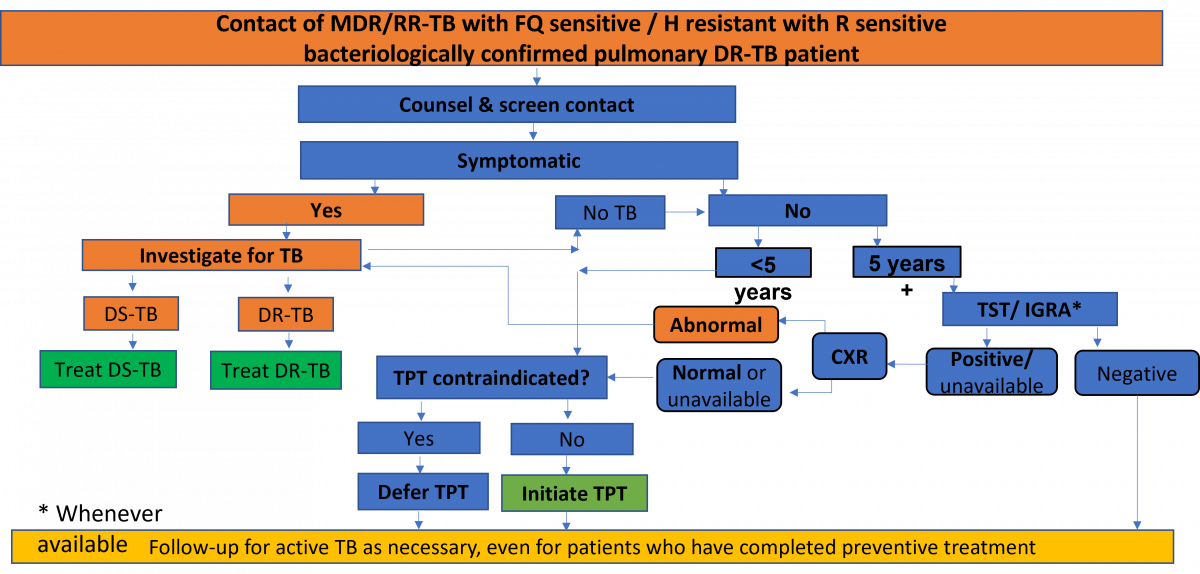
Figure: Integrated Algorithm for Screening and Ruling out Active TB among HHCs of DR-TB Patients; Source: Guidelines for PMDT in India, 2021, p118.
Abbr: MDR/RR-TB: Multidrug-resistant/ Rifampicin-resistant TB; FQ: Fluoroquinolone; h: Isoniazid; R: Rifampicin; DR-TB: Drug-resistant TB; DS-TB: Drug-susceptible TB; TPT: TB Preventive Treatment; CXR: Chest X-ray; TST: Tuberculin Skin Tests; IGRA: Interferon Gamma Release Assay.
Salient Features of the Screening Algorithm
- Once a DR-TB patient is identified, all HHCs are counselled, screened and evaluated to rule out active TB.
- Nucleic Acid Amplification Test (NAAT) will be used up front among contacts with symptoms or abnormal Chest X-ray (CXR) to diagnose TB.
- If the result is Mycobacterium tuberculosis (MTB) detected with no resistance, the treatment for Drug-sensitive TB (DS-TB) is initiated.
- If the result is MTB detected with Isoniazid (H) and/or Rifampicin (R) resistance, manage as per DR-TB guidelines.
- If the result is MTB not detected, in HHC <5 years of age, assess for TB Preventive Treatment (TPT) and check for any contraindications.
- If the result is MTB not detected, in HHC >5 years of age with Latent TB Infection (LTBI) test positive or unavailable and CXR is normal or unavailable, check for any contraindications.
- If contraindications to TPT drugs exist, defer TPT and if no contraindication exists, offer TPT regimen as appropriate based on the Drug Susceptibility Testing (DST) pattern of the index patient
Follow-up for active TB as necessary, even for patients who have completed preventive treatment irrespective of TPT offer.
Footnotes
- HIV-positive contact: If <10 years of age, any one of current cough, fever, history of contact with TB, reported weight loss, confirmed weight loss >5% since last visit or growth curve flattening or weight for age <-2 Z-scores. Asymptomatic infants, <1 year, with HIV are only treated for LTBI if they are household contacts of a TB patient. TPT or Interferon Gamma Release Assay (IGRA) may identify People Living with HIV (PLHIV) who will benefit most from preventive treatment. CXR may be used in PLHIV on Anti-retroviral Treatment (ART), before starting TPT.
- Symptomatic HHC: Any one of cough or fever or night sweats or haemoptysis or weight loss or chest pain or shortness of breath or fatigue. Children <5 years should also be free of anorexia, failure to thrive, not eating well, decreased activity or playfulness to be considered asymptomatic.
- Other high-risk groups: Includes silicosis, dialysis, anti-TNF agent treatment, preparation for transplantation or other vulnerable risk groups where testing must precede TPT.
- Contraindication to TPT: Include acute or chronic hepatitis; peripheral neuropathy (if Isoniazid is used); regular and heavy alcohol consumption. Pregnancy or a previous history of TB are not contraindications.
- Selection of TPT regimen: Regimen is chosen based on considerations of age, strain (drug-susceptible or otherwise), risk of toxicity, availability and preferences.
- CXR may have been carried out early on as part of intensified case finding.
Resources
- Guidelines for Programmatic Management of Drug-resistant Tuberculosis in India, March 2021.
- WHO Consolidated Guidelines on Tuberculosis: Module 1: Prevention: Tuberculosis Preventive Treatment, 2020.
- Latent TB Infection: Updated and Consolidated Guidelines for Programmatic Management, WHO, 2018.
Kindly provide your valuable feedback on the page to the link provided HERE
-
-
DR-TB HIV Coordinator: Adherence Management
Fullscreen-
DR-TB HIV Coordinator: General Concepts in Adherence Management
FullscreenTB Treatment Adherence
ContentTuberculosis(TB) is curable if patients are treated with effective, uninterrupted anti-tuberculous treatment. Treatment adherence is critical for curing individual patients, controlling the spread of infection in the community, and minimizing the development of drug resistance.
Adherence to treatment means that a patient follows the recommended course of treatment by taking all the prescribed medications for the entire length of time, as necessary. In other words, “right dose for the right duration”.
In Drug Sensitive Tuberculosis(DSTB), a TB patient completes 168 doses of TB treatment and adheres to TB treatment.
Importance of Treatment adherence
ContentAdherence to tuberculosis(TB) treatment is important for promoting individual and public health. Poor adherence to TB treatment results in:
- More individual suffering and death,
- Costly treatment as treatment regimens lengthen and
- Increases the risk for Drug Resistant Tuberculosis
Proper treatment of all forms of TB is critical to reducing individual morbidity and mortality and to interrupting transmission among family and community members.
Recording and Monitoring Adherence
ContentRecording of Treatment Adherence can be done as
- Manually by DOT/Health Care Provider in TB Treatment Card of a patient.
- Self-reported by Patient using digital tools for reporting adherence using 99 DOTS and MERM technologies.
Monitoring Treatment Adherence:
All TB patients should be monitored to assess their response to TB treatment. Nikshay Adherence calendar has a colour legend for various doses taken by a patient
Figure: Sample Nikshay Adherence Calendar in web and Mobile App
COLOUR LEGEND DOSE DESCRIPTION Treatment Start /End Denotes Treatment start and End Date Digitally Reported Dose Denotes that the patient has successfully called the Toll Free Number displayed on the envelope Manually Reported Dose Indicates that the staff has marked manually confirmed dose for the day Unreported Dose Indicates that there was no call event received on Nikshay for that day Manually Reported Missed Dose Indicates that the staff has marked a manually confirmed missed dose for the day Digitally Reported(From Shared Phone Number) Indicates that the patient has been calling from a shaed number(A mobile number that is common for more than one patient) Image
Figure: DSTB Treatment Card (Paper)
Digital Adherence Monitoring Technologies
Content99DOTS is a low-cost digital adherence technology built-in Nikshay that uses inexpensive packaging(envelopes or stickers) with medication that enables people taking medication to engage with their treatment daily. This packaging, distributed to TB patients taking medications, has a hidden number behind perforated flaps on the external envelope; in some cases, the number may be fixed outside the medication blister or pill bottle. This number can be a toll-free number that can be called to register daily adherence or a code sent by SMS, USSD, or other communication channels. Calling or messaging the number is free!
Figure: 99 DOTS Envelope
MERM: The Medication Event Reminder Monitor(MERM) is a digital pillbox that provides daily pill-taking reminders and facilitates remote monitoring of medication adherence. This system provides visual and audible reminders for both daily dosing and refill,.transmits this data to a server so that healthcare providers can remotely visualize patients’ dosing histories to support enhanced adherence counselling.
Figure: MERM Box
Directly Observed Treatment
ContentDirectly observed treatment (DOT) is one of the key elements of the DOTS strategy. In DOT, an observer (health worker or trained community volunteer, or trained family member for selected patients) watches and supports the patient intaking their drugs. Direct observation ensures treatment adherence with the right drugs, in right doses for the right duration.
Treatment Support
ContentA person affected by TB requires support throughout the course of treatment and beyond that. The support to a TB patient is essential to ensure that s/he completes the treatment without affecting her/his quality of life (QoL). Keeping the patient as the central figure in the continuum of care, and ensuring social and personal circumstances are supportive (not only meeting immediate requirements of medical treatment) is the key to treatment support.

Figure: Key Components of Treatment Support
Resources
National Strategic Plan for Tuberculosis Elimination 2017–2025, RNTCP, 2017.
A Patient-centred Approach to TB Care, WHO, 2018.
Assessment
Question
Answer 1
Answer 2
Answer 3
Answer 4
Correct answer
Correct explanation
DOT is the only treatment support provided to TB patients.
True
False
2
Ensuring social and personal circumstances are supportive for treatment adherence and not just medical requirement is the key to treatment support.
Treatment supporter to TB Patient
ContentA Treatment Supporter can be any person such as a Medical Officer, MPWs, community volunteers working with the program etc. Even a patient’s relative or family member can be a Treatment Supporter.
As per NTEP guidelines, salaried NTEP/General Health System staff may also be assigned as treatment supporters for a patient. However, they will not be eligible for any honorarium.
A patient can only be linked to one treatment supporter at a time in Nikshay.
Assigning a TS
ContentAt treatment initiation a suitable Treatment Supporter has to be identified and assigned to the Patient.
How to identify a Treatment supporter for a patient
- The Treatment Supporter has to be acceptable and accessible to the patient and accountable to the health system.
- Should be identified in mutual consultation with the patient and provider, during pre-treatment evaluation.
- The Treatment Supporter can either be a healthcare worker, community worker/ volunteer, private practitioner or family member.
- Should be able to receive training on drug administration, adherence monitoring, ADR referrals etc., and perform these functions.
Assigning a Treatment Supporter to a Patient
Once the Treatment Supporter is identified, the patient records (Ni-kshay & treatment card) have to be updated by assigning the treatment supporter (prior registration in Ni-kshay is a pre-requisite) to the patient. See the steps below to assign a Treatment Supporter to the episode of a patient.
Treatment Supporters are eligible to receive the Treatment Supporters Honorarium as a Direct Benefit Transfer. However, to receive the DBT he/she should not be a salaried government employee.
NOTE:
- Only one Treatment Supporter can be assigned to an episode with status "OnTreatment" of the patient
- Treatment Supporters can be assigned by both the current PHI/ TU user.
- If required, a Treatment Supporter can be removed/ replaced by another Treatment Supporter anytime during the treatment.
Image
Figure: Steps to Assign a Treatment Supporter in Ni-kshay
Image
Figure: Screenshot Assigning a Treatment Supporter in Ni-kshay
Resources
- Direct Benefit Transfer Manual for National Tuberculosis Elimination Programme, Central TB Division, Ministry of Health & Family Welfare, India, 2021.
- Training Modules (5-9) for Programme Managers and Medical Officers, Central TB Division, Ministry of Health & Family Welfare, India, 2020.
Assessment
Question Answer 1 Answer 2 Answer 3 Answer 4 Correct answer Correct explanation Page id Part of Pre-test Part of Post-test When should a treatment supporter be identified assigned to a patient episode ? While declaring treatment outcomes Any time while the patient is on treatment At treatment initiation When the patient is transferred 2 Treatment Supporters are to be identified and assigned to a patient at the time of treatment initiation.
Treatment Supporters can be assigned or re-assigned anytime during treatment, but this is in-case it has not been assigned before
Yes Yes A TB-HV acting as a Treatment Supporter can receive the Treatment Supporters Honorarium. TRUE FALSE 2 TB HV is a Salaried Government Employee and hence cannot receive the Treatment Supporters Honorarium. Yes Yes To assign a Treatment Supporter to a patient, which of the following are True? The Treatment Supporter needs to be registered on Ni-kshay The Treatment Supporter should be acceptable to the patient Should be able to record and monitor adherence, ADR, administer drugs, refer to the nearest Health Facility All of the above 4 Treatment Supporter needs to fulfill all the mentioned criteria. Role of Health Volunteers
ContentHealth Volunteers
- are members of the communities where they work,
- are supported by the health system but not necessarily a part of its organization,
- and have shorter training than professional workers”

Figure: Role of Health Volunteers
Resources:
Kindly provide your valuable feedback on the page to the link provided HERE
Registering a TS in Nikshay
Treatment Support Groups
ContentTreatment Support Groups play an important role in providing treatment support to TB patients. It has been envisioned as a non-statutory body of socially responsible citizens and volunteers to provide social support to TB patients. This group goes beyond just providing treatment-related support as it also helps the community in accessing information, free and quality services and linkage to social welfare programmes without compromising confidentiality and respecting the dignity of the patient.
A good treatment support group creates a conducive environment for TB patients to access complete care without experiencing stigma and incurring out-of-pocket expenditures.

Figure: Schematic representation of the concept of treatment support groups.
Treatment Support Group (TSG): Example from Kerala
The initiative in the Pathanamthitta district of Kerala demonstrated that treatment support groups helped in minimising the loss-to-follow-up cases and better treatment outcomes. The group supported the patients in accessing information, free and quality services and social welfare programmes, thereby empowering the patients to complete the treatment successfully.
Resources
National Strategic Plan for Tuberculosis Elimination 2017–2025, RNTCP, 2017.
Assessment
Question Answer 1 Answer 2 Answer 3 Answer 4 Correct answer Correct explanation What is a treatment support group? A group of treatment supporters in the community A group of TB patients in the community A non-statutory body of citizens and volunteers to provide social support to TB patients All of the above 3 A treatment support group is a non-statutory body of citizens and volunteers to provide social support to TB patients.
-
DR-TB HIV Coordinator: Adherence Support
FullscreenRecording manual doses in Nikshay
ContentManual recording of Adherence in Nikshay:
in Nikshay, Adherence can only be recorded only if there is corresponding dispensation being issued to a Patient
Figure: Steps to record manual dose in Nikshay
Recording in Patient Treatment Card:
Figure: Filled Treatment card for TB Patient
Recording missed doses in Nikshay
ContentMissed Dose recording in Nikshay:
For recording missed doses in Nikshay, following steps should be followed:
-
DR-TB HIV Coordinator: 99 DOTS
Fullscreen99 DOTS- Features and Benefits
ContentVideo fileVideo: Features of 99 DOTS
Video fileVideo: Benefits of 99 DOTS
99 DOTS- Envelopes
ContentThe 99DOTS product consists of customised envelopes (see Figure 1) that fit around the tuberculosis medication blister pack distributed to patients.

Figure 1: 99DOTS Envelope
Universal Envelopes (Figure 2): Each adult patient gets the same sleeve, regardless of their weight band.
These are new envelopes that are currently being introduced by the program. Weight band wise envelopes will be used while the stock lasts, but new requirements by the state will be fulfilled by providing universal envelopes.
There are 2 types of these envelopes: 1 envelope for IP: Intensive Phase, and 1 envelope for CP: Continuation Phase, for both Macleods and Lupin Fixed-dose Combinations (FDCs). These envelopes are only to be used for adult patients on anti-TB treatment using FDCs.
Figure 3: Universal 99DOTS Envelopes 

Using the Universal Envelope
- The counsellor/ pharmacist/ treatment supporter write the number of pills per day the patient should take on the envelope.
- Every day, the patient will take the prescribed number of pills and reveal 1, 2, or 3 hidden phone numbers. The patient calls any one of the numbers they reveal that day.
- The patient should start at pill 1 and move in sequence (1,2,3…28), completing each column, and starting from the top of each row.
- The district should always have sufficient stock, which can be calculated as:
- Number of IP strips = Number of IP envelopes + some buffer
- Number of CP strips = Number of CP envelopes + some buffer
Advantages of the Universal Envelopes
- There is no need to estimate the requirements of weight band wise envelopes.
- Less space is required to store the envelopes.
- Stock-outs of envelopes for a particular weight band will not occur.
- It is easy for patients to follow the top to down arrow mark pattern while dispensing and ingesting medicines.
- Counselling time and dispensing time by pharmacists reduce per patient, thus increasing efficiency.
Resources:
- Nikshay 99DOTS Training Manual, 2021.
- Nikshay 99DOTS Universal Envelope Training Manual, 2021.
- 99 DOTS Website.
Assessment
Question Answer 1 Answer 2 Answer 3 Answer 4 Correct answer Correct explanation Page id Part of Pre-test Part of Post-test Which of the following is correct about 99DOTS envelopes? The envelopes have medicine inside them. The envelopes have hidden numbers that can be called by the patient. There are weight-band wise envelopes. All of the above 4 99DOTS envelopes have anti-TB medicines with hidden toll-free numbers that patients call. These envelopes can be weight-band wise or universal envelopes. For weight-band wise 99DOTS envelopes, background colours differ for each weight band. True False 1 For weight-band wise 99DOTS envelopes, background colours differ for each weight band. 99 DOTS- Envelope Dispensing Process
ContentThe 99DOTS (Directly Observed Treatment, Short-course) universal envelope is developed to avoid the complexity of weight band wise 99DOTS envelope.
The overall dispensing process is easy and can be divided into these steps:
- The patient consumes 2, 3, 4, or 5 pills per day, as per the doctor's prescription.
- One or more toll-free numbers can be seen behind the pill flap after taking out the pills every day.
- The patient takes the pill.
- The patient calls any one of the toll-free numbers seen on that day.
This call will be recorded as a consumed dose for the day.
The dispensing process is outlined in the figure below.

Figure: 99DOTS Universal envelope dispensing process
Resources:
- Nikshay 99DOTS Training Manual, 2021.
- Nikshay 99DOTS Universal Envelope Dispensing Training Manual, 2021.
Assessment
Question
Answer 1
Answer 2
Answer 3
Answer 4
Correct answer
Correct explanation
Page id
Part of Pre-test
Part of Post-test
Which of the following is the 99DOTS universal envelope dispensing process?
The patient calls the number on the envelope to ask for medicines.
Pharmacist/ treatment supporter fills the number of pills to be taken – Patient opens the pill flap, takes the pills, and reveals the hidden number – Patient calls the toll-free number.
The treatment supporter calls the medical officer to know how many pills to fill on the envelope – The pharmacist opens the pill flap to check that the medicine is in place.
All of the above
2
The 99DOTS universal envelope dispensing process is: Pharmacist/ treatment supporter fills the number of pills to be taken – Patient opens the pill flap, takes the pills, and reveals the hidden number – Patient calls the toll-free number.
99 DOTS- Initiating adherence monitoring of the patient
ContentInitiating adherence monitoring of the patient on 99DOTS (Directly Observed Treatment, Short-course) on Nikshay is done by the STS/ Health care provider initiating patient on treatment.
Registering a Patient
It is the responsibility of the STS/ Health care provider initiating patient on treatment to register the patient on the Nikshay . S/he has to make sure to enter all the phone numbers of the patient and to keep them updated. They also add the complete address where the patient is currently residing, entering a landmark in the address field, if possible.
Before adherence monitoring can be initiated on Nikshay, the patient’s status must show that they have positive test results and have started treatment on Nikshay. After entering a positive test result for a patient, treatment is started from the “Treatment Details” tab by clicking the “Start Treatment” button, as shown in Figure 1.

Figure 1: Starting Treatment on Nikshay
How to Select 99DOTS as the Adherence Technology?
- After entering the test details of the patient, click on the “Treatment Details” tab.
- Under the “Adherence Monitoring” option, select “99DOTS” as the adherence technology and click “Start Treatment" (Figure 2).

- Once you click “Start Treatment” you will be able to see the adherence calendar of the patient under the “Adherence Tab”.

Counselling Information to be given to the Patient when Initiating 99DOTS
The counselling checklist to be followed by the National TB Elimination Programme (NTEP) staff when initiating patients on 99DOTS is shown in the table below.

Resources:
- Nikshay 99DOTS NTEP Staff Training Manual, 2021.
- 99DOTS Counselling Poster, Nikshay, 2021.
- 99DOTS Patient Follow-up Counselling Checklist, Nikshay, 2021.
Assessment
Question
Answer 1
Answer 2
Answer 3
Answer 4
Correct answer
Correct explanation
Page id
Part of Pre-test
Part of Post-test
What is the correct sequence for initiating 99DOTS adherence for a patient on Nikshay?
For 99DOTS, there is no need to register the patient on Nikshay.
Register the patient – Select adherence details – Enter the test results – Enter treatment details.
Register patient name, phone number and address – Add test details – Start treatment – Select 99DOTS as the adherence mechanism – Click ‘Start treatment’ to view the adherence calendar.
None of the above
3
The correct sequence for initiating 99DOTS adherence for a patient on Nikshay is: Register patient name, phone number and address – Add test details – Start treatment – Select 99DOTS as the adherence mechanism – Click ‘Start treatment’ to view the adherence calendar.
Yes
Yes
99 DOTS- Self Reporting Adherence
ContentSelf-reporting adherence by dispensing pills and calling toll-free numbers
When patients dispense pills, they break through perforated flaps on the back of the envelope, revealing a hidden, unpredictable phone number.

Patients use an ordinary phone (usually their own or a relative’s) to place a free call to this number, which a computer answers, says “Thank You”, and hangs up.
Important information to tell patients about calling the toll-free number:
- Make a free call (from a mobile or landline phone) on any one of the toll-free numbers revealed every day.
- Don’t add ‘0’ or ’91’ before the toll-free number.
- The call can be made with no balance and from any city and anytime (no roaming charges).
- A call for a day’s medication must be made on the same day.
- Make calls only from the phone (mobile/ landline) numbers given to the centre (and registered on Nikshay).
- Do not cut the call till you hear “Thank You”.

From this simple interaction — the combination of the patient’s registered caller ID on Nikshay and the sequence of unpredictable numbers that they call over time — healthcare workers can monitor when pills were dispensed and likely taken.
In addition to this mechanism for self-reporting adherence, 99DOTS also supplies supporting Information, Communication and Technology (ICT) tools (Nikshay, 99DOTS platform) for health workers, enabling them to efficiently monitor and respond to any missed doses.
If a patient does not call 99DOTS on any given day, they receive an escalating series of dosage reminders. First, an automated SMS message is sent. If additional doses are missed, the patient can expect a personal outreach from a health worker, either via a phone call or a home visit.
Resources:
Assessment
Question
Answer 1
Answer 2
Answer 3
Answer 4
Correct answer
Correct explanation
Page id
Part of Pre-test
Part of Post-test
99DOTS is a digital adherence technology that allows for self-reporting adherence by the patient.
True
False
1
99DOTS is a digital adherence technology that allows for self-reporting adherence by the patient.
99 DOTS- Troubleshooting
ContentWhenever a patient calls a toll-free line on the 99DOTS (Directly Observed Treatment, Short Course) envelope, they should have the following experience:
- The call is answered immediately.
- A brief "thank you" message is played.
- The call hangs up automatically.
In total, the call is less than two seconds long. After this sequence, the Nikshay adherence dashboard will be updated with the adherence details.
Patients may sometimes face issues with the toll-free lines. In such cases, the healthcare worker must try to understand the challenge and help the patient to resolve the issue. The table below shows common issues with the toll-free lines and their solutions.
Issues
Solutions
The patient dials the toll-free number and hears “Thank You”, but the Nikshay dashboard is still showing red.
- Ask the patient to give a missed call to your phone. Check that it is the same number that is registered in Nikshay. If there is a data entry error in the registered phone number, correct the number in Nikshay.
- The patient might also have a dual SIM phone or another alternative phone number. If another number is being used by the patient, add the number in Nikshay.
The patient dials the toll-free number but hears an out-of-service voice message.
- Visit the patient and check the balance in the pre-paid phone connection.
- If it is negative, the call cannot be made.
- The call can be made with zero or more balance in pre-paid connections.
- In post-paid connections, if the bill is not paid, the patient cannot dial the toll-free number.
The patient dials the toll-free number but hears “Please check the number”, “Invalid number”, or “Number not in use” voice messages.
- Ask the patient to dial the number.
- Check that they are dialling the entire number, without adding ‘0’, ‘91’, or ‘+91’ and they should not cut the call till they hear “Thank You”.
The patient says that their pre-paid balance is deducted after dialling the toll-free number.
- Ask the patient to make a toll-free call.
- Check the balance SMS they receive. The last call charge will show as Rs.0.00 and the total balance will also be shown.
The patient has very little or zero balance, dials the toll-free number and hears a long message regarding less or zero balance.
- When the balance in the pre-paid connection is very little or zero, the patient might hear a long message from the telecom service provider.
- Request the patient to wait for that voice message to end. On completion of this voice message, the toll-free number will be dialled, and the patient will hear “Thank You”.
The patient dials the toll-free number but cannot hear anything or “Thank You” is not heard.
- Request the patient to try multiple times.
- At times, due to network congestion, the call may not go through, just like any other mobile number.
- You can also try dialling the same toll-free number from your phone, to check that the toll-free line is working.
The patient says that they are not able to connect to the toll-free lines after 1:00 PM or 3:00 PM.
- The toll-free calls can be made till 11:59 PM for the current day’s dose. The timing restriction is only for the SMS alerts.
- Educate the patient that if they do not call by 1:00 PM they will get an SMS reminder.
- Even after that, if they do not call till 3:00 PM the staff will get an SMS alert.
- They can still call after 3:00 PM till 11:59 PM. The moment they call, the dashboard will turn green.
- It is only at 12:00 AM (midnight) that the dashboard turns red.
Resources:
Assessment
Question
Answer 1
Answer 2
Answer 3
Answer 4
Correct answer
Correct explanation
Page id
Part of Pre-test
Part of Post-test
What should be done if a patient dials the 99DOTS toll-free number and hears “Thank You”, but the Nikshay dashboard is still showing red?
Tell the patient that they lied as they did not take their medication.
Check that there are no errors in the patient’s phone number on Nikshay.
Check if the patient used an alternative number to call the toll-free line and register this dual line on Nikshay.
Options 2 and 3
4
If a patient dials the 99DOTS toll-free number and hears “Thank You”, but the Nikshay dashboard is still showing red, then: Check that there are no errors in the patient’s phone number on Nikshay, also check if the patient used an alternative number to call the toll-free line and register this number on Nikshay.
-
DR-TB HIV Coordinator: MERM Boxes
FullscreenMedication Event Reminder Monitor [MERM] Boxes
ContentThe Medication Event Reminder Monitor (MERM) is a digital pillbox that has been designed to monitor Multidrug-resistant TB (MDR-TB) treatment in resource-constrained settings, using relatively affordable technology and drugs provided by the National TB Elimination Programme (NTEP).
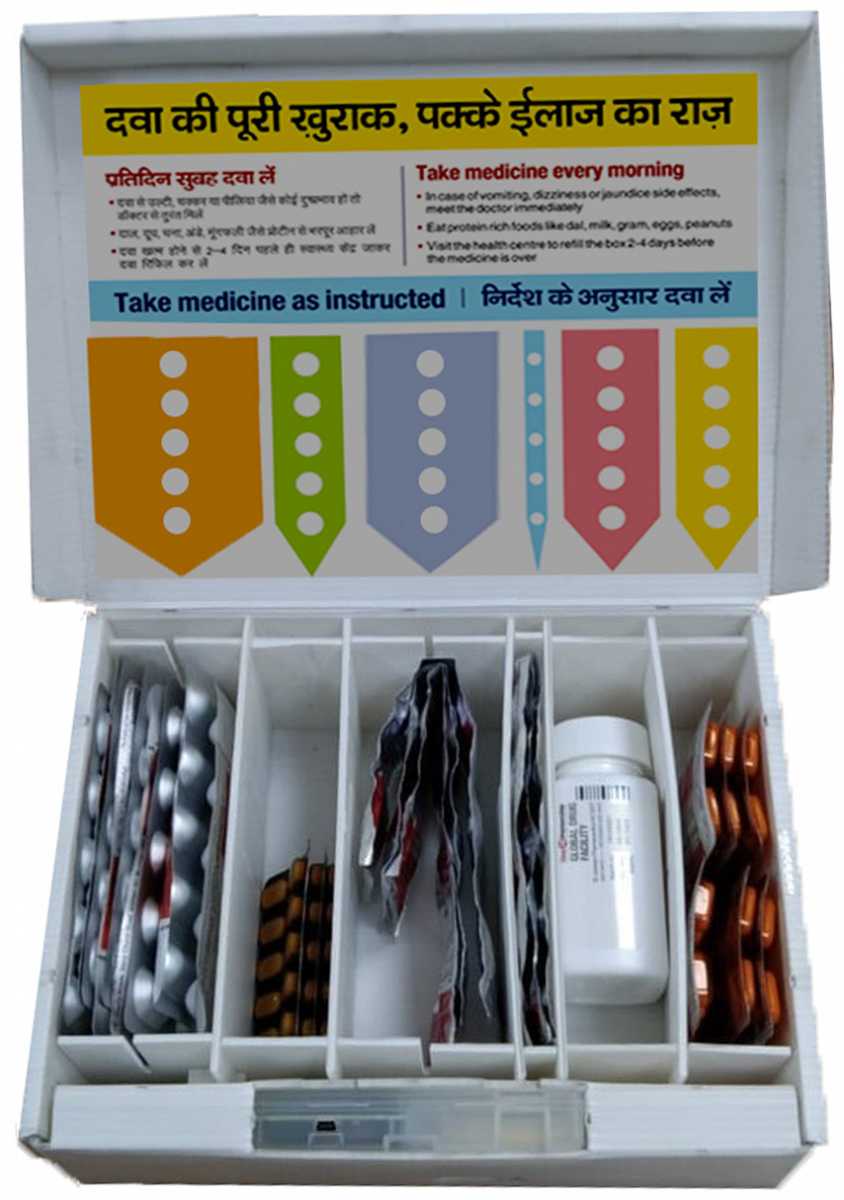
Figure: MERM Container for Shorter/ Longer Oral MDR-TB Regimen; Source: Guidelines for PMDT in India, 2021, p143.
- This system is specifically designed to be used with multiple blister-packaged TB medications in Drug-resistant TB (DR-TB) regimens.
- The MERM provides programmable visual and audible reminders of daily dosing and monthly refill by capturing data on pillbox opening as a proxy for dose ingestion.
- It transmits these data to a server so that Healthcare Providers (HCPs)/ treatment supporters can remotely visualize patients’ dosing histories to support enhanced adherence counselling.
- In addition, by providing near real-time adherence data, the MERM can facilitate the identification of high-risk patients and prompt early intervention by HCPs to reduce non-adherence.
- When compared to facility-based Directly Observed Therapy (DOT) in which patients travel to clinics to be observed taking their medications, monitoring using the MERM may also reduce the required frequency of patient visits to TB clinics.
Resources
- Guidelines for Programmatic Management of Drug-resistant Tuberculosis in India, March 2021.
- Standard Operating Procedure Manual - Procurement & Supply Chain Management, MOHFW, GOI.
Kindly provide your valuable feedback on the page to the link provided HERE
MERM Box: Components
ContentVideo fileVideo: MERM Box: Components
MERM Box: Dosing reminder
ContentVideo fileVideo: MERM Box: Dosing reminder
MERM Box: Medication Refill Reminder
ContentVideo fileVideo: MERM Box: Medication Refill Reminder
MERM Box: Low Battery alert
ContentVideo fileVideo: MERM Box: Low Battery alert
MERM Box: Patient Counselling
ContentVideo fileVideo: MERM Box: Patient Counselling
MERM Box: Box Assembly
ContentVideo fileVideo: MERM Box: Box Assembly
MERM Box: Battery Assembly and Charging
ContentVideo fileVideo: MERM Box: Battery Assembly and Charging
MERM Box: Battery Troubleshooting
ContentVideo fileVideo: MERM Box: Battery Troubleshooting
MERM Box: MERM Allocation in Nikshay
ContentVideo fileVideo: MERM Box: MERM Allocation in Nikshay
MERM Box: Setting Alarm and Refill Alarm Date
ContentVideo fileVideo: MERM Box: Setting Alarm and Refill Alarm Date
MERM Box: Allocating MERM Boxes in Mobile App
ContentVideo fileVideo: MERM Box: Allocating MERM Boxes in Mobile App
MERM Box: Last opened and Last seen
ContentVideo fileVideo: MERM Box: Last opened and Last seen
-
DR-TB HIV Coordinator: Adherence Monitoring and Follow-up Actions
FullscreenMonitoring of Adherence by NTEP Staff
Monitoring of Adherence by Pateint/TS
Adherence Summary Dashboard
ContentThe Adherence Summary dashboard is designed primarily for treatment supporters and field staff to help them monitor the day to day adherence statistics of their patients and incorporate necessary actions wherever required. This dashboard enables staff at district level hierarchies and below to view real-time adherence information of all patients on treatment.
The adherence summary dashboard is available in both Ni-kshay web portal as well as the mobile application.
Image
Figure 1: Adherence Summary Dashboard; Source: Ni-kshay Web Portal (L) and Ni-kshay Mobile Application (R)
Image
Figure 2: Adherence Summary Dashboard; Source: Ni-kshay Web Portal
Image
Figure 3: Adherence Summary Dashboard (contd.); Source: Ni-kshay Web Portal
Image
Figure 4: Adherence Summary Dashboard; Source: Ni-kshay Mobile Application
This dashboard provides a summary of the following:
- The Number of Patients currently enrolled on various Digital Adherence Technologies (99DOTS, MERM, VOT)
- Graph representing % of 'Average Adherence' of all patients on treatment
- Graph representing the % 'Digital Adherence' of all patients on treatment
- Real time update on the number of patients who have reported a dose (Digital + Manual) for the day and the number of patients who are yet to report a dose.
- Adherence Task Lists: This tab gives information on the number and proportion (%) of treatment interrupting patients based on the no. of doses missed, which helps the NTEP staff to undertake immediate actions to bring such patients back on treatment.
Resources
- Adherence Summary View, v5, Nikshay Knowledge base, India, 2022
- Ni-kshay 2.0 App User Guide, CTD, MoHFW, India, 2018.
- Adherence Monitoring in Ni-kshay Version-2.0, CTD, MoHFW, India.
Assessment
Question Answer 1 Answer 2 Answer 3 Answer 4 Correct answer Correct explanation Page id Part of Pre-test Part of Post-test Identify the correct statement from the options below Adherence summary dashboard allows viewing only digital adherence of the patients Adherence summary dashboard allows viewing only average adherence of the patients Adherence summary dashboard allows viewing both digital and average adherence of the patients. None of the above 3 Adherence summary dashboard allows viewing both digital and average adherence of the patients. Yes Yes
-
-
DR-TB HIV Coordinator: Public Health Actions
Fullscreen-
DR-TB HIV Coordinator: Patient Support
FullscreenNutritional Support
ContentNutrition constitutes an important part of TB Treatment. Undernutrition increases the risk of Tuberculosis (TB), and in turn, TB can lead to malnutrition. It has been demonstrated that undernutrition is a risk factor for progression from TB infection to active TB disease, and undernutrition at the time of diagnosis of active TB is a predictor of increased risk of death and TB relapse. There is, as yet, little evidence showing that additional nutrition support improves TB-specific outcomes, but low body mass index, as well as lack of adequate weight gain during TB treatment, are associated with an increased risk of TB relapse and death.
The following table illustrates the effect of undernutrition on outcomes in TB.
Effects on disease
- Increased severity of disease
- Increased risk of death
Effects on treatment
- Delayed sputum conversion
- Risk factor for drug-induced hepatotoxicity
- Malabsorption of rifampicin
- Reversion of positive cultures in Multidrug-resistant (MDR) -TB
Effects on long-term outcomes
- Increased rate of relapse
Effects on contacts
- Increased incidence in undernourished contacts
The basic recommendations to address the nutritional needs of TB patients are discussed below.
- Conducting an initial nutrition assessment of TB patients with further monitoring
- Providing ongoing counselling for patients on their nutritional status; Diet for TB patients starting treatment should include: cereals (maize, rice, sorghum, millets, etc.), pulses (peas, beans, lentils, etc.), oil, sugar, salt, animal products (canned fish, beef and cheese, dried fish), and dried skimmed milk
- Managing severe acute malnutrition according to national guidelines and WHO recommendations
- Managing moderate undernutrition for TB patients who fail to regain normal Body Mass Index (BMI) after two months of TB treatment or appear to lose weight during TB treatment and evaluating for proper treatment adherence and other comorbidities. If indicated, these patients should be provided with locally available nutrient-rich or fortified supplementary foods.
- Special categories of TB patients, such as:
- Children who are less than 5 years of age should be managed as any other children with moderate undernutrition.
- Pregnant women with active TB and patients with MDR-TB should be provided with locally available nutrient-rich or fortified supplementary foods.
6. Micronutrient supplementation for all pregnant women as well as lactating women with active TB. These women should be provided with iron and folic acid and other vitamin and minerals to complement their maternal micronutrient needs. In situations when calcium intake is low, calcium supplementation is recommended as part of antenatal care.
To achieve the above objectives, the guidelines for nutrition for TB patients are available and a mobile application (N-TB) is available for decision-making on nutritional support for TB patients.
Improving nutritional status at a population level is important for TB prevention which should be part of broader actions on social determinants. All efforts should be made to link TB patients for nutritional support which can be done through the existing public distribution system, local self-government or Non-governmental Organisations (NGOs)or donor agencies or through the corporate sector under Corporate Social Responsibility (CSR).
Resources
- Guideline: Nutritional Care and Support for Patients with Tuberculosis, WHO, 2013.
- Guidance Document: Nutritional Care and Support for Patients with Tuberculosis in India, MoHFW, WHO, CTD, 2017.
- Training Modules (1-4) For Programme Managers & Medical Officer NTEP, CTD, WHO, MoHFW, 2020.
- Guidelines for Programmatic Management of Drug-resistant Tuberculosis in India, MoHFW, WHO, 2021.
Assessment
Question 1
Answer 1
Answer 2
Answer 3
Answer 4
Correct Answer
Correct Explanation
Page id
Part of Pre-Test
Part of Post-Test
Undernutrition doesn’t affect the outcomes of TB.
True
False
2
Undernutrition affects the outcomes of TB in terms of treatment.
Psychosocial Support to TB Patients
ContentWho can provide Psychosocial support?
Family Members, Peer groups, treatment support groups, TB Champions, Community Health Volunteers(CHVs) and NGOs can provide psychosocial support to TB patients and their families by:
- Building a strong sense of community
- Helping the patients to contact a health worker or visit a health facility
- Providing treatment support to take their drugs and finish their treatment. Family members, community-based volunteers and workers can be trained as treatment supporters by NGOs
- Facilitating patients to access DBT for nutritional support under NPY
- Helping TB patients with comorbidities to visit the referral facility for treatment
- Treatment adherence support through peer support and education and individual follow up
- Home-based palliative care for TB
- Awareness generation, providing right information, behaviour change communication and community mobilisation for reducing stigma and discrimination
- Facilitating patients to join yoga/meditation/exercise groups once the active phase is over
- Facilitating and arranging rehabilitative services for problems/disabilities in TB patients
- Social and livelihood support
- Food supplementation
- Income-generation activities(NGO can start or facilitate patients to join activities like candle making, making festival-related goods)
- Sensitising PRIs to engage TB patients(who can work) through the Mahatma Gandhi National Rural Employment Guarantee Scheme(MGNREGS)
Support for deaddiction
ContentSubstance use has been one of the major reasons for non-adherence to TB treatment and therefore, the National TB Elimination Programme (NTEP) has implemented several initiatives for control and de-addiction of substance use in association with various other health programmes like the National Tobacco Control Programme (NTCP), Drug De-Addiction Programme (DDAP), etc.
NTEP has also included referral services to de-addiction facilities for TB patients as a part of the ‘Standards for TB Care in India (STCI)'.
Deaddiction Services and Linkages
- Brief substance use counselling during the pre-treatment, treatment initiation and regular follow-up counselling sessions by the trained NTEP staff.
- Referral to National Tobacco Quitline provides telephonic counselling via the toll-free number in English and Hindi languages 8 a.m. to 8 p.m. between Tuesday to Sunday.
- Referral to mCessation Programme provides evidence-based behavioural change Short Text Messages (SMSs) in English and Hindi languages on mobile phones, which include health information on tobacco use hazards, tips on quitting, and encouragement for those attempting to do so.
- Referral to nearest Tobacco cessation clinics/ centres in the government facilities.
- Referral under the Drug De-Addiction Programme (DDAP) wherein affordable, easily accessible and evidence-based treatment for all substance use disorders are provided through the government health care facilities of the Ministry of Health and Family Welfare, viz., All India Institute of Medical Sciences (AIIMS), New Delhi; Postgraduate Institute of Medical Education and Research (PGIMER), Chandigarh; National Institute of Mental Health and Neuro-Sciences (NIMHANS), Bengaluru; Dr Ram Manohar Lohia (RML) Hospital, New Delhi; AIIMS, Bhubaneswar; and Central Institute of Psychiatry (CIP), Ranchi.
Resources
- National Strategic Plan 2017-2025 for TB Elimination in India, MoHFW, India, 2017.
- National Framework for Joint TB-tobacco Collaborative Activities, MoHFW, India, 2017.
Assessment
Question
Answer 1
Answer 2
Answer 3
Answer 4
Correct answer
Correct explanation
Page id
Part of Pre-test
Part of Post-test
What service does the National Tobacco Quitline provide?
Telephonic counselling
Face-to-face counselling
None of the above
Both 1 & 2
1
National Tobacco Quitline: Telephonic counselling via the toll-free number in English and Hindi languages.
Yes
Yes
Travel support for TB Patient
ContentEliminating the catastrophic expenditure on TB patients and their families has been an important goal of the World Health Organisation's (WHO’s) END TB strategy.
The National TB Elimination Programme (NTEP) has also attempted the same through various partnerships and one of the action plans under this strategy was to provide transport allowance to cover the TB treatment-related travel costs of the TB patients as well as their attendants.
Travel cost for Drug-resistant TB (DR-TB) patients
- Travel costs are reimbursed for DR-TB patients travelling to District or Nodal DR-TB Centre for initiation/ follow-ups/ adverse reaction management during the treatment, along with one accompanying person/ attendant.
- The reimbursement is as per actual cost per visit through public transport with a limit of up to Rs. 400 per visit within the district and up to Rs. 1000 per visit for outside district travel.
Travel cost for TB Patients in tribal/ hilly/ difficult areas
- TB Patients from tribal /hilly/difficult areas are provided with an aggregate amount of Rs. 750 as transport allowance to cover patients and the attendants' travel costs.
- Rs. 750 as a one-time payment at the time of notification.
Travel cost for Presumptive TB patients to visit District TB Centres (DTC)/ collection centres for testing
- Presumptive TB patients travelling to DTC/ collection centre are reimbursed as per actual cost with public transport.
Resources
- Guidelines on Programmatic Management of Drug-resistant TB (PMDT) in India, 2021, CTD, MoHFW, India.
- Direct Benefit Transfer Manual for National Tuberculosis Elimination Programme. Central TB Division, Ministry of Health & Family Welfare, India, 2021.
Assessment
Question
Answer 1
Answer 2
Answer 3
Answer 4
Correct answer
Correct explanation
Page id
Part of Pre-test
Part of Post-test
How much amount is provided as transport allowance to tribal/ hilly area patients and their attendants during their TB treatment
Rs.250
Rs.500
Rs.750
Rs.1000
3
Rs. 750 is provided as transport allowance to Tribal/ hilly area patients and their attendants during their TB treatment.
Yes
Yes
Nikshay Poshan Yojana
ContentNikshay Poshan Yojana (NPY) is one of the four initiative-based support schemes which provides financial support to TB patients for their nutrition. A financial incentive of Rs. 500 per month will be provided to patients on anti-TB treatment till the completion of treatment.
- All TB patients who are registered/ notified (from both public/ private sectors) on the Nikshay Portal on or after 1st April 2018 are beneficiaries of the scheme.
- The incentive is paid in cash and will be deposited to the Aadhaar enabled bank account of the patient. In the case of paediatric TB patients, money will be deposited in parents'/ guardians’ accounts.
- The first instalment of Rs. 1000 total for the first 2 months is expected to be disbursed immediately after starting treatment. To ensure treatment adherence, after the first instalment, the conditionality of follow-up examination is applicable.
- Each month of treatment extension, Rs. 500 will be transferred to the patient's DBT account, till the treatment is continued.
- In some states, where the incentive is transferred in-kind, they should provide food baskets with a total value not less than the corresponding eligible benefit.

Figure: Aims of Nikshay Poshan Yojana
The health volunteer/ Treatment supporter, Multi-purpose Health worker in-charge, or the Senior Treatment Supervisor (STS), are responsible to collect the bank details of the patient from the field level and enter it on the Ni-kshay.
Resources
Nutritional Support DBT Scheme Details, CTD.
Direct Benefit Transfer Manual for National Tuberculosis Elimination Programme, CTD, 2020.
Guidelines for Programmatic Management of Drug-resistant TB in India, 2021.
Assessment
Question Answer 1 Answer 2 Answer 3 Answer 4 Correct answer Correct explanation Only patients seeking treatment in public hospitals are eligible for Nikshay Poshan Yojana. True False 2 All patients who are receiving treatment from both public and private sectors and are notified on the Nikshay platform are eligible to receive the benefit. Free drugs and free treatment
ContentIn the National Sample Survey Office (NSSO) 68th round 2011-2012, India was reported to have the highest out-of-pocket expense on healthcare, of which over 67% was spent on drugs. Recognising the importance of essential drugs being available and accessible to the general public, the Ministry of Health & Family Welfare, Govt. of India, implemented the Free Drugs Service Initiative (FDSI) under the National Health Mission (NHM) in 2015.
Objectives
- To ensure that a set of essential drugs is made available free of cost to all those who access public health care facilities.
- To reduce the Out-of-Pocket Expenses (OOPE) of patients to support their treatment and adherence to medication.
Under this initiative, provision for obtaining free of cost essential medicines is made available through public health facilities under the National Health Mission at Primary Health Centres (PHCs), Community Health Centres (CHCs), Sub Divisional Hospitals (SDH) and District Hospitals (DHs).
Under this scheme, National TB Elimination Programme (NTEP) recommended Fixed-Dose Combination (FDC) anti-TB medicines are also available for both paediatric and adult TB patients. While most of these medicines are procured centrally, few loose drugs, especially for prophylaxis, are allowed to be procured at the state or district level at times when central supply is short.
NHM has dedicated funding for free drugs, and various levels, including Peripheral Health Institutions (PHI), are allotted preset budgets under this scheme. PHIs are supposed to procure essential drugs which are not supplied by the government-owned "General Medical Stores" from this budget. Although most of the drugs are readily provided to the PHIs, some subsidiary drugs and supplements, which are required in TB care, can be made available under this scheme. For example drugs required to treat minor adverse drug reactions, vitamins, protein supplements, expectorants, antitussives, etc.
Resources
-
Operational Guidelines - Free Drugs Service Initiative, MoHFW, GoI.
-
National Strategic Plan for Tuberculosis Elimination 2017–2025, RNTCP, CTD, 2017.
-
Essential Medicine List for SHC & PHC Level, Ayushman Bharat - Health and Wellness Centre, 2020.
Assessment
Question
Answer 1
Answer 2
Answer 3
Answer 4
Correct Answer
Correct explanation
To reduce the Out-of-Pocket Expenses (OOPE) of patients.
True
False
1
Free drug service initiative under NHM aims to reduce the Out-of-Pocket Expenses (OOPE) of patients.
PMJAY
Content
Figure: Components of Ayushman Bharat Yojana
Pradhan Mantri Jan Arogya Yojana (PM-JAY) is one of the two key components of the Ayushman Bharat Yojana launched by the Government of India as part of the National Health Policy 2017. It is one significant step toward achieving Universal Health Coverage (UHC) and Sustainable Development Goal - 3 (SDG3): Good health and well-being.
Aim
To provide health protection cover to poor and vulnerable families against financial risk arising from catastrophic health episodes.
Provisions
- Financial protection (Swasthya Suraksha) to 10.74 crore poor, deprived rural families and identified occupational categories of urban workers’ families as per the latest Socio-Economic Caste Census (SECC) data (approx. 50 crore beneficiaries). It will offer a benefit cover of Rs. 5,00,000 per family per year (on a family floater basis).
- Cover medical and hospitalisation expenses for almost all secondary care and most of the tertiary care procedures. PM-JAY has defined 1,350 medical packages covering surgery, medical and daycare treatments, including medicines, diagnostics and transport.
- To ensure that nobody is left out (especially girl child, women, children and the elderly), there will be no cap on family size and age.
- Cashless & paperless at public hospitals and empanelled private hospitals.
- Beneficiaries are not required to pay any charges for hospitalisation expenses.
- Benefit also includes pre and post-hospitalisation expenses.
- The scheme is entitlement based; the beneficiary is decided based on the family being figured in the SECC database.
Benefits for the Health Care System of the Country
- Helps to achieve UHC and SDG.
- Ensures improved access and affordability of quality secondary and tertiary care services through a combination of public hospitals and well-measured strategic purchasing of services in health care deficit areas from private care providers, especially the not-for-profit providers.
- Significantly reduces out-of-pocket expenditure for hospitalisation. Mitigates financial risk arising out of catastrophic health episodes and consequent impoverishment for poor and vulnerable families.
- Acts as a steward, align the growth of the private sector with public health goals.
- Promotes the use of evidence-based health care and cost control for improved health outcomes.
- Strengthens public health care systems through the infusion of insurance revenues.
- Enables the creation of new health infrastructure in rural, remote and under-served areas.
- Increases health expenditure by the government as a percentage of Gross Domestic Product (GDP).
Resource
Assessment
Question
Answer 1
Answer 2
Answer 3
Answer 4
Correct answer
Correct explanation
Page id
Part of Pre-test
Part of Post-test
PM-JAY benefits can be redeemed only from government hospitals.
True
False
2
PM-JAY provides cashless & paperless benefits at public hospitals and empanelled private hospitals. It ensures improved access and affordability of quality secondary and tertiary care services through a combination of public hospitals and well-measured strategic purchasing of services in health care deficit areas from private care providers, especially not-for-profit providers.
Yes
Yes
-
DR-TB HIV Coordinator: Contact Investigation
FullscreenContact Tracing and Investigation
ContentContact tracing is a process to identify people who are at a high risk of developing TB due to their contact with a known TB case.
The aim of contact tracing is to find other people with TB disease and those infected with TB
All close contacts, especially household contacts of a Pulmonary TB patient, should be screened for TB.
In paediatric TB patients, reverse contact tracing for the search of any active TB case in the child's household must be undertaken.
Particular attention should be paid to contacts with the highest susceptibility to TB infection.
Figure: Contacts to be Prioritized for contact TB screening
How to do contact tracing
ContentIndex TB patient: Initially identified person of any age with new or recurrent TB in a specific household or other comparable settings in which others may have been exposed. The Index TB patient is the person on whom a contact investigation is centred, but is not necessarily the source/ primary case.
Contact: Any individual who was exposed to a person with active TB disease
Household Contact (HHC): Person who shared the same enclosed living space as the index TB patient for one or more nights or for frequent or extended daytime periods during the three months before the start of current TB treatment.
Close contact: Person who is not in the household but shared an enclosed space, such as at a social gathering, workplace or facility, for extended periods during the day with the index TB patient during the three months before the commencement of the current TB treatment episode.
Contact tracing: Contact tracing is the process of listing out all the contacts (household contacts and close contacts) of the index TB patient. Contact tracing has to be done for all Index TB cases, whether pulmonary (sputum positive or negative) or Extra-pulmonary (EPTB). As per the current policy, it is compulsory to trace household contacts but it is desirable to trace other close contacts (workplace, social gathering etc) also.
Why Contact Tracing is done: Contact tracing is followed by contact investigation to identify active TB cases and Tuberculosis Preventive Treatment (TPT) beneficiaries.
Contact investigation: This is a systematic process for identifying previously undiagnosed people with TB disease and TB infection, among the contacts of an index TB patient.
Conducting Contact Tracing and Contact Investigation
Once a new/ recurrent TB case is diagnosed (ideally within 1 week), a healthcare worker (usually the Multipurpose Worker (MPW) from the nearby public health facility visits/ tele calls the patient’s household, interviews the patient about his/her contacts in the household and other settings such as workplace or social gatherings. The contacts’ details are recorded in a standardised format and entered in Ni-kshay contact tracing module. Each contact's details enter the workflow as a presumptive TB case or TPT beneficiary.
The traced contacts are screened for TB using a symptom checklist and if found to have any symptoms suggestive of TB, they are tested using X-ray/ sputum microscopy/ Cartridge-based Nucleic Acid Amplification Test (CBNAAT) as required.
Outcome of Contact Tracing and Contact Investigation
- Those contacts diagnosed with active TB are initiated TB treatment.
- As per the current policy, those HHC of sputum-positive Pulmonary TB (PTB), in whom active TB disease is ruled out, are considered for TB Preventive Therapy (TPT)
References
- Guidelines for Programmatic Management of TB Preventive Treatment in India, 2021.
- Technical and Operational Guidelines for Tuberculosis Control in India, 2016.
Assessment
Question
Answer 1
Answer 2
Answer 3
Answer 4
Correct answer
Correct explanation
Page id
Part of Pre-test
Part of Post-test
Which of the following statements are true?
Contact tracing should always be followed by contact investigation.
Household contacts of Extrapulmonary TB are offered TPT.
The index case is always the primary source of infection in the household.
Contact tracing and investigation need to be done only during ACF campaigns.
1
2- Only HHC of Sputum positive PTB cases are offered TPT.
3 – The index case need not be the primary source of infection in the household.
4 – Contact tracing and investigation are to be done routinely for all TB cases. ACF campaigns are only an added measure.
Yes
Yes
Recording and Reporting Contact Tracing [Ni-kshay]
ContentContact Tracing plays an important role in the detection of all those who are secondarily infected for proper diagnosis and prompt treatment. This process can be recorded and reported in Ni-kshay under the ‘contact tracing’ option. The process of recording contact tracing in Ni-kshay is given below.
Process Overview
Image
Detailed Step-wise Procedure
Step 1: Login to the Ni-kshay ecosystem and enter the patient ID for which the contact tracing details are being recorded.
Step 2: Click on the ‘Contact tracing’ tab to reach the contact tracing window.
Image
Step 3: Click on the 'Edit' tab and fill in the relevant information in the fields provided.
Image
Step 4: Once the details are entered, click on the ‘update’ tab present at the upper right corner of the window to finish the process. A message will be displayed by the system once the details are updated successfully.
Image
Step 5: Once the details are updated successfully, an option to add the contact will appear at the upper right corner of the contact tracing window. This option can be used to add contacts as Beneficiaries (Presumptive TB/ TB Preventive Treatment (TPT) beneficiaries) in the system.
Image
Step 6: Selecting the 'Add contact' tab will take the user to the enrollment window. The process of entering information in this window is similar to adding a New presumptive TB case in Ni-kshay, except that the option of “Contact of Known TB Patient” is automatically selected for the field “Key Population”.
Once the contact is added as a beneficiary (Presumptive TB/ TPT beneficiary) in the system, the contact details can be seen in the contact tracing tab.
Video fileVideo: Recording Contact tracing in Ni-kshay (Web)
Video fileVideo: Recording Contact tracing in Ni-kshay (Mobile App)
Resources
Assessment
Question Answer 1 Answer 2 Answer 3 Answer 4 Correct answer Correct explanation Page id Part of Pre-test Part of Pre-test Contact tracing plays an important role in the detection of all those who are secondarily infected. False True 2 Contact tracing plays an important role in the detection of all those who are secondarily infected for proper diagnosis and prompt treatment. Yes Yes
-
DR-TB HIV Coordinator: Counselling and education
FullscreenTB Awareness Generation in Community
ContentAwareness should be generated in the community for promoting various health programmes, health seeking behaviours, screening of TB cases etc. by involving and sensitizing community influencers including PRI members and treatment support groups.
Figure: Activities for awareness generation in community
Counselling of TB Patients
ContentConfidential dialogue between a health care provider and a patient that helps a patient to define his/her feelings, cope with stress, and to make informed decisions regarding treatment.
The patient should be counselled at all the three phases i.e.,
Pre-treatment counselling`
- About TB disease and treatment
- Air borne infection control
- Need for adherence
- Public Health Actions
- Identification of adverse events
- Tobacco /Alcohol cessations
- Identification of comorbidities
During Treatment Counselling
- Importance of Adherence
- Identification of adverse events
- Importance of timely follow ups
- Public Health Actions
- Tobacco /Alcohol cessations
- Management of comorbidities
Post treatment Counselling
- Testing at the end of treatment.
- Long term follow up
- Tobacco /Alcohol cessations
Objectives of TB Counselling:
- Prevention of TB transmission.
- Provision of emotional support to TB patients.
- Motivation of TB clients to complete treatment.
- Helping patients make their own informed decisions about their behaviour and supporting them in carrying out their decisions.
Figure: Characteristics of effective counselling
Do's & Don'ts for Patient Communication
ContentDo’s
- Active listening, emphatic gestures and expressions
- Ensure the confidentiality of the conversation done with the patient
- Ensure Minimum interruption during the conversation with patient
- Ensuring availability of IEC materials such as posters, videos, pamphlets etc. to dispel myths and misconceptions.
Don'ts
- Do not use any negative stereotypes
- Do not have any physical wall or glass between patient and yourself
- Do not breach the trust and confidentiality of the TB patient
- Do not make threats or use coercive language
- Do not exaggerate dangers or risk of TB
- Do not blame or shame TB patients
Nutritional Counselling
ContentNutritional Counselling begins with the nutritional assessment of TB patients by
-
Nutritional Status: Assessing the height, weight and BMI of the TB patient
-
Diet and Preference food for TB patients
-
Current appetite and food intake of TB patients
Based on the nutritional assessment, following information can be conveyed to TB Patients
-
Patients with TB should be encouraged to have frequent food intake in the form of three meals and three snacks.
-
Attempts should be made to increase the energy and protein content in the meals and snacks without increasing its volume.
-
The addition of oil, butter or ghee to the chapati or rice can increase the energy content of the diet.
-
Pulses in other forms, e.g. sprouts, roasted Chana, groundnuts, can be taken as snacks in either fried or in roasted form. Milk and eggs to be included in the diet.
-
The use of easily available nutritious foods based on vegetarian/non-vegetarian preferences of the patients must be emphasized.
-
Information about NFSA (National Food Security Act) and Poshan abhiyan should be given.
Figure: Healthy diet for TB Patients
Resources:
Kindly provide your valuable feedback on the page to the link provided HERE
-
Key Points of Health Education and Counselling in DR-TB Care
ContentProviding health education and counselling to each Drug-resistant TB (DR-TB) patient is an essential step in the management of DR-TB patients.
It is important to consider the long duration of treatment and the multitude of factors that may influence the overall treatment continuation and success.
The treatment duration of any DR-TB regimen is long enough for the patient who needs multiple sessions of counselling, preferably more frequently in the initial phase of treatment.
Counselling during treatment offers an opportunity to explore and address past and present difficulties faced by patients. The National TB Elimination Programme (NTEP) provides a counsellor at every Nodal DR-TB Centre (NDR-TBC).
All counsellors and healthcare workers in the health system should know the key points of counselling for DR-TB patients, which include:
- Confidentiality and informed decision-making process
- Information on the nature and duration of treatment
- Possible changes in the regimen based on the additional investigations carried out
- Importance of adherence to treatment and the need for complete and regular treatment
- Consequences of irregular or premature cessation of treatment
- Possible side effects of the drugs
- Mechanism of infection transmission
- Cough etiquette
The counsellors are expected to maintain the counsellor register for recording the information related to counselling services provided under NTEP.
Resources
- Guidelines for Programmatic Management of Drug-resistant Tuberculosis in India, March 2021.
- WHO Training Modules for the Syndromic Management Sexually Transmitted Diseases, 2nd Edition, Module 5: Educating and Counselling the Patient, 2007.
- Technical and Operational Guidelines for TB in India, 2016.
- Central TB Division, MoHFW, GOI - Training Modules (1-4) for Programme Managers & Medical Officers, NTEP, 2020.
Kindly provide your valuable feedback on the page to the link provided HERE
Components of Drug Resistant TB Counselling Tool
ContentDuring the treatment of Drug-resistant TB (DR-TB) patients, there are some important points that patients and caregivers must be counselled on.
The table below shows all the aspects of DR-TB counselling that must be covered by health workers.
Table: DR-TB Counselling Tool; Source: PMDT Guidelines, March 2021, p232. DR-TB COUNSELLING TOOL COMPONENTS DETAILS 1. Greeting and Introduction: Build rapport in order to establish an effective relationship
- Greet the patient and introduce yourself; establish boundaries by describing your role clearly
- Collect basic demographic details
- Ensure that all the information shared or discussed will be kept confidential
- Inform patients of free diagnosis and free treatment under National TB Elimination Programme (NTEP)
2. Education: Assess and provide correct and updated information
- Provide basic information on TB and discuss about the symptoms of TB
- Differentiate between drug-sensitive-TB and drug- resistant TB
- Explain about the diagnosis of DR-TB
- Explain about the DR-TB treatment regimen, duration, side effects and importance of adherence to the regimens
- Assess and arrange available support systems for adherence
- Addressing stigma and discrimination
3. Importance of Cough Hygiene and Airborne Infection Control (AIC) at Home - Discuss about the contagious nature of TB
- Inform about the correct cough hygiene and safe disposal of sputum
- Provide information on the use of mask/ handkerchief
- Explain that wet mopping is advisable
4. Importance of Nutritious and High-protein Diet - Assess food habits
- Advise the patient based on socio-cultural and economic background
- Consider underlying comorbidities while advising on diet (e.g., diabetes, hypertension)
5. Nikshay Poshan Yojana: Inform about social welfare schemes
- Link the patient with Nikshay Poshan Yojana and other social welfare schemes
6. Other Important Aspects of Counselling - De-addiction counselling
- Sexual and reproductive health
- Addressing mental health
- Family/ caregiver counselling
Resources
Kindly provide your valuable feedback on the page to the link provided HERE
DR-TB Counselling Register
ContentThe Drug-resistant TB (DR-TB) counselling register is a format developed for documenting information about the patient's treatment-related and psycho-social status as observed by the counsellor during the course of the treatment and counselling services provided from the time of diagnosis till the post-treatment follow-up period.
This register is maintained in all the District DR-TB Centres (DDR-TBCs) where the DR-TB counsellors are placed and are recognised as Annexure 13 under the Programmatic Management of Drug-resistant Tuberculosis (PMDT).
Image
Figure: DR-TB Counselling Register; Source: Guidelines on Programmatic Management of Drug-resistant TB (PMDT) in India, 2021, CTD, MoHFW, India.
The DR-TB counsellor is expected to update and maintain the counselling register on a regular basis.
The DR-TB counselling register requires the counsellors to fill in the following information about the patients.
- District, Block, and Health facility from where the patient is receiving DR-TB treatment
- Patient’s DR-TB diagnosis date, type of DR-TB, Ni-kshay id - Episode id
- Name and mobile number of the patient’s treatment supporter
- Observations during the counselling session as applicable related to the psycho-social aspects, and treatment adherence (i.e., for pre-treatment counselling, initial home visit counselling, follow-up counselling)
- Reason for treatment interruption/ lost to follow-up along with details on the retrieval status of the patient
Importance
- Documenting the counselling sessions in an appropriate manner helps the counsellors to record the observations and take corrective actions wherever required.
- This register can further be used to tailor future counselling sessions in a way that contributes to treatment adherence by the patients.
- The counselling register also acts as a guide for the counsellor to refer the patients for psychiatric treatment whenever required.
Resources
- Guidelines on Programmatic Management of Drug-resistant TB (PMDT) in India, 2021, CTD, MoHFW, India.
Assessment
Question Answer 1 Answer 2 Answer 3 Answer 4 Correct answer Correct explanation Page id Part of pre-test Part of post-test Who is responsible for writing the counselling register? Patient Nurse District TB Officer DR-TB Counsellor 4 The DR-TB counselling register is maintained in all the District DR TB Centres where the DR-TB counsellors are placed and are recognised as Annexure 13 under the Programmatic Management of Drug-resistant Tuberculosis (PMDT). Yes Yes
-
DR-TB HIV Coordinator: DBT
FullscreenDirect Benefit Transfer(DBT) under NTEP
ContentDirect Benefit Transfer (DBT) is a major initiative of Government of India (GoI) whereby any government subsidy or benefit is to be transferred directly into the beneficiary's bank accounts. Intermediary government agencies only manage the process of payments, without handling actutal money.
NTEP is one of the first health programmes in India to use a fully adopt DBT. It uses an end to end electronic system, to digitise beneficiary information and transfer monetary benefits. In NTEP to process benefits, two electronic systems are used, Ni-kshay (operated by NTEP) and PFMS (Public Finance Management System, operated by the Ministry of Finance). Ni-kshay enables Direct Benefit Transfer by digitizing the beneficiaries(bank account details of patients, treatment supporters and providers) and calculates of incentives/ benefits (eligible payment) and processes them for payment through PFMS under various schemes. The various schemes operational under NTEP are:
- Nikshay Poshan Yojana(NPY)
- Tribal Support Scheme
- Treatment supporter’s Honorarium
- Incentive for Notification and Outcome
Stakeholders/Systems for DBT under NTEP
Content- Beneficiary: These are the individuals who get benefits from payments under a particular scheme. E.g., all notified TB patients are beneficiaries under the Ni-kshay Poshan Yojana. An individual may be eligible for multiple payments under one scheme or may be eligible for multiple schemes. Only individuals with bank accounts will receive these benefits. Also, beneficiaries and their bank accounts need to be approved by a district-level authority to receive any of the benefits from Ni-kshay.
- Processing authorities: The DBT maker and checker are designated personnel in the health system for in processing benefits. They are responsible for the two levels of verification in Ni-kshay; confirming and approving each benefit under their jurisdiction. Both maker and checker are roles that are assigned to any personnel in NTEP as decided by the District TB Officer. They perform their role through a special staff login in Ni-kshay with the designation “DBT Maker” or “DBT Checker,” created under the staff management module of Ni-kshay.
- DBT Maker: Maker acts at the TU level. All benefits created are assigned to the maker, who has to reconfirm the eligibility manually, update necessary details if required and send the benefit to the checker for approval.DBT maker is created by the District Tuberculosis Officer (DTO) upon request from the Medical Officer Tuberculosis Center (MOTC).
- DBT Checker: DBT checker acts at the district level. Checker is responsible for approving all beneficiaries under the district once it has been created by the DBT makers at TU levels. DBT checker role in Ni-kshay app is created by the State TB Officer (STO).
Resources
- Introduction to DBT, Ni-kshay Knowledge Base.
- https://tbcindia.gov.in/WriteReadData/NTEPTrainingModules5to9.pdf
- Direct Benet Transfer Manual for National Tuberculosis Elimination Programme; MoHFW, Government of India, 2020.
Assessment
Question Answer 1 Answer 2 Answer3 Answer 4 Correct Answer Correct explanation An individual is only eligible for a benefit under NTEP at one point in time. True False 2 An individual may be eligible for multiple payments under one scheme or may be eligible for multiple schemes. DBT Schemes in NTEP
ContentSchemes Beneficiary Benefit Amount Nikshay Poshan Yojana(NPY) - All Notified TB Patients in Nikshay from the point of diagnosis
Rs. 1000 at the time of Notification and Rs 500 per treatment month there after paid in advance as installments. Tribal Support Scheme Confirmed TB Patients residing in Tribal TU Rs 750(one time) at the time of notification Treatment supporter’s Honorarium Treatment supporters of patients who have achieved outcome of treatment success - Rs 1,000 in the case of DS TB patients and Rs 5,000 in the case of patients, paid at the time of treatment completion.
Incentive for informants, Notification and Outcomes Private Health Facilities: including Practitioner /Clinic etc.(Single), Hospital/Clinic/Nursing Home etc.(Multi), Laboratories and Chemists
Any citizen reporting TB patients to public health facility or a self-reporting by patient may also be incentivized as an informant
- Rs 500 for Notification or informant
- Rs. 500 for Outcome declaration to health facilities.
Other Local DBT Schemes
ContentThere may be other Central or State government schemes and programmes that beneficiaries related to the TB program are eligible for, over and above the 4 schemes provided by the central government through NTEP. Some examples are:
- State Illness Relief Fund (can serve seriously ill TB patients)
- Chief Minister’s Farmers Security Scheme
- Nutritional Support to DR-TB Patients
- Sanjay Gandhi Niradhar Yojana
- Surakhaya Yojana
- Pridhar Parasar Yojana
- Scheme for treatment of critical disease for schedule caste/schedule Tribe and people below poverty line (BPL).
- Rastriya Swasthiya Bhima Yogana (RSBY) reimbursement for those TB patients who required hospitalisation
- Sudurvarti Sahayaks from CM's Sudurvarti Gram Yojana involved TB services
These schemes are paid through their respective payment processing channels and not through Ni-kshay.
Criteria for availing DBT Scheme benefits under NPY
Content- All TB patients notified on or continues treatment after 1st April 2018 including all existing TB patients under treatment are eligible to receive incentives.
- For availing DBT scheme benefits under NTEP Programme, TB patients have to provide their bank details to the nearest NTEP Health facility.
- The patient must be registered\notified on the NIKSHAY portal.
- Each beneficiary can be linked to unique savings bank account belonging to him/her. Beneficiaries without bank accounts need to be facilitated to open bank accounts in any bank as convenient.
- If a Beneficiary does not have a bank account and is unable to open a new bank account, his/her relative’s bank account may be used(immediate family member such as parents, spouse, siblings).
- If a relative’s bank account is used, written consent should be taken from beneficiary.
- If a bank account has already been used for another beneficiary, it cannot be re-used for another beneficiary. If a new Bank account needs to be opened, it’s easy to open a zero-balance account with Indian Post Payments Bank.
Transport Support for TB Patients in Notified Tribal Areas
ContentSpecial provisions have been made in the tribal, hilly and difficult to reach areas of the country under the National TB Elimination Programme (NTEP) to expand diagnosis and treatment centres, improve access for TB patients and coverage of TB services.
To provide access to diagnosis and treatment centres for people in the tribal areas, NTEP has initiated transport support for TB patients in notified tribal areas from the year 2019.
Transport support is available for patients receiving treatment from both the private and public sectors.
This is a one-time benefit of Rs. 750, provided to a TB patient notified from a health facility registered under a TB Unit (TU) that is flagged as “Tribal TU” on Nikshay to be eligible for this transport support.
To receive the benefit, the patient should be identified as unique by the Nikshay system or approved by the District TB Officer (DTO).
Resources
Direct Benefit Transfer Manual for National Tuberculosis Elimination Programme, CTD, 2020.
Guidelines for Programmatic Management of Drug-resistant TB in India, 2021.
Assessment
Question Answer 1 Answer 2 Answer 3 Answer 4 Correct answer Correct explanation TB patients in tribal areas are eligible for transport support for every visit to the nearest health facility. True False 2 Transport support for TB patients is a one-time benefit for a notified TB patient registered under Tribal TU. Treatment Supporter Honorarium Eligibility
ContentTreatment supporters are eligible for Honorarium at the end of TB patients treatment, only if the patient's treatment outcome has been declared either as "Cured “or "Treatment Complete".
The eligible amount of honorarium is
- Rs. 1,000 for DSTB Patients and for
- Rs. 5,000 for DRTB patients.
These benefit amount are processed through Nikshay and below are the prerequisite conditions that needs to be met in Nikshay, for generating incentive
- Treatment supporter should be registered and enabled for receiving honorarium from Nikshay.
- Bank details of Treatment supporter should be submitted to the nearest NTEP health facility staff.
- In Nikshay, this is the only scheme where benefits are generated manually by TU users - STS
- Nikshay will allow NTEP TU users to generate benefits, only if
- Treatment Outcome has been declared as "Cured “or "Treatment Complete"
- Patient duplication status should be Unique i.e. Nikshay marks the patient duplicate based on Gender and Mobile Number
- For DSTB patient, one benefit of maximum amount of Rs. 1,000 can be created if outcome is updated as “Cured” or “Treatment Completed
- For DR TB patients two benefits can be generated in Nikshay:
- First benefit of maximum amount Rs. 2,000 can be created at end IP - Intensive Phase (i.e. Initiation Date + 6 months)
- Second benefit of maximum amount Rs. 3,000 can be created if Outcome is updated as “Cured” or “Treatment Completed”
Incentives for Private Providers and Informants
ContentPrivate health providers are an inevitable part of the TB treatment and support in the country. These private providers include:
- Practitioner / Clinic etc. (Single)
- Hospital/ Clinic/ Nursing Home etc. (Multi)
- Laboratories
- Chemists
To improve complete reporting and ensure support care for patients in the private sector, the facilities will receive an incentive of:
- Rs 500 as Informant or Notification Incentive
- Rs. 500 for Outcome declaration
For patients seeking healthcare from a facility in a different district, Nikshay enables the feature of linking a health facility (HF) in addition to the current HF. This enables the private facilities to enter treatment outcomes and become eligible for the incentive.
Private health providers are also eligible for treatment supporter incentives of Rs. 1000 for DS-TB patients and Rs 5000 for each DR-TB patient for ensuring support for the entire course of treatment.Resources
Guidelines for Programmatic Management of Drug-resistant TB in India, 2021.
Assessment
Question Answer 1 Answer 2 Answer 3 Answer 4 Correct answer Correct explanation What incentive does a private sector facility receive for every TB patient notified? Rs. 1000 Rs. 700 Rs.500 Rs. 250 3 A private facility will receive an incentive of Rs. 500 for every TB patient notified.
-
-
DR-TB HIV Coordinator: Integration of TB and HIV Services
Fullscreen-
DR-TB HIV Coordinator: General concepts
FullscreenTB-HIV BURDEN
ContentThe interaction between HIV and TB in co-infected persons is bidirectional and synergistic; on the one hand, HIV infection predisposes the development of active TB, and, on the other, the course of HIV-related immunodeficiency is worsened by active TB infection.
Globally and in India, TB is the most common opportunistic infection seen in HIV patients and a leading cause of death in these patients. The lifetime risk of TB in immune-competent persons is 5-10%, whereas, in an HIV-infected person, the annual risk of TB is 5-15%. Thus, people living with HIV are 18 (15-21) times more likely to develop active TB disease than people without HIV.
TB and HIV Burden Trends in India
India is one of the WHO’s 30 high TB/HIV burden countries; of the 3 million TB incident cases, close to 54000 occurred in HIV-infected persons (See Table 1 for more details). TB and HIV are major public health challenges in India and are leading causes of mortality and morbidity among all other infectious diseases.
Table 1: Comparison between global and Indian TB/HIV burden estimates, Source: WHO Global TB Report 2022 INDICATORS GLOBAL ESTIMATES INDIA ESTIMATES Total TB Incidence 11 million 3 000 000 HIV-positive TB Incidence 703 000 54 000 HIV-positive TB Mortality 187 000 11 000 Resources
HIV in TB Patients
ContentThe primary impact of HIV on TB is that the risk of developing TB becomes higher in patients with HIV. Overall, HIV-infected persons have an approximately 8-times greater risk of TB than persons without HIV infection.
Screen TB PLHIV patients for symptoms of TB and HIV
Figure: Screening steps for TB - HIV patients
Treatment for TB HIV Patients
- All TB patients who have been diagnosed and registered under NTEP should be referred for screening for HIV.
- Referral of TB patients for screening for HIV and its recording & reporting is the responsibility of the Peripheral Health Institutions(PHI) where TB treatment is initiated.
- TB patients diagnosed with HIV will receive the same duration of TB treatment with daily regimen as non-HIV TB patients.
- TB patients must be referred to the nearest ART(Anti - Retroviral Treatment) centre for management of HIV.
-
DR-TB HIV Coordinator: TB and HIV Collaborative Activities
FullscreenNational TB-HIV Collaborative Framework
ContentTB-HIV collaborative activities between the Revised National Tuberculosis Control Programme (RNTCP) and National AIDS Control Programme (NACP) started initially in the year 2001, in the six states with a high prevalence of HIV/AIDS, i.e., Andhra Pradesh, Karnataka, Maharashtra, Manipur, Nagaland and Tamil Nadu. The collaborative activities were extended to 8 additional states in 2004.
NACP and RNTCP developed the “National framework of joint TB/HIV collaborative activities” in 2007 which was revised in February 2008 to redefine the scope of TB/HIV collaborative activities being implemented in the country.
The 2009 revision of the National framework:
- Establishes uniform activities at Antiretroviral Therapy (ART) centres and Integrated Counselling and Testing Centres (ICTCs) nationwide for intensified TB case finding and reporting
- Strengthens joint monitoring and evaluation with specified national TB/HIV programme indicators and performance targets.
The overall purpose of the National framework is to articulate the policy for strengthening TB/HIV collaborative activities between the National TB Elimination Programme (NTEP) and NACP, resulting in the reduction of the TB and HIV burden in India.
Objectives
- To strengthen the mechanisms for coordination between NTEP and NACP at the national, state and district levels
- To decrease morbidity and mortality due to tuberculosis among persons living with HIV/AIDS
- To decrease the impact of HIV on tuberculosis patients and provide access to HIV-related care and support to HIV- infected TB patients
For smooth coordination mechanisms at the national, state and district levels, the National Technical Working Group (NTWG) is constituted at the national level comprising key officials from NACO and Central TB Division (CTD) dealing with TB/HIV collaborative activities; State Coordination Committees (SCC) at the state level chaired by the Principal Health Secretary ; State Working Group (SWG) composed of key officials from State AIDS Prevention and Control Society (SACS) and State TB Cell; and district level coordination committees are established.
Resources
Assessment
Question Answer 1 Answer 2 Answer 3 Answer 4 Correct Answer Correct Explanation Page id Part of Pre-Test Part of Post-Test One of the objectives of the National TB-HIV Collaborative framework is to strengthen the mechanisms for coordination between NTEP and NACP at the national, state and district levels. True False 1 The objective of the National TB-HIV Collaborative framework is to strengthen the mechanisms for coordination between NTEP and NACP at the national, state and district levels. Yes Yes Overview of TB-HIV Collaborative Activities under NTEP
ContentTB-HIV collaborative activities are the first among the TB comorbidities-specific interventions started in India and globally. In India, structured and systematic TB and HIV collaborative efforts were started in 2001.
The scope of work for collaboration between the National AIDS Control Programme (NACP) and the National TB Elimination Programme (NTEP) includes:
1. Establish/ strengthen NACP-NTEP coordination mechanisms at the national, state and district levels
2. Scaling up of intensified TB/HIV package of services across the country
3. Joint monitoring and evaluation including standardised reporting shared between the two programmes
4. Training of the programme and field staff on TB/HIV
5. TB and HIV service delivery coordination by:
- Offering HIV testing to TB patients
- Intensified TB case finding at Integrated Counselling and Testing Centres (ICTCs), Antiretroviral Therapy (ART) and Community Care Centres
- Linking of HIV-infected TB patients to NACP for HIV care and support (including ART) and to NTEP for TB treatment
- Provision of Cotrimoxazole Prophylactic Treatment (CPT) for HIV-infected TB patients
6. Implementation of feasible and effective infection control measures
7. Involvement of Non-government Organisations (NGOs)/ Community Based Organisations (CBOs) and affected communities working with NACP and NTEP for all activities on TB/HIV collaboration
8. Operational research to improve the implementation and impact of TB/HIV collaborative activities
Intensified efforts are required for addressing the TB Burden among PLHIV. The three “I” s to reduce the burden of TB among PLHIV include:
- ICF: Intensified (TB) Case Finding at ICTC, ART centres and Link ART Centres (LAC)
- IC-AIC: Air-borne Infection Control measures for prevention of TB transmission in HIV care settings
- IPT: Implementation of Isoniazid Preventive Treatment for all PLHIV (on ART + Pre-ART
Resources
- National Framework for Joint HIV/TB Collaborative Activities, NACO, CTD, MoHFW, GoI, 2009.
- Training Modules (1-4) for Programme Managers & Medical Officers, NTEP, CTD, MoHFW, GoI, 2020.
Assessment
Question Answer 1 Answer 2 Answer 3 Answer 4 Correct Answer Correct Explanation Page id Part of pre-test Part of post-test Three I’s include ICF, IPT and IC to reduce the burden of TB among PLHIV. True False 1 Three Is to reduce the burden of TB among PLHIV include all ICF, IPT and IC. Yes Yes NACP and NTEP Coordination at National, State and District Levels
ContentThere is a well-structured system of National AIDS Control Programme (NACP) and National TB Elimination Programme (NTEP) coordination at the national, state and district levels which includes the following:
1. National Level
- National Technical Working Group (NTWG): At the national level, a technical working group comprising key officials from NACO and Central TB Division (CTD), dealing with TB/HIV collaborative activities and experts from World Health Organisation (WHO), is in place. The purpose of the TWG, which meets at least quarterly, is to review, optimise and plan for future TB/HIV coordination activities.
2. State Level
- State Coordination Committees (SCC): To ensure smooth implementation and regular review of TB/HIV collaborative activities, SCCs chaired by the Principal Health Secretary are established at the state level. These coordination committee meetings are organised by the State AIDS Control Society (SACS) on a biannual basis.
- State Working Group (SWG): At the state level, SWG is composed of key officials from SACS and State TB Cell (State TB Officer, second Medical Officer, if present), along with other officials dealing with TB/HIV collaborative activities and consultants involved in HIV/TB collaborative activities. The SWG is organised by SACS at least once in a quarter to review and streamline the collaborative activities.
3. District Level
- District Coordination Committees (DCCs): To ensure smooth implementation and regular review of TB/HIV collaborative activities, coordination committees are established at the district level. These coordination committees meet on a quarterly basis. DCCs are organised by District AIDS Prevention Control Unit (DAPCU) Nodal Officers or District TB Officers (DTOs) (in districts where there is no DAPCU).
- Monthly meeting at the District level: A monthly meeting of the DTO and the District Nodal Officer (DNO) is held with the participation of key staff from both programmes. Monthly key staff meetings for NTEP are already being conducted at the district level. It is envisaged that during these monthly key staff meetings, additional sessions be organised for TB/HIV which should be attended by the key district staff of NACP. In these monthly meetings, a review of the ongoing TB/HIV collaborative activities and discussion on key issues emerging from the field is done.
4. Annual Review of TB/HIV Collaborative Activities at National and State Level
- NTEP conducts regular programme reviews at the national and state levels. It is planned that at one of these reviews at the national level, an annual review of the TB/HIV collaborative activities is held with the participation of State Programme Managers of both programmes. The annual review is held in close coordination between NACO and CTD. Similar annual reviews are also held at the state level.
5. Dedicated Positions Sanctioned to Facilitate Coordination and Successful Implementation of TB/HIV Collaborative Activities
- Full-time regular government officer would be in charge of TB/HIV collaborative activities in the programmes at the national and state level in NACP and NTEP
- National consultants for TB/HIV (NACP & NTEP)
- Technical Officers at SACS for basic services (including TB/HIV) are available across the country (1-2 per state)
- State TB/HIV Coordinators
- District level DR-TB HIV Coordinator
Resources
Assessment
Question Answer 1 Answer 2 Answer 3 Answer 4 Correct Answer Correct Explanation Page id Part of Pre-Test Part of Post-Test NACP and NTEP coordinate only at the national level.
True False 2 NACP and NTEP coordination occurs at national, state and district levels. Yes Yes State AIDS Control Society [SACS]
ContentNational AIDS Control Organisation (NACO) provides leadership to HIV/AIDS Control Programme in India, implementing one National Plan within one monitoring system. State AIDS Prevention and Control Societies (SACS) implement the NACO programme at the state level, but have functional independence to upscale and innovate.
SACS Structure
SACS are autonomous and decentralised. Each SACS has a governing body, its highest policy-making structure, headed either by the minister in charge of health or the chief secretary.
It has onboard representatives from key government departments, civil society, trade and industry, the private health sector and People Living with HIV/AIDS (PLHA) networks, who meet twice a year.
It approves new policy initiatives, annual plans and budget, appoints statutory auditors and accepts the annual audit report. For better financial and operational efficiency, administrative and financial powers are vested in the Executive Committee and the Programme Director.
Functions of SACS
- Medical and public health service
- Communication and social sector services
- Administration, planning, coordination, monitoring and evaluation, finance and procurement.
With the setting up of the District AIDS Prevention and Control Unit (DAPCU) under the National AIDS Control Programme-III (NACP-III), there will be an increased emphasis on improving coordination functions at the state level in supporting the programme implementation at the district level.
The specific roles of SACS with respect to TB and HIV collaborative activities are:
- SACS ensures smooth implementation and regular review of TB/HIV collaborative activities, chaired by the Principal Health Secretary by organising coordination committee meetings twice on a biannual basis.
- The State Working Group (SWG) is organised by SACS at least once in a quarter to review and streamline the TB/HIV collaborative activities.
- In order to strengthen the field-level collaborative activities, joint field visits are undertaken by the SACS & State TB Centre (STC) to at least one district every quarter.
- The SACS is also a part of an annual review of the TB/HIV collaborative activities organized by the state in coordination with SACs.
- Trainings on TB/HIV are an integral part of NACP and National TB Elimination Programme (NTEP) activities. Budgets for the training of staff are borne by SACS for their programme personnel.
- The supply of Cotrimoxazole Preventive Therapy (CPT) is procured and packaged into monthly pouches by SACS and the local distribution is carried out by NTEP in coordination with NACP.
Resources
Assessment
Question 1 Answer 1 Answer 2 Answer 3 Answer 4 Correct Answer Correct Explanation Page id Part of Pre-Test Part of Post-Test SACS work at the district level. True False 2 SACS implement the NACO programme at the state level. Yes Yes - Medical and public health service
District AIDS Prevention and Control Units [DAPCU]
ContentProgramme management under NACP was decentralised to the district level in the form of District AIDS Prevention and Control Units (DAPCU).
Constitution of DAPCU
The DAPCU team consists of District AIDS Control Officer (DACO), District Integrated Counselling and Testing Centre (ICTC) Supervisor (DIS), the Monitoring & Evaluation Assistant (M&E Assistant) and Accounts Assistant. DAPCU staff reports to the DACO and functions as a unit at the district level.
The key functions of DAPCU are:
- Through active engagement of the district administration mobilise response from allied line departments and private sector in mainstreaming the programme.
- Mentor facility staff in efficient delivery of services, conducts impact monitoring through regular supervisory visits to HIV facilities, monthly review meetings and management and use of multiple databases (Strategic Information Management System (SIMS)/ Mother and Child Tracking System (MCTS)/ Pregnancy, Child Tracking and Health Services (PCTS) management).
- Coordinate among NACP as well as NHM facilities and functionaries in strengthening referrals and linkages.
- Address supply chain management issues through inter and intra-district transfers and liquidation of advances.
- Other activities entrusted by SACS such as setting up of Facilitated Integrated Counselling and Treatment Centres (FICTCs) in both Government and PPP mode, facilitating Migrant Health Camps, and Mid-media campaigns under the Information, Education, and Communication (IEC) programme, and preparation of district epidemiological profiles are also part of their functions.
Operations related to TB services:
- The DAPCU convenes a joint review meeting of all NACP facilities which includes National TB Elimination Programme (NTEP) facilities in the district to review:
- Ensure 100% reporting from all NACP facilities in the district.
- Review and validate monthly reports (SIMS) submitted by the facilities.
- Review of facility performance
- Review of referrals and linkages between facilities.
- Review status on benefits of social benefit schemes to PLHIV and HRG.
2. DACO and/or DPM from DAPCU are expected to participate in the DHS meetings, facilitate HIV TB coordination meetings and convene such forums and meetings as per requirements of SACS and district priorities.
3. Ensure HIV testing for all TB notified cases in the district in coordination with NTEP.
4. To ensure that all symptomatic clients are referred to NTEP and all TB-positive cases are referred to ICTCs for HIV testing.
Resources
Assessment
Question
Answer 1
Answer 2
Answer 3
Answer 4
Correct Answer
Correct Explanation
Page id
Part of Pre-Test
Part of Post-Test
DAPCU works independently of NTEP.
True
False
2
DAPCU ensures HIV testing for all TB notified cases in the district in coordination with NTEP.
Yes
Yes
Linkage to TB-HIV services in the private sector
ContentNational AIDs Control Programme (NACP) has established partnerships with bonafide registered entities, which include non-governmental organisations (NGOs), community-based organisations, federations of self-help groups (SHGs), registered medical practitioners (allopathic/ AYUSH), hospitals, nursing homes, clinics, health professional bodies and organisations. The three primary models for establishing a ‘Facility-ICTC’ in the private sector under a Public Private Partnership Integrated Counselling and Testing Centre (PPP-ICTC) are:
-
Provide training to medical/para-medical staff on national guidelines and protocols with no support for commodities
-
Provide training to medical/para-medical staff on national guidelines and protocols with support for commodities such as HIV diagnostic test kits, prevention of parent to child transmission of HIV (PPTCT) drugs, counselling tools, information, education and communication (IEC) as per requirement
-
Provide sensitisation to medical/ para-medical staff on national guidelines with no training to medical/ para-medical staff and no support on commodities
The Guidance Document on Partnerships Revised National Tuberculosis Control Programme mentions providing services in the private sector for linking TB-HIV coordination services. This includes collaborating and designing the appropriate model of referral linkage and testing services at private hospitals and clinics based on National TB Elimination Programme (NTEP) and NACO guidelines. This may include
- Establishing HIV testing facilities at the private hospital
- Facilitating patient testing, preferably at a free testing centre, such as F-ICTC/ICTC or NACO-empanelled HIV testing centres
- Establishing effective linkages between the patient and the nearest ICTC for confirmatory test
- Update HIV status of TB patients in Ni-kshay
- Providing HIV testing services through the Patient Provider Support Agency (PPSA)
Resources
Question
Answer 1
Answer 2
Answer 3
Answer 4
Correct Answer
Correct Explanation
Page id
Part of Pre-Test
Part of Post-Test
According to Guidance Document on Partnerships, PPSA can be hired to offer HIV counselling, testing and treatment linkage services.
True
False
1
According to Guidance Document on Partnerships, PPSA can be hired to offer HIV counselling, testing and treatment linkage services.
Yes
Yes
-
Advocacy to affected communities and PLHA networks
ContentPLHA network is a network of People Living with Human Immuno-deficiency Virus (HIV)/ Acquired Immuno-Deficiency Syndrome (AIDS) [PLHA] created for PLHA, by PLHA. The goal of the PLHA network is to sensitise the communities on HIV and AIDS, improve access of communities to HIV prevention and PLHA to treatment and care; and support services.
Advocacy to PLHA networks
Objective
Data suggests that people with HIV often have either latent TB infection or TB disease. Hence the objective is to utilize the PLHA network under the (NTEP) which is available at national, state and also at some of the districts is an appropriate step for advocacy towards catering to TB -HIV patients.
Opportunities for advocacy to PLHA networks under NTEP
Under the TB programme PLHA network can be utilized for advocacy in following areas:
-
Social mobilization to raise awareness and increase TB testing among the PLHA and contacts.
-
Information, Education and Communication (IEC) activities on initiation of appropriate TB treatment services for the PLHA along with uptake of Anti Retro-viral Therapy (ART).
-
Advocacy to improve coverage of TB preventive treatment in the eligible PLHA and their children.
-
Promotion of TB literacy for the PLHA and focus on de-stigmatization and social inclusion measures.
Importance of advocacy to PLHA networks:
The National AIDS Control Programme (NACP) has benefitted extensively by the role played by the PLHA network in community mobilization, increasing access to services, addressing stigma and discrimination issues in the field of HIV. Further, many PLHA are also members of other key population groups who encounter the challenges affecting TB care. Since PLHA networks are available at the district levels utilizing them in the field of TB through TB Forum meetings, HIV Co-ordination meetings etc., for advocacy to the district administrators as well as for the community level meetings should be an important consideration for the NTEP towards the goal of ending TB.
Resources
NATIONAL STRATEGIC PLAN FOR TUBERCULOSIS: 2017-25 ELIMINATION BY 2025, MoHFW, India
Training Modules (5-9) for Programme Managers & Medical Officers, WHO, NTEP, CTD, MoHFW, GoI, 2020.
Assessment
Question
Answer 1
Answer 2
Answer 3
Answer 4
Correct Answer
Correct Explanation
Page id
Part of Pre-Test
Part of Post-Test
The main function of PLHA networks is to provide a voice for PLHA at the local, regional and national levels.
True
False
1
The main function of PLHA networks is to provide a voice for PLHA at the local, regional and national levels.
Yes
Yes
-
HIV testing of presumptive TB cases and TB patients
ContentContent
In order to reduce coverage gaps and improve access to HIV prevention, treatment, care and support, the National HIV Counselling Testing Services (HCTS) guidelines, 2016 recommends the routine HIV testing for all presumptive and diagnosed TB cases and partners of known HIV-positive TB patients.
The process flow for the testing of presumptive TB cases and patients is as follows:
Image
Resources
Assessment
Question Answer 1 Answer 2 Answer 3 Answer 4 Correct Answer Correct Explanation Page id Part of Pre-Test Part of Post-Test Routine HIV testing should be offered to all presumptive and diagnosed TB cases. True False 1 National HIV Counselling Testing Services (HCTS) guidelines, 2016 and WHO consolidated guidelines on HIV, 2015 recommend offering routine HIV testing to all presumptive and diagnosed TB cases. Yes Yes Tuberculosis Health Action Learning Initiative [THALI]
ContentTuberculosis Health Action Learning Initiative (THALI) initiative was started in 2016, with the support of the United States Agency for International Development (USAID) as a four-year patient-centric family focused TB prevention and care initiative to facilitate quality TB services to vulnerable populations. THALI was implemented by the Karnataka Health Promotion Trust (KHPT) in Karnataka in collaboration with the National Tuberculosis Elimination Programme (NTEP).
The project focused on behaviour change, primarily among communities of the urban poor. The population with co-morbidities such as HIV-AIDS, diabetes and undernutrition were prioritized under THALI. KHPT piloted this project from June 2019-July 2020 in four high-burden HIV districts in the intervention states. In Karnataka, it was launched in Belgaum and Bagalkot.
Best practices that can be learned from this initiative are:
- Integrating TB-HIV activities by capacitating providers and officials, and advocacy.
- Raising awareness about direct benefit transfer (DBT) and how to acquire it.
- Supporting patient support groups (PSGs) to help patients overcome unpleasant side-effects and stigma, follow healthy nutritional practices and adhere to treatment with a goal to improve TB treatment experiences within government TB facilities.
- Capacity building of TB champions.
- Partnering with the care and support centres (CSC) teams to conduct awareness-raising meetings for people living with HIV (PLHIV) at the anti-retroviral (ART) centres, and advocate with the district health officer (DHO), district TB officer (DTO) and state TB office to increase isoniazid preventive therapy (IPT) supply.
While there is still a lot to be done to address the remaining gaps consistently and cohesively, the intervention has been successful in helping the stakeholders recognize the value of an integrated approach and understand the problems better. Among other high-risk groups (HRGs), THALI has made a start with data (there is no screening data from the past) and other activities. THALI has demonstrated pathways through a collaborative approach involving the NTEP and PLHIV networks that, if sustained, will enable the success of future efforts.
Resources
Tuberculosis Health Action Learning Initiative (THALI) - Best Practices and Lessons in TB-HIV Integration from Bagalkot, USAID, KHPT, 2020
Assessment
Question
Answer 1
Answer 2
Answer 3
Answer 4
Correct Answer
Correct Explanation
Page id
Part of Pre-Test
Part of Post-Test
THALI is a patient-centric family-focused TB prevention and care initiative to facilitate general populations.
True
False
2
THALI is a patient-centric family-focused TB prevention and care initiative to facilitate vulnerable populations.
Yes
Yes
-
DR-TB HIV Coordinator: Intensified Case Finding
FullscreenTB-HIV Bidirectional Screening
Intensified TB Case Finding [ICF] in HIV testing Settings
ContentIntensified Case Finding (ICF) in TB-HIV Collaboration
ICF is the systematic screening for evidence of Tuberculosis (TB) in people infected with Human Immunodeficiency Virus (HIV), at high risk of HIV, or living in congregate settings. It helps in the early detection and treatment of TB, thereby reducing morbidity and mortality due to HIV-TB co-infection. It also prevents ongoing TB transmission and is an initial step to rule out active TB disease to enable early IPT initiation.
All individuals who visit a HIV-testing site should be screened for presence of for the 4 TB symptoms (4S) at every encounter:
4S in adults and adolescents - Current cough, fever, weight loss and/or night sweats
4S in children - Current cough, fever, poor weight gain and/or history of contact with a TB case
The presence of at least one symptom is considered as 4S+ve.
ICF at Integrated Counselling and Testing Centres (ICTCs)
- Systematic TB screening should be integrated and offered at all HIV testing facilities and to all populations receiving HIV testing, irrespective of their test results.
- All clients who have symptoms or signs of TB disease, irrespective of their HIV status, should be referred to the nearest facility providing National TB Elimination Programme (NTEP) diagnostic and treatment services.
- For better coordination in the field between the two programmes, NACP and NTEP promotes the establishment of co-located facilities.
ICF in HIV Congregate Settings (ART Plus Centres, ART Centres, Link ART Centres, Community Care Centres (CCC))
- HIV-infected clients with undiagnosed and untreated TB can be expected to seek care in ART or CCCs, posing the risk of exposing other HIV-infected persons to TB.
- All people living with HIV (PLHIV) should be regularly screened for TB using 4S at the time of initial presentation and follow-up visits.
- During each visit, 4S screening is done by all personnel involved in the following order:
- Care coordinator --> Staff Nurse --> Counsellor --> Medical Officer.
- 4 S screening is first done by the care coordinator. According to the results, they apply a "4S positive"(Red) or "4S negative" (Blue) seal.
- In the next station, a 4-symptom seal is applied by the nurse who does a detailed screening and positive symptoms are tick marked.
- In the next two stations, the counsellor and medical officer also perform 4S screening.
- Screening at multiple levels ensure that no symptoms are missed.
- PLHIV/ children living with HIV (CLHIV) found positive for any of the four symptoms (4S+), should be considered presumptive TB and fast-tracked for TB diagnostic work-up using molecular diagnostic tests by the medical officer.
ICF among HIV High-risk Groups (HRG)
- Operational research conducted in high HIV prevalent states has shown that HRGs like female sex workers (FSW), men who have sex with men (MSM), injecting drug users (IDU), etc. are more likely to have TB compared to the general population.
- Also, it is known that HIV prevalence among HRGs is several times higher than in the general population.
- Among the HRGs, IDUs have the highest HIV prevalence thus provision of ICF services and prompt linkage to care support and treatment to IDUs is treated as a priority at the centres.
References
- National Guidelines for HIV Care and Treatment, NACO, MoH, GoI, 2021.
- National Framework for Joint HIV/TB Collaborative Activities, Department of AIDS Control, MoHFW, GoI, 2009.
- WHO Consolidated Guidelines on Tuberculosis: Module 2: Screening: Systematic Screening for Tuberculosis Disease.
Assessment
Question
Answer1
Answer2
Answer3
Answer4
Correct Answer
Explanation
Page ID
Part of Pre-test
Part of Post-test
Which of the following is not included in 4S in CLHIV?
Current cough
Significant loss of weight
Fever
Contact with a TB case
2
4S in Children - current cough, fever, poor weight gain and/or history of contact with a TB case
yes
yes
Reporting of ICF activities among PLHIV
ContentRecording and Reporting of Intensive Case Finding (ICF) among People Living with HIV (PLHIV)
Reporting of ICF is an important activity for coordination between NACP and NTEP. Since ICF activities occur at the ICTCs, LAC and ART centres, the recording and reporting of the same should be done to the NTEP using line lists and consolidated reports. The details about referrals have to be filled by the ART staff (counsellor/nurse), and details about TB diagnosis and treatment initiation have to be filled by the NTEP staff (STS). These records are validated during monthly HIV/TB coordination meetings. It helps to maintain continuum of care between the two programs.
Integrated Counselling and Treatment Centres (ICTCs) and Link Antiretroviral Treatment (ART) Centre (LAC)
In all ICTCs and LAC (because ICTC counsellor operated the LAC), referrals of TB suspects should be recorded on the ICTC line list to facilitate coordination with National TB Elimination Programme (NTEP) to determine TB diagnosis and initiation of DOTS of the referred patients.
To streamline this process further NTEP staff should stay in touch with ICTC counsellors to complete the exchange of information in time.
It is crucial that the ICTC counsellor attends the NTEP monthly meeting for coordination with NTEP staff to validate the line lists, and monthly HIV/ TB reports and solve operational issues if any.
Image
Figure 1: Line-list of persons referred from ICTC to NTEP; Source: National Framework for Joint HIV-TB Collaborative Activities, 2013.
Image
Figure 2: ICTC TB-HIV Monthly Report; Source: National Framework for Joint HIV-TB Collaborative Activities, 2013.
ART Centres/ LAC Plus
All referrals of presumptive TB cases from ART Centre/ LAC plus centres should be recorded on an ART centre TB-HIV line list to facilitate coordination with NTEP programme staff and to track the patient closely through the process of TB diagnosis and DOTS initiation. It is also crucial that ART centre staff members attend monthly HIV/TB coordination meetings.
Image
Figure 3: Line-list of persons referred from ART centre to NTEP; Source: National Framework for Joint HIV-TB Collaborative Activities, 2013.
The HIV/TB monthly reporting format generated at ART centres is incorporated into the ART centre monthly report (CMIS).
Image
Figure 4: ART Centre Monthly TB-HIV Report; Source: National Framework for Joint HIV-TB Collaborative Activities, 2013.
Information about all HIV-infected TB patients in HIV care should be recorded in the ART centre's HIV/TB register. These include:
- TB patients detected by ART/ LAC plus centre staff
- TB patients found HIV-infected while on DOTS treatment and referred to ART centre by the RNTCP
TB-HIV register is an important monitoring tool to track the timeliness of initiation of Cotrimoxazole Preventive Therapy (CPT) and ART, and also the TB treatment outcome so as to modify Antiretroviral (ARV) regimens as per guidelines.
It is important that ART centre staff carry this register when they attend monthly HIV/TB coordination meetings to update information on TB treatment outcomes from NTEP staff and share information pertaining to CPT and ART with them for recording into NTEP TB registers.
Image
Figure 5: ART Centre TB-HIV Register; Source: National Framework for Joint HIV-TB Collaborative Activities, 2013.
References
- National Framework for Joint HIV-TB Collaborative Activities, Department of AIDS Control, CTD, MoHFW, GoI, 2013.
- Operational Guidelines for ART Services, NACO, 2012.
Assessment
Question
Answer 1
Answer 2
Answer 3
Answer 4
Correct Answer
Explanation
Page ID
Part of Pre-test
Part of Post-test
Which of the following tracks the status of ART, ATT and CPT?
ICTC line list for presumptive TB
ART centre TB-HIV monthly report
TB - HIV register
ART centre TB -HIV line list
3
TB-HIV register is an important monitoring tool to track the timeliness of initiation of CPT and ART also the TB treatment outcome so as to modify ARV regimens as per guidelines.
yes
yes
-
DR-TB HIV Coordinator: Prevention of TB-HIV Coinfection
FullscreenAirborne Infection Control [AIC]
ContentMycobacterium tuberculosis is transmitted in airborne particles called droplet nuclei that are expelled when a person with pulmonary TB coughs, sneezes, shouts, or sings. People nearby may breathe in these bacteria and become infected.
Airborne infection control is essential to prevent the spread of TB within a health facility and other settings.
Hierarchy of Controls to Reduce Risk of Transmission of TB (see the Figure)

Figure: Hierarchy of controls to reduce risk of transmission of TB
Environmental factors that influence transmission of M. tuberculosis are elaborated in the table below.
Table: Environmental factors that influence the transmission of M. tuberculosis; Source: Tuberculosis Infection Control Factor Description Concentration of infectious bacilli The more bacilli in the air, the more probable that M. tuberculosis will be transmitted Space Exposure in small, enclosed spaces Ventilation Inadequate local or general ventilation that results in insufficient dilution or removal of infectious droplet nuclei Air circulation Recirculation of air containing infectious droplet nuclei Specimen handling Improper specimen handling procedures that generate infectious droplet nuclei Air pressure Positive air pressure in an infectious patient's room that causes M. tuberculosis organisms to flow to other areas Resources
- Guidelines on Airborne Infection Control in Healthcare and Other Settings.
- Tuberculosis Infection Control.
Question
Answer 1
Answer 2
Answer 3
All
Correct answer
Correct explanation
Page id
Part of Pre-test
Part of Post-test
The hierarchy of controls to reduce the risk of transmission of TB includes which of the following?
Environmental controls
Administrative controls
Personal protective equipment
All of the above
4
The hierarchy of controls to reduce the risk of transmission of TB includes administrative controls, environmental controls and the use of personal protective equipment.
Prevention of TB in facilities caring for HIV-infected persons
ContentWith a high burden of TB patients in close proximity to large numbers of vulnerable patients frequently visiting the ART centre, there is an increased risk of TB transmission. Factors like overcrowding, inadequate natural ventilation and re-circulating air-conditioners add to this risk.
ART centres are required to initiate the following measures aimed at reducing the exposure of HIV-infected patients to M. tuberculosis:
1. Infection control activities
- All the team members of ART centre shall be trained in universal workplace precautions, waste segregation and disposal and Airborne Infection Control (AIC) practices, with special reference to tuberculosis.
- Conduct TB risk assessment in collaboration with National TB Elimination Programme (NTEP) and National AIDS Control Organisation (NACO).
- Develop a written TB infection control plan by the Hospital infection control committee and ART nodal officer. This may be incorporated into the facility infection control plan.
- Hospital infection control committee and ART nodal officer should be assigned the responsibility for TB infection control at ART centres.
- Display proper IEC material on cough and hand hygiene practices in the hospital, hospital waiting area, ART centre, and particularly the waiting area of the ART centre. Notice to be put up that patients with cough shall be seen on a priority.
- Make surgical masks, tissues, and appropriate no-touch disposal receptacles available.
2. ART centres with specific location and design
- ART centres should be located at a distance from chest clinics, Direct Microscopy Centres (DMCs), or DOT Centres, with no shared waiting areas.
- There should be a well-ventilated waiting & seating area. Open outdoor roofed additional waiting areas are encouraged.
- There should be a separate, well-ventilated waiting area for respiratory symptomatic wherever possible (particularly in busier ART centres).
- Adhere to ventilation standards for airborne infection control (>15 air exchanges per hour [ACH] throughout). Where natural ventilation is of concern, augmenting ventilation through the well-planned use of exhaust fans may be considered. Installation should be properly designed and maintained, and electrical power must be consistently available.
- Any cooling/ heating systems should be implemented in a way that adheres to ventilation standards (>15 ACH). Use of re-circulating (split) air conditioners should be avoided.
3. Screening of clients for respiratory symptoms
- Care coordinators or nurses should screen all clients arriving at the ART centre as early as possible for respiratory symptoms. Patients with respiratory symptoms should be educated on cough hygiene, kept in a separate, well-ventilated waiting area if possible, and fast-tracked through their visit.
- Educate people with respiratory symptoms on cough hygiene.
- Educate Healthcare Workers (HCWs), patients, family members, and visitors on the importance of cough etiquette to help prevent the transmission of airborne infections (both TB and respiratory viruses). Instruct patients about covering their mouth and nose with a tissue when coughing and dispose of used tissue in waste containers.
- Provide a disposable surgical mask to coughing patients.
4. Fast-tracking of known pulmonary TB patients and persons with respiratory symptoms
- Fast-tracking of patients with respiratory symptoms is critical in reducing the time the patient is in the facility to reduce possible contamination of air and spread of disease.
- Care coordinator or nurse of the ART centre shall facilitate the fast-tracking of patients with respiratory symptoms. These patients will be helped by the nurse to get them counselled by the counsellors, examined by the doctors and provided with the drugs quickly, without making them wait in the regular queue.
- Presumptive TB shall be referred to the DMC/ DOTS centre for their sputum smear examination as a part of Intensified Case Finding (ICF). This will facilitate early recognition and identification of possible pulmonary TB patients.
- A signboard display of the fast-tracking policy within the ART centre should be visible to avoid confusion among waiting patients.
References
- Operational Guidelines for ART Services, NACO, 2012.
- Tuberculosis and HIV, Global HIV Programme, WHO.
Assessment
Question Answer 1 Answer 2 Answer 3 Answer 4 Correct Answer Explanation Page ID Part of Pre-test
Part of Post-test
Which of the following is true? The ART centre should be ideally located adjacent to the NTEP clinic. Patients attending ART clinic should be served on a ‘first come, first serve’ basis irrespective of symptoms. PLHIV are equally at risk of catching TB and dying from it, compared to the general population. ART centres are high transmission settings for TB. 4 1- ART centres should be located at a distance from chest clinics, Direct Microscopy Centres, or DOT Centres, with no shared waiting areas.
2- Patients who are symptomatic of TB should be fast-tracked.
3 – PLHIV are at higher risk of getting TB infection and dying from it, compared to the general population.
3262 Yes Yes Co-trimoxazole prophylactic therapy in HIV-infected TB cases
ContentThe objective of Co-trimoxazole Preventive Therapy (CPT) is to reduce morbidity and mortality among People Living with HIV (PLHIV) from opportunistic infections.
CPT is effective in preventing a range of bacterial fungal and protozoal opportunistic infections in PLHIV including Pneumocystis Pneumonia (PCP) caused by the fungus Pneumocystis jirovecii, toxoplasmosis, bacterial pneumonias, nocardiasis and isosporiasis. Hence, CPT is a standard component of HIV care.
Co-trimoxazole is a combination of two drugs – Sulfamethoxazole (SMX) and Trimethoprim (TMP). A single-strength tablet contains 400 mg SMX and 80 mg TMP
There are two types of CPT prophylaxis:
1. Primary prophylaxis - Aims to avoid the first occurrence of infection
2. Secondary prophylaxis - Aims to avoid the recurrence of infection after successful treatment
Table 1: CPT for Adults and Adolescents living with HIV Prophylaxis
Recommendations
Commencing primary CPT
Initiated in PLHIV with:
- CD4 count < 350/mm3 OR
- PLHIV with Pulmonary TB or Extra-Pulmonary TB
Commencing secondary CPT
For all patients who have completed successful treatment for Pneumocystis pneumonia (PCP)
Timing the initiation of Co- trimoxazole in relation to initiating ART
- Start CPT first
- Start Antiretroviral Therapy (ART) after starting CPT or as soon as CPT is tolerated, and the patient has completed the “preparedness phase “of counselling
Dosage of Co-trimoxazole in adults and adolescents
One double-strength tablet (or two single-strength) tablets once daily – total daily dose of 960 mg (800 mg Sulfamethoxazole (SMX) + 160 mg Trimethoprim (TMP))
Co-trimoxazole for pregnant and breastfeeding women
- Women who fulfil the criteria for CPT should continue it throughout pregnancy
- If a woman requires CPT during pregnancy, it should be started regardless of the stage of pregnancy
- Breastfeeding women should continue CPT where indicated
Patients allergic to sulpha- based medications
- Use dapsone 100 mg per day
- Co-trimoxazole desensitisation may be attempted but not in patients with a previous severe reaction to co-trimoxazole or other sulpha- containing drugs
Monitoring
No specific laboratory monitoring is required in patients receiving co-cotrimoxazole the a
Discontinuation of CPT (primary or secondary)
When CD4 count > 350/mm3 on two different occasions 6 months apart with an ascending trend and devoid of any WHO clinical stage 3 and 4 conditions
Table 2: CPT in Infants/children exposed to/living with HIV Group
When to start Co-trimoxazole?
When to discontinue CPT prophylaxis?
Notes
All HIV- exposed infants/ children
From 6 weeks of age (or at first encounter with health services)
HIV infection has been reliably excluded by a negative antibody test at 18 months, regardless of ARV initiation.
In infants confirmed to be HIV infected, CPT should be continued till 5 years of age
All HIV- infected infants and children up to 5 years
Irrespective of WHO stage or CD4 counts or CD4%
At 5 years of age, when clinical or immunological indicators confirm restoration of the immune system for more than 6 months i.e. in a child > 5 years of age with a WHO T- stage 1 or 2 and CD4 count of > 350 cell/mm3 on two occasions not less than 3 months apart
Children with history of severe adverse reactions (grade 4 reaction) to co-trimoxazole or other sulpha drugs as well as children with glucose-6-phosphate dehydrogenase deficiency (G6PD) should not be initiated on CPT. The alternative drug, in this case, is Dapsone 2 mg/kg once daily (not to exceed 100 mg/day) orally.
All HIV-infected
children > 5 years of ageWHO Stage 3 and 4 irrespective of CD4
OR
CD4 < 350 cells/mm3 irrespective of WHO stagingWhen clinical or immunological indicators confirm restoration of the immune system for more than 6 months i.e. in a child > 5 years of age with a WHO T- stage 1 or 2 and CD4 count of > 350 cell/mm3 on two occasions not less than 3 months apart
As secondary prophylaxis
After completion of treatment for PCP
< 5 years old: Do not stop
> 5 years old: may consider stopping as per the adult guidelinesTable 3: Weight bands and dosage of CPT in children Weight (kg)
Approx. Age
Cotrimoxazole once a day
Syrup 5ml (40 TMP/200 SMX)
Child Tablet (20 TMP, 100 SMX)
Single strength adult (80 TMP/ 400 SMX)
Double strength adult tablet (160 TMP/800 SMX)
<5
6 weeks – 2 months
2.5 ml
1 tablet
-
-
5-10
2-12 months
5 ml
2 tablets
½ tablet
-
10-15
1-2 years
7.5 ml
3 tablets
½ tablet
-
15-22
2-5 years
10 ml
4 tablets
1 tablet
½ tablet
>22
>5 years
15 ml
-
1 ½ tablet
½ to 1 tablet depending on weight
Dispensation of CPT:
References
Assessment
Question
Answer 1
Answer 2
Answer 3
Answer 4
Correct answer
Explanation
Page ID
Part of pre-test
Part of post-test
Which of the following statements is true?
A PLHIV diagnosed with PTB or EPTB should be given CPT.
A CLHIV diagnosed with PTB or EPTB should be given CTP.
An infant diagnosed with TB and is born to a mother with HIV should be given CPT.
All the above
4
All the statements are true.
Yes
Yes
- CD4 count < 350/mm3 OR
Isoniazid Preventive Therapy [IPT] in People Living with HIV [PLHIV]
ContentIsoniazid Preventive Therapy (IPT) administration in People Living with HIV (PLHIV) prevents the incidence and relapse of TB and is a key public health intervention for TB prevention in PLHIV. Concomitant administration of Anti-retroviral Therapy (ART) and IPT, restores TB-specific immunity and prolongs the beneficial effect of IPT.
Combined use of IPT with ART is recommended for all Children Living with HIV (CLHIV)/ PLHIV regardless of:
-
Degree of immunosuppression
-
Previous treatment for TB
-
Pregnancy
ART should not be delayed while starting or completing a course of IPT. If there is any doubt about the TB status of a patient, IPT should be delayed.
PLHIV/ CLHIV are offered IPT by the treat-only policy, i.e., tests for TB infections, like Tuberculin Skin Test (TST) or Interferon Gamma Release Assay (IGRA) are not warranted. However, active TB disease must be ruled out before starting IPT.
Ruling Out Active TB
-
In adults and adolescents living with HIV: Screen for active TB with a clinical algorithm, for the four symptoms (current cough, night sweats, fever, weight loss). (4S symptom negative, i.e., 4S -ve) identifies PLHIV with a very low probability of having TB disease and who can be reliably initiated on IPT.
-
In CLHIV (more than 12 months of age): Screen for current cough, fever, poor weight gain and history of contact with a TB case. When negative (4S -ve), they are unlikely to have active TB. A chest X-ray may be useful.
-
Infants aged <12 months living with HIV who are in contact with a person with TB should undergo clinical evaluation. Those who are unlikely to have active TB should receive TB Preventive Treatment (TPT).
Contraindications to IPT
- Signs and symptoms of peripheral neuropathy such as persistent tingling, numbness and burning sensation in the limbs
- Regular and heavy alcohol consumption
- Active hepatitis
- Concurrent use of other hepatotoxic medications
- Contact with a Multidrug-resistant TB (MDR-TB) case
- PLHIV who have completed DR-TB treatment
IPT Work-up: The patient should be examined for signs of liver disease (jaundice, tenderness in the right upper quadrant of the abdomen) and neuropathy. Wherever available, routine Liver Function Tests (LFTs)/ Alanine Aminotransferase (ALT) should be performed, but a lack of LFTs/ALT results should not delay the initiation of IPT in asymptomatic patients.
Dosage in Adults and Adolescents: Isoniazid 300 mg + Pyridoxine 50 mg (Vitamin B6) per day x 6 months
Table 1: Paediatric Dosages Weight Range (Kg)
Number of 100 mg tablets of INH to be administered per dose (Total Dose 10 mg/kg/day)
Dose (mg)
<5
1⁄2 tablet
50
5.1–9.9
1 tablet
100
10–13.9
11⁄2 tablets
150
14–19.9
2 tablets
200
20–24.9
21⁄2 tablets
250
>25
3 tablets or one adult tablet
300
Non-availability of pyridoxine should not be a reason to withhold TPT. Alternatively, the multivitamin/ B-complex formulations with the requisite prophylactic dose of pyridoxine may be given.
IPT Initiation and Follow-up
- All 4S -ve patients should be assessed by the Senior Medical Officer (SMO)/ MO to determine eligibility for IPT. IPT should be considered for both on-ART and pre-ART patients and initiated if not contraindicated. IPT drugs must be provided monthly (30 days) to all eligible patients.
- In case a patient becomes 4S +ve during the IPT course, he/she should be investigated for TB and if found positive, IPT should be stopped, and appropriate anti-TB treatment should be initiated.
References
Assessment
Question
Answer 1
Answer 2
Answer 3
Answer 4
Correct answer
Explanation
Page ID
Part of pre-test
Part of post-test
Which of the following statements is false?
IPT should be for all infants living with HIV with a history of contact with a PTB case, after ruling out active TB
IPT can be given to a pregnant woman with HIV
If there is any doubt of active TB disease, IPT should be withheld
IGRA should be done before administering IPT to a PLHIV
4
Tests for TB infection are not indicated in PLHIV. They are offered TPT after ruling out active TB disease by the “Treat only” policy.
3260
Yes
Yes
-
-
-
DR-TB HIV Coordinator: Supervision, Monitoring and Evaluation
Fullscreen-
DR-TB HIV Coordinator: Supervision
FullscreenConcept and objectives of supervision
ContentConcept of Supervision
- Supervision is a systematic, ongoing process for increasing the efficiency of health personnel by developing their knowledge, perfecting their skills, improving their attitudes towards their work and increasing their motivation.
- It is one of the most important management functions in an organisation.
- Supervision is also defined as an act of a superior person overseeing the work of the personnel working under him or her. This overseeing means directing, investigating, guiding, helping and advising the subordinates in their performance with the purpose of achieving the established objectives.
- Therefore, it is an extension of training which provides constant observation, monitoring, evaluation and guidance to workers, with the aim of enabling them to perform their activities effectively and efficiently while maintaining the required standards.
Basic Tenets of a Good Supportive Supervisory Process
- Supervision is carried out in direct contact with health personnel.
- It is a two-way communication between supervisors and those being supervised.
- Supervisors are always accountable for the performance of the subordinates under her/his span of control.
- It should not be a fault-finding exercise but a collaborative effort to identify problems and find solutions. Supervisors are to help the workers improve, develop and reinforce knowledge and skills according to their individual learning needs.
- Supportive supervision is provided to health personnel at all levels since they need ongoing support for solving problems and to overcome difficulties.
- Health personnel also need constructive feedback on their performance and continuous encouragement in their work.
- Supportive supervision assists workers to perform in the best possible way to yield the best results in terms of realisation of the organisational goals.
Supportive supervision ensures smooth implementation and continuous programme improvement.
Objectives of Supervision
- To ensure equitable provision of high-quality healthcare services to all sections of society.
- To build capacity of the health staff to implement programme procedures correctly.
- To increase the involvement and commitment of staff at different levels, and to help staff develop their highest potential.
- To plan services cooperatively and to develop coordination to avoid overlapping.
- To develop standards of service and methods of evaluation of personnel and services.
- To assist in problem-solving of the matters concerning personnel, administrative and operational services.
- To provide timely and actionable feedback.
- To assess human resources and their training needs.
- To ensure logistic management as per guidelines.
- To ensure accurate and valid data recording and reporting in Nikshay and other recording systems.
- To interpret policies, objectives and needs of the organisation and to suggest ways and means to improve them.
Resources
- NTEP Training Modules (5-9) for Programme Managers & Medical Officers, 2020.
- Supervision and Monitoring Strategy, RNTCP, 2012.
Assessment
Question
Answer 1
Answer 2
Answer 3
Answer 4
Correct answer
Correct explanation
Page id
Part of Pre-test
Part of Post-test
Which of the following are the basic principles of supervision?
It is an ongoing process.
It involves a co-ownership between supervisors and those supervised.
It is a fault-finding exercise designed to point out the weaknesses in healthcare personnel.
Options 1 and 2
4
Supervision is an ongoing, two-way communication between supervisors and those being supervised. It should not be a fault-finding exercise but a collaborative effort to identify problems and find solutions.
Yes yes Supervisory activities by the DR-TB HIV Coordinator
ContentDistrict Drug-resistant TB (DR-TB) HIV coordinator works as the stakeholder at district level to:
- Coordinate with the diagnostic facility, treatment facility and National TB Elimination Programme (NTEP) field staff of the Peripheral Health Institute (PHI)/ TB Unit (TU) for the diagnosis, treatment initiation and public health action of DR-TB cases as well as supervision and monitoring of data entry, linkage, logistics of all DR-TB cases in the district
- Coordinate and supervise HIV-TB collaborative activities
Facility/ stakeholder to be supervised Frequency DR-TB patient At least once a quarter Diagnostic Centres Once a quarter TU (incl. TU Drug Store) Once a month Nucleic Acid Amplification Testing (NAAT) Lab Once a month District Drug Store (DDS) Once a month District DR-TB Centre (DDR-TBC) As and when a patient comes for drug initiation Treatment Observation Centres Once in every quarter Antiretroviral Therapy (ART) Centre Once a month Separate checklists are available for each facility/stakeholder. Supervisory activities are conducted using a standard checklist.
Field visits are conducted in the district at least 15 days a month.
They should visit:
- All TUs every month
- All DMCs every quarter
- All treatment observation centres in the district once every quarter
- Home visit of DR-TB patient at least once every quarter
Resources
- Guidelines for Programmatic Management of Drug-resistant Tuberculosis in India, NTEP, CTD, MoHFW, GoI, 2021.
- TOR and Need Norms of NTEP Contractual Staff, CTD, NTEP, 2021.
Assessment
Question Option 1 Option2 Option3 Option4 Answer Explanation page id pretest post-test Which of the following is false regarding the DR-TB HIV coordinator? There is one DR TB -HIV coordinator at the district level They coordinate for treatment initiation of DR-TB patient They supervise the pharmacist providing DR-TB drugs They coordinate HIV-TB activities of only DR-TB patients attending the ART centre 4 They coordinate the HIV-TB collaborative activities of all patients attending the ART centre. Supervisory role of the DR-TB HIV Coordinator for DR-TB patients
ContentThe District Drug-resistant TB (DR-TB) HIV coordinator ensures treatment initiation, public health actions, logistics, and follow-up of the patient in coordination with the National TB Elimination Programme (NTEP) staff (STS/ STLS), PHI/ treatment centre and DR-TBC/Nodal DR-TBC.
The DR-TB HIV coordinator receives the information about the newly diagnosed DR-TB patient from the lab and coordinates with the field staff/ medical officer of the concerned area. DR-TB HIV coordinator need to coordinate in
- locating the patient, information disclosure about DR-TB status
- ensure that initial home visit to the patient is done
-
arranging for transportation of the patient to the concerned DDR-TBC for pre-treatment evaluation, and treatment initiation
Once the patient reaches the DDR-TBC,
- District DR-TB HIV coordinator facilitates counselling, pre-treatment evaluation, and fast-tracking of reports for treatment initiation.
- DR-TB HIV coordinator maintains a list of treatment providers and helps in identifying the suitably trained treatment provider for the patient
Once the treatment is initiated and the patient is sent home, they will be regularly followed up over the phone.
DR-TB HIV coordinates with the NTEP field staff of the corresponding PHI/TU to:
- Pay home visits to the patient at least quarterly
- Ensure that the contact tracing of the DR-TB patient is done, presumptive TB cases are referred for TB diagnosis and TPT is initiated for those eligible
- Ensure that patient receives DBT, nutritional support and linkage to social welfare schemes
- Screening of comorbidity and appropriate management at the health facility.
- Maintain and update the district-level DR-TB treatment cards and information in Ni-kshay
- Monitor the treatment and give feedback and coordinate proactive reach out to patient for follow-up culture, toxicity monitoring
- Coordinate the information sharing with the difficult-to-treat TB clinic, in case of complicated cases
- They coordinate with DR-TBC for treatment initiation and ADR management when required and sent the treatment card to be maintained at Nodal DR-TBC
- ensure regular post treatment follow-up for 2 years.
Resources
- Guidelines for Programmatic Management of Drug-resistant Tuberculosis in India, NTEP, CTD, MoHFW, GoI, 2021.
- TOR and Need Norms of NTEP Contractual Staff, CTD, NTEP, 2021.
Assessment
Question Option 1 Option 2 Option 3 Option 4 Answer EXPLANATIOM PAGE ID PREREST POSTTEST Which of the following are the roles of the District DR-TB HIV coordinator for DR-TB patients? Treatment initiation Home visit for the patient Ensure regular follow up All of the above 4 Role of the DR-TB HIV Coordinator in diagnostic centres
ContentThe district Drug-resistant TB (DR-TB) HIV coordinator coordinates the diagnosis and treatment of DR-TB patients with the diagnostic facility, treatment facility (District DR-TB Centre (DDR-TBC)) and Peripheral Health Institute (PHI).
Their roles in the National TB Elimination Programme (NTEP) in TB diagnostic facilities are the following:
- Coordinate to ensure that Nucleic Acid Amplification Test (NAAT) and first-line Line Probe Assay (LPA) are done/sent for all diagnosed TB cases
- Coordinate with Senior Treatment Supervisor (STS)/ Senior TB Lab Supervisor (STLS) to ensure that for all DR-TB cases follow-up sputum samples are tested/ sent for testing
- See whether treatment initiation/ necessary actions are taken against the results of all DR-TB cases
- Ensure that diagnosed TB cases are referred for HIV testing
- Ensure that all the data is entered in Ni-kshay and check the accuracy of the data
At the Integrated Counselling and Treatment Centre (ICTC) ensure that the following activities are done in coordination with ICTC staff and NTEP staff.
- Coordinate to see whether the patient referred from NTEP diagnostic facilities has reached ICTC
- Screen all the clients attending the ICTC for symptoms of TB
- Ensure that the presumptive TB cases are referred for TB diagnosis
- Check whether the HIV TB line list and HIV TB registers are updated and the data is entered in Ni-kshay
- Ensure that Isoniazid Preventive Therapy (IPT) is started for all eligible People Living with HIV (PLHIV)
Resources
- Guidelines for Programmatic Management of Drug-resistant Tuberculosis in India, NTEP, CTD, MoHFW, GoI, 2021.
- TOR and Need Norms of NTEP Contractual Staff, CTD, NTEP, 2021.
Assessment
Question option1 option 2 option 3 option 4 answer explanation page id pretest post test Which of the following diagnostic facility is not supervised by the DR-TB HIV coordinator? All diagnosed cases are sent for NAAT/ First line LPA Sample transportation Maintain records and Ni-kshay data entry ICTC cases that are symptom screened 2 In all the activities other than sample transportation they are having a supervisory role. Role of the DR-TB HIV Coordinator in treatment centres
ContentAt the treatment centre, the District Drug-resistant TB (DR-TB) HIV coordinator coordinates the counselling, pre-treatment evaluation, treatment initiation and maintains records of the DR-TB patient.
As the patient arrives at the DR-TB centre, the DR-TB HIV coordinator facilitates counselling of the patient, consultation with the DR-TB medical officer, and referral for pre-treatment evaluation. He/ she arranges for fast-tracking of consultation/ investigations and ensure that treatment is initiated
The District DR TB HIV coordinator
- Coordinate to arrange treatment supporters, train and monitor them
- Coordinate with Peripheral Health Institute (PHI) for treatment continuation and follow-up
- Ensure that the follow-up visit of the patient at the treatment centre is happening on time
- Ensure that PMDT treatment books are updated and the data entry to Ni-kshay is accurate
- Coordinate with Nodal/ DDR-TB Centre to update patient information records/ treatment cards and Ni-kshay data
- Coordinate with Nodal/ DDR-TB Centre for patient referral and Adverse Drug Reaction (ADR) management
- Support updating the patient information template for referral of difficult-to-treat TB cases
Thus, the DR-TB HIV coordinator is responsible for treatment initiation, continuation and follow-up. They can develop a good rapport with the patient and family and function as an effective link between the DR-TB patient and the National TB Elimination Programme (NTEP), which will improve treatment adherence and completion.
DR TB HIV coordinator coordinate with the private provider in the treatment and follow up of DR TB patients diagnosed and wish to continue their treatment from private provider.
- He/ She ensures that the patient is initiated on DR TB treatment and the data entry is done in Ni-kshay.
-
They coordinate with the private provider for regular follow up and treatment adherence of patient as well.
The DR TB HIV coordinator coordinates with the staff of peripheral health institution
- To locate the newly diagnosed DR TB patient and information disclosure
- To mobilise the patient for treatment initiation
- To ensure public health actions, contact tracing , TB screening and TPT initiation for eligible cases
- Coordinate with the pharmacist of PHI for timely delivery of the DR TB drugs to the patient
- Ensure and monitor PMDT data completion at Ni- kshay at PHI/ T
- Ensure that PMDT treatment books are updated at PHI level
- Coordinate with NTEP staff of PHI for regular follow up of the patient
Resources
- Guidelines for Programmatic Management of Drug-resistant TB in India, CTD, MoHFW, GoI, 2021.
- TOR and Need Norms of NTEP Contractual Staff , CTD, NTEP, 2021.
Assessment
Question Option 1 Option 2 Option 3 Option 4 Answer Explanation Page ID Pre-test Post-test Which of the following id true in relation to the role of DR TB coordinator in the treatment centre? Ensures treatment initiation Coordinates data management with NDR-TBC Ensures timely follow-up of the patient All the above 4 All statements are correct. Role of the DR-TB HIV Coordinator at the ART/ICTC centres
ContentThe DR-TB HIV coordinator supervises and coordinates the activities related to TB diagnosis and treatment at the ART centre and ICTC
Prepare and maintain a directory of ICTCs, ART Centres /LACs, Community Care Centers and NGOs working in National AIDS Control Programme (NACP) in the district and the collaborating NTEP centres
The DR-TB HIV Coordinator visits the ICTC quarterly to:
- Coordinate to check whether the patient referred from NTEP diagnostic facilities has reached ICTC for HIV testing
- Ensure that all the clients attending the ICTC are symptom screened for TB
- Ensure that all Presumptive TB cases are referred for TB diagnosis to TB Detection centers (TDCs).
- Inspect records and line list of presumptive TB referral for ICTC and ensure proper maintenance of records
During their monthly visits to the ART center, the DR-TB HIV coordinator does the following:
- Coordinates to check whether the patient referred from NTEP diagnostic facilities has reached the ART centre
- All the clients attending the ART centre are symptom screened for TB
- Ensure that the presumptive TB cases are referred for TB diagnosis
- Ensure a single window mechanism for TB diagnosis and TB treatment initiation in the ART centre
- To see whether the HIV TB line list and HIV TB registers are updated and the data is entered in Ni-kshay
- Ensure that the list of patients on Cotrimoxazole Preventive Therapy (CPT) is entered in Ni-kshay
- To ensure that Isoniazid Preventive Therapy (IPT) is started for all eligible People Living with HIV (PLHIV).
Any deficiencies or issues noted and brought to the notice of the officials of the visiting facility and also to the District TB Officer and District Nodal Officer under NACO for taking corrective actions.
Resources
- Integrated Training Module for HIV/TB Collaborative Activities, CTD & National AIDS Control Organisation, Ministry of Health and Family Welfare, GoI, 2015.
- TOR and Need Norms of NTEP Contractual Staff, CTD, NTEP, 2021.
Assessment
Question option 1 option2 option 3 option 4 correct answer Explanation page id pretest post-test Which of the following is not the role of DR-TB HIV coordinators in ART Centre? Supervisory visits monthly
ART initiation to PLHIV IPT therapy TB HIV data entry in Ni- kshay 2 They don't supervise ART initiation. YES YES - Coordinate to check whether the patient referred from NTEP diagnostic facilities has reached ICTC for HIV testing
TB-HIV joint review mechanisms
ContentNational TB Elimination Programme (NTEP) and National AIDS Control Programme (NACP) conduct regular review meetings on HIV TB collaborative activities at national and state levels.
At National levelNational level review meeting is held jointly by National AIDS Control Organisation (NACO) and Central TB Division (CTD) and representatives from CTD or NACO jointly review the HIV TB activities.
At State level
The joint review meetings are organised organised in close coordination by State AIDS Prevention and Control Societies (SACS) and State TB Centre (STC).
Joint Review at field level - To strengthen the implementation of collaborative activities at all levels joint field visits are undertaken by:
- National team (NACO & CTD) - To at least one state per quarter
- State teams (SACS & STC) - Visit at least one district every quarter
External Programme Review like Joint Monitoring Mission will have TB-HIV as one of the thematic areas.
TB-HIV activities are reviewed during Central Internal Evaluation (CIE) and JSS (Joint Supportive Supervision). The team usually consists of representatives from NACO & CTD. Similarly TB-HIV activities are reviewed at State Internal Evaluation (SIE) also.
Other Forums for Review Of HIV/TB activities
- National TB HIV Coordination Committee (NTCC)/ National Technical Working Group (NTWG) on TB HIV collaborative activities consist of representatives from both the programme at the national level and jointly review HIV TB collaborative activities quarterly.
- State TB-HIV Co-ordination Committee (SCC)/ State Technical Working Group (SWG) consist of representatives from both the programme at the state level and jointly review HIV TB collaborative activities quarterly.
- District Coordination Committees (DCC) review activities at the district level. State HIV/TB coordinator or other officers from STC and SACS can attend these meetings to improve the coordination with the districts.
- Monthly HIV/TB coordination meetings of NTEP staff are routinely conducted at the district level. During these meetings, one session should be dedicated to reviewing of HIV/TB activities and all key NACP will attend the session.
Resources
Assessment
Question option 1 option 2 option 3 option 4 correct answer explanation page id pretest post-test Which of the following is false for the joint review of HIV TB activities? Occurs at the national level and state level No review of activities at the district level Field visits are part of monitoring Both internal review and external review of the programme happens 2 Review activities at the district level happen in the district coordination committee and monthly review meetings. Performance Indicators and Targets for TB-HIV Collaborative Activities
ContentPerformance indicators for TB HIV collaborative activities can be grouped under four headings.
- Indicators for state and district level coordination
- Indicators for Intensified case finding
- Indicators for Isoniazid Preventive Treatment (IPT)
- Indicators for HIV testing of TB patients and HIV care, support and treatment
Indicators for State and District Level Coordination
Indicator Source of Data Proportion of TB HIV State Coordination Committee (SCC)/ State Working Group (SWG) meetings held at the state level over the past four quarters TB-HIV collaborative activity (National TB Elimination Programme - NTEP) quarterly report Proportion of districts with at least two District Coordination Committee (DCC) meetings over the past four quarters TB-HIV collaborative activity district report (NTEP) Indicators for Intensified Case Finding (reported separately for Integrated Counselling and testing Centre (ICTC) and for Antiretroviral Therapy (ART) centres)
Indicator Source of Data 1. Proportion of ICTC/ART centre reporting on TB/HIV ICF National AIDS Control Programme (NACO) Strategic Information Management System (NACO SIMS)
2. Number of ICTC/ART clients referred to TB diagnostic facility as TB suspect 3. Number of cases who are diagnosed with TB out of the total referred cases 4. Percentage of diagnosed TB patients put on Anti-tuberculosis Drugs (ATT) 5. Number of ART clients referred to TB diagnostic facilities as presumptive TB cases 6. Number of referred presumptive TB cases (ART clients) who are diagnosed with TB 7.Number/percentage of diagnosed TB patients (referred from ART clinic) put on ATT Isoniazid Preventive Treatment (IPT)
Indicator Source of Data a. Number of ART clients NOT having symptoms suggestive of TB during the last visit NACO IPT Monthly Report
b. Number out of (a) assessed for eligibility for IPT c. Number out of (b) initiated on IPT HIV testing of TB patients and HIV care, support and treatment
Indicator Source of Data Number/ percentage of notified TB
patients with known HIV statusNi-kshay Number of notified TB patients found to
be HIV-positiveNi-kshay Number/ percentage of HIV-positive TB patients receiving CPT during TB treatment Ni-kshay Number/ percentage of HIV-positive TB patients receiving ART during TB treatment Ni-kshay Number/ percentage of presumptive TB cases with known HIV status (Monitored in high prevalence settings) NTEP Programme Management Report (PMR) Number/ percentage of presumptive TB cases found to be HIV positive (Monitored in high prevalence settings) NTEP PMR Resources
Assessment
Question Option 1 Option2 Option 3 Option 4 Answer Explanation Page id Pretest Post-test Which of the following is not an indicator for HIV-TB collaborative activity monitoring? The proportion of districts with at least one DCC meeting help in the past four quarters Number/ percentage of HIV-positive TB patients receiving CPT during TB treatment Percentage of diagnosed TB patients put on ATT Number/ percentage of HIV-positive TB patients receiving ART during TB treatment 1 It is the proportion of districts with at least two DCC meetings conducted. Quarterly report on TB-HIV Collaborative Activities
ContentThe quarterly report on HIV/TB collaborative activities helps to monitor and assess the performance of HIV-TB collaborative activities.
The report will give an insight to:
- TB and HIV coordinated activities at the district level and state level
- Steps taken to reduce the burden of TB in People Living with HIV (PLHIV) and early Anti-retroviral Therapy (centre)
- Measures to reduce the burden of HIV in people with presumptive and diagnosed TB
These reports are analysed locally at review meetings and sent to districts, state and national levels for further aggregation, analysis, dissemination and management of the programme.
The analysis will help to identify problems/ opportunities and take necessary actions on them.
HIV/TB activities are implemented with close coordination between two national programmes having different reporting systems.
HIV/TB recording and reporting involves staff of both programmes.
The following table shows the reporting responsibilities.
TB-HIV Recording and Reporting and Source of Data
HIV/TB coordination activities
Quarterly report on HIV/TB collaborative activities by State AIDS Prevention and Control Society (SACS) sent to National AIDS Control Organisation (NACO)
- Minutes of State Coordination Committee (SCC) centres meetings sent to centre and reported in the National TB Elimination Programme (NTEP) State Programme Management Report (PMR)
- Minutes of state TB/HIV working group meeting sent to the centre
- Minutes of District Coordination Committee meeting sent to State TB Cell and SACS and reported on NTEP District PMR
- Minutes of Monthly HIV/TB meeting sent to State TB Cell and SACS by district
Intensified TB case finding at ICTCs / Link ART Centre (LAC)
- Monthly line-list of Integrated Counselling and Treatment Centre (ICTC) referrals of presumptive TB cases and TB diagnostic outcomes jointly prepared by ICTC counsellor and Senior Treatment Supervisor (STS)
- Monthly ICTC TB-HIV Register
- Monthly ICTC TB-HIV Report
- Consolidated state Intensified TB Case Finding (ICF) at ICTC monthly report
Isoniazid (INH) preventive therapy NACO Isoniazid Preventive Therapy (IPT) monthly report Intensified TB case finding at ART centres/LAC Plus centre
· Monthly line-list of ART referrals of presumptive TB cases and TB diagnostic outcomes jointly prepared by ART centre staff nurse and Revised National TB Control Programme (RNTCP) STS
· Monthly ART centre TB-HIV report as a part of 4-page monthly report of ART centre
· TB/HIV register at ART centres jointly maintained by ART centre staff nurse and NTEP STS
· Consolidated state ICF at ART center monthly
HIV-testing of TB/ D- TB patients
Ni-kshay, PMDT quarterly reports based on case finding
reports
HIV-testing of presumptive TB cases RNTCP laboratory register, NTEP Quarterly Report (Programme management report Peripheral Health Institute (PHI), TB Unit (TU), District and state) Provision of CPT to HIV-infected TB patients
Ni-kshay
Provision of ART to HIV-infected TB patients
Ni-kshay
The reporting format of the quarterly report on HIV/TB collaborative activities can be found as Annex 6 in the Integrated Training Module for HIV/ TB collaborative activities, 2015.
Resources
-
Integrated Training Module for HIV/TB Collaborative Activities, CTD, NACO, MoHFW, GoI, 2015.
-
National Framework for Joint HIV/TB Collaborative Activities, CTD, NACO, MoHFW, GoI, 2013.
Assessment
QUESTION OPTION 1 OPTION 2 OPTION 3 OPTION 4 ANSWER Explanation page id pre-test post-test Which of the following is not included in the quarterly HIV-TB collaborative report? Details of the meeting of DCC Information on the number of link ART centres
Information on CPT given to HIV TB cases Information of joint review meeting 2 It does not have information on the number of linked ART centres. Ni-kshay HIV Status Report
ContentNi-kshay HIV status report is available in the comorbidity reports (Figure 1) which are listed under summary reports (patient management) of Ni-kshay.
The reports are available at the TB Unit (TU), District and State levels.
The report gives a summary (Figure 2) of:
-
Total notified cases
-
Cases with known HIV status
-
Total cases with TB HIV coinfection
-
Antiretroviral Therapy (ART) coverage among TB HIV co-infected
-
Cotrimoxazole Preventive Therapy (CPT) coverage among TB HIV co-infected
Image
Figure 1: Comorbidity Reports; Source: Ni-kshay Portal
Image
Figure 2: Summary of comorbidity report; Source: Ni-kshay Portal
The summary reports are auto-generated based on the patient information entered in Ni-kshay.
Those who have access to Ni-kshay can see the report at their level of operation.
The information from the report is used to:
-
Calculate the NTEP performance indicator 2 - Percentage of TB Notified Patients with Known HIV Status and indicators for HIV TB collaborative activity
-
Analyse reports to address the gaps in performance at various levels.
Resources
Assessment
Question Option 1 Option2 Option3 Option4 Answer Explanation Page id Pre-test Post-test Which of the following is not a part of the Ni-kshay HIV status report? Cases with known HIV status Total cases with TB HIV coinfection TPT coverage among HIV patients IPT coverage among TB- HIV report 3 TPT coverage is not documented in the HIV status report -
-
DR-TB HIV Coordinator: Monitoring and Review
FullscreenMonitoring and Evaluation
ContentMonitoring and Evaluation (M&E) refers to the set of activities used to assess the progress of a programme towards specific objectives and address weaknesses in the programme design.
Monitoring
It is a systematic, ongoing collection, collation, analysis and interpretation of the data to detect deviations from the expected norms, followed by dissemination of feedback information for corrective actions.
Significance of Monitoring
- Ensure that activities are implemented as planned
- Verifies that the data recorded and reported is accurate and valid
-
Provides evidence for making mid-course correction decisions
Evaluation
A systematic method for collecting, analysing, and using data mainly to examine the effectiveness and efficiency of the program for continuous program improvement. The evaluation consists of process evaluation, outcome evaluation and impact evaluation.
Significance of Evaluation
- Estimates the programmatic costs for implementation
- Measures the programme coverage
- Assess the TB treatment outcomes
- Assess the impact of implemented activities
Under the National TB Elimination Programme (NTEP), monitoring is conducted at various levels - Central, State, District, Tuberculosis Unit (TU) and Peripheral Health Institutes (PHIs) and the respective authorities at each of these units are responsible for the same, whereas evaluation is conducted mainly at the central and state level.
The programme has designed an M&E framework and is revising it time to time. NTEP’s Ni-kshay application facilitates case-based real-time monitoring of all the major programmatic indicators.
Resources
- Training Modules (5-9) for Programme Managers & Medical Officers, NTEP, CTD, 2020.
- Compendium of Indicators for Monitoring and Evaluating National Tuberculosis Programmes, WHO, 2004.
Assessment
Question Answer 1 Answer 2 Answer 3 Answer 4 Correct answer Correct explanation Page id Part of Pre-test Part of Post-test Monitoring and evaluation play an important role in which of the following? Assess the programme activities Measure programme effectiveness Identify problem areas All of the above 4 Monitoring and evaluation play an important role in assessing the programme’s effectiveness and activities and identifying problem areas. Program Monitoring Indicators
ContentSignificance
- Helps to assess the progress of the programme periodically at each hierarchical level.
- Provide insight into the aspects that may have an impact on final outcome.
- Helps to make decisions on undertaking corrective course of actions whenever required.
Grouping of programmes monitoring indicators
The national strategic plan (2017-2025) has classified programme monitoring indicators under the four strategic pillars of the End TB strategy which include:
1) Detect: The indicators included are primarily related to early identification of presumptive TB cases, prompt diagnosis using high sensitivity diagnostic tests and providing universal access to quality TB diagnosis and focuses on TB notification (public and private) and Laboratory and diagnostic services coverage
Examples of Program monitoring indicators under this pillar are: Total TB patients notified against the target; % of diagnosed TB patients offered rapid molecular test.
2) Treat: The indicators included are primarily related to initiating appropriate anti-TB treatment for all diagnosed TB patients in both public and private and successfully sustaining them on treatment until completion through patient-friendly systems, social support.
Examples of Program monitoring indicators under this pillar are: Proportion of notified TB patients initiated on treatment in Public and Private; Treatment success rate for RR TB; Proportion of notified TB patients using ICT supported adherence; Proportion of notified TB patients receiving financial support through DBT.
3) Prevent: The indicators included are primarily related to preventing the emergence of TB in susceptible populations and focuses on Air-borne Infection Control (AIC) in secondary and tertiary care settings, diagnosis of Latent TB infection (LTBI) and coverage of TB preventive treatment services.
Examples of Program monitoring indicators under this pillar are: Proportion of tertiary and secondary facilities with budgeted action plan for AIC in TB facilities; Proportion of identified/eligible individuals for preventive therapy / LTBI s - initiated on treatment.
4) Build: The indicators included are primarily related to building and strengthening enabling policies, empowering the institutions and human resources with enhanced capacities to control and eliminate TB.
Examples of Program monitoring indicators under this pillar are: No. of rapid molecular laboratories established; Proportion of sanctioned positions (newly created positions in this NSP) filled; Proportion of Patient Provider Support Agency (PPSA) units established at the state level; Proportion of electronic drugs and supply chain management systems deployed in the districts.
Resources
Assessment
Question
Answer 1
Answer 2
Answer 3
Answer 4
Correct answer
Correct explanation
Page id
Part of Pre-test
Part of Post-test
Which of the following is true about programme monitoring indicators?
Assess the progress of the programme periodically
Provide insight into the aspects that may have an impact on final outcome.
Helps to implement correction course of action
All of the above
4
The programme monitoring indicators:
1) Help to assess the progress of the programme periodically at each hierarchical level.
2) Has the capacity to provide insight into the aspects that may have an impact on final outcome.
3) Helps to make decisions on undertaking corrective course of actions whenever required.
Yes
Yes
- Helps to assess the progress of the programme periodically at each hierarchical level.
Nine NTEP Performance Indicators
ContentThe Central TB Division assesses the States/ Union Territories (UTs) achievements and performances utilising nine key indicators by using the State TB score.
State TB score indicators are shown in the table below and the maximum attainable total score is 100.
S/No
Performance Indicator
Numerator
Denominator
Score
1
% of target TB notification achieved
Total TB patients notified during the defined period
Target TB patients estimated for the year
20
2
% of TB notified patients with known HIV status
Number of patients with HIV status known, i.e., HIV result is either positive or negative/ reactive or non-reactive
Net TB patients notified during the defined period
10
3
% of TB notified patients with Universal Drug Susceptibility Testing (UDST) done
Number of patients with UDST done and rifampicin status known, i.e., rifampicin status is either sensitive or resistant
State benchmark of net TB patients notified during the defined period
10
4
Treatment success rate
Number of TB patients with treatment outcome given as successful, i.e., either cured or treatment completed
Net TB patients notified during the same period
15
5
% of eligible beneficiaries paid under Nikshay Poshan Yojana
TB patients in whom payment has been done at least once
Total eligible TB patients during the same period
10
6
% of multi-drug resistant or rifampicin-resistant (MDR/ RR-TB) patients initiated on treatment out of the total diagnosed
Number of MDR patients initiated on treatment during the defined period
Net MDR patients diagnosed during the defined period
15
7
% of expenditure amongst the approved Record of Proceedings (ROP)
Fund utilised in the defined period
ROP approved during the financial year
10
8
% of children given chemoprophylaxis from the total eligible children identified
Number of children <6 years given Isoniazid chemoprophylaxis
Number of children <6 years eligible for chemoprophylaxis (total children identified- children with active TB detected/ treated)
5
9
% of People living with HIV (PLHIV) given Isoniazid Preventive Therapy (IPT) from the total eligible PLHIV
Number of PLHIV given IPT
Number of PLHIV in whom active TB have been ruled out among the PL attending the Anti-retroviral Therapy (ART) centre
5
Resources
Assessment
Question
Answer 1
Answer 2
Answer 3
Answer 4
Correct answer
Correct explanation
Page id
Part of Pre-test
Part of Post-test
The State TB score combines nine NTEP performance indicators to rate the performance of states/ UTs.
TRUE
FALSE
1
The State TB score combines nine NTEP performance indicators to rate the performance of states/ UTs.
Yes Yes Which of the following is not one of the nine NTEP performance indicators?
% of eligible beneficiaries paid under Nikshay Poshan Yojana
% of NTEP districts visited during the quarter (By STO, MO or STDC officials)
Treatment success rate
% of target TB notification achieved
2
% of NTEP districts visited during the quarter (By STO, MO or STDC officials) is not one of the key nine NTEP performance indicators.
Yes
Yes
TB Performance Indicator - Percentage of Target TB Notification Achieved
ContentTB Performance Indicator - Percentage of Target TB Notification Achieved
Percentage of Target TB notification achieved is one of the most important indicators to assess the National TB Elimination Programme (NTEP) performance at the state/ UT, district or TB Unit (TU) level.
Indicator Numerator Denominator Multiplier Data source % Target TB notification achieved Total TB cases notified during a defined period Target TB patients estimated for the year 100 Ni-kshay Numerator - The data regarding the total TB cases notified in the defined time period is available in Ni-kshay
Denominator - Target TB patients estimated for the year are arbitrarily decided on a yearly basis area-wise based on:
1. Trends in previous year's notification
2. Anti-TB drug sale data
3. Reports of subnational certification survey/ TB Prevalence surveys/ other studies, if available
The estimated figures are entered in Ni-kshay at the beginning of every year.
Example:
The estimated target for TB notifications of District X in the year 2021 is 790. But the number of notified cases in District X in the year 2021 is 510.
% Target TB notification achieved =
= 72.2%.
(100 % is desirable)
Resources
Assessment
Question Answer 1 Answer 2 Answer 3 Answer 4 Correct answer Correct explanation Page id Part of Pre-test Part of Post-test What is the denominator of the percentage of Target TB notification achieved? Total TB cases notified Prevalent cases of TB Treatment completed Target TB patients estimated for the year 4 Target TB patients estimated for the year is the denominator of the percentage of Target TB notification achieved. Root cause analysis for low performance- suggested solutions- case studies along 1
ContentRoot Cause Analysis of Low Performance in Percentage of Target TB Notification Achieved
Low performance means notification of TB cases is not happening as desired.
Data is available in Ni-kshay and analysed in terms of:
- Whether the notification is less from a geographical area? (Peripheral Health Institute (PHI)/ TB Unit (TU), private hospital) - Place Analysis
- e.g., less notification from a particular PHI may be due to a newly recruited Medical Officer (MO) who is not trained in National TB Elimination Programme (NTEP). The solution should aim at training the MO to improve the notification from that PHI.
- Whether the notification is less in special age group/ gender/ population group?- Person Analysis
- e.g., teen-aged female patients due to attached stigma. Identification of the stigma by such analysis might be helpful in planning stigma reduction campaigns/ Advocacy, Communication and Social Mobilisation (ACSM) activities to enhance notification.
- Whether there is a change in notification trends across months? - Time Analysis
- e.g., festive season and marriage season might have less notification, as many patients neglect cough or chronic ill-health. However, this might be dangerous as the probability of spread during such festivals and marriage functions is quite high. Such analysis gives insights for enhanced active case finding during these seasons.
The notification depends on the presumptive TB examination rate. Look at the trends of presumptive examination rate. The expected is about 1500/ lac population.
Some of the reasons and suggested solutions for decreased TB notification are listed below.
Domains Possible Problems Suggested Solutions Patient
- Lack of awareness regarding TB symptoms, fear of stigma/ lack of motivation to seek health care
- Accessibility to health care services
- Financial reasons
- Advocacy communication and social mobilisation (ACSM)
- Targeted Information, Education and Communication (IEC) for high-risk groups
- Community mobilisation through Accredited Social Health Activists (ASHA), Non-government Organisations (NGOs), volunteers
- Steps to set up a Designated Microscopy Centre (DMC), if indicated
- Steps to minimise out-of-pocket expenditure through mobile testing facilities and point-of-care testing
PHI Is the poor referral for testing due to:
- Presumptive TB cases not seeking care
- Due to deficient knowledge of the staff
- Due to lack of facilities for sputum collection/ transportation
- Due to lack of diagnostic services
- Vulnerability mapping of all the residents of the PHI area to identify high-risk cases and conduct active and intensified case-finding efforts
- Provider-oriented IEC, training and periodic reinforcement
- Arrange facilities for sputum collection and transportation(Hub and spoke model)
- Enquire regarding the possibility of a DMC in the area
Private Hospital - Deficient knowledge of the provider regarding the NTEP programme/ TB notification
- Lack of diagnostic facilities
- Lack of trust in the system or poor rapport with NTEP staff
- Fear of losing the patient
- Provider-oriented IEC, training, capacity building and periodic reinforcement steps for linkage to a diagnostic facility or enquire the possibility of setting up one through the PPP model
- Steps for private sector engagement
- Establish a system for diagnosis notification and treatment support for TB cases and supportive supervision
Testing and Diagnosis - Lack of skilled Human Resource (HR)
- Lack of facilities
- Arrange to recruit more HR/ training available HR
- Periodic training and reinforcement, monitoring and quality check helps
- Ensure adequate supply chain management
- Linkage to diagnostic facilities/ set up new facilities
Notification
Not entering the data to Ni-kshay due to:
- Lack of awareness
- Technical reasons - internet issues
- Training and capacity building along with periodic reinforcement, proper monitoring
- Steps to minimise the internet connectivity issues
Other causes - Is the number needed to test to detect one case of TB high?
- If so, is the estimated target is correct?
- Brainstorm with District TB Officer (DTO)/ State TB Officer (STO), and the stakeholders to reach a conclusion
Resources
- India TB Report, CTD, MoHFW, GOI, 2022.
- Training Modules (5-9) For Programme Managers & Medical Officers, NTEP, CTD, MoHFW, GoI, 2020.
- National Strategic Plan for Tuberculosis Elimination 2017–2025, NTEP, CTD, MoHFW, GoI, 2017.
Assessment
Question Option 1 Option 2 Option 3 Option 4 Correct answer Explanation Page id Pretest Post-test Which of the following is an exception to the steps for improving performance in target TB notification? Increasing the number of presumptive TB cases examined By active case finding
By improving diagnostic facilities By initiating TB treatment 4 Treatment initiation is done after the notification process. - Whether the notification is less from a geographical area? (Peripheral Health Institute (PHI)/ TB Unit (TU), private hospital) - Place Analysis
TB Performance Indicator - Percentage of TB Notified Patients with Known HIV Status
ContentTB Performance Indicator 2 - Percentage of TB Notified Patients with Known HIV Status
This indicator monitors efforts taken by the programme to offer HIV testing to all TB patients.
Indicator
Numerator
Denominator
Multiplier
Data source
Percentage of TB notified patients with known HIV status
Number of TB patients who know their HIV status in the defined period
Total TB patients notified in the defined period
100
Ni-kshay
HIV status of a patient can be reactive, nonreactive or unavailable.
Patients with results as reactive and non-reactive are included in the numerator.
The indicator can be monitored at the TB Unit (TU), district, and state levels.
Example:
In District A, the total number of TB cases notified in the year 2020 is 300. Out of them, 240 patients are HIV non-reactive and 10 patients are HIV-reactive as per the data from Ni-kshay.
The percentage of TB notified patients with known HIV status = (240+10) / 300 = (250 * 100) / 300 (100% is desirable)
Resources
- India TB Report, CTD, MoHFW, GoI, 2022.
- Training Modules (5-9) For Programme Managers & Medical Officers, NTEP, CTD, MoHFW, GoI, 2020.
Assessment
Option 1
Option 2
Option 3
Option 4
Correct answer
Correct explanation
Page id
Part of Pre-test
Part of Post-test
What is the numerator of the percentage of TB notified cases with Known HIV status?
Total TB cases notified
Total number HIV positive cases
Total number of patients who know their HIV status
Total HIV-negative cases of TB
3
The number of TB patients who know their HIV status is the numerator of the percentage of TB notified cases with Known HIV status irrespective of whether its positive or negative.
Root cause analysis for low performance of Percentage of TB Notified Patients with Known HIV Status
ContentRoot Cause Analysis (RCA) for Low Performance in Percentage of TB Notified Patients with Known HIV Status
Low performance in the indicator means that the notified TB cases are not getting HIV tests done as desired.
Analyse the Ni-kshay data and try to gain more insights into the problem. Some examples are given below.
The key questions are
- Who is not knowing the status (Person analysis)? – Are the patients from the public sector or private sector or both? Is it any specific age group (e.g. paediatric) or gender?
- Are there specific geographies where the problems are more (Place analysis)? - Is the issue bigger in a particular TB Unit (TU)/ Peripheral Health Institute (PHI) or is the pattern the same throughout the district?
- Is the low performance specific to any time period (Time analysis)? - Is the performance the same throughout the year or was it different in a particular time period?
Once this is figured out, try to explore the specific reasons for the observations. For that, step-by-step processes that lead to low performance need to be analysed.
For the indicator, the key processes are:
(1) Referral for HIV testing by the provider
(2) Patient reach Integrated Counselling and Testing Centres (lCTCs)
(3) Performing an HIV test at the laboratory
(4) Entering the results in Ni-kshay. Ask the above three questions at each process level. Keep on asking questions at each step to get an answer to why is that so.
Discussion with beneficiaries and health providers, and verification of source records would be helpful.
Some of the possible causes and suggested solutions are listed below.
Possible causes Suggested solutions Poor referral from a provider Plan for provider-oriented communication, sensitisation and capacity-building of the providers Patient resistance Arrange facilities for proper patient counselling/ training of staff on counselling/ using peers for effective counselling Resistance to testing in a particular group in the community Plan targeted advocacy & communication activities Lack of testing facility Take steps to set up co-located ICTC/ linked ICTC at the TB detection centre. If the issue is specific to patients notified from the private sector, take steps for linking private health facilities to ICTC or explore the possibility to set up an ICTC/ linked ICTC in private health facilities through the Public Private Partnership (PPP) model Lack of Human Resources (HR) Take steps to provide adequate HR/ optimise available HR through redistribution/ train available HR Poor data entry in Ni-kshay Measures such as proper monitoring/ training of staff/ sorting out internet issues etc. Disruption of supply chain Take steps to resolve the same Less testing specific to any age group, e.g., paediatric age group Take measures to sensitise the paediatricians Note: This page describes only an approach for analysis of low performance and has not captured the entire list of problems or solutions. The root cause analysis may be modified according to the local context.
Resources
- India TB Report, MoHFW, GoI, 2022.
- Training Modules (5-9) for Programme Managers and Medical Officers, Central TB Division, MoHFW, GoI, 2020.
Assessment
Question
Option 1
Option 2
Option 3
Option 4
Correct answer
Correct explanation
Page id
Part of Pre-test
Part of Post-test
What is the possible cause for the low performance of the indicator- Percentage TB notified with known HIV status?
Poor referral to ICTC
Lack of testing facility
Data entered in Ni-kshay
All the above
4
Poor referral to ICTC, lack of testing facility and data entered in Ni-kshay may all contribute to the low performance of the indicator - Performance TB notified with known HIV status.
TB Performance Indicator - Percentage of TB Notified Patients with Universal Drug Susceptibility Testing (UDST) Done
ContentTB Performance Indicator - Percentage of TB Notified Patients with Universal Drug Susceptibility Testing (UDST) Done
This indicator measures the efforts by the programme to get the Universal Drug Susceptibility testing done for TB patients.
Indicator Numerator Denominator Multiplier Data source % of TB notified patients with UDST done Number of TB patients with UDST done Total number of TB patients notified during the defined period 100 Ni-kshay - Number of patients with UDST done includes all the TB patients with drug susceptibility testing to at least Rifampicin done.
- UDST is not possible for all TB patients. For example, specimens may not be available for testing in extrapulmonary. The aim is to do UDST for all the cases with specimens available for testing.
- The denominator includes the net notified cases.
- States can set a benchmark to be achieved for this indicator, around 70% is desirable.
Example:
In District X, the number of notified TB cases in a year is 600. Out of them, 300 underwent UDST. Out of them, 10 patients are resistant to Rifampicin.
% TB notified cases with UDST done = (300 * 100) / 600 = 50%
Resources
- India TB Report, CTD, MoHFW, GoI, 2022.
- Training Modules (5-9) For Programme Managers & Medical Officers, NTEP, CTD, MoHFW, GoI, 2020.
Assessment
Question option 1 Option 2 Option 3 Option 4 Correct answer Correct explanation Page id Part of Pre-test Part of Post-test What is the numerator of the percentage of TB notified cases with UDST done? Total TB cases notified No. of Rifampicin Resistant cases The total number of patients with UDST done Total no. of drug-sensitive cases 3 The total number of patients with UDST done is the numerator of the percentage of TB notified cases with UDST done. Root cause analysis for low performance of Percentage of TB Notified Cases with Universal Drug Susceptibility Testing Done
ContentRoot Cause Analysis of Low Performance in Percentage of TB Notified Cases with Universal Drug Susceptibility Testing Done
Low performance means Universal Drug Susceptibility Testing (UDST) is not done for the notified TB patients as desired.
At the TB Unit (TU) level, obtain the list of patients not offered UDST from Ni-kshay. Write against each patient why UDST is not offered. Analyse the reasons.
- Who is not offered UDST (Person analysis)? - Are these patients from the public sector or private sector or both?
- Are there specific geographies where the problems are more (Place analysis)? - Is the issue bigger in a particular TU/ Peripheral Health Institute (PHI) or is the pattern the same throughout the district?
- Is the low performance specific to any time period (Time analysis)? - Is the performance the same throughout the year or was it different in a particular time period?
Once this is figured out, try to explore the specific reasons for the observations.
Step-by-step processes which lead to low performance is to be analysed.
For the indicator the key processes are:
a) Patient referral for testing
b) Availability of specimens for testing
c) Specimen reaching the testing facility
d) Testing the specimen
e) Entering the report in Ni-kshay.
Explore the processes to answer the specific observations obtained during the initial analysis.
Keep on asking questions at each step to get an answer to why is that so.
Discussion with beneficiaries and health providers, and verification of source records would provide more insight to the underlying cause.
A few possible causes and suggested solutions are given below.
Possible Causes
Suggested Solution
Poor referral from the provider (public or private)
Plan for provider-oriented communication, sensitisation, and capacity building of the providers
Difficulty in extracting extrapulmonary specimens/ specimens other than sputum
Linkages with facilities for specimen extraction/ train providers for extracting specimens
Issues in the transportation of the specimen to the testing centre
Arrange facilities for specimen collection and transportation (Hub & spoke model)
Lack of testing facilities
Explore the possibility to set up Nucleic Acid Amplification Testing (NAAT) facilities/ starting in the private sector through partnership schemes
Disruption of supply chain
Identify the cause and take steps to resolve the same and explore the possibility to outsource the testing till the supply chain resumes
Incomplete data entry in Ni-kshay
Proper monitoring/ training of staff/ sorting out internet issues etc.
Note: This page describes only an approach for analysis of low performance and has not captured the entire list of problems or solutions. The root cause analysis may be modified according to the local context.
Resources
- India TB Report, MoHFW, GoI, 2022.
- Training Modules (5-9) for Programme Managers and Medical Officers, Central TB Division, MoHFW, GoI, 2020.
Assessment
Question
Option 1
Option 2
Option 3
Option 4
Correct answer
Correct explanation
Page id
Part of Pre-test
Part of Post-test
Select the probable reason for low performance in the percentage of notified cases with UDST done.
Poor provider referral
Lack of testing facility
Lack of specimen transportation facility
All the above
4
Poor provider referral, lack of testing facility and lack of specimen transportation facility may contribute to low performance in the percentage of notified cases with UDST done.
TB Performance Indicator - Percentage of TB Notified Patients with Universal Drug Susceptibility Testing (UDST) Done
ContentTB Performance Indicator - Percentage of TB Notified Patients with Universal Drug Susceptibility Testing (UDST) Done
This indicator measures the efforts by the programme to get the Universal Drug Susceptibility testing done for TB patients.
Indicator Numerator Denominator Multiplier Data source % of TB notified patients with UDST done Number of TB patients with UDST done Total number of TB patients notified during the defined period 100 Ni-kshay - Number of patients with UDST done includes all the TB patients with drug susceptibility testing to at least Rifampicin done.
- UDST is not possible for all TB patients. For example, specimens may not be available for testing in extrapulmonary. The aim is to do UDST for all the cases with specimens available for testing.
- The denominator includes the net notified cases.
- States can set a benchmark to be achieved for this indicator, around 70% is desirable.
Example:
In District X, the number of notified TB cases in a year is 600. Out of them, 300 underwent UDST. Out of them, 10 patients are resistant to Rifampicin.
% TB notified cases with UDST done = (300 * 100) / 600 = 50%
Resources
- India TB Report, CTD, MoHFW, GoI, 2022.
- Training Modules (5-9) For Programme Managers & Medical Officers, NTEP, CTD, MoHFW, GoI, 2020.
Assessment
Question option 1 Option 2 Option 3 Option 4 Correct answer Correct explanation Page id Part of Pre-test Part of Post-test What is the numerator of the percentage of TB notified cases with UDST done? Total TB cases notified No. of Rifampicin Resistant cases The total number of patients with UDST done Total no. of drug-sensitive cases 3 The total number of patients with UDST done is the numerator of the percentage of TB notified cases with UDST done. Root cause analysis for low performance- suggested solutions- case studies along 6
ContentRoot Cause Analysis of Low Performance in Percentage of Rifampicin-resistant (RR)/ Multidrug-resistant (MDR)-TB Cases Initiated on Treatment out of the Total Diagnosed
Low performance means the diagnosed cases of MDR/ RR-TB cases are not started on treatment as desired.
Obtain the data from the Programmatic Management of Drug-resistant TB (PMDT) quarterly report and Ni-kshay and analyse in terms of:
- Who was not initiated on treatment? (Person Analysis) - Patients from the public sector or private sector, of any specific age group (elderly or paediatric), of any specific gender.
- Whether the problem is more in a specific geography? (Place Analysis) - Patients from a particular TB Unit (TU)/ Peripheral Health Institute (PHI)? Patients staying in specific geographical areas (difficult to access areas).
Once this is done, analyse at the process level. The process is:
- Patient diagnosed as RR/ MDR-TB in the lab and data entered in Ni-kshay
- Patient should be traced (at PHI/ private hospital) and information disclosed
- Pretreatment evaluation
- Initiation of treatment
Case to case audit can be done to find the cause against each patient.
Discussion with patients, treatment supporters and verification of source records may be done to get more information.
Examine if there is a pattern - e.g., only patients from one particular place (may be hard to reach area) are not initiated on treatment.
There may not be a single pattern. Then examine the most common patterns.
Understanding the underlying cause is important to address the problem in an efficient manner.
Possible Causes Suggested Solutions Is there any problem in patient tracing and contact at PHI/ private hospital level? - Contact information not available in Ni-kshay
- Incorrect address
- No contact number
- Assign one Drug-resistant TB (DR-TB) coordinator for the patient and entrust him for the follow-up.
- Ensure correct data entry in Ni-kshay. Double check the address with id at Ni-kshay entry. Proper training and capacity building of the staff for the same.
- Procure more than one contact number.
- Seek the help of a Local Self Government (LSG) representative.
- If the patient has moved out of the area, take measures to trace and transfer out to the respective area.
Patient resistance - Fear
- Apprehension
- Lack of family support
- No bystanders
- Proper counselling of the patient and the immediate relative at the time of disclosure of the result is very important.
- Counselling should be provided at each stage.
- An immediate relative can be counselled and trained to be a treatment supporter of the patient.
- Seek cooperation from Non-government Organisations (NGOs)/ volunteers.
Is there any issue in pretreatment evaluation? - Distance to the testing facility
- Cost of evaluation
- Multiple visits needed
- Delay in getting the reports
- Transportation issues
- Arrange for patient-centric quality services at a government facility to avoid patient discomfort.
- Outsource in a partnership model in areas where facilities are not available.
- Arrange for transportation or refund of travel expenses.
Is there a delay in the initiation of treatment? - Patient resistance
- Delay in results of pretreatment evaluation
- Distance from the treatment centre
- Counselling
- Fast-tracking the report
- OPD-based treatment
- Setting up a decentralized treatment facility
- Arranging for transportation or reimbursement for travel
Do the patients from the private sector have issues in starting treatment? - Patient wants to continue the clinical services from the private provider, but drugs are not available.
- Patient wants to change the treatment to a public health facility.
- Coordinate with the hospital management and provide the drugs and necessary support.
- Linkage through Public Private Partnership (PPP)
- Arrange for the patient transfer to a public health facility.
Other causes - Duplication of data entry leading to an inflated denominator (total diagnosed cases)
- Issues with data entry in Ni-kshay
- Proper monitoring to avoid duplication
- Training, monitoring of staff
- Sort out internet connectivity issues
Note: This page describes only an approach for analysis of low performance and has not captured the entire list of problems or solutions. The root cause analysis may be modified according to the local context.
Resources
- India TB Report, CTD, GoI, 2022.
- TB Training Modules (5-9) for Programme Managers and Medical Officers, NTEP, CTD, MoHFW, GoI, 2020.
- Guidelines for Programmatic Management of Drug-resistant Tuberculosis in India, NTEP, CTD, MoHFW, GoI, 2021.
Assessment
Question Option1 Option 2 Option 3 Option 4 Correct answer Explanation Page id Pretest Post-test Which of the following does not minimise the delay in treatment initiation/ treatment not initiated for MDR-TB cases? Timely tracing of the patient Proper counselling of the patient A trained treatment provider Not offering drugs to private patients 4 Timely tracing of the patient. proper counselling of the patient, a trained treatment provider will help minimise the delay in treatment initiation. Performance Indicator - Percentage of People Living with HIV (PLHIV) given INH Preventive Treatment (IPT) Against Total Eligible PLHIV
ContentPerformance Indicator - Percentage of People Living with HIV (PLHIV) given INH Preventive Treatment (IPT) Against Total Eligible PLHIV
Measures the capacity of the programme to initiate TB preventive treatment for all individuals with HIV who are eligible for the same.
Indicator Numerator Denominator Multiplier Data source Percentage of People Living with HIV (PLHIV) given INH Preventive Treatment (IPT) against total eligible PLHIV Number of PLHIV given IPT in the defined period Number of PLHIV enrolled in the Antiretroviral Therapy (ART) clinic in a defined period 100 National AIDS Control Organisation (NACO) - Numerator - Number of PLHIV given IPT in the defined period includes All the eligible HIV Patients started on INH Preventive Therapy in a defined time period
- Denominator - Number of PLHIV enrolled in the ART clinic in the defined period includes all the new HIV cases enrolled in the ART clinics without active TB disease in a defined time period. Those who are already on TB treatment should also be excluded.
Example:
The total number of HIV patients newly registered in an ART clinic from Jan-Dec 2019 is 100. Out of them, 10 were already on TB treatment, 10 were newly detected to have TB and 78 people were started on IPT.
Percentage of PLHIV given IPT against total eligible PLHIV = (78 / 80) * 100 = 97.5%
Resources
- India TB Report, MoHFW, GoI, 2022.
- Training Modules (5-9) for Programme Managers & Medical Officers, NTEP, CTD, MoHFW, GoI, 2020
Assessment
Question option 1 Option 2 Option 3 Option 4 Correct answer Correct explanation Page id Part of Pre-test Part of Post-test What is the correct statement about the denominator of the Percentage of PLHIV given IPT against total eligible PLHIV? Does not Include HIV cases with active TB disease Does not include HIV cases on TB treatment Both 1 and 2 All cases started on INH chemoprophylaxis are included 3 Denominator for Percentage of PLHIV given INH Preventive Treatment (IPT) against total eligible PLHIV includes number of PLHIV enrolled in the ART clinic in the defined period includes all the new HIV cases enrolled in the ART clinics without active TB disease in a defined time period. Those who are already on TB treatment should also be excluded. Root cause analysis for low performance- suggested solutions- case studies along 9
ContentRoot Cause Analysis of Low Performance in Percentage of People Living with HIV (PLHIV) given Isoniazid (INH) Preventive Treatment (IPT) Against Total Eligible PLHIV
Low performance means the eligible PLHIV are not getting the INH preventive therapy as desired. The data is available with National AIDS Control Organisation (NACO) and analyse it in terms of:
- Who is not getting INH chemoprophylaxis? (Person Analysis) - Are people of any specific age group or is there any gender difference?
- This may indicate certain stigma, beliefs, or awareness problem in certain category of people - the approach to solution may be different.
- Whether they are from specific geography? (Place Analysis) - Any specific Antiretroviral Therapy (ART) centre or some specific area or a population or occupation group?
- There may be training issue with certain providers, or accessibility issues with certain groups - a separate strategy may be needed to address them.
- Whether the low performance is specific to any time period? (Time Analysis)
- This analysis, for e.g., may indicate certain supply chain issues during a sepcified period - then the strategy may be different for addressing the same.
The process of IPT implementation in a patient visiting the ART clinic is as follows:
- TB symptom screening
- IPT assessment for those who are SS negative and IPT card, if eligible
- IPT collection from the ART pharmacy
- Recording and reporting in IPT register
A breach/ delay in any of the above process will cause delayed or non-initiation of INH.
Collecting information from ART centre staff, PLHIV, source records will help in analysis of each case.
Possible Causes Suggested Solutions Was the symptom screening for TB done and the decision on IPT made? if No - Deficient knowledge of health care provider
- Proxy attendance to collect ART/ collecting drugs from Link ART / lost to follow-up
- Capacity building of the healthcare provider, periodic refresher training
- All cases registered at ART centre should get the symptoms screened and decision on IPT at the first visit itself
- Arrange for transportation facilities/ reimbursement
Was the patient started on INH? If No,
Was there a delay/ non initiation in children and elderly?
- Resistance from patient due to inadequate knowledge, stigma, or fear of pill overload or adverse effects
- Shortage of drugs
- Adequate knowledge of ART centre staff
- Apprehensive patients/ parents
- Alcoholism/ comorbidity of the patient
- Proper counselling of the patient
- Demand generation
- Peer group support
- Proper supply chain management to ensure continuous supply of drugs
- Capacity building and periodic training
- Patient/ caregiver counselling
- Facilities for deaddiction/ comorbidity management
Was there an information gap? - Non-maintenance of details entered IPT register and monthly IPT report
- Training and capacity building of the ART centre staff and proper monitoring.
Note: This page describes only an approach for analysis of low performance and has not captured the entire list of problems or solutions. The root cause analysis may be modified according to the local context.
Resources
- India TB Report, CTD ,GoI, 2022.
- Technical and Operational Guidelines for Tuberculosis Control in India, CTD, MoHFW, GoI, 2016.
Assessment
Question Option 1 Option 2 Option 3 Option 4 Correct answer Explanation Page id Pretest Post-test What are the possible reasons for PLHIV not getting IPT as expected? Deficient knowledge of the provider Resistance from patient Lack of drugs All the above 4 All the mentioned reasons can be the possible cause for PLHIV not getting IPT as expected. - Who is not getting INH chemoprophylaxis? (Person Analysis) - Are people of any specific age group or is there any gender difference?
PMDT Review Mechanisms
ContentAlongside regular monitoring through Ni-kshay application, National TB Elimination Programme (NTEP) also recommends conducting periodic meetings at various levels across the country to review the Programmatic Management of Drug-resistant Tuberculosis (PMDT).
These meetings help the programme through discussions and reviews of various aspects such as updates on guidelines, performance tracking, and taking corrective actions in order to address the implementation challenges wherever required.
PMDT Review Mechanism at Various Levels
Level Meeting Chair Frequency Participants/ Committees National level Biannual National State TB Officer (STO) - Consultants’ meeting Deputy Director General (DDG)- TB Annual STOs & state PMDT coordinators in the region Regional PMDT review meeting World Health Organisation (WHO) NTEP Regional Team Leads (RTLs) & consultants State-level State PMDT committee meeting Principal Secretary (Health)/ Managing Director (MD) National Health Mission (NHM) Quarterly Members of state PMDT committee District TB Officers (DTO) quarterly review meeting MD NHM/ STO Quarterly Concerned NHM and State TB Cell (STC) officials, State TB Training and Demonstration Centre (STDC), Intermediate Reference Laboratory (IRL), Culture and Drug Susceptibility Testing (C&DST) lab and DTOs Nodal DR-TB Centre (NDR-TBC) site coordination meeting Nodal officer/ Senior medical officer – NDR-TBC Quarterly (1st week of each quarter) Concerned NDR-TBC staff & all senior DR-TB TB-HIV supervisors of the districts linked to NDR-TBC District-level NTEP review meeting of the Medical Officer – Tuberculosis Units (MO-TU) District magistrate/ Chief medical officer/ DTO Monthly District programme managers, MO-TU, medical college nodal officers, DR-TB nodal officers, In-charge/ microbiologists C&DST lab, Senior Treatment Supervisor (STS), Senior Tuberculosis Laboratory Supervisor (STLS), Tuberculosis Health Visitor (TBHV), Laboratory Technician (LT), General Health System (GHS) staff Block Level NTEP performance review MO-TU/ Block medical officer Monthly Block medical officer/ MO-TU, TU staff (STS, TBHV, STLS), Health Facility (HF) staff Health Facility (HF) level NTEP performance review MO-HF Monthly STS, TBHV, STLS, HF staff including Community Health Officer (CHO) & team Following are the key indicators* reviewed during a PMDT review:
- Coverage of Universal Drug Susceptibility Testing (UDST)
- Profile of resistance pattern reported for patients during that period
- Turn-around time for lab activates
- DR-TB notification rate
- DR-TB treatment initiation rate within 7 days of diagnosis
- DR Treatment adherence rate (both treatment interruption and lost to follow-up (LTFU))
- Counselling and rate of retrieval or treatment interrupting/ LTFU patients
- Interim smear/ culture conversion rate as per various regimen
- Resolution of serious adverse events
- Treatment outcomes
- TB Preventive Treatment (TPT) Coverage and completion rate
- Direct Beneficiary Transfer (DBT) coverage rate
(*All indicators are disaggregated and reviewed across age, gender and type of drug resistance.)
Resources
Assessment
Question Answer 1 Answer 2 Answer 3 Answer 4 Correct answer Correct explanation Page id Part of Pre-test Part of Post-test At what level under the NTEP are the Regional PMDT review meetings conducted? National State District Block 1 Regional PMDT review meetings are conducted at the national level and are attended by the World Health Organisation (WHO) NTEP Regional Team Leads (RTLs) & consultants. Yes Yes Internal Evaluation
ContentIntroduction
Internal Evaluation (IE) is a process of critically evaluating a programme by the programme people to understand determinants of both good and poor performance and enable uptake of the strategic measures for improvement. IE is an integral component of the National Tuberculosis Elimination Programme’s (NTEP) supervision and monitoring strategy.
Objectives of IE
1. To provide a systematic framework for assessing programme performance, financial & logistics management, recording and reporting, and quality of care received by patients.
2. To give recommendations for improving the quality of programme implementation and performance with a realistic action plan and timeline.
3. To monitor efforts to improve and maintain programme quality and performance over time.
Types of IE
Image
IE Methodology
-
Selection of Districts:
At least one good-performing district and one under-performing district should be selected. For states with population up to 30 million – 2 districts per quarter; 30-100 million – 3 districts per quarter; >100 million – 3-4 districts per quarter should be evaluated. In States/Union Territories (UTs) with 4 or less districts, 1 district or Tuberculosis Unit (TU) per quarter may be evaluated.
-
Selection of TB Units/ Designated Microscopy Centres (DMCs):
Five DMCs are selected as follows:
-
DMC at District TB Centre (DTC)
-
Two DMC that are examining a higher number of TB suspects (preferably from different TU)
-
Fourth and fifth DMC are selected randomly from the remaining DMCs (preferably from different TU)
-
Selection of Directly Observed Treatment (DOT) Centres:
The DOT Centres attached to each of the 5 selected DMCs (and Medical College conveniently selected) should be evaluated.
5 additional DOT Centres must be identified in the district with unique characteristics such as those attached to a medical college (other than the one conveniently selected for a visit), other sectors like ESI, Railways, NGOs, private sector, Anganwadi workers, Accredited Social Health Activist (ASHA), community volunteer) and evaluated.
d) Selection of Patients:
A total of 36 to 39 patients should be interviewed in the district.
-
In each of the 2 DMCs with a low caseload, 4 New Smear Positive (NSP) patients are selected randomly, and one previously treated case conveniently (5 X 2= 10 patients).
-
In each of the DMCs at DTC & 2 TU level DMC, 4 NSP patients are selected randomly, and 1 patient, each of the types Relapse, Treatment after Loss to Follow up (LFU) and Failure, are conveniently selected.
-
Also select 1 TB/HIV patient and 1 DOTS-Plus patient (for districts implementing DOTS-Plus) (7 X 3 =21 + 3 +3= 27).
-
At least 2 paediatric patients undergoing DOTS treatment within the district must be visited.
IE Activities
Image
Resource
Assessment
Question
Answer 1
Answer 2
Answer 3
Answer 4
Correct answer
Correct explanation
Page id
Part of Pre-test
Part of Post-test
Which of the following is an objective of IE?
To provide a systematic framework for assessment of programme performance.
To give recommendations for improving the quality of the programme.
To monitor efforts to improve and maintain programme quality and performance over time.
All of the above
4
The objectives of IE are:
1. To provide a systematic framework for assessment of programme performance, financial & logistics management, recording and reporting, and quality of care received by patients.
2. To give recommendations for improving the quality of programme implementation and performance with a realistic action plan and time line.
3. To monitor efforts to improve and maintain programme quality and performance over time.
Yes
Yes
-
-
DR-TB HIV Coordinator: aDSM Monitoring
FullscreenMethods for Pharmacovigilance Activity Reporting [aDSM]
ContentThere are three methods for reporting pharmacovigilance activities (see figure below).
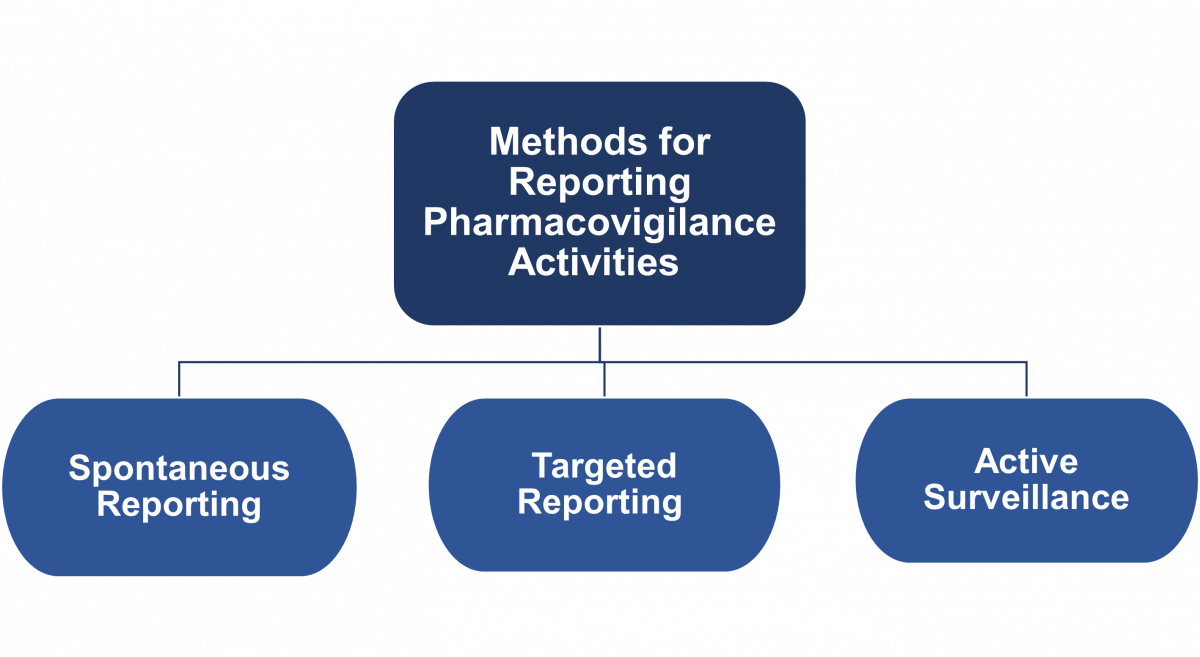
Figure: Three Methods for Reporting Pharmacovigilance Activities
- Spontaneous Reporting
- Spontaneous (or voluntary) reporting means that no active measures are taken to look for adverse effects other than the encouragement of health professionals and others to report safety concerns.
- Reporting is entirely dependent on the initiative and motivation of the potential reporters.
- This is the most common form of pharmacovigilance, sometimes termed passive reporting.
- In some countries this form of reporting is mandatory.
- Clinicians, pharmacists and community members should be trained on how, when, what and where to report.
- Targeted Reporting
- It focuses on capturing Adverse Drug Reactions (ADRs) in a well-defined group of patients on treatment.
- Health professionals in charge of the patients are sensitized to report specific safety concerns.
- Active Surveillance
- It is a proactive effort made to elicit adverse events.
- This is achieved by active follow-up after treatment and the events may be detected by asking patients directly or screening patient records.
- It is best done prospectively.
- The most comprehensive method of active surveillance is Cohort Event Monitoring (CEM), which is an adaptable and powerful method of getting good comprehensive data.
- Other methods of active monitoring include the use of registers, record linkage and screening of laboratory results in medical laboratories.
- This is an important method of reporting under active Drug Safety Monitoring (aDSM) for Drug-resistant TB (DR-TB) patients.
Resources
- Training Modules (1-4) for Programme Managers & Medical Officers (NTEP), 2020.
- A Practical Handbook on the Pharmacovigilance of Medicines Used in the Treatment of Tuberculosis, 2012.
- Ready Reckoner for Medical Officer - Adverse Drug Reactions Associated with Anti-TB Drugs Identification and Management, 2019.
Kindly provide your valuable feedback on the page to the link provided HERE
- Spontaneous Reporting
Causality Assessment for ADR Reporting
ContentAttribution definitions for causality assessment are divided into five categories and are as follows:
- Not related
Adverse Event (AE) that is not related to the use of the drug.
- Doubtful
AE for which an alternative explanation is more likely, e.g., concomitant drug(s), concomitant disease(s) or the relationship in time suggests that a causal relationship is unlikely.
- Possible
AE that might be due to the use of the drug. An alternative explanation, e.g., concomitant drug(s) or concomitant disease(s) is inconclusive. The relationship in time is reasonable, therefore, the causal relationship cannot be excluded.
- Probable
AE that might be due to the use of the drug. The relationship in time is suggestive, e.g., confirmed by de-challenge. An alternative explanation is less likely, e.g., concomitant drug(s), concomitant disease(s).
- Certain (very likely)
AE that is listed as a possible adverse reaction and cannot be reasonably explained by an alternative explanation, e.g., concomitant drug(s), concomitant disease(s). The relationship in time is suggestive, e.g., confirmed by de-challenge and rechallenge.
The Drug-resistant TB Centre (DR-TBC) committee, in coordination with the Adverse Drug Reaction (ADR) Monitoring Centre (AMC) will review and confirm the causality of all serious events/ reactions in relation to therapy.
Resources
- Guidelines for Programmatic Management of Drug-resistant Tuberculosis in India, March 2021.
- Ready Reckoner for Medical Officer - Adverse Drug Reactions Associated with Anti-TB Drugs Identification and Management, 2019.
Kindly provide your valuable feedback on the page to the link provided HERE
Causality Assessment: WHO-UMC [UPSALA Monitoring Centre] Causality Categories for ADR Reporting
ContentThe World Health Organisation-Uppsala Monitoring Centre (WHO-UMC) system has been developed as a practical tool for the assessment of case reports.
The table below lists the various causality categories and their assessment criteria that have been developed under this system.
Table: WHO-UMC Causality Categories; Source: WHO-UMC System for Standardised Case Causality Assessment, p2. CAUSALITY TERM/ CATEGORY ASSESSMENT CRITERIA Certain/ Very Likely - Event or laboratory test abnormality, with plausible time relationship to drug intake
- Cannot be explained by disease or other drugs
- Response to withdrawal plausible (pharmacologically, pathologically)
- Event definitive pharmacologically or phenomenologically (i.e., an objective and specific medical disorder or a recognized pharmacological phenomenon)
- Rechallenge satisfactory, if necessary
Probable/ Likely - Event or laboratory test abnormality, with reasonable time relationship to drug intake
- Unlikely to be attributed to disease or other drugs
- Response to withdrawal clinically reasonable
- Rechallenge not required
Possible - Event or laboratory test abnormality, with reasonable time relationship to drug intake
- Could also be explained by disease or other drugs
- Information on drug withdrawal may be lacking or unclear
Unlikely - Event or laboratory test abnormality, with a time to drug intake that makes a relationship improbable (but not impossible)
- Disease or other drugs provide plausible explanations
Conditional/ Unclassified - Event or laboratory test abnormality
- More data for proper assessment is needed, or additional data under examination
Unassessable/ Unclassifiable - Report suggesting an adverse reaction
- Cannot be judged because the information is insufficient or contradictory
- Data cannot be supplemented or verified
Resources
- The Use of the WHO-UMC System for Standardised Case Causality Assessment.
- Ready Reckoner for Medical Officer - Adverse Drug Reactions Associated with Anti-TB Drugs Identification and Management, 2019.
Kindly provide your valuable feedback on the page to the link provided HERE
Severity Criteria for Reporting ADRs
ContentAdverse Drug Reactions (ADRs) have been graded based on their severity. The figure below provides criteria for the assessment of the severity grade of ADRs.

Figure: Criteria for Severity Grade Assessment of ADRs
- The investigator should use their clinical judgment in assessing the severity of events not directly experienced by the subject, e.g., laboratory abnormalities.
- Safety assessment measure is the proportion of patients experiencing a grade 3 or greater adverse event, as defined by Division of AIDS (DAIDS) criteria during treatment and follow-up.
- Please click here for more information on the DAIDS criteria.
Resources
- Guidelines for Programmatic Management of Drug-resistant Tuberculosis in India, March 2021.
- Ready Reckoner for Medical Officer - Adverse Drug Reactions Associated with Anti-TB Drugs Identification and Management, 2019.
- Division of AIDS (DAIDS) Table for Grading the Severity of Adult and Paediatric Adverse Events, 2017.
Kindly provide your valuable feedback on the page to the link provided HERE
Reporting of Adverse Events and Serious Adverse Events
ContentAll serious and non-serious adverse events which are possibly, probably or very likely related to any anti-TB drug need to be reported by the physician to the National TB Elimination Programme (NTEP).Serious Adverse Events (SAE) needs to be reported to the nearest ADR monitoring centre (AMC) and Central TB Division (CTD) within 24 hours. Any death of a patient occurring during treatment, regardless of causality, must be reported as an SAE.
aDSM-treatment review form to be filled whenever the DR-TB patient develops any SAE
- The primary responsibility of filling up the aDSM forms will be with the nodal officer of the DR-TB centre with the help of a senior medical officer (SMO) or medical officer (MO) designated.
- It is essential that Nikshay data entry are being done on regular basis by statistical assistant at the NDR-TBC and senior DR-TB TB-HIV supervisor at the DDR-TBC centre.
- Forms should be maintained in hard copies until the ADR module is active in Nikshay.
Once relevant forms of aDSM are filled in Nikshay, information is directly communicated to the pharmaco-vigilance programme of India (PvPI) through the Vigiflow=connecting bridge for signal generation.
Resources
aDSM treatment initiation form
ContentUnder the National TB Elimination Programme (NTEP), as an integral part of the Programmatic Management of Drug-resistant TB (PMDT), the aDSM treatment initiation form is to be filled by the staff at the health facility during the treatment initiation of all DR-TB patients.
This form is available as annexure 32 in the PMDT guidelines 2021 and covers the following information:
- Patient’s name, age, sex, Ni-kshay id, PMDT number, and date of interview
- TB-related details - Type of TB, type of drug resistance, and previous history of TB treatment
- Pregnancy and lactation-related details (if applicable)
- History of addiction/ substance use
- Current and past medical conditions/ events – with the date of onset and recovery (if applicable)
- Details about the medication consumed in the past 30 days (both TB and traditional)
- Details about medicines (other than anti-TB medicines) prescribed during the interview
- Name of the treating facility, name of treating clinician and signature of the person reporting
Image
Figure: aDSM Treatment Initiation Form; Source: Guidelines on Programmatic Management of Drug-resistant TB (PMDT) in India, CTD, MoHFW, India, 2021.
Importance of aDSM Treatment Initiation Form
- This form records the pre-treatment medical (including past TB history) history of the patients and hence helps the treating physician during the treatment initiation regarding the drugs being prescribed, additional care required, etc.
- The form also helps as a document to refer back for making important medical decisions in the event of any adverse reactions (both serious and otherwise) reported by the patient during the course of the treatment.
Resources
- Guidelines on Programmatic Management of Drug-resistant TB (PMDT) in India, CTD, MoHFW, India, 2021.
- Guidelines on Programmatic Management of Drug-resistant TB (PMDT) in India, CTD, MoHFW, India, 2017.
- Active Tuberculosis Drug-safety Monitoring and Management (aDSM) - Framework for Implementation, WHO End TB Strategy, 2015.
Assessment
Question Answer 1 Answer 2 Answer 3 Answer 4 Correct answer Correct explanation Page id Part of Pre-test Part of Post-test When should the aDSM treatment initiation form be filled? When a DR-TB patient is initiated treatment When a DR-TB patient is lost to follow-up When ADR is reported by a DR-TB patient When a DR-TB patient completes treatment 1 The aDSM treatment initiation form is to be filled out by the staff at the health facility during the treatment initiation of all DR-TB patients. Yes Yes aDSM review form
ContentThe aDSM treatment review form is a schedule to be filled out:
i) When any adverse event is reported by a patient on a newer drug containing a DR-TB regimen
ii) When a Serious Adverse Event (SAE) of the Division of Allergy and Infectious Diseases (DAIDS) grade 3 or 4 is reported by patients on other DR-TB treatment
This form is to be filled out by the health facility managing the SAE and the following information needs to be covered:
- Patient details (name, age, sex, weight, height, Ni-kshay id, PMDT no.)
- TB-related details - Type of TB, type of drug resistance, and previous history of treatment
- Pregnancy and lactation-related details (if applicable)
- Adverse Drug Reaction (ADR) details – Course of events, timing and suspected cause of ADR, DAIDS grading of the Adverse Event (AE), date of onset and resolution of ADR
- Seriousness of the AE (life-threatening, requires hospitalisation, permanent disability, congenital anomaly, conditions where the intervention is required to prevent permanent impairment/ damage, death)
- Outcome of the adverse event
- Causality with the anti-TB medicines the patient was consuming and actions taken by the clinician in case of suspected adverse event linked to a drug
- Any other relevant clinical information
Image Image
Image
Figure: aDSM Treatment Review Form; Source: Guidelines on Programmatic Management of Drug-resistant TB (PMDT) in India, CTD, MoHFW, India, 2017.
Importance of aDSM Review Form
- Although all AEs are to be clinically managed, aDSM treatment review form focuses mainly on the serious AEs and is an integral component of the Programmatic Management of Drug-resistant TB (PMDT).
- This form helps to carefully monitor and document the drug-related harms attributed to the recent developments in DR-TB treatment, particularly the approval for use of new medicines ahead of the completion of phase III trials, increased use of repurposed drugs for Extensively Drug-resistant TB (XDR-TB) treatment and the development of novel second-line anti-TB regimens, some of which may not have been described yet.
- This also helps clinicians to take corrective actions and help improve the health and safety of patients.
Resources
- Guidelines on Programmatic Management of Drug-resistant TB (PMDT) in India, CTD, MoHFW, India, 2021.
- Guidelines on Programmatic Management of Drug-resistant TB (PMDT) in India, CTD, MoHFW, India, 2017.
- Active Tuberculosis Drug-safety Monitoring and Management (aDSM) - Framework for Implementation. WHO End TB Strategy, 2015.
Assessment
Question
Answer 1
Answer 2
Answer 3
Answer 4
Correct answer
Correct explanation
Page id
Part of Pre-test
Part of Post-test
Who should fill out the aDSM treatment review form?
Patient
Health facility managing the Serious Adverse Event (SAE)
Both of the above
None of the above
2
aDSM treatment review form should be filled out by the health facility managing the Serious Adverse Event (SAE).
Yes
Yes
-
-
DR-TB HIV Coordinator: Supply Chain Management
Fullscreen-
DR-TB HIV Coordinator: General concepts of SCM
FullscreenSupply Chain Management
ContentSupply Chain Management (SCM) is the handing of flow of goods and material from point of origin to point of consumption, with the objective to ensure that the supplies are present for utilization without any interruption. It covers everything from procurement and sourcing of raw materials to delivery of final product to the consumer, along with the related logistics. It will also include the related information systems that enable monitoring and exchange of information.
Effective SCM ensures the following:
- Continuous availability of quality-assured medicines/ products at the right time and at all healthcare levels.
- Minimizes wastage by preventing expiry of drugs at all levels, maintenance of adequate stock levels and accurate records.
- Maximizes patient care by coordination in all departments and by minimizing human errors/ medication errors.
- Economically viable by minimizing monetary loss (e.g., through pilferage) and optimizing cost via bulk purchasing or according to consumption needs.
Robust supply chain management systems have two main components:
- Physical flow: Involved the movement and storage of supplies
- Information flow: Allows the various stakeholders to coordinate and control the flow of supplies
Resources
- NTEP Training Modules 1-4 for Programme Managers & Medical Officers, 2020.
- NTEP Training Modules 5-9 for Programme Managers & Medical Officers, 2020.
- Guidelines for Programmatic Management of Drug-resistant TB, 2021.
Assessment
Question
Answer 1
Answer 2
Answer 3
Answer 4
Correct answer
Correct explanation
Page id
Part of Pre-test
Part of Post-test
Which of the following statements are correct about supply chain management?
It is useful to ensure a continuous supply of good quality medicines.
It is an essential activity that must be undertaken by health programmes.
It helps reduce the cost burden on the healthcare system.
All of the above
4
Effective SCM is an essential activity that ensures a continuous supply of good quality medicines and cost optimization.
Principles of Supply Chain Management
ContentTo ensure successful implementation, sustainability and quality services under the National TB Elimination Programme (NTEP), some guiding principles in Supply Chain Management (SCM) and drug logistics are to be ensured. These are showcased in the figure below.

Figure: Principles of SCM under NTEP
Important Points
- Timely procurement, uninterrupted supply and maintenance of stock and in-time distribution of anti-TB drugs and other consumables are essential for quality services.
- Monitoring of drug supply from the central to peripheral health institute level through web-based real-time software, Nikshay-Aushadhi, is crucial to avoid under-stocking (and delays in treatment initiation) and over-stocking (resulting in wastages).
- Maintaining appropriate storage and stacking norms i.e., different batches of drugs with different dates of manufacture and expiry are stored separately so as to facilitate First-expiry-first-out (FEFO) principles, viz., drug batches with the most recent expiry are issued first.
Under FEFO, the storekeeper at the drug store is responsible for:
- Installing appropriate tools to periodically monitor controls over the expiry position of drugs.
- Exercising prudence in the case of short-expiry drugs, wherein distribution is on a rational basis that considers the utilization pattern. This includes the following:
- The storekeeper marks ‘Expiry Dates’ in Bold Letters 3” to 4” in size, on the drug cartons with a marker pen, for easy identification and control of drugs immediately on their arrival.
- Routine monitoring of the stock position of all drugs.
- Maintaining proper records.
- Analyzing shelf-life analysis of drug stocks at all levels regularly.
Resources
- NTEP Training Modules 1-4 for Programme Managers & Medical Officers, 2020.
- NTEP Training Modules 5-9 for Programme Managers & Medical Officers, 2020.
- Guidelines for Programmatic Management of Drug-resistant TB, 2021.
Assessment
Question
Answer 1
Answer 2
Answer 3
Answer 4
Correct answer
Correct explanation
Page id
Part of Pre-test
Part of Post-test
What is FEFO?
FEFO is the division that manages drug receipts under NTEP.
FEFO is a supply chain principle that is used to forecast consumables that are required by the programme.
FEFO means First-expiry-first-out and it is a principle to be followed when issuing drugs/ consumables.
None of the above
3
FEFO means First-expiry-first-out and it is a principle to be followed when issuing drugs/ consumables.
Drug distribution flow
ContentUnder the National TB Elimination Programme (NTEP), the anti-TB drugs are procured at the centre level by the Central TB Division (CTD), Ministry of Health and Family Welfare (MoHFW), and supplied to the central warehouses.
From the central level warehouses, the drugs are supplied to different State Drug Stores (SDS) and further distributed to District Drug Stores (DDS) and sub-district level (TB Unit (TU) Store and Peripheral Health Institute (PHI)).
This movement of drug flow is monitored in real-time through Ni-kshay Aushadhi.

Figure: Flowchart Showing the Overview of Distribution of Drugs
Abbr: CMSS: Central Medical Services Society; GDF: Global Drug Facility; CTD: Central TB Division; GMSD: Government Medical Store Depot; SDS: State Drug Store; DDS: District Drug Store; TU: TB Unit; PHC: Primary Health Centre; PHI: Peripheral Health Institute.
Resources
Logistics
Content'Logistics' is the process of planning and implementing the efficient transportation and storage of supplies (drugs, consumables and other related items) from the point of origin to the point of consumption through a systematic mechanism.
Image
Figure: Flowchart depicting overview of logistics under National TB Elimination Programme (NTEP)
Resources
- Standard Operating Procedure Manual - Procurement & Supply Chain Management, CTD, MoHFW, India, 2018.
- Procurement, Supply Chain Management & Preventive Maintenance, Module 6, CTD, MoHFW, India.
Assessment
Question Answer 1 Answer 2 Answer 3 Answer 4 Correct answer Correct explanation Page id Part of Pre-test Part of Post-test From where do the PHIs receive supplies? GMSD CMSS SDS TU 4 The PHIs receive the supplies from the TU. Yes Yes Ni-kshay Aushadhi
ContentNi-kshay Aushadhi is a web-based portal that deals with the management of stocks (anti-TB drugs, consumables and other commodities) across all the stocking points across the National TB Elimination Programme (NTEP), i.e., Government Medical Store Depot (GMSD), Central Medical Services Society (CMSS) warehouses, State Drug Stores (SDS), District Drug Stores (DDS), TB Units (TUs) including Peripheral Health Institutes (PHIs).
Ni-kshay Aushadhi also helps in real-time management of stock position, providing expiry details of commodities, routine/ Additional Drug Request (ADR) Requirements, and patient-wise consumption of drugs at all levels.
Table 1: Nikshay Aushadhi Stakeholders
User Services Central TB Division (CTD)
1. Quantification
2. Purchase Order (PO) generation
3. Quality control
4. State warehouse Drug Transfer Advice (DTA)
5. Monitoring of nation-wide stock & expiry
CMSS warehouse
1. Quantification
2. Purchase request generation
3. Advance shipment details
4. Supplier delivery details
5. Release Order (RO) to SDS
6. Acknowledge desk
7. Transfer of drugs to other warehouses
GMSD
1. Quantification
2. Acknowledge desk
3. Advance shipment details
4. Transfer of drugs to other warehouses
Supplier
1. View Purchase Order (PO) and delivery schedule
2. Enter dispatch details
3. View receipt
4. Demand vs issue
SDS/ DDS/ Drug-resistant TB Centre (DR-TBC)/ TU
1. Routine/ ADR & dispatch to sub-stores
2. Acknowledge desk
3. Transfer of drugs to other warehouses
4. Issue voucher DTA
5. Box preparation, box modification, unpacking and box completion
6. Local purchase
PHI
1. Routine/ ADR
2. Acknowledge the receipt of drugs
3. Issue to patient
4. Return from patient
The Ni-kshay Aushadhi can be used for the following purposes:
- Quantification and forecasting
- Monitoring and distribution
- Data management and analysis
- Recording and reporting of the drugs related data
- Training and capacity building
- Quantification of drugs
- Issue/ dispatch
- Return of drugs
- Drug request management - Routine/ ADR
- Stock management (like drug inventory, Physical Stock Verification (PSV))
- Packaging/ repackaging
- Receive from store/ Acknowledge desk
- Quality control management
Image
Figure: Supply chain management in NTEP through Ni-kshay Aushadhi; Source: Ni-kshay Aushadhi Manual
Resources
Assessment
Question Answer 1 Answer 2 Answer 3 Answer 4 Correct Answer Correct Explanation Page ID Part of Pre-Test Part of Post-Test Ni-kshay Aushadhi can be used for the quantification and forecasting of drug stocks. True False 1 The Ni-kshay Aushadhi can be used for the following purposes:
- Quantification and forecasting
- Monitoring and distribution
- Data management and analysis
- Recording and reporting of the drugs-related data
- Training and capacity building
- Quantification of drugs
- Issue/ dispatch
- Return of drugs
- Drug request management - Routine/ ADR
- Stock management (like drug inventory, PSV)
- Packaging/ Repackaging
- Receive from store/ Acknowledge desk
- Quality control management
- Miscellaneous
Yes Yes Overview : Return and Reconstitution
ContentReturn
- Return is the process of returning the drug to the parent/ issuing store. This is generally followed whenever there are situations like lost to follow-up, transfer out, death, etc.
- Ni-kshay Aushadhi is being used to record and report the process.
- At present, the return of drugs from the patient/ treatment supporters is taking place in Ni-kshay (in Drug Dispensation Module)
- All the unconsumed drugs should be brought back by the treatment supporter to the Peripheral Health Institute (PHI)---->Tuberculosis Units (TU)---->District TB Centre (DTC) within the shortest possible time in order to ensure that they can be re-used in the future.
- Return of Bedaquiline (Bdq): Partially used Bdq bottle should be sent back to State Drug Stores (SDS) wherein it will be accounted for.
- Return of Delamanid (Dlm): Leftover Dlm tablets should be returned back to the District Drug Stores (DDS).
Reconstitution
- Reconstitution is defined as the process of re-packaging the returned anti-TB drugs in the event of loss to follow-up/ death/ discontinuation for any reason, back into a full treatment course for issuing to other patients.
- If the expiry of the remaining drugs is less than six months, the same may be issued at the Nodal Drug-resistant TB Centre (NDR-TBC) for patients while they are admitted and later adjusted from the long expiry bottle that is issued on discharge.
- The reconstitution exercise is carried out only for the Bedaquiline drug and is done at the SDS.
- First Expiry First Out (FEFO) principle should be strictly followed while issuing re-constituted drugs to the patients and also be cautious about the reconstituted drugs belonging to the different expiry batches.
- The reconstituted drugs should be accounted for and reported in Ni-kshay Aushadhi through the Box-preparation module under the Packaging/ Re-packaging service.
Resources
- Standard Operating Procedure Manual Procurement & Supply Chain Management, CTD, MoHFW, India, 2018.
- Return from Patient, Ni-kshay Aushadhi User Manual, CTD, MoHFW, India.
- Packaging and Repackaging, Ni-kshay Aushadhi User Manual, CTD, MoHFW, India.
Assessment
Question
Answer 1
Answer 2
Answer 3
Answer 4
Correct answer
Correct explanation
Page id
Part of Pre-test
Part of Post-test
Where is the reconstitution of Bdq drugs carried out?
District Drug Store
State Drug Store
Tuberculosis Unit
Peripheral Health Institute
2
The reconstitution of Bdq drugs should be carried out only at the State Drug Store.
Yes
Yes
Reconstitution Register
ContentA Reconstitution Register (RR), as the name suggests, is a register used to record the details of drug boxes reconstituted from the leftover/ remaining/ unused drug boxes of patients who have defaulted, died, failed treatment, or transferred out.
This register in the format shown below (Figure) is maintained at all the District Tuberculosis Centres (DTCs).
Image
Figure: Reconstitution Register
Abbr: IP: Intensive Phase; CP: Continuation Phase; PC: Product Code; PP: Prolongation Pouch
The RR consists of 13 columns designated by small alphabets 'a' to 'm'. The information in the relevant columns is filled by the pharmacist or storekeeper of the district under the supervision of the District Tuberculosis Officer (DTO).
Reconstitution of the drugs and hence updation of the RR is done once a quarter. However, this interval can sometimes be shorter based on the need.
The following key information is recorded in the RR:
- Serial no. and date in columns ‘a’ and ‘b’
- Receipt transactions in columns 'c' to 'e'. These include information about the source and type of the Patient-wise Boxes (PWB) returned for reconstitution in
- Constituents of the returned PWBs in columns 'f' to 'j'. Separate columns for IP and CP are provided.
- Withdrawal transactions in columns 'k' to 'm'.
Note: Receipt transactions shall be recorded in the RR in blue ink, whereas withdrawals for reconstitution purposes, shall be in red ink for clear demarcation
At present, reconstitution is carried out for Bedaquiline (BDQ) only. Unlike other second-line drugs, reconstitution of BDQ takes place at the State Drug Store (SDS) under the supervision of the State Tuberculosis Officer (STO). The number of the tablets received back and the newly reconstituted bottles from these tablets are recorded in appropriate columns of the reconstitution register.
Resources
- Standard Operating Procedures Manual for State Drug Stores, Central TB Division, MoHFW, GoI, 2012.
- Standard Operating Procedure Manual, Procurement & Supply Chain Management, CTD, 2017.
Assessment
Question Answer 1 Answer 2 Answer 3 Answer 4 Correct answer Correct explanation Page id Part of Pre-test Part of Post-test Reconstitution registers are maintained at? DMC PHI DTC STC 3 Reconstitution registers are maintained at all the District Tuberculosis Centres (DTCs). YES YES Recording reconstitution in Nikshay Aushadhi
ContentBox reconstitution means to unpack the prepared boxes into loose medicine. The loose medicine is then added back to the inventory of the store where reconstitution is done. Any box whether complete, incomplete, or modified can be reconstituted. Reconstitution can be done at State Drug Store (SDS) and District Drug Store (DDS) level only and once reconstituted, the box will no longer exist in the inventory. The process of reconstitution in Nikshay Aushadhi is known as box unpacking and involves the following steps:

Figure 1: Overview of process of recording of reconstitution in Nikshay Aushadhi
Detailed procedure:
Step 1: Go to the Nikshay Aushadhi website and click on login. Enter your user ID, Password, the captcha text and click login.
Step 2: Reach the ‘Box unpacking’ window following the path Home-menu>services>packing/repacking>Box unpacking and select your store. Select the TB subcategory then drug name and click on the ‘go’ tab.
Step 3: The system will show all the available boxes (complete, incomplete, and modified) with batch number, expiry Date, stock Quantity, and Stock Status. Select the desired box to be unpacked.

Figure 2: Box unpacking window in Nikshay Aushadhi
Source: Nikshay Aushadhi portal
Step 4: Once selected the system will show details of the drugs in that box. Any quantity less than or equal to the stock quantity of that box can be unpacked. For example, if the stock quantity of the selected box is 100 then any number of boxes between 1 and 100 van be unpacked. Specify the number of the boxes to be unpacked and then click the ‘save’ tab to complete the process. Upon completion, the system will generate the ‘box unpacking complete’ alert. After unpacking the box, the drugs from the box will be added loose into the inventory.

Figure 3: Saving details of box reconstitution
Source: Nikshay Aushadhi portal
Resources
Nikshay Aushadhi Manual-Central TB Division, Ministry of Health and Family Welfare, Government of India
Assessment
Answer 1
Answer 2
Answer 3
Answer 4
Correct answer
Correct explanation
Page id
Part of Pre-test
Part of Post-test
Box unpacking can be done at
SDS
DDS
Both 1 and 2
At any store
3
Box unpacking can be done at SDS, and DDS level only
YES
YES
Disposal of expired supplies
ContentExpiry management of supplies is crucial to avoid financial losses and harm to patients.
If any drug expires due to reasons beyond control, the write-off of expired drugs should be as per the guidelines given in NTEP National Strategic Plan. As per NSP, the State is allowed to write off up to 2% of the cost of the annual supply of drugs on implementation of Drug Sensitivity Testing (DST) guided treatment and 2% cost of rapid molecular test cartridges. The expired stock should be disposed-off as per the Bio-medical Waste (Management and Handling) guidelines of Govt. of India.
Disposal of Expired/Discarded Medicines
Colour of the bag to be used: Yellow
Image
Figure 1: Disposal of expired supplies according to Bio-Medical Waste Management Rules 2016
Updating in Ni-kshay Aushadhi
To dispose of or remove the expired/rejected drugs from the online inventory, follow the steps below:
- Go to the ‘Write-Off/Disposal’ process in Stock Management,
- Click on the ‘Request’ button to generate the disposal request,
- Select the ‘Expired or Rejected’ category, and the system will show the respective drugs
- Select the drug with an expired batch and enter the quantity
- Click on the ‘Save’ button.

Figure 2: Write-off/disposal register in Nikshay Aushadhi Source: Nikshay Aushadhi portal

Figure 3: Entering details of expired drugs in the write-off/disposal register in Nikshay Aushadhi Source: Nikshay Aushadhi portal
Steps to follow
- After saving, select the request and click on the ‘Write-off’ button,
- Verify the drug details and select the type of write-off as ‘Burned/Buried’,
- Enter the ‘Remarks’, and click on the ‘Save’ button,
- System will generate the voucher, and the drug quantity will be deducted from the inventory.

Figure 3: Expired drug details in Nikshay Aushadhi Source: Nikshay Aushadhi portal
Condemnation of laboratory supplies

Figure 4: Process of condemnation of laboratory supplies which are non-functional, obsolete, non-reparable equipment in NTEP’s laboratories
Information is required in below mentioned format to condemn the lab equipment:

Figure 5: Form GFR 10 Source: General Financial Rules 2017, Ministry of Finance, Department of Expenditure, GoI
The request for the replacement of the equipment condemned has to be submitted to State TB Officer (STO)/Central TB Division (CTD) in the below-mentioned format:

Figure 6: Annexure 4 for details of equipment for condemnation Source: Guidelines for the condemnation and replacement of Tuberculosis (TB) laboratory equipment under the Revised National Tuberculosis Control Programme (RNTCP) 2019
Resources
1. Guidelines for Management of Healthcare Waste as per Biomedical Waste Management Rules, 2016
Assessment:
Question Answer 1 Answer 2 Answer 3 Answer 4 Correct answer Correct explanation Page id Part of Pre-test Part of Post-test Disposal of expired supplies is done in which colour bag? Yellow Red White Blue 1 Discarded or expired medicine in yellow coloured non-chlorinated plastic bags color coding and type of container
ContentThe National TB Elimination Programme (NTEP) utilizes different coloured bags for the segregation of waste generated in TB laboratory settings as shown in the table below.
Table: Waste Segregated and Collected According to Colour-coded Bags
Yellow bag:
- Broomsticks
- Parafilm tape & plastic bag – contaminated with samples
- Löwenstein-Jensen (LJ) media without the bottle
- Microbial sample/ blood/ body fluids contaminated paper/ cotton/ swab
- Blood bags
- Microbiological cultures Truenat chips (MTB/ Rif)
- Used mask/ gowns
- Expired medicines/ drugs/ antibiotics
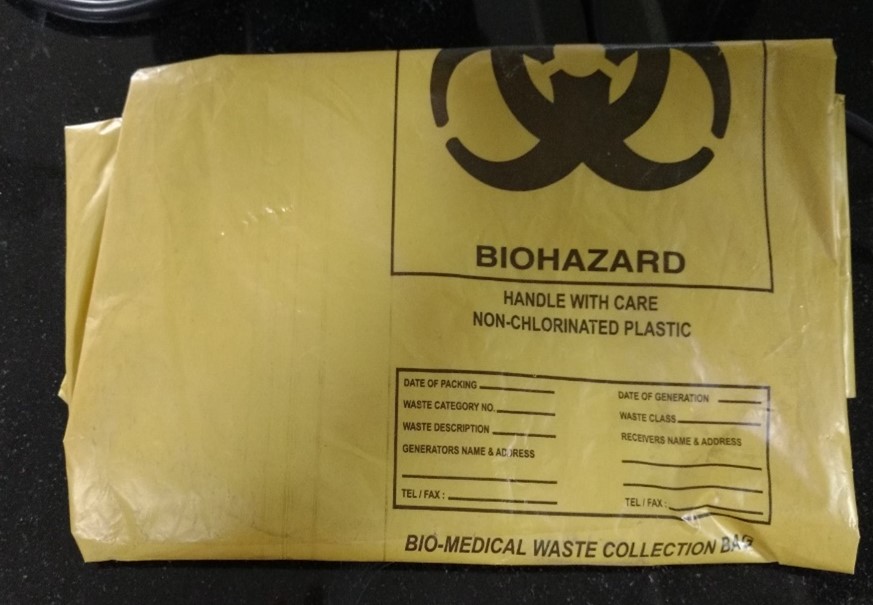
Red bag:
- Specimen collection tubes
- Sputum cups
- Cartridge Based Nucleic Acid Amplification Test (NAAT)/ Truenat cartridges
- Infected plastic
- Contaminated tips
- Pasteur pipettes
- Polymerase Chain Reaction (PCR) tubes
- Mycobacteria Growth Indicator Tube (MGIT) tubes
- Disposable LJ tubes
- Contaminated falcon tubes
- Used gloves
- Contaminated droppers
- Empty Cartridge-based Nucleic Acid Amplification Test (CBNAAT) reagent bottles
Blue bag:
Glass slide in Truenat machine and used microscopy slides. Slides should not be broken.
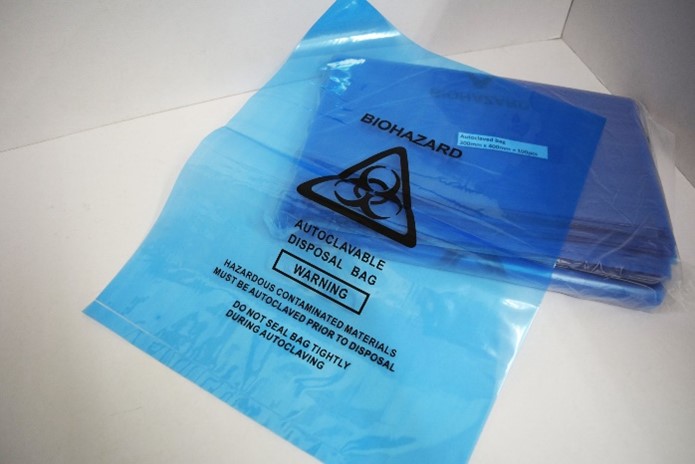
All these bags are to be labelled with the Biohazard logo (figure below) on them.
Figure: Biohazard Logo
- Waste generated in the Culture Drug Susceptibility Testing (CDST) laboratories is autoclaved prior to segregation in colour-coded bags.
- The biohazard materials are collected and handed over to handlers authorized by the pollution control board.
- Personnel handling/segregating biomedical wastes must use appropriate Personal Protective Equipment (PPE) and should be trained in spill management.
Resources
- Guidelines for Programmatic Management of Drug-resistant Tuberculosis in India, 2021.
- Guidelines for Management of Healthcare Waste as per Biomedical Waste Management Rules, 2016.
Kindly provide your valuable feedback on the page to the link provided HERE
-
DR-TB HIV Coordinator: Stocking Norms
FullscreenStorage norms
ContentTo preserve the quality of medicines, good storage practices should be in place at all levels, which requires that staff are appropriately trained and storage conditions adequate.
General Guidelines on Storage of Drugs
Mechanisms to improve TB stock management in central or peripheral drug stores are:
- Stock rotation follows a First-expiry, First-out (FEFO) approach.
- The cleanliness of the area is ensured.
- The environment of the warehouse protects medicines from factors that could inhibit their effectiveness or use, such as sunlight, heat, cold, moisture, pests and theft.
- The stock area is divided into zones for easy location of different products.
- There is a designated area for second-line TB medicines.
Storage Guidelines under the National TB Elimination Programme (NTEP)
Under NTEP, space requirements change at the state, district and peripheral levels according to the NTEP stocking norms, but all other requirements remain the same as shown in the table below. The State TB Officer (STO)/ District TB Officer (DTO) must ensure that the pharmacist/ storekeeper adheres to the following guidelines on the proper storage of drugs.
Table: Guidelines for the Storage of Anti-TB Drugs in NTEP Drug Stores
Space Requirements at the State Drog Store (SDS)
- For every ten lakh population, provision should be made for the storage of about 45 cartons (of 20 boxes each), of Patient-wise Boxes (PWBs) for new cases (PC-1) and PWBs for retreatment cases (PC-2) taken together.
- This is approximately equivalent to 6 months requirement of drugs. For this volume of drugs, the minimum space requirement may be approximated as 50 cubic feet.
- For loose drugs, space provision would be 10% of space allocated to PC-1 and PC-2 PWB cartons. These could alternatively be stored in cupboards/ almirahs where volumes are low and should be kept under lock and key. Do not stack drug cartons on the floor or on top of one another.
Room Requirements
- The store should preferably comprise one large room. Where multiple rooms exist, these should be contiguous or proximate to each other.
- The ceiling must have a height of at least 5 metres.
- There should be a lockable door and at least one window with a grill and wire meshing.
- Properly lit with extra light points for plugging in the required office equipment.
- An even-level, ‘pukka’ floor.
Stacking Requirements
- Ensure that different drug/ consumable items are clearly segregated and stacked on separate racks.
- Different batches of drugs with different dates of manufacture and expiry are stored separately to facilitate FEFO principles (drug batches with the most recent expiry are issued first)
- Mark ‘Expiry Dates’ in Bold Letters 3” to 4” in size, on the drug cartons with a marker pen, for easy identification and control of drugs immediately on their arrival.
- Separate and dispose of damaged or expired products without delay as soon as approval of the same has been received, according to the biomedical waste guidelines.
Temperature and Humidity Control
- To keep humidity levels below the maximum 60% recommended for storage of drugs ensure appropriate ventilation and air circulation, and do not open cartons/ drug boxes unless necessary.
- Hydro thermometers are to be installed up to TB Unit (TU) drug store levels to monitor humidity and temperature regularly.
- Overhead exhaust fan required.
- Plastered walls and ceiling with whitewash without any kind of seepage in the room.
- The store should be clean, dry and well-ventilated.
- Ceiling and sidewalls should preferably be insulated, ensuring that the ambient temperature during peak summer does not result in damage to anti-TB drugs. The ambient temperature may be taken as 15-25°C or depending on climatic conditions, up to 30°C.
- PWBs/ cartons should be placed on shelves ensuring that there is sufficient space between shelves and walls of the storeroom.
- A regular power supply should be available for air conditioning.
Protection from Sunlight
- Shade the windows or use curtains if they are in direct sunlight.
- Keep products in cartons/ drug boxes.
- Do not store or pack products in sunlight.
- Maintain trees around the premises of the drug store to help provide shade and cooling. Check their condition regularly to prevent any untoward incidents.
Fire Safety
Ensure that the fire safety equipment is available and accessible, and that personnel are trained to use it.
Others
- Store medical supplies separately, away from rodents, insecticides, chemicals, old files, office supplies and other materials.
- Stores should not have any odour or indications of contamination and should be sanitised periodically including pest control measures.
Resources
- NTEP Training Modules (5-9) for Programme Managers & Medical Officers, 2020.
- Standard Operating Procedures Manual for State Drug Stores, NTEP, 2012.
Assessment
Question
Answer 1
Answer 2
Answer 3
Answer 4
Correct answer
Correct explanation
Page id
Part of Pre-test
Part of Post-test
Concerning storage of anti-TB drugs, which of the following is correct?
Stock rotation follows a First-expiry, First-out (FEFO) approach.
Store drugs away from direct sunlight.
Hydro thermometers are to be installed up to TU drug store levels to monitor humidity and temperature regularly.
All of the above
4
Appropriate anti-TB drug storage conditions include keeping drugs away from direct sunlight, maintaining appropriate temperature and humidity and following a FEFO approach.
Yes Yes Paper-based Format: Stock Register
ContentThe Stock Register is a paper-based recording register kept in drug stores of the National Tuberculosis Elimination Programme (NTEP). It is useful to ensure uninterrupted supply of anti-TB drugs to the patient. The stock register is maintained at the state, district, and tuberculosis unit (TU) drug stores, by the storekeeper.
Uses of the Stock Register
- It is used for recording receipt, issue and balance of stocks of drugs and consumables.
- It provides drug stock visibility as well details such as batch numbers and expiry dates (thus, facilitating the issue of drugs according to First Expiry, First Out (FEFO) principles).
- It provides a receipt for reconstituted Patient-wise Boxes (PWBs) since these are recorded in the District TB Centre (DTC) stock register.
Important Points to Note
- All receipts should be entered neatly in red colour including transfers from other districts.
- The issue of drugs should be entered in blue colour including all transfers out to other districts/state drug stores.
- The medical officer at the peripheral health institution (MO-PHI) should monitor the monthly replenishment of drugs stock to treatment supporters if drugs are not already given and update the drug stock register accordingly.
The figure below shows the NTEP stock register format.

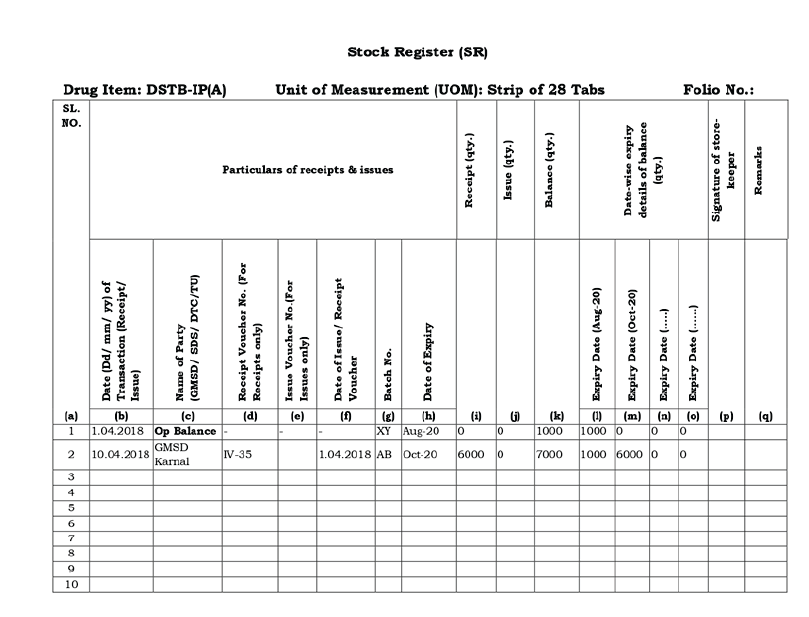
Figure: The NTEP Stock Register; Source: Standard Operating Procedures Manual for State Drug Stores, 2012, p.79
Resources
- NTEP Training Modules 5-9 for Programme Managers & Medical Officers, 2020.
- Standard Operating Procedures Manual for State Drug Stores, 2012.
Kindly provide your valuable feedback on the page to the link provided HERE
-
DR-TB HIV Coordinator: Supply Chain Processes
FullscreenPreparation of Patient-wise Boxes [PWB] for DR-TB Patients
ContentUnder the National TB Elimination Program (NTEP), Drug-resistant TB (DR-TB) patients receive standardized DR-TB treatment boxes (called Patient-wise Boxes - PWB) for each month. These boxes are either with the health facility nearest to DR-TB patients (DOT centre) or with the treatment supporter who is involved in the care of DR-TB patients.
Steps involved in the preparation of second-line drug boxes for DR-TB patients:
- NTEP State Drug Store (SDS) receives quality-assured second-line drugs from the centre through the General Medical Stores Depot (GMSD) and/or Central Medical Services Society (CMSS).
- The loose medicines are utilized for individual patient-wise box creation at the SDS/DDS by the store staff.
- Each patient-wise second-line drug box is prepared according to the NTEP standard box preparation guidelines utilizing the logistics, labels and drugs, and the same details are entered in Ni-kshay Aushadi for maintaining accountability of all drug boxes.
- Each patient-wise box needs to clearly mention the batch number of different drugs it contains, the expiry of the drug box and individual drugs, and any specific instructions that need to be followed, e.g., temperature, humidity or local storage.
- Second-line drug regimen box for INH mono/ poly regimen can be prepared at the district level considering its 6-month duration with the selected 4 drugs while Bdq/ Dlm regimen-based boxes are usually prepared at SDS and provided to District Drug Stores (DDS).
The exercise of preparing the standard patient-wise boxes is done at the NTEP DDS under the guidance and supervision of the District TB Officer (DTO). In such cases, drugs to the district will be supplied in loose form through Nikshay Aushadhi.
Resources
Constituents of Monthly Patient-wise Boxes [PWB] for Shorter Oral Bedaquiline-containing MDR/RR-TB Regimen
ContentThe patient on shorter oral Bedaquiline-containing multi-drug resistant (MDR)/rifampicin resistant TB (RR-TB) regimen shall be put on Type A and Type B box when initiated on treatment on a monthly patient wise box (PWB). Bedaquiline (Bdq) needs to be issued separately and stopped after 6 months. The patient should be provided with only Type A boxes when started on continuation phase (CP).
Table 1: Constituents of monthly-type A and B PWB of shorter oral Bedaquiline-containing MDR/RR-TB regimen; Source : Guidelines for PMDT, India 2021, p.132-133 TYPE A BOX
(USE IN IP AS WELL AS CP)
Drugs
Strength
16-29 kg
30-45 kg
46-70 kg
>70 kg
Tab. Levofloxacin#
250/500 mg
250 mg *30tab
250 mg *30tab + 500 mg *30tab
500 mg *60tab
500 mg *60tab
Tab. Clofazimine
50/100 mg
50 mg *30tab
100 mg *30tab
100mg *30tab
100 mg *60tab
Tab. Ethambutol
400/800 mg
400 mg *30tab
800 mg *30tab
400 mg *30tab + 800 mg *30tab
800 mg *60tab
Tab. Pyrazinamide
500/750 mg
750 mg *30tab
500 mg *30tab + 750 mg *30tab
500 mg *60tab + 750 mg *30tab
500 mg *30tab + 750 mg *60tab
Tab. Pyridoxine
50/100 mg
50 mg*30tab
100 mg*30tab
100 mg*30tab
100 mg*30tab
Type B Box
(Use in IP)
Drugs
Strength
16-29 kg
30-45 kg
46-70 kg
>70 kg
Tab. Isoniazid
100/300 mg
300 mg *30tab
300 mg *60tab
300 mg *90tab
300 mg *90tab
Tab. Ethionamide
125/250 mg
125 mg *30tab + 250 mg *30tab
250 mg *60tab
250 mg *90tab
250 mg *120tab
Bedaquiline bottle
100 mg
1 Jar (Jar of 188 tablets for full course)
# When moxifloxacin prescribed under exceptional condition instead of levofloxacin, the modified box with moxifloxacin (normal dose) can be prepared from standard box at district drug store (DDS)
Resources
Kindly provide your valuable feedback on the page to the link provided HERE
Constituents of Patient-wise Boxes [PWB] for Isoniazid [H] Mono/Poly DR-TB Regimen
ContentStandard Patient-wise Boxes (PWBs) are constituted for TB patients initiated on Isoniazid (H) Mono/ Poly Drug-resistant TB (DR-TB) regimen.
This regimen has no segregation in terms of Intensive Phase (IP) or Continuation Phase (CP), hence drugs are provided in a single type of PWB.
Table: Constituents of standard PWB (6 months) of H mono/ poly DR-TB regimen; Source: Guidelines for PMDT, India 2021, p134
STANDARD PWB
CONTINUE FOR COMPLETE TREATMENT Drugs
Strength
16-29 kg
30-45 kg
46-70 kg
>70 kg
Tab. Levofloxacin
250/ 500 mg
250 mg *180 tab
250 mg *180 tab + 500 mg *180 tab
500 mg *360 tab
500 mg *360 tab
Tab. Rifampicin
150/ 300/ 450 mg
300 mg *180 tab
450 mg *180 tab
300 mg *360 tab
300 mg *360 tab + 150 mg *180 tab
Tab. Ethambutol
400/ 800 mg
400 mg *180 tab
800 mg *180 tab
400 mg *180 tab + 800 mg *180 tab
800 mg *360 tab
Tab. Pyrazinamide
500/ 750 mg
750 mg *180 tab
750 mg *180 tab + 500 mg *180 tab
750 mg *180 tab + 500 mg *360 tab
750 mg *360 tab + 500 mg *180 tab
Tab. Pyridoxine
50/100 mg
50 mg *30 tab
100 mg *30 tab
100 mg *30 tab
100 mg *30 tab
*No separate box for IP and CP.
Resources
- Guidelines for Programmatic Management of Drug-resistant Tuberculosis in India, March 2021.
- Central TB Division, MoHFW. Training Modules (5-9) for Programme Managers & Medical Officers, 2020.
- Standard Operating Procedure Manual - Procurement & Supply Chain Management, RNTCP.
- Technical and Operational guidelines for TB in India, 2016.
Kindly provide your valuable feedback on the page to the link provided HERE
Guidelines for Issuing Bedaquiline and Delamanid to the Patient
ContentLoose drugs will be supplied to the Nodal (N)/ District DR-TB Centre (DDR-TBC) from the State Drug Stores (SDS)/ District Drug Stores (DDS) as per the consumption pattern of the previous month and requested via Nikshay Aushadhi.
- On discharge, the patient will be handed over the drugs for one month of consumption for transit.
- The senior DR-TB TB-HIV supervisor under the guidance of the N/DDR-TBC, shall guide the senior treatment supervisor (STS) for arranging the treatment supporter.
- The entire course available with the patient shall be handed over to the treatment supporter.
- For the provision of newer drugs, the table below shows the protocol to be followed for different regimens.
Table: Protocol for New Drug Provision for DR-TB Patients
PATIENT CATEGORY PROTOCOL Patient put on Bedaquiline (Bdq)-containing regimen The entire bottle of Bdq (188 tablets) shall be earmarked for each enrolled patient and handed over to the treatment supporter under the supervision of the senior DR-TB TB-HIV supervisor in every district. Patients put on the Delamanid (Dlm)-containing regimen The entire course of Dlm treatment will be earmarked at the DDS level. However, drugs will be supplied on a monthly basis to the TB Unit (TU) and further to the Health Facility (HF). Resources
Kindly provide your valuable feedback on the page to the link provided HERE
Management of Patient-wise Boxes in Different Scenarios
ContentThere are different scenarios regarding patient-wise box (PWB) management. These are described below.
Scenario 1: Modification in regimen
In this scenario, the nodal and district drug-resistant tuberculosis centre (N/DDR-TBC) committee decides on a regimen modification.
- The district drug store (DDS) prepares modified PWBs from standard available boxes and loose drugs and arranges the supply of these PWBs to the treatment supporter (TS).
- The district TB officer (DTO) ensures that the drugs are supplied as per the modified regimen for all subsequent months.
Scenario 2: Extension of intensive phase
If intensive phase (IP) is extended:
- N/DDR-TBC informs the DTO
- DTO informs the health facility (HF) doctor and respective TB unit (TU)
- HF releases 1-month PWB to the respective treatment support centre from where the patient is taking treatment
When the patient is switched to continuation phase (CP) in case of a shorter regimen:
- DTO, again, informs HF doctor and respective TU
- HF releases 1-month PWB to the respective treatment support centre from where the patient is taking treatment
In the case of a longer regimen, after completion of 6-8 months of treatment, Linezolid (Lzd) should be reduced to 300 mg following N/DDR-TBC directives.
All patients must complete their monthly boxes before switching to the subsequent box provided.
Scenario 3: Change in DR-TB regimen
If N/DDR-TBC decides to change the DR-TB regimen of a patient, the DDS supplies a new treatment regimen box from PWB/ loose drugs. Unused drugs including Bdq containers should be sent back to the DDS. In this scenario, the patient should be immediately switched to the new regimen designed by N/DDR-TBC.
Resources
Kindly provide your valuable feedback on the page to the link provided HERE
Role of the State Drug Store [SDS] in the Constitution of Patient-wise Boxes
ContentThe State Drug Store (SDS) shall constitute drug boxes for:
- Shorter oral Bedaquiline (Bdq)-containing Multi-drug resistant (MDR)/ Rifampicin-resistant Tuberculosis (RR-TB) regimen (Type A and B)
- Longer oral Multi (M)/ Extensively Drug-resistant Tuberculosis (XDR-TB) regimen
- Isoniazid (H) mono/ poly DR-TB regimen
Boxes will be prepared manually only and not through Nikshay Aushadhi software.
From Nikshay Aushadhi drugs will be supplied in loose to districts.
Based on the requirement of districts SDS will supply boxes to respective districts by a hired transport agency or other mechanisms.
Loose drugs will also be supplied from SDS to the District Drug Store (DDS) for modification and preparation of new boxes.
Resources
Kindly provide your valuable feedback on the page to the link provided HERE
Role of the District Drug Store [DDS] in the Constitution of Patient-wise Boxes
ContentWhen there is a modification in the Drug-resistant TB (DR-TB) regimen as suggested by the Drug-Resistant Tuberculosis Centre (DR-TBC), the district drug storekeeper/ pharmacist prepares the modified boxes from loose Second-line anti-TB Drugs (SLD) supplied from the State Drug Store (SDS).
- The state shall provide the necessary support for capacity building of the District Drug Store (DDS) for carrying out the entire exercise of preparing standardized/ modified patient-wise drug boxes at the DDS level.
- Whenever oral regimens are modified during the course of treatment, the DDS needs to ensure that the change in the regimen should be incorporated into the supply of subsequent boxes.
- A full-time DDS storekeeper/ pharmacist must be mandatorily recruited/ placed for a successful decentralized system of preparation of drug boxes at the DDS level.
- District TB Officer (DTO) and Medical officer-DTC usually perform a random check to understand if there is any challenge in the constitution of patient-wise boxes.
Resources
Kindly provide your valuable feedback on the page to the link provided HERE
Patient-wise Drug Boxes: Packing Instructions
ContentPackaging of loose drugs into monthly patient-wise boxes should be done under the guidance of those in charge of drug logistics at the state and district levels.
Patient-wise drug box preparation should be done for the following Drug-resistant TB (DR-TB) regimens:
- Shorter oral Bedaquiline-containing Multidrug-resistant/ Rifampicin-resistant TB (MDR/RR-TB) regimen
- Longer oral Multi (M)/ Extensively Drug-resistant TB (XDR-TB) regimen
- Isoniazid (H) mono/poly DR-TB regimen
Packaging Instructions
Patient-wise drug boxes are prepared as per the type of DR-TB regimen and weight bands. One monthly pouch of the capsule Cycloserine (Cs) and tablet Ethambutol (E) each, should be made from a plastic bag with a zip lock facility in which 1 gm pouch of silica gel desiccant should be kept.
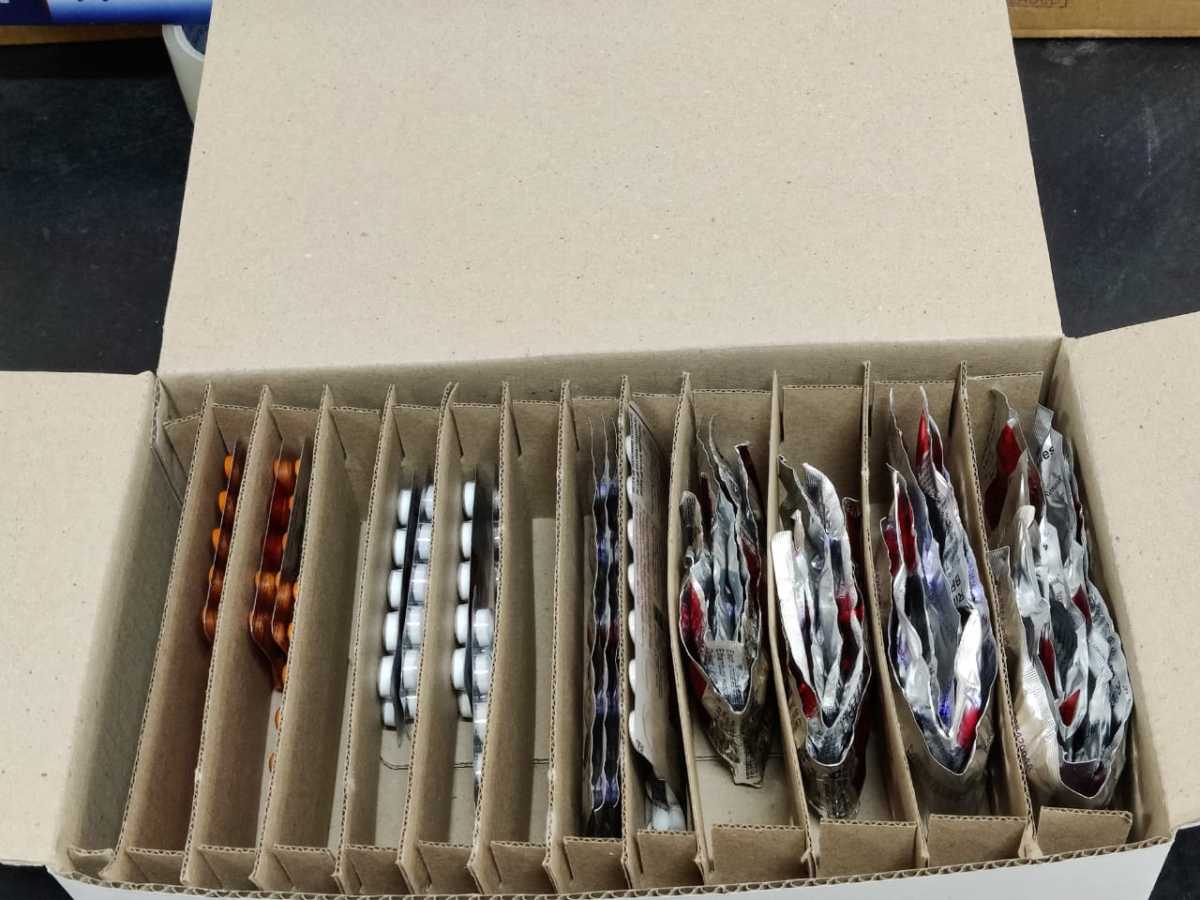
Figure 1: Isoniazid (H) Mono/ Poly Regimen DR-TB Treatment Box
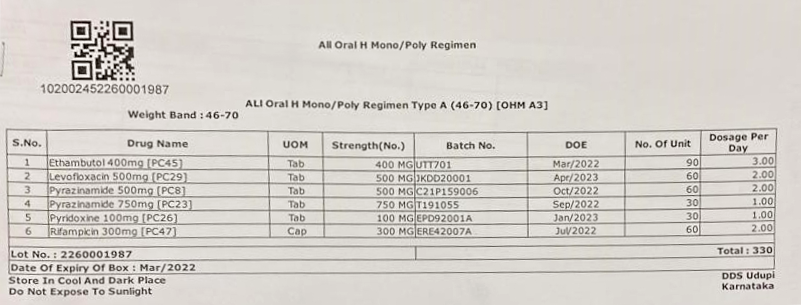
Figure 2: Isoniazid (H) Mono/ Poly Regimen DR-TB Label
In each Type A box, one pouch of silica gel desiccant of 4 gm weight should also be kept.
Labels for the boxes should be developed with the following information (Figures 2 and 3):
- Item-wise name of drugs with a quantity of each drug in the box
- Batch number and Date of Expiry (DOE) of the individual drugs
- DOE of boxes, with expiry date of the drug having the shortest expiry date
- Date of issue of the box from the State Drug Store (SDS)
- Serial number of the box
- Storage instructions on the box for ensuring adequate precautions in storage of the drugs, especially at the treatment supporter level. Some suggested messages are:
- “Store in a cool and dark place, preferably in a clean cupboard”
- “Do not expose to direct sunlight”
- “Keep away from children/unauthorized persons”
- “Box to be closed properly every time after the withdrawal of drugs”.
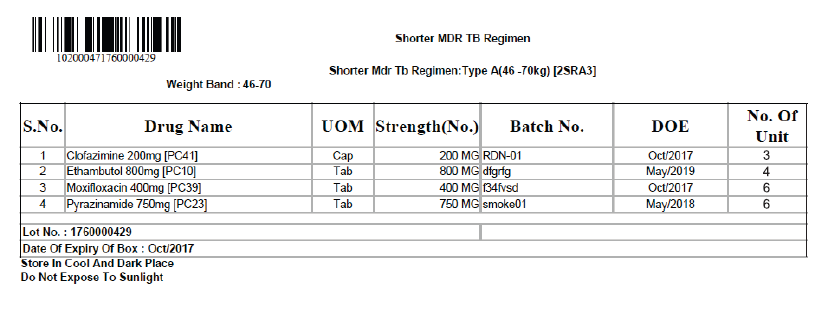
Figure 3: Prototype of a Label (Type A box for shorter DR-TB regimen for the weight band - 46 to 70 kg)
Resources
- Guidelines for Programmatic Management of Drug-resistant Tuberculosis in India, March 2021.
- Standard Operating Procedure Manual - Procurement & Supply Chain Management, MOHFW, GOI.
Kindly provide your valuable feedback on the page to the link provided HERE
Recording box preparation in Nikshay Aushadhi
ContentRecording Box Preparation in Ni-kshay Aushadhi
As per the National TB Elimination Programme (NTEP) guidelines, CTD procures loose medicines for the treatment of DR-TB patients. These loose medicines are packed into Monthly Patient-Wise Boxes (PWB). PWB are prepared only at the State Drug Store (SDS) and District Drug Store (DDS) levels. Depending upon the availability of drugs, two types of boxes can be prepared in Ni-kshay Aushadhi.
Complete box – contains all the required drugs as per the regimen
Incomplete box – has less than the required number of drugs as per the regimen
Image
Figure 1: Overview of the process of recording box preparation in Ni-kshay Aushadhi
Detailed stepwise procedure:
Box Preparation
Step 1: Go to the Ni-kshay Aushadhi website and click on login. Enter your User ID, Password, and then the captcha text and click login.
Step 2: Reach the ‘Box Preparation Window’ following the path Home-menu > Services > Packing/Repacking > Box preparation and select the appropriate options as per the regimen from the drop-down menus of different sections given in the window and then press the ‘Go’ tab.
Image
Figure 2: Box completion window in Ni-kshay Aushadhi
Source: Ni-kshay Aushadhi portal
Step 3: Select the drug from the checkbox. The system will auto-fill the quantity required as per the box preparation quantity. Batch of near expiry date will be highlighted in pink colour. This is to be noted that the expiry date of the nearest expiry drug in the box will be the expiry date of the box itself. You can select any batch as per your requirement.
Image
Figure 3: Entering details of the box
Source: Ni-kshay Aushadhi portal
Step 4: After selecting the batch, click on ‘Add’ button to add the drug to the box. The system will highlight the added drug into the table with green colour. Repeat the process for all the drugs in the regimen. When all the drugs are added into the box as per the required quantity, the system will highlight them in green.

Figure 4: Details of drugs added to the box
Source: Ni-kshay Aushadhi portal
Step 5: Enter the ‘Remarks’ if required and click on the ‘Save’ button. The system will generate the voucher. You can save or print the voucher.

Figure 5: Voucher generated
Source: Ni-kshay Aushadhi portal
Note: If the available number of drugs is less than required, the selection could still be saved, and a voucher generated. Such boxes will be shown in blue in the view boxes section and are called as incomplete boxes.
Box Completion
This process involves adding the remaining drugs to the prepared incomplete boxes and can also be done at the receiving store. The process can be repeated multiple times depending upon the availability of the remaining drugs.
Steps to be followed in Ni-kshay Aushadhi:
Step 1: Reach the ‘Box Completion’ window following the path Menu > Services > Packing/Repacking > Box completion and enter your store name.
Step 2: On selecting the regimen from Tuberculosis (TB) subcategory, those batches with incomplete boxes will be displayed within the ‘Batch’ section. On selecting the batch from the Drug Details section will get displayed.
Step 3: Select a drug from the Drug Details table. Once selected, the batch details table of that drug will appear. Select the batch and add the drug quantity into the ‘To Be Added Qty' column.

Figure 6: Box completion window
Source: Ni-kshay Aushadhi portal
Step 4: Click on the 'Add' button. The selected row in the drug details gets coloured in green, which means that the given drug has been successfully added.
Step 5: Repeat steps 3 and 4 to fill more drugs and complete the box. Click on 'Save' to complete the process and generate the voucher.
Resource
Ni-kshay Aushadhi Manual-Central TB Division, Ministry of Health and Family Welfare, Government of India.
Assessment
Answer 1
Answer 2
Answer 3
Answer 4
Correct answer
Correct explanation
Page id
Part of Pre-test
Part of Post-test
Where can box preparation be done? SDS only SDS and DDS only
TU
DDS only
2
This activity can be done at the SDS and DDS levels only.
Yes
Yes
Reconstitution of Bedaquiline [Bdq] Bottle
ContentThe reconstitution of Bedaquiline (Bdq) bottle should be done at the State Drug Store (SDS).
In case of lost to follow-up/ death/ transferred-out/ treatment stopped patients, Bdq bottle shall be brought back from the treatment centre to the Health Facility (HF) to the TB Unit (TU) to the District TB Centre (DTC) within the shortest possible time.
- A partially used Bdq bottle shall be sent back to the SDS for repackaging.
- The remaining tablets in the bottle received back shall be accounted for in the stock register and Nikshay-Aushadhi at the SDS.
- Upon reconstitution, the bottle shall be accounted for in the stock register (loose tablets to be mentioned in the remarks column) to be issued as per First-expire-first-out (FEFO) principles.
- When reconstitution is done, tablets of the same expiry can be considered using the same container to a maximum of 188 tablets.
- These reconstituted containers shall be used for the treatment of subsequent patients found eligible for Bdq.
- All such drugs that are taken from the new containers shall be collected as a group of 188 tablets of the same expiry and put in a light-resistant container as per the advice from the manufacturer.
- The actual expiry of tablets should be mentioned over the container.
- In the event of the SDS falling short of 188 tablets from an expiry batch, reconstitution can still be done using a number of tablets to complete 188 tablets with another expiry batch.
- In such a case, tablets of the respective expiry should be retained in their same respective containers and issued to patients and providers with counselling to consume the tablets with the nearest expiry first.
- If the expiry of the remaining tablets is less than six months, the same shall be consumed at the Nodal/ District Drug-resistant TB Centre (N/DDR-TBC) for admitted patients. It will be adjusted from the new long expiry bottle on discharge.
Resources
- Guidelines for Programmatic Management of Drug-resistant Tuberculosis in India, March 2021.
- Standard Operating Procedure Manual - Procurement & Supply Chain Management, MOHFW, GOI.
Kindly provide your valuable feedback on the page to the link provided HERE
Storage of Drugs
ContentGood storage conditions and safe custody of drugs is important to ensure quality of drugs. Temperature and humidity control systems should be appropriately designed, installed, qualified and maintained, to ensure that the required storage conditions are maintained.
The State TB Officer (STO)/ District TB Officer (DTO) must ensure that the pharmacist/ store-keeper adheres to the following guidelines on proper storage of drugs.
Temperature
- The storage temperature should be 250C and maintained with an air conditioner wherever applicable.
Humidity
- Humidity levels should be below 60% and maintained with a dehumidifier, wherever required
Power Supply
- Regular power supply should be available for cooling devices (AC, ceiling fans etc) and dehumidifiers.
Drug Safety
Storage Room
- Should be cleaned and disinfected regularly, should be dry, well-lit and well-ventilated
- Should be free from any water penetration, rodent and pests
- Should have fire safety equipment in place
- The drugs should not be exposed to direct sunlight.
Stacking
- The shelves should be placed in such a way that there is sufficient space around for air circulation and free movement of personnel.
- Similar boxes should be stored adjacent to each other and stacked as per their expiry dates.
- The drugs expiring early should be placed closer to the ground and as those expiring late should be place at higher levels.
- Expired drugs should be segregated, sealed and stored in a separate part of the store so as to avoid issue to patients
Labelling
- The identification label, expiry date & manufacturing date of the anti-TB drugs should be marked with a bold marker pen on the visible side of the carton.
Resources
- WHO Technical Report Series, No. 908, 2003; Annex.9: Guide to Good Storage Practices for Pharmaceuticals.
- Procurement, Supply Chain Management & Preventive Maintenance, Module 6, CTD, MoHFW, India.
- Standard Operating Procedure Manual Procurement & Supply Chain Management, CTD, MoHFW, India, 2018.
Assessment
Question
Answer 1
Answer 2
Answer 3
Answer 4
Correct answer
Correct explanation
Page id
Part of Pre-test
Part of Post-test
What is the maximum acceptable humidity levels in a drug store to maintain drug efficacy?
10%
25%
45%
60%
4
Humidity levels should be below 60% and maintained with a dehumidifier wherever required in order to ensure shelf life and efficacy of the drugs.
Yes
Yes
-
-
DR-TB HIV Coordinator: Private Sector Engagement
Fullscreen-
DR-TB HIV Coordinator: Overview of Private Sector Engagement
FullscreenPrivate Sector Engagement
ContentPrivate sector engagement is a cross-cutting area under the BUILD pillar.
With an estimated 70% of tuberculosis (TB) patients seeking care in the private sector, the private sector involvement is important to ensure TB patients in private setting receive:
- Timely diagnosis
- Good quality treatment
- Protection from high out-of-pocket expenditure
- Other public health services such as:
- Comorbidity testing
- Contact investigation
- Counselling
- Adherence monitoring
- Nutritional support
- Outcome reporting
Table 1 highlights the successful activities and planned activities to achieve private sector engagement under the NSP 2020-2025.
Table 1: Select private sector engagement interventions deployed or planned under the Build Pillar of the NSP 2020-25;
Source: National Strategic Plan for Tuberculosis Elimination 2020–2025; pp 39; 63-70
Strategic Area 1.4
Strengthen and scale-up the existing private sector engagement mechanisms with new additionalities to enlist greater private sector participation and programme reach
Key Interventions
Specific Activities
1.4.1. Continue to improve Tuberculosis (TB) notification from private healthcare providers
- Penalizing non-notification of TB cases
- Incentives to private providers/ chemists for notification and reporting treatment outcomes
- Expand collaborative effort with the private sector
1.4.2. Strengthen collaboration with corporate hospitals to cover all facets of TB elimination
- Establish nodal centres within corporate hospitals
- Linkage with existing management information systems (MIS) to Nikshay
1.4.3. Ensure patient support till completion of treatment
- Deploying refilling and adherence monitoring system
- Nutritional support via Nikshay Poshan Yojana
- Use of Patient Provider Support Agency (PPSA) support
1.4.4. Improve access to diagnostics for TB patients notified from the private sector
- Establish linkages for giving diagnostic access to patients in the private sector
- Access to rapid diagnostic services
- Use of national free diagnostic scheme in private labs that are collocated with district hospitals
1.4.5. Improve access to drugs for TB patients notified from the private sector
- Access to drugs in local private pharmacies, or Jan-Aushadhi, or online pharmacies
- Establish a scheme for free anti-TB drugs that flow through the private supply chain
1.4.6. Enhance surveillance and quality improvement
- Patient feedback systems
- Strengthening use of Schedule H1 Register
1.4.7. Expand Information and Communications Technology (ICT) support to support the TB patients and private provider
- Enhanced use of Nikshay
- QR coding of TB drugs
- Increase uptake of Digital Adherence Technologies
1.4.8. Involvement of AYUSH Providers
- AYUSH providers will be provided with informant incentives for referring presumptive TB and detection of TB patients
1.4.9. Involvement of Health Establishments under other line Ministries, Public sector undertakings (PSUs), Corporates, etc.
- Engagement with the Private Sector through Indian Medical Association (IMA) and other such associations
Resources
Kindly provide your valuable feedback on the page to the link provided HERE
NTEP Services for Private Notified DR-TB Patients
ContentProgrammatic Management of Drug-resistant TB (PMDT) services for patients seeking care in the private/ other sectors can be accessed from the National TB Elimination Programme (NTEP) at all levels of the health system.
- This includes care offered from the field level, through the network of Health and Wellness Centres (HWCs) under Ayushman Bharat, to tertiary care available in medical colleges/ nodal DR-TB centres and national-level institutions.
- It would be the responsibility of NTEP to reach out to all private providers of the respective area and make them aware of the free-of-cost services including drugs, diagnostics, and patient support available through the public sector.
- The decision to avail these services depends on the willingness of the patient as well as the provider, nevertheless, the availability of these services should always be explained to the private providers.
- Similarly, patients should be made aware of free services through private providers and communities.
Resources
Kindly provide your valuable feedback on the page to the link provided HERE
Increasing Support for Patients in the Private Sector
ContentTo increase support for Tuberculosis (TB) patients coming from the private sector, the National TB Elimination Programme (NTEP) has affirmed that public health response to all TB patients notified from the private sector will be the responsibility of the public health system.
Patients support services like adherence support, drug susceptibility testing, comorbidity detection, recording treatment outcomes, and infection prevention measures are already being extended to patients in the private sector.
Benefits given to TB patients in the public sector have also been extended to patients in the private sector including social welfare support.
As per the National Strategic Plan (NSP) 2017-25, support to patients from the private sector has already increased as follows:
- Nikshay Poshan Yojana (NPY): A nutritional support of 500 INR per month for the entire duration of treatment will be extended to all TB patients irrespective of the sector from which they seek treatment.
- Nikshay Sampark: A National Call Centre will serve as a platform for grievance redressal, notification of TB patients, and for treatment adherence support. This can be particularly useful in the case of private sector notification.
- Expanding the Patient-Provider Support Agency (PPSA) to 45 cities: This scheme comes with several supports for the private sector patients.
- Free diagnosis with public sector Cartridge Based Nucleic Acid Amplification Test (CBNAAT)
- Augmenting private sector notification, bringing them under the ambit of the support scheme
- Free treatment with voucher mechanisms at the chemist shop
- Direct Benefit Transfer (DBT) of NPY.
- Incentives to private providers/ chemists for notification and reporting treatment outcomes: As per NTEP’s recent policy 500 INR would be given at the time of TB notification and another 500 INR at the time of reporting the treatment outcome.
Increasing the reach to private providers and supporting patients under care in the private health sector has been the priority agenda of NTEP under Universal Access to TB Care. There has been much scope for innovations in this area.
Future Priority Areas to Explore
- Extending PPSA initiative to other cities
- Establishing linkage to co-infection management in the private sector
- Establishing linkage to Drug-resistant TB (DR-TB) management in the private sector
- Expanding the scope of standards for TB care in India to be adopted by all practitioners in India (with a formal mechanism to review)
- TB drug sales surveillance to track all the un-notified TB cases
Resources
Kindly provide your valuable feedback on the page to the link provided HERE
Partnership Options for Private sector Engagement
ContentPartnership options refer to the different modalities utilised by stakeholders of the National TB Elimination Programme (NTEP) to engage with a private-sector partner to improve the availability and quality of service delivery for TB patients.
The table below shows the partnership options that are currently available. The programme manager, based on the findings of the needs assessment, can identify the relevant partnership options that they can implement in their region.
Table: Available Partnership Options and their Scope of Services
Partnership Option
Services
Patient Provider Support Agency (PPSA)
- Private provider empanelment and engagement
- Linkages for specimen transportation and diagnostics
- Patient management (public health action, counselling, adherence support)
- Logistics of anti-TB drugs
The PPSA is an example of a “service bundle” that covers a whole range of activities for end-to-end management of the private sector.
Public Health Action
- Counselling and adherence management
- Contact tracing and chemoprophylaxis
- HIV counselling, testing and treatment linkage
- Drug Susceptibility Testing (DST) and linkage for Drug-resistant TB (DR-TB) services
- Blood sugar testing and linkages for diabetic care
- Linkages for Nikshay Poshan Yojana
Specimen Management
- Collection of sputum samples
- Collection of respiratory (excluding sputum) and extrapulmonary specimens
- Transportation of specimens
Diagnostics
- X-ray centres
- Smear Microscopy (ZN/ FM)/ Molecular diagnostics
- Culture (stand-alone)/ Line Probe Assay/ Culture and Drug Susceptibility Testing (CDST)
- Pre-treatment and follow-up investigation
- Latent TB infection (LTBI) test
Treatment Services
- TB management centre
- DR-TB treatment centre (outdoor)
- DR-TB treatment centre (indoor)
- Specialist consultation for DR-TB patients
Drug Access and Delivery Services
- Drug supply chain management
- Improving access to anti-TB drugs for TB patients notified by the private sector
Active TB Case Finding and TB Prevention
- Active TB case finding
- TB prevention package for vulnerability mapping and LTBI management
Advocacy, Communication and Community Empowerment
- Advocacy
- Communication
- Community Empowerment
The partnership options stated above are those which are currently identified and recommended in the NTEP Guidance Document on Partnerships.
A programme manager can innovate new partnership options which suit the local context, e.g., hiring a service provider for airborne infection control, facility-risk assessment, rehabilitation of DR-TB patients, or alcohol de-addiction programmes for people with TB, etc.
In scenarios where multiple systemic gaps have been identified during the needs assessment, the programme manager may consider using more than one partnership option, via bundling. Bundling refers to combining a series of partnership options in a logical and sequential manner to ensure that no patient is left out at any point in the care cascade.
Resources
Assessment
Question
Answer 1
Answer 2
Answer 3
Answer 4
Correct answer
Correct explanation
Page id
Part of Pre-test
Part of Post-test
Which of the following are partnership options available for NTEP to engage with the private sector?
Partnership option for drug access and delivery services
Partnership option for diagnostics and specimen management
Partnership option for treatment services
All of the above
4
All of the options fall under available partnership options designated by NTEP. But programme managers can be innovative and create new options as required.
PHA for patient notified from the private sector
ContentAs a public health responsibility to prevent transmission of TB infection and development of drug resistance it is essential to engage both the public and private sectors for effective TB prevention and control. A total of seven standards related to Public Health Actions (PHA) (Standard 12 to Standard 18) have been mentioned in the Standards for TB Care in India (STCI)-2014. All patients notified from the private sector also need to be offered all public health actions.
This could be achieved in collaboration with the local public health services and/or other agencies.
1) Provide Access to Correct and Complete Diagnosis for Private Sector Patients
- In this regard all private providers must be sensitized, and their capacities must be built with respect to early diagnosis, prompt referral for sputum smear examination to the National TB Elimination Programme (NTEP) diagnostic facilities / NTEP accredited private labs.
- All private providers and chemists/pharmacists must mandatorily notify the TB patients to the local health authorities – District Health Officer / District TB Officer.
2) Provide Support for Treatment Adherence
- A treatment support plan must be developed at the time of treatment initiation for all patients in the private sector too, in mutual consultation with patient and private provider.
- All patients receiving treatment from the private sector must also be eligible to receive counselling services and upon consent, home visit counselling sessions (or at the location convenient to the patient) may be provided to patients and their caregivers under the NTEP’s Public Private Mix (PPM) or in association with partner agencies providing counselling services under NTEP.
- Any instance of treatment interruption must be reported at the earliest through Ni-Kshay.
- The patients may also be linked to Ni-Kshay call-centers for adherence support.
- The NTEP has also partnered with Patient Provider Support Agency (PPSA) / Patient Provider Interface Agency (PPIA) wherein vouchers were provided to private sector TB patients for utilizing subsidized TB diagnostic and follow up investigation services and can be scale up in high burden districts across the country with support from state governments/ Corporate Social Responsibilities (CSR) agencies.
4) Contact Tracing and TB Preventive Treatment
- All private providers must hold a responsibility to ensure that persons in close contact with patients who have infectious tuberculosis are evaluated at the earliest and managed in line with NTEP recommendations. The district health officers and district TB officers must be responsible to ensure this is being done on a regular basis.
- Eligible contacts should also be counselled for initiation of TB preventive treatment.
5) Linkage to Social Welfare and Protection
- Upon notification by the private provider and initiation of appropriate TB treatment, all patients seeking treatment under the private sector become eligible to receive direct benefit transfer (DBT) under the government of India's Nikshay Poshan Yojana (NPY)
- In districts where PPSA is available, PPSA staff may perform the linkage of private sector patients to DBT services and in districts where PPSAs are not available, the TB Health Visitor/ Senior Treatment Supervisor (STS) needs to undertake the public health action under the supervision of the PPM Coordinator.
- The patients may also be guided and linked to various other social protection and welfare schemes available under central and state governments. The partner agencies with expertise in referral linkages shall help the NTEP in achieving this.
6) Liaison with Professional Bodies
- Professional bodies such as Indian Medical Association and Indian Pharmaceutical Association must be involved for advocacy regarding the services available under public health actions of NTEP for the private patients.
Resources
- Guidelines on Programmatic Management of Drug-resistant TB (PMDT) in India, CTD, MoHFW, GoI, 2021.
- Mandatory TB Notification Gazette for Private Practitioners, Chemists and Public Health Staff, RNTCP, 2018.
- Notification of TB Cases: Amendments, MoHFW, GoI, 2015.
- TB Notification Order, MoHFW, GoI, 2012.
- National Strategic Plan for Tuberculosis Elimination 2017-2025, RNTCP, CTD, MoHFW, 2017.
- Standards for TB Care in India, WHO, 2014.
Assessment
Question Answer 1 Answer 2 Answer 3 Answer 4 Correct answer Correct explanation Page id Part of Pre-test Part of Post-test Linkage of private sector TB patients to available social support schemes is a part of public health action. True False 1 Linkage of private sector TB patients to available social support schemes is a part of public health action Yes Yes
-
DR-TB HIV Coordinator: Regulations
FullscreenMandatory Notification of TB Diagnosis
ContentTB is a notifiable disease in India, and TB notification has been made mandatory at the point of diagnosis since May 2012. This means that when a case of TB is diagnosed and/or put on treatment it is to be reported to the NTEP.
- Every healthcare provider, i.e., clinical establishments run or managed by the Government (including local authorities), private or NGO sectors and/or individual practitioners, need to notify diagnosed or treated TB patient’s.
- Reporting is to be done on the online reporting system called Nikshay and should include details of patient identification, and TB diagnosis.
- This, apart from enabling essential public health actions such as Treatment initiation, and Contact Tracing, chemoprophylaxis, but also enables provisions of Direct beneficiary transfer for Nikshay Poshan Yojana
Points to Note:
As per MCI code of ethics a registered medical practitioner giving incorrect information on his name and authority about notification amounts to misconduct and such a medical practitioner is liable for deregistration. It is the duty of the registered medical to divulge this information to the authorized notification official as regards communicable and notifiable diseases.
Resources
Schedule H-1 Regulation
ContentUnder the Drugs & Cosmetics Rules 1945, drugs specified under Schedule H are required to be sold by retail on the prescription of a Registered Medical Practitioner (RMP) only. At present, Schedule H contains 510 drugs.
Recently, a new Schedule H1 has been introduced through gazette notification GSR 588 (E) dated 30-08-2013, which contains certain third and fourth-generation antibiotics, certain habit-forming drugs and anti-TB drugs.
These drugs are required to be sold in the country under the following conditions:
(1) The supply of a drug specified in Schedule H1 shall be recorded in a separate register at the time of the supply giving the name and address of the prescriber, the name of the patient, the name of the drug and the quantity supplied and such records shall be maintained for three years and be open for inspection.
(2) The drug specified in Schedule H1 shall be labelled with the symbol "Rx" which shall be in red and conspicuously displayed on the left top corner of the label, and shall also be labelled with the following words in a box with a red border:
“Schedule H1 Drug Warning:
-It is dangerous to take this preparation except in accordance with the medical advice.
-Not to be sold by retail without the prescription of a Registered Medical Practitioner.”
List of anti-TB drugs included in Schedule H1
- Ethambutol hydrochloride
- Ethionamide
- Isoniazid
- Levofloxacin
- Moxifloxacin
- Pyrazinamide
- Rifabutin
- Rifampicin
Obligations of Chemists with Regard to Sales of Anti-TB Drugs Under Schedule H1
- Mandatorily keep a copy of the prescription of drugs covered under Schedule H1 in a separate record and such record should be maintained for three years and be available for inspection.
- The supply of a drug specified under schedule H1 shall be recorded in a separate register at the time of supply giving the name and address of the prescriber, the name of the patient, the name of the drug and the quantity supplied and such record shall be maintained for three years and be open for inspection (Annexure IV).
Table: Annexure IV – Schedule H1 Drugs Record Format; Source: Frequently Asked Questions on Gazette on Mandatory TB Notification for Chemists/ Pharmacies. tbcindia.gov.in.
Sl No:
Date
Name of doctor/ prescriber
Address & Reg. No:
Name of patient & address
Name of drug
Batch number
Expiry
Quantity sold
Bill no.
Resources
- Rules for Selling of Drugs Under Schedule H1, Press release by MoHFW, 2013.
- The Drugs & Cosmetics Act and Rules, Ministry of Health & Family Welfare, Government of India, 2016.
- Frequently Asked Question on Gazette on Mandatory TB Notification for Chemists/ Pharmacies, Central TB Division.
Assessment
Answer 1
Answer 2
Answer 3
Answer 4
Correct answer
Correct explanation
Page id
Part of Pre-test
Part of Post-test
Schedule H1 drugs can be sold without the prescription of a registered medical practitioner.
True
False
2
Schedule H1 Drug Warning:
-It is dangerous to take this preparation except in accordance with the medical advice.
-Not to be sold by retail without the prescription of a Registered Medical Practitioner.”
Yes
Yes
-
DR-TB HIV Coordinator: Private sector engagement for DR-TB management
FullscreenCascade of Care for DR-TB Patients in the Private Sector
ContentThe Drug-resistant Tuberculosis (DR-TB) care cascade is to be ensured for every patient notified/ referred.
The figure below showcases the flow of care cascade for a patient seeking care in the private sector.
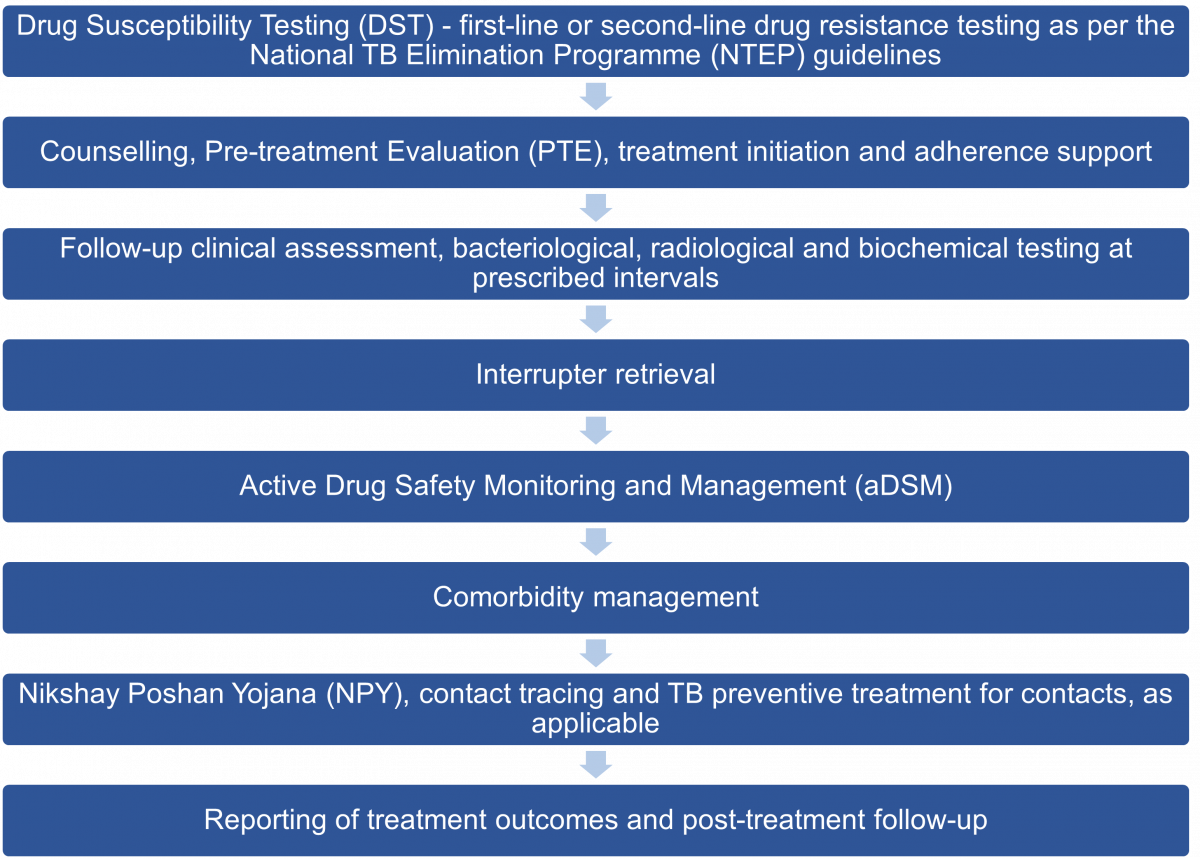
Figure: Flow of Care Cascade for a Patient Seeking Care in the Private Sector
Resources
Kindly provide your valuable feedback on the page to the link provided HERE
Drug-resistant TB Service Linkages to Private Sectors
ContentIt is a well-known fact that although free, quality diagnostic, treatment and patient support services are available in the public health sector, a significant number of patients seek health services from the large, unorganized private health sector.
Reaching out to these patients is important to:
- Deliver essential public health services to prevent the spread of disease and emergence of drug-resistance
- Support TB patients on treatment
- Address co-morbidities that adversely affect treatment outcomes
Additionally, healthcare-seeking is also guided by the willingness on the part of the patient as well as the provider.
A TB patient seeking care in the private sector should come in the purview of the National TB Elimination Programme (NTEP) through notification or referral.
There are at least three different ways that programme officers can expand drug-resistant TB (DR-TB) treatment services using the Guidance Document on Partnerships. They are:
- DR-TB centre inpatient services
- DR-TB centre on an outpatient basis
- Provision of consultation charges for the private specialist to support public sector DR-TB centres in clinical management
Resources
- Guidelines for Programmatic Management of Drug-resistant TB in India, 2021
- Guidance Document on Partnerships, 2019
Kindly provide your valuable feedback on the page to the link provided HERE
DR-TB Services Referral Linkage Scenario 1: Patient Notified from the Private Sector
ContentThe National TB Elimination Program (NTEP) makes an effort to provide Tuberculosis (TB) services to each TB patient, including services to Drug-resistant TB (DR-TB) patients notified/ referred from the private sector.
- It is assumed that a TB/ DR-TB patient who has been notified on Nikshay from the private sector is seeking care from a health facility that is already engaged by the NTEP.
- This engagement could have been established by the NTEP or a public health department directly or through a Patient Provider Support Agency (PPSA) or any other Non-government Organization (NGO)/ partner agency.
- TB patients (diagnosed and treated in the private sector) under the notification act are notified to NTEP from the private Health Facility (HF) using the digital surveillance system - Nikshay.
- It is the responsibility of the local public health and NTEP staff to reach out to the private provider directly or through PPSA and ensure that the TB care cascade is followed for the patient as per the NTEP guidelines or standards of TB care.
Resources
Kindly provide your valuable feedback on the page to the link provided HERE
DR-TB Service Referral Linkages Scenario 3: DR-TB Patient Referred for Treatment from the Private Sector with Bacteriological Confirmation in the Private Sector
ContentMany times, Drug-resistant Tuberculosis (DR-TB) patients diagnosed in the private sector will wish to avail services from the public sector.
The National TB Elimination Programme (NTEP) strongly recommends bacteriological confirmation of any DR-TB patient before initiation of treatment and discourages any empirical treatment.
Drug Susceptibility Testing (DST) results available from private laboratories for such patients will be considered acceptable under the following situations:
- Nucleic Acid Amplification Test (NAAT) results from labs that regularly undertake annual calibration of machines and/or are a part of the External Quality Assurance (EQA) mechanism of quality assurance under NTEP.
- Culture and Drug Susceptibility Test (C&DST) labs that participate in the annual proficiency testing through National Reference Laboratories (NRLs) under NTEP for the respective DST technology.
For patients who do not have results in accordance with the above, DST would be offered under NTEP as per the updated integrated DR-TB algorithm.
Resources
Kindly provide your valuable feedback on the page to the link provided HERE
DR-TB Service Referral Linkages Scenario 5: DR-TB Patient Referred for Treatment from the Private Sector with Treatment Initiated in the Private Sector
ContentIn a situation where Drug-resistant TB (DR-TB) patients may have consumed anti-TB drugs for some duration from the private sector, such prior anti-TB treatment is not likely to be uniformly reliable as far as the quality or quantity and duration of drugs consumed is concerned.
Given that uncertainty, the basic principle is that the duration of the DR-TB regimen under the National Tuberculosis Elimination Programme (NTEP) need not be reduced.
There may be exceptional circumstances that the Drug-resistant Tuberculosis Centres (DR-TBCs) may consider reducing the duration of treatment, where prior treatment is very well-documented, adequate and effective.
The DR-TBC committee can adjust the duration after a detailed patient review, approval and documentation of decisions taken.
If such a referral from the private sector has taken place without notification on Nikshay, the patient needs to be freshly notified after due confirmation of diagnostic results.
Resources
Kindly provide your valuable feedback on the page to the link provided HERE
Joint Effort for Elimination of Tuberculosis [JEET] Model of the Patient Provider Support Agency [PPSA]
ContentStudies have shown that nearly half of all patients with TB in India first seek care in the private sector, where there are significant gaps across the patient-care cascade, notably diagnostic delays, irrational and non-standardized regimens, and under-reporting to authorities. As a result, over a million cases of TB are missed in India every year. In order to address these challenges, project “Joint Effort for Elimination of Tuberculosis” (JEET) was envisaged. The key objective of this project is to set up effective and sustainable structures to strengthen existing systems and seamlessly extend quality TB care to patients in the private sector.
Patient Provider Support Agency (PPSA)
PPSA is one of the implementation Models under JEET Project and is responsible for continuous, end-to-end engagement of private sector to provide quality TB services to patients seeking care in private sector. The PPSA Model has the following key components:
1. Engagement of private providers
-
Network with private sector providers and promotes quality and early diagnosis,
-
Use of rapid diagnostics and Drug Susceptibility Testing (DST), TB notifications, and treatment as per Standards for TB Care in India (STCI)
-
Utilisation of available public sector services under the National TB Elimination Programme (NTEP) for the patients seeking care in the private sector.
2. Support engaged private sector providers for TB notifications in Ni-kshay
-
Through sensitisation
-
By establishing mechanisms/ modalities to support private sector notifications.
3. Linkage to free diagnostics services by the programme
-
All the presumptive TB cases are linked to free TB diagnostics services extended through a sample transport mechanism established under PPSA.
4. Linkage to free treatment services by the NTEP
-
Facilitates issue of NTEP Fixed Dose Combinations (FDCs) through engaged private sector practitioners and chemists
-
Facilitates linking patients to the public sector for initiation of treatment of Drug-sensitive TB (DS-TB) and Drug-resistant TB (DR-TB)
5. Support for treatment adherence
Adherence support is provided to patients through:
-
A team of treatment coordinators
-
NTEP provided Information and Communication Technology (ICT) enabled mechanism/ Call Centre for reminder SMS and phone calls.
6. Incentives to patients and private providers
-
NTEP provisioned incentives as per the National Strategic Plan (NSP) are provided to the engaged private providers and patients seeking care through them.
Image
Figure: The Service Delivery Model for PPSA
Patient Provider Support Agency Lite (PPSA lite)
An alternative model of PPSA called PPSA lite is implemented in 141 cities across seven states. City officers in PPSA lite cities/ districts support:
-
Mapping of private practitioners and identification of TB champions
-
Private sector provider engagement through Continuing Medical Education (CMEs)
-
Capacity building of NTEP staff to undertake private sector engagement.
-
Providing program monitoring support and facilitating reviews.
Resources
Answer 1
Answer 2
Answer 3
Answer 4
Correct answer
Correct explanation
Page id
Part of Pre-test
Part of Post-test
Under PPSA treatment adherence support is provided to patients in the private sector.
True
False
1
Adherence support is provided to patients through a team of treatment coordinators and through NTEP-provided Information and Communication Technology (ICT) enabled mechanism/ Call Centre for reminder SMS and phone calls.
YES
YES
-
-
-
DR-TB HIV Coordinator: Community Engagement
Fullscreen-
DR-TB HIV Coordinator: General Concepts in ACSM
FullscreenAdvocacy Communication and Social Mobilisation
ContentAdvocacy refers to activities that seek to influence the influencers and decision-makers, so as to make TB more central as a public health agenda and enlist their (influencers’) support to create an enabling environment in support of the National TB Elimination Programme (NTEP) to eliminate TB. Advocacy fosters political will, increases financial and other resources on a sustainable basis, and holds authorities accountable to ensure that pledges are fulfilled and results achieved.
Communication is a process people use to exchange information about TB through media, including such channels of communication as mass media, mid-media, and Interpersonal Communication (IPC). Much of the communication effort on TB is concerned with transmitting a series of messages to the people affected by TB through mass media and mid-media, which are necessary but not sufficient. As ‘participation’ and ‘dialogue’ are necessary for effective communication, IPC occupies a place of vital importance. Communication aims to improve knowledge about TB and TB services and change attitudes and practices to encourage people to seek care and complete TB treatment.
Social mobilisation is the process of bringing together different stakeholders and building partnerships to prevent, detect, and cure TB. It targets different sections of the targeted population, say a village community, ward, or other small groupings, and raises awareness of and demand for the TB elimination program. The emphasis here is on community participation and involvement in TB case detection and cure.
Resources
Assessment:
Answer 1
Answer 2
Answer 3
Answer 4
Correct answer
Correct explanation
Page id
Part of Pre-test
Part of Post-test
Placing TB higher on the political agenda of governments is an achievement of:
Advocacy
Coordination
IPC
None of the above
1
Advocacy is a broad set of coordinated efforts to place TB higher on the political agenda, strengthen government commitment to implement or improve TB-related policies and increase and sustain financial and other resources for TB.
Yes
Yes
What is A in ACSM
ContentIn ACSM, "A" stands for Advocacy. "Advocacy" is an activity by an individual or a group that aims to influence the decisions within political, economic and social institutions.
Advocacy focuses on influencing policy-makers, funders and international decision-making bodies through a variety of channels:
- Conferences, summits and symposia
- Celebrity spokespeople, press conferences, news coverage
- Meetings between various levels of government and civil society organizations
- Official Memoranda of Understanding (MoU), parliamentary debates and other political events
- Partnership meetings, patients’ organizations, private physicians, radio and television talk shows, and service providers.
Types of advocacy
- Policy advocacy: Mainly targets policy-setting, influencing policymakers to incorporate the latest evidence and informs senior politicians and administrators how an issue will affect the country, and outlines actions to take for improving the laws and policies.
- Programme advocacy: Targets opinion leaders at the community level on the need for local action.
- Media advocacy: Validates the relevance of a subject, puts issues on the public agenda and encourages the media to cover TB-related topics regularly and in a responsible manner so as to raise awareness of possible solutions and problems.
Resources
- Advocacy, Communication & Social Mobilization (ACSM) for Tuberculosis Control - A Handbook for Country Programmes, WHO, 2007.
- Operational Handbook on Advocacy, Communication & Social Mobilization for RNTCP, Central TB Division, MoHFW, GoI, 2014.
Assessment:
Answer 1
Answer 2
Answer 3
Answer 4
Correct answer
Correct explanation
Page id
Part of Pre-test
Part of Post-test
News reports on World TB day celebrations are an example of which of the following types of advocacy?
Policy advocacy
Programme advocacy
Media advocacy
None of the above
3
Media advocacy encourages the media to cover TB-related topics regularly and in a responsible manner so as to raise awareness of possible solutions and problems.
Yes Yes What is C in ACSM
ContentCommunication aims to favourably change knowledge, attitudes and practices among various groups of people.
Types of communication in healthcare are:
- Oral/verbal communication- by word of mouth (speech/talk)
- Written communication- exchange of facts, ideas and opinions through the use of written materials
- Non verbal communication- through gestures, body language or posture, facial expressions, and eye contact
- Visual communication- exchange of ideas through visuals
Health communication aims to influence and empower individuals, populations and communities to make healthier choices. It frequently informs the public of the services that exist for diagnosis and treatment and relays a series of messages about the disease. It aims to inculcate behaviour change for healthy life choices.
E.g.: “Seek treatment if you have a cough for more than two weeks”, “TB hurts your lungs” or “TB is curable”.
Approaches to health communication
1. Informative communication
Provides information about a new idea and makes it familiar to people.
2.Educative communication
A new idea on health behaviour is explained, including its strengths and weaknesses.
3.Persuasive communication
Usually in the form of a message that promotes a positive change in behaviour and attitudes, and which encourages that audience to accept the new idea. This approach to message development involves finding out what most appeals to a particular audience. Persuasive approaches are more effective than coercive approaches in achieving behaviour change.
4.Prompting communication
Messages are designed so that they are not easily ignored or forgotten they can be used to remind the audience about something that reinforces earlier messages.
Behaviour Change Communication (BCC)
- Behaviour Change Communication (BCC) is an interactive process of any intervention with individuals, groups or communities to develop communication strategies to promote positive health behaviours which are appropriate to the current social conditions and thereby help the society to solve their pressing health problems.
- BCC creates an environment through which the affected communities can discuss, debate, organize and communicate their own perspectives on TB.
- It aims to change behaviour – such as persuading people with symptoms to seek treatment – and to foster social change, supporting processes in the community or elsewhere to spark a debate that may shift social mores and/or eliminate barriers to new behaviour.

Figure: Behaviour Change Communication
Resources
- Advocacy, Communication & Social Mobilisation (ACSM) for Tuberculosis Control - A Handbook for Country Programmes, WHO, 2007.
- Operational Handbook on Advocacy, Communication & Social Mobilisation for RNTCP, Central TB Division, MoHFW, GoI, 2014.
Assessment:
Answer 1
Answer 2
Answer 3
Answer 4
Correct answer
Correct explanation
Page id
Part of Pre-test
Part of Post-test
What does the environment created by behaviour change communication encourage the TB-affected communities to do?
Discuss, debate, organize, communicate
Discuss, organize, implement, communicate
Organize, enforce, communicate
None of the above
1
Behaviour change communication creates an environment through which the affected communities can discuss, debate, organize and communicate their own perspectives on TB.
What is SM in ACSM
ContentSocial Mobilisation (SM) is the process of bringing together different stakeholders and building partnerships to prevent, detect and cure TB. It generates dialogue, negotiation and consensus among a range of players that includes decision-makers, the media, Non-government Organisations (NGOs), opinion leaders, policy-makers, the private sector, professional associations, TB-patient networks and religious groups.
At the heart of social mobilisation is the need to involve people who are either living with active TB or have suffered from it at some time in the past.
Aims of Social Mobilisation
• Increase awareness of the disease (TB) and the demand for diagnosis and treatment services
• Expand service delivery through community-based approaches
• Enhance sustainability, accountability and community ownership of TB services
Activities for Social Mobilisation
- Group and community meetings - Engaging yuva/ mahila mandals, village health sanitation and nutrition committees under the National Rural Health Mission (NRHM), sensitization of local and religious leaders on TB and related stigma in the community. Regular meetings at the village level to address myths and misconceptions and help people with TB symptoms seek timely and appropriate care or referrals.
- School activities - Conducting TB awareness campaigns in schools by addressing the school assembly/ class, painting competitions, rallies, road shows, essay competitions, drawing competitions, exhibitions, dramas, pictorial presentations, quizzes, puzzles, puppet shows, leaflet distributions etc.
- Traditional media group performances - Performing entertainment-centred folk performances, street plays with scripts centred around TB awareness messages.
- Rallies and road shows - Spreading TB related messages on World TB day.
- Home visits - Encouraging interpersonal communication and empowering former TB patients and TB champions to become Directly Observed Treatment, Short-course (DOTS) providers.
Here, inter-personal communication and group communication are the main channels of communication for disseminating TB-related key messages.
In the National TB Elimination Programme (NTEP), partner NGOs play an important role in social/ community mobilisation. It generates dialogue, negotiation and consensus, engaging a range of players in interrelated and complementary efforts while taking into account people’s needs.
Resources
- Advocacy,Communication & Social Mobilisation (ACSM) for Tuberculosis Control - A Handbook for Country Programmes, WHO, 2007.
- Operational Handbook on Advocacy, Communication & Social Mobilisation for RNTCP, Central TB Division, MoHFW, GoI, 2014.
Assessment:
Answer 1
Answer 2
Answer 3
Answer 4
Correct answer
Correct explanation
Page id
Part of Pre-test
Part of Post-test
A roadshow was conducted by local PHC in a village on World TB day with message to End TB. This is an example of:
Policy making
Social mobilisation
Institutional strengthening
Diagnostics
2
Roadshow is one of the activities of social mobilisation strategy which aims at increasing awareness about the disease, involving major stakeholders.
ACSM goals for TB Elimination
ContentAdvocacy, Communication and Social Mobilization (ACSM) strategies are directed at achieving specific goals in terms of TB elimination.
They are:
- Setting and developing the policy based on the latest evidence
- Mobilizing political commitment and resources for TB
- Improving case detection and treatment adherence
- Widening the reach of services
- Combating stigma and discrimination
- Empowering people affected by TB and the community at large
It is useful to determine how ‘ideal behaviour’ in the community relates to these goals. The ‘ideal behaviour’ which is promoted through messages and ACSM strategies should be connected to the overall goal of the TB control programme. A few examples of this are:
- For the general public: Going to a healthcare provider at the first signs of possible TB infection (ideal behaviour) relates directly to the National TB Elimination Programme (NTEP) goal of increasing the case-detection rate for TB.
- For healthcare providers: Following the standards set for the treatment of TB – includes knowing what regimen, how to administer anti-tubercular therapy and what treatment path to take in case of multidrug-resistant or extensively drug-resistant TB. This relates to treatment adherence and outcomes.
The ACSM goals are planned in such a way as to achieve/ address:
• Structural or systemic issues (such as the lack of community Direct Observation Treatment, Short-course (DOTS) programmes)
• Communication interventions (such as behaviour change)
• Individual and social barriers (such as stigma, risk perception and knowledge among populations and health staff)
• Social mobilization activities that promote changes throughout a community or priority group.
Resources
- Advocacy, Communication & Social Mobilization (ACSM) for Tuberculosis Control - A Handbook for Country Programmes, WHO, 2007.
- Operational Handbook on Advocacy, Communication & Social Mobilization for RNTCP, Central TB Division, MoHFW, GoI, 2014.
Assessment:
Answer 1
Answer 2
Answer 3
Answer 4
Correct answer
Correct explanation
Page id
Part of Pre-test
Part of Post-test
Seeking healthcare at the earliest symptom of TB directly relates to which goal of NTEP?
Mobilizing political commitment and resources for TB
Improving case detection
Widening the reach of services
Combating stigma and discrimination
2
Improving case detection is an important goal of NTEP and seeking health care early helps in the detection of more number of cases.
Yes Yes Target Audience for ACSM activities
ContentIdentifying target audience is a key step in the process of developing Advocacy, Communication and Social Mobilisation (ACSM) strategy.
Specific target audience need to be addressed to prevent hinderances in achieving the programme objectives.
Image
Figure: Steps in Identifying Target Audience for ACSM Activities
Target Audience for ACSM Activities
-
Advocacy
• Decision-makers at national, regional and district levels (National Health Mission officials, District Magistrate, National TB Elimination Programme leadership)
• Policy-makers
• Professional groups
• Funders
• Media
-
Communication
• General public, including different vulnerable groups, healthcare workers (i.e., primary healthcare providers, Allopathic and Ayurvedic, Yoga and Naturopathy, Unani, Siddha and Homeopathy (AYUSH) doctors, private healthcare providers, traditional healers, etc.)
• TB patients currently on treatment as well as cured TB patients
• Contacts of patients with active TB
• People at high risk of developing TB
-
Social mobilisation
• Communities
• Community groups, e.g., mahila mandals, youth groups
• National and local level leaders
• Local Non-government Organisations (NGOs), Youth organizations, Community-based Organisations (CBOs)
Resources
Assessment
Question
Answer 1
Answer 2
Answer 3
Answer 4
Correct answer
Correct explanation
Identifying target audience is crucial in the process of developing ACMS strategy.
True False 1 Specific target audiences need to be addressed to remove the causes/ reasons that are hindering programme objectives.
-
ACSM approaches
ContentOnce Advocacy, Communication and Social Mobilisation (ACSM) objectives are designed, linking them with activities strengthens the overall programme effectiveness. Several ACSM approaches can be considered for TB. Decisions on which approach or combination of approaches to use should take into account the benefits and risks, the time frame and the expertise and financial resources needed for effective implementation.
There are two parameters to determine:
(1) What ACSM activities to conduct?
(2) Which channels of communication to use?
Following are the various ACSM approaches relevant to the National TB Elimination Programme (NTEP) and the activities included in it:
NTEP Goal
ACSM Approaches
Activities & Channels
Gaining political commitment to TB elimination
- Educate national policy-makers and political leaders about the health and economic benefits of TB elimination. Aim to have TB declared a national health priority.
- Educate local and community level authorities to encourage them to contribute to TB elimination efforts.
- Solicit the support of international and national partners.
- Seminars and briefing meetings
- Print information (letters, fact sheets)
- Events around World TB Day and other occasions
Improving case detection
- Raise public awareness about TB.
- Reduce stigma against people with TB and correct misconceptions about TB infection by actively involving current and former TB patients.
- Help health workers, communities and individuals identify TB cases.
- Encourage individuals to seek care from appropriate sources.
- Target hard-to-reach populations (prisoners, urban poor, homeless).
- Formative research to determine the best messages and approaches
- Mass media including radio and television
- Distribution of print materials at community meetings or events
- Interpersonal communication and counselling training for health workers
- Community mobilisation activities
Increasing treatment success and discouraging the spread of Multidrug-resistant TB (MDR-TB)
- Give people with TB hope of complete cure.
- Encourage people with TB to seek treatment from appropriate sources.
- Provide materials to counsellors.
- Encourage people with TB to complete treatment even if they improve before treatment ends.
- Make people with TB aware of possible side effects, and where to seek care, if present.
- Encourage health workers, family and community members to directly observe people with TB taking their medicine.
- Engage people who are fully recovered to encourage people currently affected by TB to complete treatment.
- Interpersonal communication and counselling training for health workers
- Mass media, including radio and television
- Extensive distribution of print materials at healthcare facilities
- Community mobilisation activities
- Peer education at community or interest group meetings
Resources
- Advocacy, Communication & Social Mobilisation (ACSM) for Tuberculosis Control - A Handbook for Country Programmes, WHO, 2007.
- Operational Handbook on Advocacy, Communication & Social Mobilisation for RNTCP, Central TB Division, MoHFW, GoI. 2014.
Assessment:
Answer 1
Answer 2
Answer 3
Answer 4
Correct answer
Correct explanation
Page id
Part of Pre-test
Part of Post-test
Factors to be considered while adopting an ACSM approach include:
Risks & benefits
Time frame
Expertise & financial resources
All of the above
4
Decisions on which ACSM approach or combination of approaches to use should take into account the benefits and risks, the time frame and the expertise and financial resources needed for effective implementation.
Yes
Yes
Communication channels
ContentThere are several communication channels for the effective dissemination of messages.
Below are various channels with their advantages and disadvantages listed.
Channels/ Tools Audiences Reached Advantages Disadvantages Mass media channels Television Households, families - Wider reach in urban and rural areas
- Maximum impact due to audiovisual elements
- Expensive production costs
- Less reach among rural and migrant populations, who are vulnerable to TB.
Radio Individuals, households, families - Radio production is simple and much less expensive than TV.
- Relatively wider reach than TV among rural and migrant populations.
- Accessible even on mobile phones
- Radio listening is no more popular; TV viewing/online portals are more popular.
Newspapers
and
magazines
Educated
individuals,
households
- Timely and fixed schedule of dissemination.
- Pictorial description of message.
- Not useful for the illiterate population
- People read newspapers for news about political developments, crime, etc., and not for advertisements per se, unless the advertisement is attractive and eye-catching enough.
Mid-Media - Outdoor Publicity Materials and Folk Arts/ Dramas Posters Individuals - Strong pictorial description of the message.
- Useful in high-traffic areas
- Brief messages
- Short lifespan
Pamphlets Individual - Good for communicating core messages with illustration/ visual support.
- Mass distribution and a kind of take-home message.
- Not very expensive.
- Can be used for repeated exposure and to reinforce messages broadcasted through mass media.
- Useful for the literate population, but can be used by the illiterate people as well
- If the pamphlet looks attractive enough, it is taken home and contents are deciphered with the help of literates or children at home/ in the neighbourhood.
Brochures Individuals, groups - Detailed information/ instructions with illustrations/ visuals/ graphs etc.
- Production costs may be relatively high.
Flip charts Individuals - Good support in counselling sessions.
- Production costs may be relatively high.
Wall writings/ hoardings Individuals, households - Useful in high-traffic areas.
- Good for identification, pictorial description and reinforcement of message
- Only for the literate population.
- Message retention is low
Kiosks Individuals - Face-to-face communication along with audio-visual communication for better message retention.
- Useful in dispelling myths and practices.
- Expensive to scale up.
- Requires trained staff.
- Relatively small reach.
Mobile vans and videos on wheels Groups, community - Entertaining and can grab audience attention and better message retention
- Expensive to implement and scale up
- Relatively small reach
- Requires precision of timing
Folk dramas Groups, community - Entertaining and can grab audience attention and better message retention
- Can touch an emotional chord with individuals/ households; useful for sensitisation.
- Relatively small reach.
- Expensive to scale up.
- Requires precision of timing.
- Requires good artists with prior training.
Interpersonal Communication (IPC) Counselling Individuals - Credible source due to face-to-face communication.
- Allows detailed explanation of key health messages.
- Can help dispel myths and check wrong practices.
- Time-taking to build reach.
- Small reach (individual).
- Costly to scale up.
- Requires special training.
Home visits Households - Credible source due to face-to-face communication.
- Allows detailed explanation of key health messages.
- Can help dispel myths and check wrong practices.
- Useful for rapport building.
- Time-taking to build reach.
- Small reach to the target audience.
- Requires adequate capacity building.
Community Dialogue Seminars, workshops, and Parliament questions Policy-makers, implementers, urban population - Brainstorming of key stakeholders.
- Identification of key communication challenges,
- Key inputs from experts and academicians.
- Not timely.
- High cost of implementation.
- Time-taking to bring about change.
- Difficulty in mobilizing key stakeholders.
Public meetings and gatherings Key
influencers,
individuals,
households
- Emphasis on key messages by influencers/ stakeholders.
- Useful for addressing different segments of the target audience together.
- Intermittent in occurrence.
- High organising cost.
- Only verbal communication involved.
- Reach is relatively small.
Working with groups Households,
individuals
- Dissemination of key messages among communities.
- Word-of-mouth communication.
- Low frequency.
- Only verbal communication involved.
Social Media Facebook, Blogs, YouTube, SMS Individuals - Targets individuals but has a wide/ mass reach.
- An effective method of reaching a large number.
- High visibility among decision-makers.
- Only limited people have access to internet accounts on Facebook, and an even smaller number have blogs.
Resources
- Advocacy, Communication & Social Mobilisation (ACSM) for Tuberculosis Control - A Handbook for Country Programmes, WHO, 2007.
- Operational Handbook on Advocacy, Communication & Social Mobilisation for RNTCP, Central TB Division, MoHFW, GoI, 2014.
Assessment
Question Answer 1 Answer 2 Answer 3 Answer 4 Correct answer Correct explanation Page id Part of Pre-test Part of Post-test Home visits for communication are an example of: Mass media Interpersonal communication Community dialogue Mid-media approach 2 A home visit is a form of Interpersonal Communication (IPC).
- Credible source due to face-to face communication
- Allows detailed explanation of key health messages
- Can help dispel myths and check wrong practices
- Useful for rapport building
Yes Yes ACSM activities at different levels
ContentAdvocacy, Communication and Social Mobilization (ACSM) activities must place the individual at the centre and bring in the family, community and society to bring about sustained changes in TB perceptions and behaviours. ACSM activities must target these 4 groups accordingly:
- Individual: Specific interventions that ensure sustained engagement of people or individuals in maintaining positive behaviours/ changing to desired behaviours. E.g., counselling, use of positive TB messages, message by TB champions, etc.
- Family: Interventions that create an enabling environment for promoting positive behaviour change and developing necessary skills for a person affected by TB. E.g., counselling of the entire family.
- Community: Mobilizes groups toward a common goal, raises local resources and fosters support and awareness for TB-related issues. E.g., conducting TB awareness campaigns in public meeting places, melas, street dramas, etc.
- Society: Advocates for rights-based and socially inclusive approaches and seek support for the TB programme. E.g., workshops and seminars to drive change in legislation, policy, partnerships and resource allocation.
Aimed at individuals, families, communities, and the society, varied ACSM activities are undertaken at the national, state, district and community levels to:
- Create awareness and an enabling environment
- Build capacities to bring about desired changes in TB-related health behaviour
- Sustain positive behaviour
These are shown in the figure below.

Figure: ACSM Activities Spanning Across All Levels
Resources
- Operational Handbook on Advocacy, Communication, and Social Mobilization (ACSM), NTEP, 2014.
- NTEP Training Modules 5-9 for Programme Managers & Medical Officers, 2020.
Assessment
Question Answer 1 Answer 2 Answer 3 Answer 4 Correct answer Correct explanation Page id Part of Pre-test Part of Post-test ACSM activities span across which levels? Individual only. Individual, family, community, society and from central down to the village level. Individual and family levels only. ACSM activities do not span across any level. 2 ACSM activities must span across the individual, family, community, societal levels, and from the central down to the village level. Community Engagement
ContentCommunity engagement is a process of developing relationships that enable stakeholders to work together to address health-related issues and promote well-being to achieve positive health impact and outcomes.
Mobilize communities to engage them in TB care and to increase ownership of the Programme by communities.
Why Community Engagement?
Figure: Importance of Community Engagement
Importance of Community Engagement in TB
ContentCommunity-based TB activities are conducted outside the premises of formal health facilities (e.g. hospitals and clinics) in community-based structures (e.g. schools and places of worship) and homesteads. Community health workers and community volunteers carry out community-based TB activities. Both can be supported by nongovernmental organizations and/or the government.
Community Engagement is a cost effective intervention to improve health service coverage and deliver accessible and people-centered integrated care.
Figure: Importance of Community Engagement
Strategies of Community Engagement in NTEP
Content- Scaling up community participation in the National TB Elimination Programme through community-led activities and working with various community groups, especially TB survivors and key populations
- Empower TB survivors and affected populations to act as mentor’s/change agents and build their capacity for engaging them in programme planning, implementation and monitoring
- Working with community stakeholders to aid in early case identification amongst the vulnerable population
- Increasing accountability of the service delivery system through community participation
District TB Forum
ContentThe district TB forum is a community-engagement modality that aims to empower and engage the TB-affected community. Constituted by TB patients (cured or on treatment), community leaders, government officials, experts and NGOs; it gives a voice to the affected community and advocates with the programme managers for the resolution of challenges faced by TB patients in accessing TB services.
District TB forum is composed of various stakeholders as shown in the table below and its meeting is to be convened at least every 6 months at the district level.
Table: Composition of the District TB Forum
Chairperson District Magistrate Co-Chairperson Chief Executive Officer, Zilla Parishad Members - District Development Officer
- Chief Medical/ Health Officer
- WHO Representative – TB Consultant
- Representative of Tuberculosis Association of India
- Pulmonologist and Professor of Community Medicine of Medical Colleges
- District President, Indian Medical Association
- Two representatives of reputed local NGOs/CSOs on a rotation basis
- Representative from NTEP partners on a rotation basis (REACH/ UNION/ CHAI/ PATH/ FIND/ WHP/ KHPT)
- Five TB patient representatives (past TB patients/ family members)
- Representative of district-level PLHIV Network
- Representative Officer from RCH who manages NGOs
- District TB Officer
- PRI member (Zilla Parishad/ BDC/ Panchayat)
- Journalist
- Advocate
- Representative of the corporate sector
Abbr: WHO: World Health Organisation; NGOs/CSOs: Non-governmental and Civil Society Organisations; NTEP: National TB Elimination Programme; WHP: World Health Partners, PLHIV: People Living with HIV; RCH: Reproductive Child Health; PRI: Panchayati Raj Institutions; BDC: Block Development Council Functions of the District TB Forum
- To advise on strategies for engaging communities affected by TB and increasing community participation in TB programs by forming a network of people affected by TB.
- To periodically review the progress of community involvement and network of people affected by TB.
- Highlight the concerns and needs of TB patients, and work with the government and a broad range of individuals/ organisations to develop better and more responsive health services.
- Advocate for greater and more equitable access to quality, accurate and independent information for patients. To focus on reducing health inequalities by campaigning for patients to have the right to be involved in decision-making.
- Enable dialogue between all stakeholders involved in a TB patient’s care such as government (including local self-government), medical and paramedical associations, industry, medical insurance companies, private healthcare providers and diagnostic centres.
- Create and manage resources to sustain and accelerate TB prevention, control, care and treatment services through community engagement and a network of people affected by TB.
- Facilitate nutritional support, linkages with social welfare schemes, and rehabilitation of TB patients.
- Perform grievance redressal.
Resources
Assessment
Question Answer 1 Answer 2 Answer 3 Answer 4 Correct answer Correct explanation Page id Part of Pre-test Part of Post-test Concerning the district TB forum, which of the following is true? It is involved in engaging communities affected by TB at the state level. It is chaired by the person affected by TB. It has only 3 stakeholders. It convenes meetings biannually. 4 The district TB forum engages communities affected by TB at the district level is chaired by district magistrates, convenes meetings biannually, and comprises of various stakeholders. Yes Yes Local Self Government [LSG]
ContentLocal Self Government is the management of local affairs by local bodies who have been elected by the local people.
-
The local self-Government includes both rural and urban government.
Image
Figure 1: Types of local self government
Rural Local Governments:
-
Panchayati Raj Institution (PRI) is a system of rural local self-government in India. PRI was constitutionalized through the 73rd Constitutional Amendment Act, 1992. The panchayat raj system in the entire country is not the same but, by and large, structure of LSG in most of the States have the three-tier structure:
Image
Figure 2: Structure of Panchayati Raj
Urban Local Governments:
-
An urban area is usually a compact and densely populated area. All types of urban local governments are democratically elected by the people based on electoral wards.
-
Municipal administration is necessary to provide basic civic facilities like water supply, drainage, garbage disposal, public health, primary education, construction, and maintenance.
Image
Figure 3: Types of Urban local bodies
- Other types of urban local governments in India - Notified Area Committee, Town Area Committee, Cantonment Board, township, Port trust, Special purpose agency.
Role of Local Self Government in Health.
-
The common departments in the LSGs are General Administration, Finance, Public Works, Agriculture, Health, Education, Social Welfare, Information Technology, and others. Thus, LSG could play an important role in addressing the determinants of health.
-
LSGs play an active role in preventive healthcare services like vaccination, controlling drinking water and foods, mother-child health, disease screening programs, sanitation precautions, controlling of wastes and animal diseases, controlling of environmental factors that have disease risks such as air and water pollution. They are seen as critical to the planning, implementation, and monitoring of the NHM. Implementation of the NHM in achieving its outcomes is significantly dependent on well-functioning gram, block and district level panchayats.
-
LSGs also deliver services toward health promotion.
-
The other services provided by the LSGs are: Emergency and ambulance services, rehabilitation centers, elderly care centers and home care services
-
ASHA/USHA is one of the important functionary in health care service delivery and selected by the Gram Panchayat.
Resources
Assessment
Question
Answer 1
Answer 2
Answer 3
Answer 4
Correct answer
Correct explanation
The fundamental objective of Panchayati Raj system is to ensure which among the following?
1. People’s participation in development
2. Political accountability
3. Democratic decentralisation
4. Financial mobilisation
1,2,3
2,3
1,4
1,3
4
Panchayat Raj Institution (PRI) was constitutionalised to build democracy at the grassroots level and was entrusted with the task of rural development in the country. Active participation and vigilance on the part of the rural public is a must for the sustenance of democratic de-centralisation.
-
Role of LSG in TB Elimination
ContentLocal Self Governance is the management of local affairs by local bodies who have been elected by the local people. There are 2 types of Local Self Government (LSG): panchayats in rural areas and municipalities in urban areas. Local self-government (LSG) has deep connections and linkages with local people. Role of LSG in Tuberculosis (TB) elimination includes:
Image
Fig 1: Role of Local Self Government in TB Elimination
-
Awareness generation activities
With the participation of Panchayati Raj Institution (PRI) members in rural areas and municipalities in urban areas following awareness generation activities can be carried out:
- Health education on symptoms of TB, good cough etiquettes, available services for screening, diagnosis and treatment of TB, patient support/benefit schemes, TB in vulnerable groups (children, pregnant women, diabetic patients, patients on immunosuppressants, alcoholics and smokers) with emphasis on periodic screening for TB.
- Observance of World Tuberculosis Day on March 24
- Organize health-checkup camps and talks with the TB survivors
- Sensitize Panchayat Raj Institutions (PRI) members, faith leaders etc.
- Organize anti-stigma and non-discrimination campaigns
- Advocacy interventions
Local administration or Panchayat Raj Institutions (PRI) can be engaged in advocacy interventions to promote healthy behaviours and leverage support of TB patients:
- To install spitting bins.
- To install signages on good cough etiquettes.
- Free distribution of masks/handkerchief/tissues to TB patients in the community.
- Services for case finding (Active and latent TB Infection)
With the help of LSGs outreach activity can be planned and undertaken by community/non-governmental organizations (NGO) volunteers, Accredited Social Health Activist (ASHA) and Multi-Purpose Worker (MPW-Male)/ Auxiliary Nurse Midwife (ANM) under the supervision of the Community Health Officer (CHO)/Medical Officer- Urban Primary Health Centre (MO-UPHC), for case finding. These activities include:
- Vulnerability assessment
- Screening for symptoms of TB using Community Based Assessment Checklist (CBAC)
- Periodic active case finding among identified vulnerable populations
- Prompt referral of persons with TB symptoms to health center
- Treatment support and monitoring
- Local self governments can engage in formation and conducting meetings of treatment support groups.
- Health education for TB patients and their household contacts can be conducted on TB symptoms, treatment, managing adverse drug reactions, nutrition during house visits and treatment support group meetings.
- Counselling for TB patients and caregivers can be organised by PRI members and local administration.
- LSGs can mobilise funds from philanthropists to support the TB Patients, to supplement and augment healthcare facilities, screening and testing requirements, buying diagnostics and any other resources that might be required.
- TB preventive measures
- Under supervision of LSGs screening can be conducted of household/workplace contacts and other contacts of TB patients as eligible in the local context and identified vulnerable population for TB/latent TB infection.
- LSG can promote airborne infection control at workplaces and community settings.
- Interventions to ensure community participation
- LSGs can participate in identifying and training TB Champions and facilitate their participation in Village Health Sanitation Nutrition Committees (VHSNCs), Mahila Arogya Samitis (MASs), Jan Arogya Samitis and TB forum meetings.
- VHSNCs and MASs can discuss TB related issues in their meetings, conduct awareness programmes and extend support to case finding and treatment.
Resources
- Operational Guidelines for TB Services at Ayushman Bharat Health and Wellness Centres Central TB Division, Ministry of Health and Family Welfare (MoHFW), Government of India 2020
- Pradhan Mantri Khanij Kshetra Kalyan Yojana (PMKKKY), Ministry of Mines, Government of India, 2015.
- Training Modules (5-9) for Programme Managers and Medical Officers, Central TB Division, Ministry of Health and Family Welfare (MoHFW), Government of India, 2020.
Assessment
Question
Answer 1
Answer 2
Answer 3
Answer 4
Correct answer
Correct explanation
Local self-government can help in identifying and mapping socially and clinically vulnerable groups using available data from Municipal/ Block/ Taluka/ Zila Panchayats' records. Periodic drives can be conducted by them to identify and trace cases and link them to services provided under National Tuberculosis Elimination Programme (NTEP) and other social schemes.
True
False
1
Media advocacy by local self-government can engage the local media to disseminate information. With strategic communication and social mobilisation through Local self-government, the community members will help in gaining awareness about the services available in NTEP as well as other social schemes.
-
TB Champion
ContentA TB Champion is a person who has been affected by TB and successfully completed the treatment.
TB Champions, in their capacity as survivors, are role models and can provide valuable support to those with TB and their families.
Figure: Roles of TB Champion
Community Health Volunteers should identify TB Champions and engage them to provide their support to the patient in activities like:
Figure: Help to TB Patients by Community Health Volunteers
Patient-provider meetings
ContentPatient-provider meetings are important to ensure patient support and improve case holding/ treatment adherence.
Objective: To orient the patients on the course of the treatment, the importance of adherence and the risk for close contact. It also provides a platform to discuss the difficulty in following treatment courses by the patients and the need for further counselling if required.
Purpose: The purpose of this meeting is to counsel patients in a group who are on treatment or who are about to begin treatment. This is an opportunity for free interaction between providers and patients and also an opportunity for patients to clarify their doubts, if any.
Facilitators: These meetings are organized by the treatment supporter/ Directly Observed Treatment (DOT) provider. The Senior Treatment Supervisor (STS)/ Medical Officer (MO) are to conduct these meetings.
Target Group: Patients on treatment or who are about to begin treatment. There could be 5-10 patients (minimum) in such meetings. (If there is a large number of patients at one centre, small groups of about 10 patients may be made so that better interaction takes place between patients and providers).
Participants: Block medical officer/ Medical Officer - TB Control (MO-TC), field staff (STS, TB Health Visitor (TBHV), Senior TB Lab Supervisor (STLS)), general health system staff, patients and their attendees.
Place: These meetings are to be organized at the health facility.
Duration and Frequency: These meetings can be organized once a month so that each patient who is on treatment has the opportunity to attend one such meeting during the intensive phase. The frequency of such meetings would be more than one in a month when there is a large number of patients at one health facility.
- Each meeting can be for half-hour to one hour.
- The patient may be provided refreshments (tea, snacks etc.)
Note: Patient-provider interaction meetings are additional to, and are different from, interpersonal communication that the provider has with the patient while administering treatment.
Messages to be Provided to Patients
- Basic information about tuberculosis, cough etiquette, etc.
- Importance of completing treatment
- Side-effects of drugs and how to manage these
- Importance of follow-up sputum examination
- Prophylaxis for children in the family
- Do’s and don’ts including protective measures, the role of a nutritious diet, etc.
Health Communication Materials: Flip book, banner, posters on TB, etc., are to be provided and used during these meetings.
Report Writing: At the end of each meeting, a report may be prepared to state the date and time of meetings, number of patients, name of facilitators, presence of MO in the meeting, topics covered/ main points discussed in the meeting, along with major concerns mentioned by the patients.
- The report is to be prepared by the STS.
- The list of patients who attended the meeting may be attached to the report.
- It may be more convenient to have a register at each centre for such meetings, and patients can write their names in the same register.
- These may be submitted by STS to the MO-TC on a monthly basis for onward submission to the District TB Officer (DTO) to be included in the quarterly Performance Monitoring Report (PMR).
Resources
- Training Modules (1-4) for Programme Managers and Medical Officers, 2020.
- Technical and Operational Guidelines for Tuberculosis Control, RNTCP, 2019.
Assessment
Question Answer 1 Answer 2 Answer 3 Answer 4 Correct answer Correct explanation Page id Part of Pre-test Part of Post-test How often should patient-provider meetings be conducted? Everyday Twice a year Once every month Once a year 3 Patient-provider meetings can be organised once a month so that each patient who is on treatment has the opportunity to attend one such meeting during the intensive phase. The frequency of such meetings would be more than one in a month when there is a large number of patients at one health facility. Yes Yes
-
DR-TB HIV Coordinator: Social Inclusion and wellness activities
FullscreenStigma and Discrimination towards TB Patient
ContentStigma is when someone sees you in a negative way.
Discrimination is when someone treats you in a negative way.
TB patients face various forms of stigma and discrimination in the community
Figure: Stigma towards TB Patients in the community
Effects of Stigma on TB Patients
ContentAt Individual Level
- Lack of self-esteem and confidence
- Increased sense of emotional isolation, feeling of guilt and anxiety
- Physical as well as financial debilitation
- People, more often women, are forced to leave their homes
- Concealing symptoms and hesitancy in seeking medical care making disease management more difficult
- Delayed diagnosis, interrupted treatment that can lead to further transmission and DRTB
- Vulnerability increases, can lead to suicidal thoughts due to isolation and shame
At Family and Community Levels
- Loss of household earnings
- Exposure of caregivers to the risk of infection that lowers productivity and cycle of poverty further gets perpetuated
- Isolation and stigmatization of infected persons often by people of their community
- Deep-rooted lack of knowledge and misconceptions among the affected and infected within their cultural and religious environment
- Loss of status and negative impact on those with the disease, their caregivers, family, friends and communities
- Perceived and internalized stigma of the community due to socio-cultural values that TB is punishment for sins or transgression
Gender Aspects of TB
ContentAlthough more men are affected by TB, women and transgender persons experience the disease differently. Gender differences and inequalities play a significant role in how people of all gender access and receive healthcare services.
Gender difference in Men Women Incidence of TB - Higher proportion of men(approximately- 2:1) are diagnosed with TB than women
- More likely to have microbiologically confirmed Pulmonary TB
- More likely to have Clinically diagnosed pulmonary TB and extra – pulmonary forms of TB
- Prevalence of HIV-TB co-infection is higher among women who live in overcrowded houses and consume alcohol
- High Risk for developing TB – Pregnant women and women in the postpartum period
Exposure, Risk & Vulnerability - Smoking and alcohol consumption among men
- High risk for developing TB - employment in mining, quarrying, metals and construction industries
Undernutrition, their role as caretakers and the use of solid fuel for cooking puts women at risk for TB Health Seeking & Health system factors - Fear of loss of income and the consequences of absence from work hinder care seeking.
- Women face difficulties due to perceived stigma, prioritization of household chores, lack of money or financial dependence
Treatment Outcomes - Pressure to get back to work and lifestyle habits such as smoking or consumption of alcohol influence discontinuation of treatment in men
- Migrant workers, mostly men, often face difficulties in adherence to treatment in the face of extreme poverty and issues of daily survival
- Women tend to have better adherence and treatment outcome as compared to men
- Stigma and discrimination are major impediments to treatment adherence, mainly among unmarried women, newly married women and the elderly
Transgender population often has low literacy, low education levels and are poor. A high proportion of transgender persons are known to smoke, consume alcohol and use drugs. All these factors make them vulnerable to TB.
Addressing Gender Inequalities
ContentBroad principles to address gender inequalities in TB care
- Confidentiality of patient needs to be maintained
- Non-discrimination and non-stigmatising behaviour to be promoted
- Respect for all to be ensured
- Informed consent and informed treatment
- Accountability to be fixed for actions and inactions
- Access for all health services
- Rights-based approach
- Empowered communities - Ensure representation of women, men and transgender persons in all forums
- Work in partnership - Strengthen linkages between program, private sector and communities
Wellness Activity for TB Patients
ContentYoga
- Yoga aims at holistic functioning of the mind and body. It consists of various exercises and specific body positions and movements(yoga asana) which can be learnt and performed under the supervision of a yoga teacher.
- Yoga will help to clean the upper respiratory tract and the sinuses. The breathing exercise or pranayama induce relaxation and help to reduce the stress levels of the patients considerably.
Meditation
- Meditation is a practice where an individual uses a technique – such as mindfulness, or focusing the mind on a particular object, thought, or activity – to train attention and awareness, and achieve a mentally clear and emotionally calm and stable state.
Exercise
- Exercise is being recognized as an important modality for gaining good health and recovering from illness and disease.
- Exercise like cycling and walking are great ways to make sure that the TB infection that was once in your system has been completely eradicated. Once recovered, it is a good idea to keep up the exercise, as this is a factor in stopping the TB from returning at a later date.
-
Rehabilitation Service to TB Patients
- Emotional support must be provided to patients with TB and their families during illness. Receiving TB diagnosis is often regarded by patients as a real stigma that isolates them from their family and society. Psychologists can support patients to help reduce misconceptions and socially integrate former patients.
- TB is a contagious disease that induces fear and social isolation and needs a long period of drug administration, sometimes with adverse effects. Therefore, therapeutic education is very important, which serves the purpose of explaining to patients and their families about the condition of the disease, the risks of contagiousness, the stages of treatment and prognosis.
- Exercise may be light initially, followed by assisted and active exercise. Once the patient’s condition is stable, a 6-minute walk test may be done in the room or corridor. The intensity should be progressively increased, depending on the patient’s tolerance.
- Nutrition: Weight loss is associated with fatigue and decreased exercise capacity. There is a risk for the patient not recovering body weight at the end of drug therapy, despite receiving correct TB treatment. Nutritional supplementation may play a positive role in the recovery of these patients.
- Tuberculosis Drug side effects: A proactive clinical approach is required to replace/stop the use of the concerned drugs.
- Providing Assistive devices Hearing aids, cochlear implants, tinnitus-masking devices, mobility aids, and prosthetic/orthotic devices improve the quality of life of patients.
- Corrective Surgery: May be required in TB of the bones, spine etc.
- Community and home-based care: This becomes important in severe neuromuscular deficits and movement disabilities.
- Physiotherapy: A trained physiotherapist may help through:
- Sputum clearance technique for reduced sputum quantity, better ventilation and relief of symptoms
- Cough education involving body positioning during coughing, control of breathing in coughing to achieve mobilization and secretions
- Counselling: Psychological support is required for facing long-term/permanent disabilities like loss of vision and hearing loss as side effects of the drugs, paralysis in TB meningitis, infertility in genital TB etc.
- Livelihood options: NGOs and support groups can create such options and/or facilitate treated patients to find various livelihood options
Patients' charter for TB care
ContentThe Patients’ Charter for Tuberculosis Care (the Charter) outlines the rights and responsibilities of people with TB. It empowers people affected by TB and their communities through this knowledge. Initiated and developed by persons affected by TB from around the world, the Charter makes the relationship with healthcare providers a mutually beneficial one.
The Charter sets out ways in which people affected by TB, the community, health providers (both private and public), and governments can work as partners in a positive and open relationship with a view to improve TB care and enhance the effectiveness of the healthcare process.
It allows for all parties to be held more accountable to each other, fostering mutual interaction and a positive partnership.
Principles of the Patients’ Charter for TB Care
- The charter practices the principle of Greater Involvement of People with TB (GIPT).
- This affirms that the empowerment of people with the disease is the catalyst for effective collaboration with health providers and authorities and is essential to victory in the fight to end TB.
Parts of the Patients’ Charter for TB Care
There are two main parts in the patients’ charter for TB care which cover:
- Patients’ rights
- Patients’ responsibilities
These parts are further delineated in Tables 1 and 2 below.
Table 1: Patient's Rights According to the Patient's Charter for TB Care Rights Explanation of rights: You, as the patient, have the right to: Care - Free and equitable TB quality care meeting the International Standards of Tuberculosis Care (ISTC)
- Benefit from community-care programmes
Dignity - Be treated with respect and dignity
- Social support of the family, community and national programmes
Information - Information about available care services — be informed about condition and treatment, know drug names, dosage and side-effects
- Access your medical records in the local language
- Have peer support and voluntary counselling
Choice - A second medical opinion, with access to medical records
- Refuse surgery if drug treatment is at all possible
- Refuse to participate in research studies
Confidence - Have your privacy, culture and religious beliefs respected
- Keep your health conditions confidential
- Care in facilities that practice effective infection control
Justice - File a complaint about care, and have a response
- Appeal unjust decisions to a higher authority
- Vote for accountable local and national patient representatives
Organization - Join or organise peer support groups, clubs and Non-governmental Organisations (NGOs)
- Participate in policy-making in TB programmes
Security - Job security, from diagnosis through to cure
- Food coupons or supplements, if required
- Access to quality-assured drugs and diagnostics
Table 2: Patients' Responsibilities According to the Patients' Charter for TB Care Responsibilities Explanation of responsibilities: You, the patient, have the responsibility to: Share information - Inform healthcare staff all about your condition
- Tell staff about your contacts with family, friends, etc.
- Inform family and friends and share your TB knowledge
Contribute to community health - Encourage others to be tested for TB if they show symptoms
- Be considerate of care providers and other patients
- Assist family and neighbours to complete treatment
Follow treatment - Follow the prescribed plan of treatment
- Tell staff of any difficulties with treatment
Solidarity - Show solidarity with all other patients
- Empower yourself and your community
- Join the fight against TB in your country
Resources
- The Patients’ Charter for Tuberculosis Care, The Global Plan to Stop TB 2006-2015.
- Capacity-building of Affected Communities for Accelerated Response to Drug-resistant Tuberculosis in the South-east Asia Region, WHO, 2019.
Assessment
Question Answer 1 Answer 2 Answer 3 Answer 4 Correct answer Correct explanation Page id Part of Pre-test Part of Post-test According to the Patients' Charter for TB Care, it is not the patient’s responsibility to support other patients. True False 2 According to the Patients' Charter for TB Care, patients have a responsibility to support other patients, show solidarity and empower their communities. Yes Yes
-
Fullscreen