
TB Treatment Adherence
ContentTuberculosis(TB) is curable if patients are treated with effective, uninterrupted anti-tuberculous treatment. Treatment adherence is critical for curing individual patients, controlling the spread of infection in the community, and minimizing the development of drug resistance.
Adherence to treatment means that a patient follows the recommended course of treatment by taking all the prescribed medications for the entire length of time, as necessary. In other words, “right dose for the right duration”.
In Drug Sensitive Tuberculosis(DSTB), a TB patient completes 168 doses of TB treatment and adheres to TB treatment.
Importance of Treatment adherence
ContentAdherence to tuberculosis(TB) treatment is important for promoting individual and public health. Poor adherence to TB treatment results in:
- More individual suffering and death,
- Costly treatment as treatment regimens lengthen and
- Increases the risk for Drug Resistant Tuberculosis
Proper treatment of all forms of TB is critical to reducing individual morbidity and mortality and to interrupting transmission among family and community members.
Recording and Monitoring Adherence
ContentRecording of Treatment Adherence can be done as
- Manually by DOT/Health Care Provider in TB Treatment Card of a patient.
- Self-reported by Patient using digital tools for reporting adherence using 99 DOTS and MERM technologies.
Monitoring Treatment Adherence:
All TB patients should be monitored to assess their response to TB treatment. Nikshay Adherence calendar has a colour legend for various doses taken by a patient
Figure: Sample Nikshay Adherence Calendar in web and Mobile App
COLOUR LEGEND DOSE DESCRIPTION Treatment Start /End Denotes Treatment start and End Date Digitally Reported Dose Denotes that the patient has successfully called the Toll Free Number displayed on the envelope Manually Reported Dose Indicates that the staff has marked manually confirmed dose for the day Unreported Dose Indicates that there was no call event received on Nikshay for that day Manually Reported Missed Dose Indicates that the staff has marked a manually confirmed missed dose for the day Digitally Reported(From Shared Phone Number) Indicates that the patient has been calling from a shaed number(A mobile number that is common for more than one patient) Image
Figure: DSTB Treatment Card (Paper)
Digital Adherence Monitoring Technologies
Content99DOTS is a low-cost digital adherence technology built-in Nikshay that uses inexpensive packaging(envelopes or stickers) with medication that enables people taking medication to engage with their treatment daily. This packaging, distributed to TB patients taking medications, has a hidden number behind perforated flaps on the external envelope; in some cases, the number may be fixed outside the medication blister or pill bottle. This number can be a toll-free number that can be called to register daily adherence or a code sent by SMS, USSD, or other communication channels. Calling or messaging the number is free!
Figure: 99 DOTS Envelope
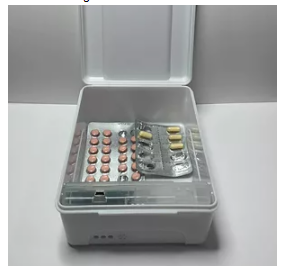
MERM: The Medication Event Reminder Monitor(MERM) is a digital pillbox that provides daily pill-taking reminders and facilitates remote monitoring of medication adherence. This system provides visual and audible reminders for both daily dosing and refill,.transmits this data to a server so that healthcare providers can remotely visualize patients’ dosing histories to support enhanced adherence counselling.
Figure: MERM Box
Directly Observed Treatment
ContentDirectly observed treatment (DOT) is one of the key elements of the DOTS strategy. In DOT, an observer (health worker or trained community volunteer, or trained family member for selected patients) watches and supports the patient intaking their drugs. Direct observation ensures treatment adherence with the right drugs, in right doses for the right duration.
Treatment Support
ContentA person affected by TB requires support throughout the course of treatment and beyond that. The support to a TB patient is essential to ensure that s/he completes the treatment without affecting her/his quality of life (QoL). Keeping the patient as the central figure in the continuum of care, and ensuring social and personal circumstances are supportive (not only meeting immediate requirements of medical treatment) is the key to treatment support.

Figure: Key Components of Treatment Support
Resources
National Strategic Plan for Tuberculosis Elimination 2017–2025, RNTCP, 2017.
A Patient-centred Approach to TB Care, WHO, 2018.
Assessment
Question
Answer 1
Answer 2
Answer 3
Answer 4
Correct answer
Correct explanation
DOT is the only treatment support provided to TB patients.
True
False
2
Ensuring social and personal circumstances are supportive for treatment adherence and not just medical requirement is the key to treatment support.
Treatment supporter to TB Patient
ContentA Treatment Supporter can be any person such as a Medical Officer, MPWs, community volunteers working with the program etc. Even a patient’s relative or family member can be a Treatment Supporter.
As per NTEP guidelines, salaried NTEP/General Health System staff may also be assigned as treatment supporters for a patient. However, they will not be eligible for any honorarium.
A patient can only be linked to one treatment supporter at a time in Nikshay.
Assigning a TS
ContentAt treatment initiation a suitable Treatment Supporter has to be identified and assigned to the Patient.
How to identify a Treatment supporter for a patient
- The Treatment Supporter has to be acceptable and accessible to the patient and accountable to the health system.
- Should be identified in mutual consultation with the patient and provider, during pre-treatment evaluation.
- The Treatment Supporter can either be a healthcare worker, community worker/ volunteer, private practitioner or family member.
- Should be able to receive training on drug administration, adherence monitoring, ADR referrals etc., and perform these functions.
Assigning a Treatment Supporter to a Patient
Once the Treatment Supporter is identified, the patient records (Ni-kshay & treatment card) have to be updated by assigning the treatment supporter (prior registration in Ni-kshay is a pre-requisite) to the patient. See the steps below to assign a Treatment Supporter to the episode of a patient.
Treatment Supporters are eligible to receive the Treatment Supporters Honorarium as a Direct Benefit Transfer. However, to receive the DBT he/she should not be a salaried government employee.
NOTE:
- Only one Treatment Supporter can be assigned to an episode with status "OnTreatment" of the patient
- Treatment Supporters can be assigned by both the current PHI/ TU user.
- If required, a Treatment Supporter can be removed/ replaced by another Treatment Supporter anytime during the treatment.
Image
Figure: Steps to Assign a Treatment Supporter in Ni-kshay
Image
Figure: Screenshot Assigning a Treatment Supporter in Ni-kshay
Resources
- Direct Benefit Transfer Manual for National Tuberculosis Elimination Programme, Central TB Division, Ministry of Health & Family Welfare, India, 2021.
- Training Modules (5-9) for Programme Managers and Medical Officers, Central TB Division, Ministry of Health & Family Welfare, India, 2020.
Assessment
Question Answer 1 Answer 2 Answer 3 Answer 4 Correct answer Correct explanation Page id Part of Pre-test Part of Post-test When should a treatment supporter be identified assigned to a patient episode ? While declaring treatment outcomes Any time while the patient is on treatment At treatment initiation When the patient is transferred 2 Treatment Supporters are to be identified and assigned to a patient at the time of treatment initiation.
Treatment Supporters can be assigned or re-assigned anytime during treatment, but this is in-case it has not been assigned before
Yes Yes A TB-HV acting as a Treatment Supporter can receive the Treatment Supporters Honorarium. TRUE FALSE 2 TB HV is a Salaried Government Employee and hence cannot receive the Treatment Supporters Honorarium. Yes Yes To assign a Treatment Supporter to a patient, which of the following are True? The Treatment Supporter needs to be registered on Ni-kshay The Treatment Supporter should be acceptable to the patient Should be able to record and monitor adherence, ADR, administer drugs, refer to the nearest Health Facility All of the above 4 Treatment Supporter needs to fulfill all the mentioned criteria. Role of Health Volunteers
ContentHealth Volunteers
- are members of the communities where they work,
- are supported by the health system but not necessarily a part of its organization,
- and have shorter training than professional workers”

Figure: Role of Health Volunteers
Resources:
Kindly provide your valuable feedback on the page to the link provided HERE
Registering a TS in Nikshay
Treatment Support Groups
ContentTreatment Support Groups play an important role in providing treatment support to TB patients. It has been envisioned as a non-statutory body of socially responsible citizens and volunteers to provide social support to TB patients. This group goes beyond just providing treatment-related support as it also helps the community in accessing information, free and quality services and linkage to social welfare programmes without compromising confidentiality and respecting the dignity of the patient.
A good treatment support group creates a conducive environment for TB patients to access complete care without experiencing stigma and incurring out-of-pocket expenditures.

Figure: Schematic representation of the concept of treatment support groups.
Treatment Support Group (TSG): Example from Kerala
The initiative in the Pathanamthitta district of Kerala demonstrated that treatment support groups helped in minimising the loss-to-follow-up cases and better treatment outcomes. The group supported the patients in accessing information, free and quality services and social welfare programmes, thereby empowering the patients to complete the treatment successfully.
Resources
National Strategic Plan for Tuberculosis Elimination 2017–2025, RNTCP, 2017.
Assessment
Question Answer 1 Answer 2 Answer 3 Answer 4 Correct answer Correct explanation What is a treatment support group? A group of treatment supporters in the community A group of TB patients in the community A non-statutory body of citizens and volunteers to provide social support to TB patients All of the above 3 A treatment support group is a non-statutory body of citizens and volunteers to provide social support to TB patients.
Fullscreen