

-
DR-TB HIV Coordinator: Supervision
FullscreenConcept and objectives of supervision
ContentConcept of Supervision
- Supervision is a systematic, ongoing process for increasing the efficiency of health personnel by developing their knowledge, perfecting their skills, improving their attitudes towards their work and increasing their motivation.
- It is one of the most important management functions in an organisation.
- Supervision is also defined as an act of a superior person overseeing the work of the personnel working under him or her. This overseeing means directing, investigating, guiding, helping and advising the subordinates in their performance with the purpose of achieving the established objectives.
- Therefore, it is an extension of training which provides constant observation, monitoring, evaluation and guidance to workers, with the aim of enabling them to perform their activities effectively and efficiently while maintaining the required standards.
Basic Tenets of a Good Supportive Supervisory Process
- Supervision is carried out in direct contact with health personnel.
- It is a two-way communication between supervisors and those being supervised.
- Supervisors are always accountable for the performance of the subordinates under her/his span of control.
- It should not be a fault-finding exercise but a collaborative effort to identify problems and find solutions. Supervisors are to help the workers improve, develop and reinforce knowledge and skills according to their individual learning needs.
- Supportive supervision is provided to health personnel at all levels since they need ongoing support for solving problems and to overcome difficulties.
- Health personnel also need constructive feedback on their performance and continuous encouragement in their work.
- Supportive supervision assists workers to perform in the best possible way to yield the best results in terms of realisation of the organisational goals.
Supportive supervision ensures smooth implementation and continuous programme improvement.
Objectives of Supervision
- To ensure equitable provision of high-quality healthcare services to all sections of society.
- To build capacity of the health staff to implement programme procedures correctly.
- To increase the involvement and commitment of staff at different levels, and to help staff develop their highest potential.
- To plan services cooperatively and to develop coordination to avoid overlapping.
- To develop standards of service and methods of evaluation of personnel and services.
- To assist in problem-solving of the matters concerning personnel, administrative and operational services.
- To provide timely and actionable feedback.
- To assess human resources and their training needs.
- To ensure logistic management as per guidelines.
- To ensure accurate and valid data recording and reporting in Nikshay and other recording systems.
- To interpret policies, objectives and needs of the organisation and to suggest ways and means to improve them.
Resources
- NTEP Training Modules (5-9) for Programme Managers & Medical Officers, 2020.
- Supervision and Monitoring Strategy, RNTCP, 2012.
Assessment
Question
Answer 1
Answer 2
Answer 3
Answer 4
Correct answer
Correct explanation
Page id
Part of Pre-test
Part of Post-test
Which of the following are the basic principles of supervision?
It is an ongoing process.
It involves a co-ownership between supervisors and those supervised.
It is a fault-finding exercise designed to point out the weaknesses in healthcare personnel.
Options 1 and 2
4
Supervision is an ongoing, two-way communication between supervisors and those being supervised. It should not be a fault-finding exercise but a collaborative effort to identify problems and find solutions.
Yes yes Supervisory activities by the DR-TB HIV Coordinator
ContentDistrict Drug-resistant TB (DR-TB) HIV coordinator works as the stakeholder at district level to:
- Coordinate with the diagnostic facility, treatment facility and National TB Elimination Programme (NTEP) field staff of the Peripheral Health Institute (PHI)/ TB Unit (TU) for the diagnosis, treatment initiation and public health action of DR-TB cases as well as supervision and monitoring of data entry, linkage, logistics of all DR-TB cases in the district
- Coordinate and supervise HIV-TB collaborative activities
Facility/ stakeholder to be supervised Frequency DR-TB patient At least once a quarter Diagnostic Centres Once a quarter TU (incl. TU Drug Store) Once a month Nucleic Acid Amplification Testing (NAAT) Lab Once a month District Drug Store (DDS) Once a month District DR-TB Centre (DDR-TBC) As and when a patient comes for drug initiation Treatment Observation Centres Once in every quarter Antiretroviral Therapy (ART) Centre Once a month Separate checklists are available for each facility/stakeholder. Supervisory activities are conducted using a standard checklist.
Field visits are conducted in the district at least 15 days a month.
They should visit:
- All TUs every month
- All DMCs every quarter
- All treatment observation centres in the district once every quarter
- Home visit of DR-TB patient at least once every quarter
Resources
- Guidelines for Programmatic Management of Drug-resistant Tuberculosis in India, NTEP, CTD, MoHFW, GoI, 2021.
- TOR and Need Norms of NTEP Contractual Staff, CTD, NTEP, 2021.
Assessment
Question Option 1 Option2 Option3 Option4 Answer Explanation page id pretest post-test Which of the following is false regarding the DR-TB HIV coordinator? There is one DR TB -HIV coordinator at the district level They coordinate for treatment initiation of DR-TB patient They supervise the pharmacist providing DR-TB drugs They coordinate HIV-TB activities of only DR-TB patients attending the ART centre 4 They coordinate the HIV-TB collaborative activities of all patients attending the ART centre. Supervisory role of the DR-TB HIV Coordinator for DR-TB patients
ContentThe District Drug-resistant TB (DR-TB) HIV coordinator ensures treatment initiation, public health actions, logistics, and follow-up of the patient in coordination with the National TB Elimination Programme (NTEP) staff (STS/ STLS), PHI/ treatment centre and DR-TBC/Nodal DR-TBC.
The DR-TB HIV coordinator receives the information about the newly diagnosed DR-TB patient from the lab and coordinates with the field staff/ medical officer of the concerned area. DR-TB HIV coordinator need to coordinate in
- locating the patient, information disclosure about DR-TB status
- ensure that initial home visit to the patient is done
-
arranging for transportation of the patient to the concerned DDR-TBC for pre-treatment evaluation, and treatment initiation
Once the patient reaches the DDR-TBC,
- District DR-TB HIV coordinator facilitates counselling, pre-treatment evaluation, and fast-tracking of reports for treatment initiation.
- DR-TB HIV coordinator maintains a list of treatment providers and helps in identifying the suitably trained treatment provider for the patient
Once the treatment is initiated and the patient is sent home, they will be regularly followed up over the phone.
DR-TB HIV coordinates with the NTEP field staff of the corresponding PHI/TU to:
- Pay home visits to the patient at least quarterly
- Ensure that the contact tracing of the DR-TB patient is done, presumptive TB cases are referred for TB diagnosis and TPT is initiated for those eligible
- Ensure that patient receives DBT, nutritional support and linkage to social welfare schemes
- Screening of comorbidity and appropriate management at the health facility.
- Maintain and update the district-level DR-TB treatment cards and information in Ni-kshay
- Monitor the treatment and give feedback and coordinate proactive reach out to patient for follow-up culture, toxicity monitoring
- Coordinate the information sharing with the difficult-to-treat TB clinic, in case of complicated cases
- They coordinate with DR-TBC for treatment initiation and ADR management when required and sent the treatment card to be maintained at Nodal DR-TBC
- ensure regular post treatment follow-up for 2 years.
Resources
- Guidelines for Programmatic Management of Drug-resistant Tuberculosis in India, NTEP, CTD, MoHFW, GoI, 2021.
- TOR and Need Norms of NTEP Contractual Staff, CTD, NTEP, 2021.
Assessment
Question Option 1 Option 2 Option 3 Option 4 Answer EXPLANATIOM PAGE ID PREREST POSTTEST Which of the following are the roles of the District DR-TB HIV coordinator for DR-TB patients? Treatment initiation Home visit for the patient Ensure regular follow up All of the above 4 Role of the DR-TB HIV Coordinator in diagnostic centres
ContentThe district Drug-resistant TB (DR-TB) HIV coordinator coordinates the diagnosis and treatment of DR-TB patients with the diagnostic facility, treatment facility (District DR-TB Centre (DDR-TBC)) and Peripheral Health Institute (PHI).
Their roles in the National TB Elimination Programme (NTEP) in TB diagnostic facilities are the following:
- Coordinate to ensure that Nucleic Acid Amplification Test (NAAT) and first-line Line Probe Assay (LPA) are done/sent for all diagnosed TB cases
- Coordinate with Senior Treatment Supervisor (STS)/ Senior TB Lab Supervisor (STLS) to ensure that for all DR-TB cases follow-up sputum samples are tested/ sent for testing
- See whether treatment initiation/ necessary actions are taken against the results of all DR-TB cases
- Ensure that diagnosed TB cases are referred for HIV testing
- Ensure that all the data is entered in Ni-kshay and check the accuracy of the data
At the Integrated Counselling and Treatment Centre (ICTC) ensure that the following activities are done in coordination with ICTC staff and NTEP staff.
- Coordinate to see whether the patient referred from NTEP diagnostic facilities has reached ICTC
- Screen all the clients attending the ICTC for symptoms of TB
- Ensure that the presumptive TB cases are referred for TB diagnosis
- Check whether the HIV TB line list and HIV TB registers are updated and the data is entered in Ni-kshay
- Ensure that Isoniazid Preventive Therapy (IPT) is started for all eligible People Living with HIV (PLHIV)
Resources
- Guidelines for Programmatic Management of Drug-resistant Tuberculosis in India, NTEP, CTD, MoHFW, GoI, 2021.
- TOR and Need Norms of NTEP Contractual Staff, CTD, NTEP, 2021.
Assessment
Question option1 option 2 option 3 option 4 answer explanation page id pretest post test Which of the following diagnostic facility is not supervised by the DR-TB HIV coordinator? All diagnosed cases are sent for NAAT/ First line LPA Sample transportation Maintain records and Ni-kshay data entry ICTC cases that are symptom screened 2 In all the activities other than sample transportation they are having a supervisory role. Role of the DR-TB HIV Coordinator in treatment centres
ContentAt the treatment centre, the District Drug-resistant TB (DR-TB) HIV coordinator coordinates the counselling, pre-treatment evaluation, treatment initiation and maintains records of the DR-TB patient.
As the patient arrives at the DR-TB centre, the DR-TB HIV coordinator facilitates counselling of the patient, consultation with the DR-TB medical officer, and referral for pre-treatment evaluation. He/ she arranges for fast-tracking of consultation/ investigations and ensure that treatment is initiated
The District DR TB HIV coordinator
- Coordinate to arrange treatment supporters, train and monitor them
- Coordinate with Peripheral Health Institute (PHI) for treatment continuation and follow-up
- Ensure that the follow-up visit of the patient at the treatment centre is happening on time
- Ensure that PMDT treatment books are updated and the data entry to Ni-kshay is accurate
- Coordinate with Nodal/ DDR-TB Centre to update patient information records/ treatment cards and Ni-kshay data
- Coordinate with Nodal/ DDR-TB Centre for patient referral and Adverse Drug Reaction (ADR) management
- Support updating the patient information template for referral of difficult-to-treat TB cases
Thus, the DR-TB HIV coordinator is responsible for treatment initiation, continuation and follow-up. They can develop a good rapport with the patient and family and function as an effective link between the DR-TB patient and the National TB Elimination Programme (NTEP), which will improve treatment adherence and completion.
DR TB HIV coordinator coordinate with the private provider in the treatment and follow up of DR TB patients diagnosed and wish to continue their treatment from private provider.
- He/ She ensures that the patient is initiated on DR TB treatment and the data entry is done in Ni-kshay.
-
They coordinate with the private provider for regular follow up and treatment adherence of patient as well.
The DR TB HIV coordinator coordinates with the staff of peripheral health institution
- To locate the newly diagnosed DR TB patient and information disclosure
- To mobilise the patient for treatment initiation
- To ensure public health actions, contact tracing , TB screening and TPT initiation for eligible cases
- Coordinate with the pharmacist of PHI for timely delivery of the DR TB drugs to the patient
- Ensure and monitor PMDT data completion at Ni- kshay at PHI/ T
- Ensure that PMDT treatment books are updated at PHI level
- Coordinate with NTEP staff of PHI for regular follow up of the patient
Resources
- Guidelines for Programmatic Management of Drug-resistant TB in India, CTD, MoHFW, GoI, 2021.
- TOR and Need Norms of NTEP Contractual Staff , CTD, NTEP, 2021.
Assessment
Question Option 1 Option 2 Option 3 Option 4 Answer Explanation Page ID Pre-test Post-test Which of the following id true in relation to the role of DR TB coordinator in the treatment centre? Ensures treatment initiation Coordinates data management with NDR-TBC Ensures timely follow-up of the patient All the above 4 All statements are correct. Role of the DR-TB HIV Coordinator at the ART/ICTC centres
ContentThe DR-TB HIV coordinator supervises and coordinates the activities related to TB diagnosis and treatment at the ART centre and ICTC
Prepare and maintain a directory of ICTCs, ART Centres /LACs, Community Care Centers and NGOs working in National AIDS Control Programme (NACP) in the district and the collaborating NTEP centres
The DR-TB HIV Coordinator visits the ICTC quarterly to:
- Coordinate to check whether the patient referred from NTEP diagnostic facilities has reached ICTC for HIV testing
- Ensure that all the clients attending the ICTC are symptom screened for TB
- Ensure that all Presumptive TB cases are referred for TB diagnosis to TB Detection centers (TDCs).
- Inspect records and line list of presumptive TB referral for ICTC and ensure proper maintenance of records
During their monthly visits to the ART center, the DR-TB HIV coordinator does the following:
- Coordinates to check whether the patient referred from NTEP diagnostic facilities has reached the ART centre
- All the clients attending the ART centre are symptom screened for TB
- Ensure that the presumptive TB cases are referred for TB diagnosis
- Ensure a single window mechanism for TB diagnosis and TB treatment initiation in the ART centre
- To see whether the HIV TB line list and HIV TB registers are updated and the data is entered in Ni-kshay
- Ensure that the list of patients on Cotrimoxazole Preventive Therapy (CPT) is entered in Ni-kshay
- To ensure that Isoniazid Preventive Therapy (IPT) is started for all eligible People Living with HIV (PLHIV).
Any deficiencies or issues noted and brought to the notice of the officials of the visiting facility and also to the District TB Officer and District Nodal Officer under NACO for taking corrective actions.
Resources
- Integrated Training Module for HIV/TB Collaborative Activities, CTD & National AIDS Control Organisation, Ministry of Health and Family Welfare, GoI, 2015.
- TOR and Need Norms of NTEP Contractual Staff, CTD, NTEP, 2021.
Assessment
Question option 1 option2 option 3 option 4 correct answer Explanation page id pretest post-test Which of the following is not the role of DR-TB HIV coordinators in ART Centre? Supervisory visits monthly
ART initiation to PLHIV IPT therapy TB HIV data entry in Ni- kshay 2 They don't supervise ART initiation. YES YES - Coordinate to check whether the patient referred from NTEP diagnostic facilities has reached ICTC for HIV testing
TB-HIV joint review mechanisms
ContentNational TB Elimination Programme (NTEP) and National AIDS Control Programme (NACP) conduct regular review meetings on HIV TB collaborative activities at national and state levels.
At National levelNational level review meeting is held jointly by National AIDS Control Organisation (NACO) and Central TB Division (CTD) and representatives from CTD or NACO jointly review the HIV TB activities.
At State level
The joint review meetings are organised organised in close coordination by State AIDS Prevention and Control Societies (SACS) and State TB Centre (STC).
Joint Review at field level - To strengthen the implementation of collaborative activities at all levels joint field visits are undertaken by:
- National team (NACO & CTD) - To at least one state per quarter
- State teams (SACS & STC) - Visit at least one district every quarter
External Programme Review like Joint Monitoring Mission will have TB-HIV as one of the thematic areas.
TB-HIV activities are reviewed during Central Internal Evaluation (CIE) and JSS (Joint Supportive Supervision). The team usually consists of representatives from NACO & CTD. Similarly TB-HIV activities are reviewed at State Internal Evaluation (SIE) also.
Other Forums for Review Of HIV/TB activities
- National TB HIV Coordination Committee (NTCC)/ National Technical Working Group (NTWG) on TB HIV collaborative activities consist of representatives from both the programme at the national level and jointly review HIV TB collaborative activities quarterly.
- State TB-HIV Co-ordination Committee (SCC)/ State Technical Working Group (SWG) consist of representatives from both the programme at the state level and jointly review HIV TB collaborative activities quarterly.
- District Coordination Committees (DCC) review activities at the district level. State HIV/TB coordinator or other officers from STC and SACS can attend these meetings to improve the coordination with the districts.
- Monthly HIV/TB coordination meetings of NTEP staff are routinely conducted at the district level. During these meetings, one session should be dedicated to reviewing of HIV/TB activities and all key NACP will attend the session.
Resources
Assessment
Question option 1 option 2 option 3 option 4 correct answer explanation page id pretest post-test Which of the following is false for the joint review of HIV TB activities? Occurs at the national level and state level No review of activities at the district level Field visits are part of monitoring Both internal review and external review of the programme happens 2 Review activities at the district level happen in the district coordination committee and monthly review meetings. Performance Indicators and Targets for TB-HIV Collaborative Activities
ContentPerformance indicators for TB HIV collaborative activities can be grouped under four headings.
- Indicators for state and district level coordination
- Indicators for Intensified case finding
- Indicators for Isoniazid Preventive Treatment (IPT)
- Indicators for HIV testing of TB patients and HIV care, support and treatment
Indicators for State and District Level Coordination
Indicator Source of Data Proportion of TB HIV State Coordination Committee (SCC)/ State Working Group (SWG) meetings held at the state level over the past four quarters TB-HIV collaborative activity (National TB Elimination Programme - NTEP) quarterly report Proportion of districts with at least two District Coordination Committee (DCC) meetings over the past four quarters TB-HIV collaborative activity district report (NTEP) Indicators for Intensified Case Finding (reported separately for Integrated Counselling and testing Centre (ICTC) and for Antiretroviral Therapy (ART) centres)
Indicator Source of Data 1. Proportion of ICTC/ART centre reporting on TB/HIV ICF National AIDS Control Programme (NACO) Strategic Information Management System (NACO SIMS)
2. Number of ICTC/ART clients referred to TB diagnostic facility as TB suspect 3. Number of cases who are diagnosed with TB out of the total referred cases 4. Percentage of diagnosed TB patients put on Anti-tuberculosis Drugs (ATT) 5. Number of ART clients referred to TB diagnostic facilities as presumptive TB cases 6. Number of referred presumptive TB cases (ART clients) who are diagnosed with TB 7.Number/percentage of diagnosed TB patients (referred from ART clinic) put on ATT Isoniazid Preventive Treatment (IPT)
Indicator Source of Data a. Number of ART clients NOT having symptoms suggestive of TB during the last visit NACO IPT Monthly Report
b. Number out of (a) assessed for eligibility for IPT c. Number out of (b) initiated on IPT HIV testing of TB patients and HIV care, support and treatment
Indicator Source of Data Number/ percentage of notified TB
patients with known HIV statusNi-kshay Number of notified TB patients found to
be HIV-positiveNi-kshay Number/ percentage of HIV-positive TB patients receiving CPT during TB treatment Ni-kshay Number/ percentage of HIV-positive TB patients receiving ART during TB treatment Ni-kshay Number/ percentage of presumptive TB cases with known HIV status (Monitored in high prevalence settings) NTEP Programme Management Report (PMR) Number/ percentage of presumptive TB cases found to be HIV positive (Monitored in high prevalence settings) NTEP PMR Resources
Assessment
Question Option 1 Option2 Option 3 Option 4 Answer Explanation Page id Pretest Post-test Which of the following is not an indicator for HIV-TB collaborative activity monitoring? The proportion of districts with at least one DCC meeting help in the past four quarters Number/ percentage of HIV-positive TB patients receiving CPT during TB treatment Percentage of diagnosed TB patients put on ATT Number/ percentage of HIV-positive TB patients receiving ART during TB treatment 1 It is the proportion of districts with at least two DCC meetings conducted. Quarterly report on TB-HIV Collaborative Activities
ContentThe quarterly report on HIV/TB collaborative activities helps to monitor and assess the performance of HIV-TB collaborative activities.
The report will give an insight to:
- TB and HIV coordinated activities at the district level and state level
- Steps taken to reduce the burden of TB in People Living with HIV (PLHIV) and early Anti-retroviral Therapy (centre)
- Measures to reduce the burden of HIV in people with presumptive and diagnosed TB
These reports are analysed locally at review meetings and sent to districts, state and national levels for further aggregation, analysis, dissemination and management of the programme.
The analysis will help to identify problems/ opportunities and take necessary actions on them.
HIV/TB activities are implemented with close coordination between two national programmes having different reporting systems.
HIV/TB recording and reporting involves staff of both programmes.
The following table shows the reporting responsibilities.
TB-HIV Recording and Reporting and Source of Data
HIV/TB coordination activities
Quarterly report on HIV/TB collaborative activities by State AIDS Prevention and Control Society (SACS) sent to National AIDS Control Organisation (NACO)
- Minutes of State Coordination Committee (SCC) centres meetings sent to centre and reported in the National TB Elimination Programme (NTEP) State Programme Management Report (PMR)
- Minutes of state TB/HIV working group meeting sent to the centre
- Minutes of District Coordination Committee meeting sent to State TB Cell and SACS and reported on NTEP District PMR
- Minutes of Monthly HIV/TB meeting sent to State TB Cell and SACS by district
Intensified TB case finding at ICTCs / Link ART Centre (LAC)
- Monthly line-list of Integrated Counselling and Treatment Centre (ICTC) referrals of presumptive TB cases and TB diagnostic outcomes jointly prepared by ICTC counsellor and Senior Treatment Supervisor (STS)
- Monthly ICTC TB-HIV Register
- Monthly ICTC TB-HIV Report
- Consolidated state Intensified TB Case Finding (ICF) at ICTC monthly report
Isoniazid (INH) preventive therapy NACO Isoniazid Preventive Therapy (IPT) monthly report Intensified TB case finding at ART centres/LAC Plus centre
· Monthly line-list of ART referrals of presumptive TB cases and TB diagnostic outcomes jointly prepared by ART centre staff nurse and Revised National TB Control Programme (RNTCP) STS
· Monthly ART centre TB-HIV report as a part of 4-page monthly report of ART centre
· TB/HIV register at ART centres jointly maintained by ART centre staff nurse and NTEP STS
· Consolidated state ICF at ART center monthly
HIV-testing of TB/ D- TB patients
Ni-kshay, PMDT quarterly reports based on case finding
reports
HIV-testing of presumptive TB cases RNTCP laboratory register, NTEP Quarterly Report (Programme management report Peripheral Health Institute (PHI), TB Unit (TU), District and state) Provision of CPT to HIV-infected TB patients
Ni-kshay
Provision of ART to HIV-infected TB patients
Ni-kshay
The reporting format of the quarterly report on HIV/TB collaborative activities can be found as Annex 6 in the Integrated Training Module for HIV/ TB collaborative activities, 2015.
Resources
-
Integrated Training Module for HIV/TB Collaborative Activities, CTD, NACO, MoHFW, GoI, 2015.
-
National Framework for Joint HIV/TB Collaborative Activities, CTD, NACO, MoHFW, GoI, 2013.
Assessment
QUESTION OPTION 1 OPTION 2 OPTION 3 OPTION 4 ANSWER Explanation page id pre-test post-test Which of the following is not included in the quarterly HIV-TB collaborative report? Details of the meeting of DCC Information on the number of link ART centres
Information on CPT given to HIV TB cases Information of joint review meeting 2 It does not have information on the number of linked ART centres. Ni-kshay HIV Status Report
ContentNi-kshay HIV status report is available in the comorbidity reports (Figure 1) which are listed under summary reports (patient management) of Ni-kshay.
The reports are available at the TB Unit (TU), District and State levels.
The report gives a summary (Figure 2) of:
-
Total notified cases
-
Cases with known HIV status
-
Total cases with TB HIV coinfection
-
Antiretroviral Therapy (ART) coverage among TB HIV co-infected
-
Cotrimoxazole Preventive Therapy (CPT) coverage among TB HIV co-infected
Image
Figure 1: Comorbidity Reports; Source: Ni-kshay Portal
Image
Figure 2: Summary of comorbidity report; Source: Ni-kshay Portal
The summary reports are auto-generated based on the patient information entered in Ni-kshay.
Those who have access to Ni-kshay can see the report at their level of operation.
The information from the report is used to:
-
Calculate the NTEP performance indicator 2 - Percentage of TB Notified Patients with Known HIV Status and indicators for HIV TB collaborative activity
-
Analyse reports to address the gaps in performance at various levels.
Resources
Assessment
Question Option 1 Option2 Option3 Option4 Answer Explanation Page id Pre-test Post-test Which of the following is not a part of the Ni-kshay HIV status report? Cases with known HIV status Total cases with TB HIV coinfection TPT coverage among HIV patients IPT coverage among TB- HIV report 3 TPT coverage is not documented in the HIV status report -
-
DR-TB HIV Coordinator: Monitoring and Review
FullscreenMonitoring and Evaluation
ContentMonitoring and Evaluation (M&E) refers to the set of activities used to assess the progress of a programme towards specific objectives and address weaknesses in the programme design.
Monitoring
It is a systematic, ongoing collection, collation, analysis and interpretation of the data to detect deviations from the expected norms, followed by dissemination of feedback information for corrective actions.
Significance of Monitoring
- Ensure that activities are implemented as planned
- Verifies that the data recorded and reported is accurate and valid
-
Provides evidence for making mid-course correction decisions
Evaluation
A systematic method for collecting, analysing, and using data mainly to examine the effectiveness and efficiency of the program for continuous program improvement. The evaluation consists of process evaluation, outcome evaluation and impact evaluation.
Significance of Evaluation
- Estimates the programmatic costs for implementation
- Measures the programme coverage
- Assess the TB treatment outcomes
- Assess the impact of implemented activities
Under the National TB Elimination Programme (NTEP), monitoring is conducted at various levels - Central, State, District, Tuberculosis Unit (TU) and Peripheral Health Institutes (PHIs) and the respective authorities at each of these units are responsible for the same, whereas evaluation is conducted mainly at the central and state level.
The programme has designed an M&E framework and is revising it time to time. NTEP’s Ni-kshay application facilitates case-based real-time monitoring of all the major programmatic indicators.
Resources
- Training Modules (5-9) for Programme Managers & Medical Officers, NTEP, CTD, 2020.
- Compendium of Indicators for Monitoring and Evaluating National Tuberculosis Programmes, WHO, 2004.
Assessment
Question Answer 1 Answer 2 Answer 3 Answer 4 Correct answer Correct explanation Page id Part of Pre-test Part of Post-test Monitoring and evaluation play an important role in which of the following? Assess the programme activities Measure programme effectiveness Identify problem areas All of the above 4 Monitoring and evaluation play an important role in assessing the programme’s effectiveness and activities and identifying problem areas. Program Monitoring Indicators
ContentSignificance
- Helps to assess the progress of the programme periodically at each hierarchical level.
- Provide insight into the aspects that may have an impact on final outcome.
- Helps to make decisions on undertaking corrective course of actions whenever required.
Grouping of programmes monitoring indicators
The national strategic plan (2017-2025) has classified programme monitoring indicators under the four strategic pillars of the End TB strategy which include:
1) Detect: The indicators included are primarily related to early identification of presumptive TB cases, prompt diagnosis using high sensitivity diagnostic tests and providing universal access to quality TB diagnosis and focuses on TB notification (public and private) and Laboratory and diagnostic services coverage
Examples of Program monitoring indicators under this pillar are: Total TB patients notified against the target; % of diagnosed TB patients offered rapid molecular test.
2) Treat: The indicators included are primarily related to initiating appropriate anti-TB treatment for all diagnosed TB patients in both public and private and successfully sustaining them on treatment until completion through patient-friendly systems, social support.
Examples of Program monitoring indicators under this pillar are: Proportion of notified TB patients initiated on treatment in Public and Private; Treatment success rate for RR TB; Proportion of notified TB patients using ICT supported adherence; Proportion of notified TB patients receiving financial support through DBT.
3) Prevent: The indicators included are primarily related to preventing the emergence of TB in susceptible populations and focuses on Air-borne Infection Control (AIC) in secondary and tertiary care settings, diagnosis of Latent TB infection (LTBI) and coverage of TB preventive treatment services.
Examples of Program monitoring indicators under this pillar are: Proportion of tertiary and secondary facilities with budgeted action plan for AIC in TB facilities; Proportion of identified/eligible individuals for preventive therapy / LTBI s - initiated on treatment.
4) Build: The indicators included are primarily related to building and strengthening enabling policies, empowering the institutions and human resources with enhanced capacities to control and eliminate TB.
Examples of Program monitoring indicators under this pillar are: No. of rapid molecular laboratories established; Proportion of sanctioned positions (newly created positions in this NSP) filled; Proportion of Patient Provider Support Agency (PPSA) units established at the state level; Proportion of electronic drugs and supply chain management systems deployed in the districts.
Resources
Assessment
Question
Answer 1
Answer 2
Answer 3
Answer 4
Correct answer
Correct explanation
Page id
Part of Pre-test
Part of Post-test
Which of the following is true about programme monitoring indicators?
Assess the progress of the programme periodically
Provide insight into the aspects that may have an impact on final outcome.
Helps to implement correction course of action
All of the above
4
The programme monitoring indicators:
1) Help to assess the progress of the programme periodically at each hierarchical level.
2) Has the capacity to provide insight into the aspects that may have an impact on final outcome.
3) Helps to make decisions on undertaking corrective course of actions whenever required.
Yes
Yes
- Helps to assess the progress of the programme periodically at each hierarchical level.
Nine NTEP Performance Indicators
ContentThe Central TB Division assesses the States/ Union Territories (UTs) achievements and performances utilising nine key indicators by using the State TB score.
State TB score indicators are shown in the table below and the maximum attainable total score is 100.
S/No
Performance Indicator
Numerator
Denominator
Score
1
% of target TB notification achieved
Total TB patients notified during the defined period
Target TB patients estimated for the year
20
2
% of TB notified patients with known HIV status
Number of patients with HIV status known, i.e., HIV result is either positive or negative/ reactive or non-reactive
Net TB patients notified during the defined period
10
3
% of TB notified patients with Universal Drug Susceptibility Testing (UDST) done
Number of patients with UDST done and rifampicin status known, i.e., rifampicin status is either sensitive or resistant
State benchmark of net TB patients notified during the defined period
10
4
Treatment success rate
Number of TB patients with treatment outcome given as successful, i.e., either cured or treatment completed
Net TB patients notified during the same period
15
5
% of eligible beneficiaries paid under Nikshay Poshan Yojana
TB patients in whom payment has been done at least once
Total eligible TB patients during the same period
10
6
% of multi-drug resistant or rifampicin-resistant (MDR/ RR-TB) patients initiated on treatment out of the total diagnosed
Number of MDR patients initiated on treatment during the defined period
Net MDR patients diagnosed during the defined period
15
7
% of expenditure amongst the approved Record of Proceedings (ROP)
Fund utilised in the defined period
ROP approved during the financial year
10
8
% of children given chemoprophylaxis from the total eligible children identified
Number of children <6 years given Isoniazid chemoprophylaxis
Number of children <6 years eligible for chemoprophylaxis (total children identified- children with active TB detected/ treated)
5
9
% of People living with HIV (PLHIV) given Isoniazid Preventive Therapy (IPT) from the total eligible PLHIV
Number of PLHIV given IPT
Number of PLHIV in whom active TB have been ruled out among the PL attending the Anti-retroviral Therapy (ART) centre
5
Resources
Assessment
Question
Answer 1
Answer 2
Answer 3
Answer 4
Correct answer
Correct explanation
Page id
Part of Pre-test
Part of Post-test
The State TB score combines nine NTEP performance indicators to rate the performance of states/ UTs.
TRUE
FALSE
1
The State TB score combines nine NTEP performance indicators to rate the performance of states/ UTs.
Yes Yes Which of the following is not one of the nine NTEP performance indicators?
% of eligible beneficiaries paid under Nikshay Poshan Yojana
% of NTEP districts visited during the quarter (By STO, MO or STDC officials)
Treatment success rate
% of target TB notification achieved
2
% of NTEP districts visited during the quarter (By STO, MO or STDC officials) is not one of the key nine NTEP performance indicators.
Yes
Yes
TB Performance Indicator - Percentage of Target TB Notification Achieved
ContentTB Performance Indicator - Percentage of Target TB Notification Achieved
Percentage of Target TB notification achieved is one of the most important indicators to assess the National TB Elimination Programme (NTEP) performance at the state/ UT, district or TB Unit (TU) level.
Indicator Numerator Denominator Multiplier Data source % Target TB notification achieved Total TB cases notified during a defined period Target TB patients estimated for the year 100 Ni-kshay Numerator - The data regarding the total TB cases notified in the defined time period is available in Ni-kshay
Denominator - Target TB patients estimated for the year are arbitrarily decided on a yearly basis area-wise based on:
1. Trends in previous year's notification
2. Anti-TB drug sale data
3. Reports of subnational certification survey/ TB Prevalence surveys/ other studies, if available
The estimated figures are entered in Ni-kshay at the beginning of every year.
Example:
The estimated target for TB notifications of District X in the year 2021 is 790. But the number of notified cases in District X in the year 2021 is 510.
% Target TB notification achieved =
= 72.2%.
(100 % is desirable)
Resources
Assessment
Question Answer 1 Answer 2 Answer 3 Answer 4 Correct answer Correct explanation Page id Part of Pre-test Part of Post-test What is the denominator of the percentage of Target TB notification achieved? Total TB cases notified Prevalent cases of TB Treatment completed Target TB patients estimated for the year 4 Target TB patients estimated for the year is the denominator of the percentage of Target TB notification achieved. Root cause analysis for low performance- suggested solutions- case studies along 1
ContentRoot Cause Analysis of Low Performance in Percentage of Target TB Notification Achieved
Low performance means notification of TB cases is not happening as desired.
Data is available in Ni-kshay and analysed in terms of:
- Whether the notification is less from a geographical area? (Peripheral Health Institute (PHI)/ TB Unit (TU), private hospital) - Place Analysis
- e.g., less notification from a particular PHI may be due to a newly recruited Medical Officer (MO) who is not trained in National TB Elimination Programme (NTEP). The solution should aim at training the MO to improve the notification from that PHI.
- Whether the notification is less in special age group/ gender/ population group?- Person Analysis
- e.g., teen-aged female patients due to attached stigma. Identification of the stigma by such analysis might be helpful in planning stigma reduction campaigns/ Advocacy, Communication and Social Mobilisation (ACSM) activities to enhance notification.
- Whether there is a change in notification trends across months? - Time Analysis
- e.g., festive season and marriage season might have less notification, as many patients neglect cough or chronic ill-health. However, this might be dangerous as the probability of spread during such festivals and marriage functions is quite high. Such analysis gives insights for enhanced active case finding during these seasons.
The notification depends on the presumptive TB examination rate. Look at the trends of presumptive examination rate. The expected is about 1500/ lac population.
Some of the reasons and suggested solutions for decreased TB notification are listed below.
Domains Possible Problems Suggested Solutions Patient
- Lack of awareness regarding TB symptoms, fear of stigma/ lack of motivation to seek health care
- Accessibility to health care services
- Financial reasons
- Advocacy communication and social mobilisation (ACSM)
- Targeted Information, Education and Communication (IEC) for high-risk groups
- Community mobilisation through Accredited Social Health Activists (ASHA), Non-government Organisations (NGOs), volunteers
- Steps to set up a Designated Microscopy Centre (DMC), if indicated
- Steps to minimise out-of-pocket expenditure through mobile testing facilities and point-of-care testing
PHI Is the poor referral for testing due to:
- Presumptive TB cases not seeking care
- Due to deficient knowledge of the staff
- Due to lack of facilities for sputum collection/ transportation
- Due to lack of diagnostic services
- Vulnerability mapping of all the residents of the PHI area to identify high-risk cases and conduct active and intensified case-finding efforts
- Provider-oriented IEC, training and periodic reinforcement
- Arrange facilities for sputum collection and transportation(Hub and spoke model)
- Enquire regarding the possibility of a DMC in the area
Private Hospital - Deficient knowledge of the provider regarding the NTEP programme/ TB notification
- Lack of diagnostic facilities
- Lack of trust in the system or poor rapport with NTEP staff
- Fear of losing the patient
- Provider-oriented IEC, training, capacity building and periodic reinforcement steps for linkage to a diagnostic facility or enquire the possibility of setting up one through the PPP model
- Steps for private sector engagement
- Establish a system for diagnosis notification and treatment support for TB cases and supportive supervision
Testing and Diagnosis - Lack of skilled Human Resource (HR)
- Lack of facilities
- Arrange to recruit more HR/ training available HR
- Periodic training and reinforcement, monitoring and quality check helps
- Ensure adequate supply chain management
- Linkage to diagnostic facilities/ set up new facilities
Notification
Not entering the data to Ni-kshay due to:
- Lack of awareness
- Technical reasons - internet issues
- Training and capacity building along with periodic reinforcement, proper monitoring
- Steps to minimise the internet connectivity issues
Other causes - Is the number needed to test to detect one case of TB high?
- If so, is the estimated target is correct?
- Brainstorm with District TB Officer (DTO)/ State TB Officer (STO), and the stakeholders to reach a conclusion
Resources
- India TB Report, CTD, MoHFW, GOI, 2022.
- Training Modules (5-9) For Programme Managers & Medical Officers, NTEP, CTD, MoHFW, GoI, 2020.
- National Strategic Plan for Tuberculosis Elimination 2017–2025, NTEP, CTD, MoHFW, GoI, 2017.
Assessment
Question Option 1 Option 2 Option 3 Option 4 Correct answer Explanation Page id Pretest Post-test Which of the following is an exception to the steps for improving performance in target TB notification? Increasing the number of presumptive TB cases examined By active case finding
By improving diagnostic facilities By initiating TB treatment 4 Treatment initiation is done after the notification process. - Whether the notification is less from a geographical area? (Peripheral Health Institute (PHI)/ TB Unit (TU), private hospital) - Place Analysis
TB Performance Indicator - Percentage of TB Notified Patients with Known HIV Status
ContentTB Performance Indicator 2 - Percentage of TB Notified Patients with Known HIV Status
This indicator monitors efforts taken by the programme to offer HIV testing to all TB patients.
Indicator
Numerator
Denominator
Multiplier
Data source
Percentage of TB notified patients with known HIV status
Number of TB patients who know their HIV status in the defined period
Total TB patients notified in the defined period
100
Ni-kshay
HIV status of a patient can be reactive, nonreactive or unavailable.
Patients with results as reactive and non-reactive are included in the numerator.
The indicator can be monitored at the TB Unit (TU), district, and state levels.
Example:
In District A, the total number of TB cases notified in the year 2020 is 300. Out of them, 240 patients are HIV non-reactive and 10 patients are HIV-reactive as per the data from Ni-kshay.
The percentage of TB notified patients with known HIV status = (240+10) / 300 = (250 * 100) / 300 (100% is desirable)
Resources
- India TB Report, CTD, MoHFW, GoI, 2022.
- Training Modules (5-9) For Programme Managers & Medical Officers, NTEP, CTD, MoHFW, GoI, 2020.
Assessment
Option 1
Option 2
Option 3
Option 4
Correct answer
Correct explanation
Page id
Part of Pre-test
Part of Post-test
What is the numerator of the percentage of TB notified cases with Known HIV status?
Total TB cases notified
Total number HIV positive cases
Total number of patients who know their HIV status
Total HIV-negative cases of TB
3
The number of TB patients who know their HIV status is the numerator of the percentage of TB notified cases with Known HIV status irrespective of whether its positive or negative.
Root cause analysis for low performance of Percentage of TB Notified Patients with Known HIV Status
ContentRoot Cause Analysis (RCA) for Low Performance in Percentage of TB Notified Patients with Known HIV Status
Low performance in the indicator means that the notified TB cases are not getting HIV tests done as desired.
Analyse the Ni-kshay data and try to gain more insights into the problem. Some examples are given below.
The key questions are
- Who is not knowing the status (Person analysis)? – Are the patients from the public sector or private sector or both? Is it any specific age group (e.g. paediatric) or gender?
- Are there specific geographies where the problems are more (Place analysis)? - Is the issue bigger in a particular TB Unit (TU)/ Peripheral Health Institute (PHI) or is the pattern the same throughout the district?
- Is the low performance specific to any time period (Time analysis)? - Is the performance the same throughout the year or was it different in a particular time period?
Once this is figured out, try to explore the specific reasons for the observations. For that, step-by-step processes that lead to low performance need to be analysed.
For the indicator, the key processes are:
(1) Referral for HIV testing by the provider
(2) Patient reach Integrated Counselling and Testing Centres (lCTCs)
(3) Performing an HIV test at the laboratory
(4) Entering the results in Ni-kshay. Ask the above three questions at each process level. Keep on asking questions at each step to get an answer to why is that so.
Discussion with beneficiaries and health providers, and verification of source records would be helpful.
Some of the possible causes and suggested solutions are listed below.
Possible causes Suggested solutions Poor referral from a provider Plan for provider-oriented communication, sensitisation and capacity-building of the providers Patient resistance Arrange facilities for proper patient counselling/ training of staff on counselling/ using peers for effective counselling Resistance to testing in a particular group in the community Plan targeted advocacy & communication activities Lack of testing facility Take steps to set up co-located ICTC/ linked ICTC at the TB detection centre. If the issue is specific to patients notified from the private sector, take steps for linking private health facilities to ICTC or explore the possibility to set up an ICTC/ linked ICTC in private health facilities through the Public Private Partnership (PPP) model Lack of Human Resources (HR) Take steps to provide adequate HR/ optimise available HR through redistribution/ train available HR Poor data entry in Ni-kshay Measures such as proper monitoring/ training of staff/ sorting out internet issues etc. Disruption of supply chain Take steps to resolve the same Less testing specific to any age group, e.g., paediatric age group Take measures to sensitise the paediatricians Note: This page describes only an approach for analysis of low performance and has not captured the entire list of problems or solutions. The root cause analysis may be modified according to the local context.
Resources
- India TB Report, MoHFW, GoI, 2022.
- Training Modules (5-9) for Programme Managers and Medical Officers, Central TB Division, MoHFW, GoI, 2020.
Assessment
Question
Option 1
Option 2
Option 3
Option 4
Correct answer
Correct explanation
Page id
Part of Pre-test
Part of Post-test
What is the possible cause for the low performance of the indicator- Percentage TB notified with known HIV status?
Poor referral to ICTC
Lack of testing facility
Data entered in Ni-kshay
All the above
4
Poor referral to ICTC, lack of testing facility and data entered in Ni-kshay may all contribute to the low performance of the indicator - Performance TB notified with known HIV status.
TB Performance Indicator - Percentage of TB Notified Patients with Universal Drug Susceptibility Testing (UDST) Done
ContentTB Performance Indicator - Percentage of TB Notified Patients with Universal Drug Susceptibility Testing (UDST) Done
This indicator measures the efforts by the programme to get the Universal Drug Susceptibility testing done for TB patients.
Indicator Numerator Denominator Multiplier Data source % of TB notified patients with UDST done Number of TB patients with UDST done Total number of TB patients notified during the defined period 100 Ni-kshay - Number of patients with UDST done includes all the TB patients with drug susceptibility testing to at least Rifampicin done.
- UDST is not possible for all TB patients. For example, specimens may not be available for testing in extrapulmonary. The aim is to do UDST for all the cases with specimens available for testing.
- The denominator includes the net notified cases.
- States can set a benchmark to be achieved for this indicator, around 70% is desirable.
Example:
In District X, the number of notified TB cases in a year is 600. Out of them, 300 underwent UDST. Out of them, 10 patients are resistant to Rifampicin.
% TB notified cases with UDST done = (300 * 100) / 600 = 50%
Resources
- India TB Report, CTD, MoHFW, GoI, 2022.
- Training Modules (5-9) For Programme Managers & Medical Officers, NTEP, CTD, MoHFW, GoI, 2020.
Assessment
Question option 1 Option 2 Option 3 Option 4 Correct answer Correct explanation Page id Part of Pre-test Part of Post-test What is the numerator of the percentage of TB notified cases with UDST done? Total TB cases notified No. of Rifampicin Resistant cases The total number of patients with UDST done Total no. of drug-sensitive cases 3 The total number of patients with UDST done is the numerator of the percentage of TB notified cases with UDST done. Root cause analysis for low performance of Percentage of TB Notified Cases with Universal Drug Susceptibility Testing Done
ContentRoot Cause Analysis of Low Performance in Percentage of TB Notified Cases with Universal Drug Susceptibility Testing Done
Low performance means Universal Drug Susceptibility Testing (UDST) is not done for the notified TB patients as desired.
At the TB Unit (TU) level, obtain the list of patients not offered UDST from Ni-kshay. Write against each patient why UDST is not offered. Analyse the reasons.
- Who is not offered UDST (Person analysis)? - Are these patients from the public sector or private sector or both?
- Are there specific geographies where the problems are more (Place analysis)? - Is the issue bigger in a particular TU/ Peripheral Health Institute (PHI) or is the pattern the same throughout the district?
- Is the low performance specific to any time period (Time analysis)? - Is the performance the same throughout the year or was it different in a particular time period?
Once this is figured out, try to explore the specific reasons for the observations.
Step-by-step processes which lead to low performance is to be analysed.
For the indicator the key processes are:
a) Patient referral for testing
b) Availability of specimens for testing
c) Specimen reaching the testing facility
d) Testing the specimen
e) Entering the report in Ni-kshay.
Explore the processes to answer the specific observations obtained during the initial analysis.
Keep on asking questions at each step to get an answer to why is that so.
Discussion with beneficiaries and health providers, and verification of source records would provide more insight to the underlying cause.
A few possible causes and suggested solutions are given below.
Possible Causes
Suggested Solution
Poor referral from the provider (public or private)
Plan for provider-oriented communication, sensitisation, and capacity building of the providers
Difficulty in extracting extrapulmonary specimens/ specimens other than sputum
Linkages with facilities for specimen extraction/ train providers for extracting specimens
Issues in the transportation of the specimen to the testing centre
Arrange facilities for specimen collection and transportation (Hub & spoke model)
Lack of testing facilities
Explore the possibility to set up Nucleic Acid Amplification Testing (NAAT) facilities/ starting in the private sector through partnership schemes
Disruption of supply chain
Identify the cause and take steps to resolve the same and explore the possibility to outsource the testing till the supply chain resumes
Incomplete data entry in Ni-kshay
Proper monitoring/ training of staff/ sorting out internet issues etc.
Note: This page describes only an approach for analysis of low performance and has not captured the entire list of problems or solutions. The root cause analysis may be modified according to the local context.
Resources
- India TB Report, MoHFW, GoI, 2022.
- Training Modules (5-9) for Programme Managers and Medical Officers, Central TB Division, MoHFW, GoI, 2020.
Assessment
Question
Option 1
Option 2
Option 3
Option 4
Correct answer
Correct explanation
Page id
Part of Pre-test
Part of Post-test
Select the probable reason for low performance in the percentage of notified cases with UDST done.
Poor provider referral
Lack of testing facility
Lack of specimen transportation facility
All the above
4
Poor provider referral, lack of testing facility and lack of specimen transportation facility may contribute to low performance in the percentage of notified cases with UDST done.
TB Performance Indicator - Percentage of TB Notified Patients with Universal Drug Susceptibility Testing (UDST) Done
ContentTB Performance Indicator - Percentage of TB Notified Patients with Universal Drug Susceptibility Testing (UDST) Done
This indicator measures the efforts by the programme to get the Universal Drug Susceptibility testing done for TB patients.
Indicator Numerator Denominator Multiplier Data source % of TB notified patients with UDST done Number of TB patients with UDST done Total number of TB patients notified during the defined period 100 Ni-kshay - Number of patients with UDST done includes all the TB patients with drug susceptibility testing to at least Rifampicin done.
- UDST is not possible for all TB patients. For example, specimens may not be available for testing in extrapulmonary. The aim is to do UDST for all the cases with specimens available for testing.
- The denominator includes the net notified cases.
- States can set a benchmark to be achieved for this indicator, around 70% is desirable.
Example:
In District X, the number of notified TB cases in a year is 600. Out of them, 300 underwent UDST. Out of them, 10 patients are resistant to Rifampicin.
% TB notified cases with UDST done = (300 * 100) / 600 = 50%
Resources
- India TB Report, CTD, MoHFW, GoI, 2022.
- Training Modules (5-9) For Programme Managers & Medical Officers, NTEP, CTD, MoHFW, GoI, 2020.
Assessment
Question option 1 Option 2 Option 3 Option 4 Correct answer Correct explanation Page id Part of Pre-test Part of Post-test What is the numerator of the percentage of TB notified cases with UDST done? Total TB cases notified No. of Rifampicin Resistant cases The total number of patients with UDST done Total no. of drug-sensitive cases 3 The total number of patients with UDST done is the numerator of the percentage of TB notified cases with UDST done. Root cause analysis for low performance- suggested solutions- case studies along 6
ContentRoot Cause Analysis of Low Performance in Percentage of Rifampicin-resistant (RR)/ Multidrug-resistant (MDR)-TB Cases Initiated on Treatment out of the Total Diagnosed
Low performance means the diagnosed cases of MDR/ RR-TB cases are not started on treatment as desired.
Obtain the data from the Programmatic Management of Drug-resistant TB (PMDT) quarterly report and Ni-kshay and analyse in terms of:
- Who was not initiated on treatment? (Person Analysis) - Patients from the public sector or private sector, of any specific age group (elderly or paediatric), of any specific gender.
- Whether the problem is more in a specific geography? (Place Analysis) - Patients from a particular TB Unit (TU)/ Peripheral Health Institute (PHI)? Patients staying in specific geographical areas (difficult to access areas).
Once this is done, analyse at the process level. The process is:
- Patient diagnosed as RR/ MDR-TB in the lab and data entered in Ni-kshay
- Patient should be traced (at PHI/ private hospital) and information disclosed
- Pretreatment evaluation
- Initiation of treatment
Case to case audit can be done to find the cause against each patient.
Discussion with patients, treatment supporters and verification of source records may be done to get more information.
Examine if there is a pattern - e.g., only patients from one particular place (may be hard to reach area) are not initiated on treatment.
There may not be a single pattern. Then examine the most common patterns.
Understanding the underlying cause is important to address the problem in an efficient manner.
Possible Causes Suggested Solutions Is there any problem in patient tracing and contact at PHI/ private hospital level? - Contact information not available in Ni-kshay
- Incorrect address
- No contact number
- Assign one Drug-resistant TB (DR-TB) coordinator for the patient and entrust him for the follow-up.
- Ensure correct data entry in Ni-kshay. Double check the address with id at Ni-kshay entry. Proper training and capacity building of the staff for the same.
- Procure more than one contact number.
- Seek the help of a Local Self Government (LSG) representative.
- If the patient has moved out of the area, take measures to trace and transfer out to the respective area.
Patient resistance - Fear
- Apprehension
- Lack of family support
- No bystanders
- Proper counselling of the patient and the immediate relative at the time of disclosure of the result is very important.
- Counselling should be provided at each stage.
- An immediate relative can be counselled and trained to be a treatment supporter of the patient.
- Seek cooperation from Non-government Organisations (NGOs)/ volunteers.
Is there any issue in pretreatment evaluation? - Distance to the testing facility
- Cost of evaluation
- Multiple visits needed
- Delay in getting the reports
- Transportation issues
- Arrange for patient-centric quality services at a government facility to avoid patient discomfort.
- Outsource in a partnership model in areas where facilities are not available.
- Arrange for transportation or refund of travel expenses.
Is there a delay in the initiation of treatment? - Patient resistance
- Delay in results of pretreatment evaluation
- Distance from the treatment centre
- Counselling
- Fast-tracking the report
- OPD-based treatment
- Setting up a decentralized treatment facility
- Arranging for transportation or reimbursement for travel
Do the patients from the private sector have issues in starting treatment? - Patient wants to continue the clinical services from the private provider, but drugs are not available.
- Patient wants to change the treatment to a public health facility.
- Coordinate with the hospital management and provide the drugs and necessary support.
- Linkage through Public Private Partnership (PPP)
- Arrange for the patient transfer to a public health facility.
Other causes - Duplication of data entry leading to an inflated denominator (total diagnosed cases)
- Issues with data entry in Ni-kshay
- Proper monitoring to avoid duplication
- Training, monitoring of staff
- Sort out internet connectivity issues
Note: This page describes only an approach for analysis of low performance and has not captured the entire list of problems or solutions. The root cause analysis may be modified according to the local context.
Resources
- India TB Report, CTD, GoI, 2022.
- TB Training Modules (5-9) for Programme Managers and Medical Officers, NTEP, CTD, MoHFW, GoI, 2020.
- Guidelines for Programmatic Management of Drug-resistant Tuberculosis in India, NTEP, CTD, MoHFW, GoI, 2021.
Assessment
Question Option1 Option 2 Option 3 Option 4 Correct answer Explanation Page id Pretest Post-test Which of the following does not minimise the delay in treatment initiation/ treatment not initiated for MDR-TB cases? Timely tracing of the patient Proper counselling of the patient A trained treatment provider Not offering drugs to private patients 4 Timely tracing of the patient. proper counselling of the patient, a trained treatment provider will help minimise the delay in treatment initiation. Performance Indicator - Percentage of People Living with HIV (PLHIV) given INH Preventive Treatment (IPT) Against Total Eligible PLHIV
ContentPerformance Indicator - Percentage of People Living with HIV (PLHIV) given INH Preventive Treatment (IPT) Against Total Eligible PLHIV
Measures the capacity of the programme to initiate TB preventive treatment for all individuals with HIV who are eligible for the same.
Indicator Numerator Denominator Multiplier Data source Percentage of People Living with HIV (PLHIV) given INH Preventive Treatment (IPT) against total eligible PLHIV Number of PLHIV given IPT in the defined period Number of PLHIV enrolled in the Antiretroviral Therapy (ART) clinic in a defined period 100 National AIDS Control Organisation (NACO) - Numerator - Number of PLHIV given IPT in the defined period includes All the eligible HIV Patients started on INH Preventive Therapy in a defined time period
- Denominator - Number of PLHIV enrolled in the ART clinic in the defined period includes all the new HIV cases enrolled in the ART clinics without active TB disease in a defined time period. Those who are already on TB treatment should also be excluded.
Example:
The total number of HIV patients newly registered in an ART clinic from Jan-Dec 2019 is 100. Out of them, 10 were already on TB treatment, 10 were newly detected to have TB and 78 people were started on IPT.
Percentage of PLHIV given IPT against total eligible PLHIV = (78 / 80) * 100 = 97.5%
Resources
- India TB Report, MoHFW, GoI, 2022.
- Training Modules (5-9) for Programme Managers & Medical Officers, NTEP, CTD, MoHFW, GoI, 2020
Assessment
Question option 1 Option 2 Option 3 Option 4 Correct answer Correct explanation Page id Part of Pre-test Part of Post-test What is the correct statement about the denominator of the Percentage of PLHIV given IPT against total eligible PLHIV? Does not Include HIV cases with active TB disease Does not include HIV cases on TB treatment Both 1 and 2 All cases started on INH chemoprophylaxis are included 3 Denominator for Percentage of PLHIV given INH Preventive Treatment (IPT) against total eligible PLHIV includes number of PLHIV enrolled in the ART clinic in the defined period includes all the new HIV cases enrolled in the ART clinics without active TB disease in a defined time period. Those who are already on TB treatment should also be excluded. Root cause analysis for low performance- suggested solutions- case studies along 9
ContentRoot Cause Analysis of Low Performance in Percentage of People Living with HIV (PLHIV) given Isoniazid (INH) Preventive Treatment (IPT) Against Total Eligible PLHIV
Low performance means the eligible PLHIV are not getting the INH preventive therapy as desired. The data is available with National AIDS Control Organisation (NACO) and analyse it in terms of:
- Who is not getting INH chemoprophylaxis? (Person Analysis) - Are people of any specific age group or is there any gender difference?
- This may indicate certain stigma, beliefs, or awareness problem in certain category of people - the approach to solution may be different.
- Whether they are from specific geography? (Place Analysis) - Any specific Antiretroviral Therapy (ART) centre or some specific area or a population or occupation group?
- There may be training issue with certain providers, or accessibility issues with certain groups - a separate strategy may be needed to address them.
- Whether the low performance is specific to any time period? (Time Analysis)
- This analysis, for e.g., may indicate certain supply chain issues during a sepcified period - then the strategy may be different for addressing the same.
The process of IPT implementation in a patient visiting the ART clinic is as follows:
- TB symptom screening
- IPT assessment for those who are SS negative and IPT card, if eligible
- IPT collection from the ART pharmacy
- Recording and reporting in IPT register
A breach/ delay in any of the above process will cause delayed or non-initiation of INH.
Collecting information from ART centre staff, PLHIV, source records will help in analysis of each case.
Possible Causes Suggested Solutions Was the symptom screening for TB done and the decision on IPT made? if No - Deficient knowledge of health care provider
- Proxy attendance to collect ART/ collecting drugs from Link ART / lost to follow-up
- Capacity building of the healthcare provider, periodic refresher training
- All cases registered at ART centre should get the symptoms screened and decision on IPT at the first visit itself
- Arrange for transportation facilities/ reimbursement
Was the patient started on INH? If No,
Was there a delay/ non initiation in children and elderly?
- Resistance from patient due to inadequate knowledge, stigma, or fear of pill overload or adverse effects
- Shortage of drugs
- Adequate knowledge of ART centre staff
- Apprehensive patients/ parents
- Alcoholism/ comorbidity of the patient
- Proper counselling of the patient
- Demand generation
- Peer group support
- Proper supply chain management to ensure continuous supply of drugs
- Capacity building and periodic training
- Patient/ caregiver counselling
- Facilities for deaddiction/ comorbidity management
Was there an information gap? - Non-maintenance of details entered IPT register and monthly IPT report
- Training and capacity building of the ART centre staff and proper monitoring.
Note: This page describes only an approach for analysis of low performance and has not captured the entire list of problems or solutions. The root cause analysis may be modified according to the local context.
Resources
- India TB Report, CTD ,GoI, 2022.
- Technical and Operational Guidelines for Tuberculosis Control in India, CTD, MoHFW, GoI, 2016.
Assessment
Question Option 1 Option 2 Option 3 Option 4 Correct answer Explanation Page id Pretest Post-test What are the possible reasons for PLHIV not getting IPT as expected? Deficient knowledge of the provider Resistance from patient Lack of drugs All the above 4 All the mentioned reasons can be the possible cause for PLHIV not getting IPT as expected. - Who is not getting INH chemoprophylaxis? (Person Analysis) - Are people of any specific age group or is there any gender difference?
PMDT Review Mechanisms
ContentAlongside regular monitoring through Ni-kshay application, National TB Elimination Programme (NTEP) also recommends conducting periodic meetings at various levels across the country to review the Programmatic Management of Drug-resistant Tuberculosis (PMDT).
These meetings help the programme through discussions and reviews of various aspects such as updates on guidelines, performance tracking, and taking corrective actions in order to address the implementation challenges wherever required.
PMDT Review Mechanism at Various Levels
Level Meeting Chair Frequency Participants/ Committees National level Biannual National State TB Officer (STO) - Consultants’ meeting Deputy Director General (DDG)- TB Annual STOs & state PMDT coordinators in the region Regional PMDT review meeting World Health Organisation (WHO) NTEP Regional Team Leads (RTLs) & consultants State-level State PMDT committee meeting Principal Secretary (Health)/ Managing Director (MD) National Health Mission (NHM) Quarterly Members of state PMDT committee District TB Officers (DTO) quarterly review meeting MD NHM/ STO Quarterly Concerned NHM and State TB Cell (STC) officials, State TB Training and Demonstration Centre (STDC), Intermediate Reference Laboratory (IRL), Culture and Drug Susceptibility Testing (C&DST) lab and DTOs Nodal DR-TB Centre (NDR-TBC) site coordination meeting Nodal officer/ Senior medical officer – NDR-TBC Quarterly (1st week of each quarter) Concerned NDR-TBC staff & all senior DR-TB TB-HIV supervisors of the districts linked to NDR-TBC District-level NTEP review meeting of the Medical Officer – Tuberculosis Units (MO-TU) District magistrate/ Chief medical officer/ DTO Monthly District programme managers, MO-TU, medical college nodal officers, DR-TB nodal officers, In-charge/ microbiologists C&DST lab, Senior Treatment Supervisor (STS), Senior Tuberculosis Laboratory Supervisor (STLS), Tuberculosis Health Visitor (TBHV), Laboratory Technician (LT), General Health System (GHS) staff Block Level NTEP performance review MO-TU/ Block medical officer Monthly Block medical officer/ MO-TU, TU staff (STS, TBHV, STLS), Health Facility (HF) staff Health Facility (HF) level NTEP performance review MO-HF Monthly STS, TBHV, STLS, HF staff including Community Health Officer (CHO) & team Following are the key indicators* reviewed during a PMDT review:
- Coverage of Universal Drug Susceptibility Testing (UDST)
- Profile of resistance pattern reported for patients during that period
- Turn-around time for lab activates
- DR-TB notification rate
- DR-TB treatment initiation rate within 7 days of diagnosis
- DR Treatment adherence rate (both treatment interruption and lost to follow-up (LTFU))
- Counselling and rate of retrieval or treatment interrupting/ LTFU patients
- Interim smear/ culture conversion rate as per various regimen
- Resolution of serious adverse events
- Treatment outcomes
- TB Preventive Treatment (TPT) Coverage and completion rate
- Direct Beneficiary Transfer (DBT) coverage rate
(*All indicators are disaggregated and reviewed across age, gender and type of drug resistance.)
Resources
Assessment
Question Answer 1 Answer 2 Answer 3 Answer 4 Correct answer Correct explanation Page id Part of Pre-test Part of Post-test At what level under the NTEP are the Regional PMDT review meetings conducted? National State District Block 1 Regional PMDT review meetings are conducted at the national level and are attended by the World Health Organisation (WHO) NTEP Regional Team Leads (RTLs) & consultants. Yes Yes Internal Evaluation
ContentIntroduction
Internal Evaluation (IE) is a process of critically evaluating a programme by the programme people to understand determinants of both good and poor performance and enable uptake of the strategic measures for improvement. IE is an integral component of the National Tuberculosis Elimination Programme’s (NTEP) supervision and monitoring strategy.
Objectives of IE
1. To provide a systematic framework for assessing programme performance, financial & logistics management, recording and reporting, and quality of care received by patients.
2. To give recommendations for improving the quality of programme implementation and performance with a realistic action plan and timeline.
3. To monitor efforts to improve and maintain programme quality and performance over time.
Types of IE
Image
IE Methodology
-
Selection of Districts:
At least one good-performing district and one under-performing district should be selected. For states with population up to 30 million – 2 districts per quarter; 30-100 million – 3 districts per quarter; >100 million – 3-4 districts per quarter should be evaluated. In States/Union Territories (UTs) with 4 or less districts, 1 district or Tuberculosis Unit (TU) per quarter may be evaluated.
-
Selection of TB Units/ Designated Microscopy Centres (DMCs):
Five DMCs are selected as follows:
-
DMC at District TB Centre (DTC)
-
Two DMC that are examining a higher number of TB suspects (preferably from different TU)
-
Fourth and fifth DMC are selected randomly from the remaining DMCs (preferably from different TU)
-
Selection of Directly Observed Treatment (DOT) Centres:
The DOT Centres attached to each of the 5 selected DMCs (and Medical College conveniently selected) should be evaluated.
5 additional DOT Centres must be identified in the district with unique characteristics such as those attached to a medical college (other than the one conveniently selected for a visit), other sectors like ESI, Railways, NGOs, private sector, Anganwadi workers, Accredited Social Health Activist (ASHA), community volunteer) and evaluated.
d) Selection of Patients:
A total of 36 to 39 patients should be interviewed in the district.
-
In each of the 2 DMCs with a low caseload, 4 New Smear Positive (NSP) patients are selected randomly, and one previously treated case conveniently (5 X 2= 10 patients).
-
In each of the DMCs at DTC & 2 TU level DMC, 4 NSP patients are selected randomly, and 1 patient, each of the types Relapse, Treatment after Loss to Follow up (LFU) and Failure, are conveniently selected.
-
Also select 1 TB/HIV patient and 1 DOTS-Plus patient (for districts implementing DOTS-Plus) (7 X 3 =21 + 3 +3= 27).
-
At least 2 paediatric patients undergoing DOTS treatment within the district must be visited.
IE Activities
Image
Resource
Assessment
Question
Answer 1
Answer 2
Answer 3
Answer 4
Correct answer
Correct explanation
Page id
Part of Pre-test
Part of Post-test
Which of the following is an objective of IE?
To provide a systematic framework for assessment of programme performance.
To give recommendations for improving the quality of the programme.
To monitor efforts to improve and maintain programme quality and performance over time.
All of the above
4
The objectives of IE are:
1. To provide a systematic framework for assessment of programme performance, financial & logistics management, recording and reporting, and quality of care received by patients.
2. To give recommendations for improving the quality of programme implementation and performance with a realistic action plan and time line.
3. To monitor efforts to improve and maintain programme quality and performance over time.
Yes
Yes
-
-
DR-TB HIV Coordinator: aDSM Monitoring
FullscreenMethods for Pharmacovigilance Activity Reporting [aDSM]
ContentThere are three methods for reporting pharmacovigilance activities (see figure below).
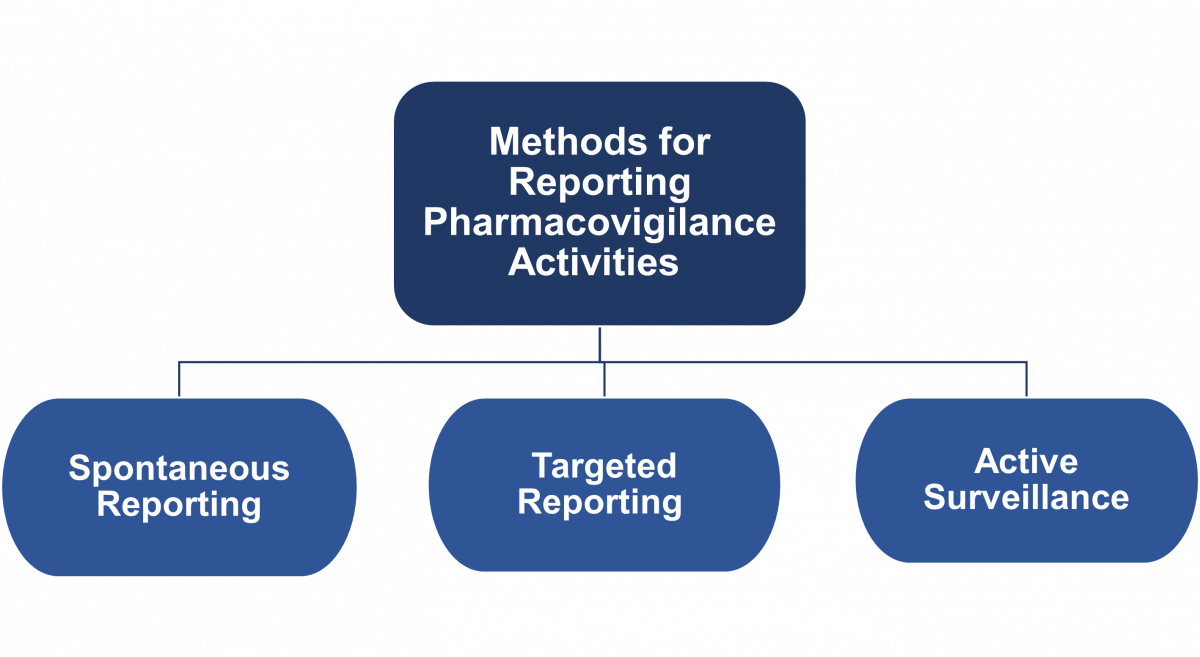
Figure: Three Methods for Reporting Pharmacovigilance Activities
- Spontaneous Reporting
- Spontaneous (or voluntary) reporting means that no active measures are taken to look for adverse effects other than the encouragement of health professionals and others to report safety concerns.
- Reporting is entirely dependent on the initiative and motivation of the potential reporters.
- This is the most common form of pharmacovigilance, sometimes termed passive reporting.
- In some countries this form of reporting is mandatory.
- Clinicians, pharmacists and community members should be trained on how, when, what and where to report.
- Targeted Reporting
- It focuses on capturing Adverse Drug Reactions (ADRs) in a well-defined group of patients on treatment.
- Health professionals in charge of the patients are sensitized to report specific safety concerns.
- Active Surveillance
- It is a proactive effort made to elicit adverse events.
- This is achieved by active follow-up after treatment and the events may be detected by asking patients directly or screening patient records.
- It is best done prospectively.
- The most comprehensive method of active surveillance is Cohort Event Monitoring (CEM), which is an adaptable and powerful method of getting good comprehensive data.
- Other methods of active monitoring include the use of registers, record linkage and screening of laboratory results in medical laboratories.
- This is an important method of reporting under active Drug Safety Monitoring (aDSM) for Drug-resistant TB (DR-TB) patients.
Resources
- Training Modules (1-4) for Programme Managers & Medical Officers (NTEP), 2020.
- A Practical Handbook on the Pharmacovigilance of Medicines Used in the Treatment of Tuberculosis, 2012.
- Ready Reckoner for Medical Officer - Adverse Drug Reactions Associated with Anti-TB Drugs Identification and Management, 2019.
Kindly provide your valuable feedback on the page to the link provided HERE
- Spontaneous Reporting
Causality Assessment for ADR Reporting
ContentAttribution definitions for causality assessment are divided into five categories and are as follows:
- Not related
Adverse Event (AE) that is not related to the use of the drug.
- Doubtful
AE for which an alternative explanation is more likely, e.g., concomitant drug(s), concomitant disease(s) or the relationship in time suggests that a causal relationship is unlikely.
- Possible
AE that might be due to the use of the drug. An alternative explanation, e.g., concomitant drug(s) or concomitant disease(s) is inconclusive. The relationship in time is reasonable, therefore, the causal relationship cannot be excluded.
- Probable
AE that might be due to the use of the drug. The relationship in time is suggestive, e.g., confirmed by de-challenge. An alternative explanation is less likely, e.g., concomitant drug(s), concomitant disease(s).
- Certain (very likely)
AE that is listed as a possible adverse reaction and cannot be reasonably explained by an alternative explanation, e.g., concomitant drug(s), concomitant disease(s). The relationship in time is suggestive, e.g., confirmed by de-challenge and rechallenge.
The Drug-resistant TB Centre (DR-TBC) committee, in coordination with the Adverse Drug Reaction (ADR) Monitoring Centre (AMC) will review and confirm the causality of all serious events/ reactions in relation to therapy.
Resources
- Guidelines for Programmatic Management of Drug-resistant Tuberculosis in India, March 2021.
- Ready Reckoner for Medical Officer - Adverse Drug Reactions Associated with Anti-TB Drugs Identification and Management, 2019.
Kindly provide your valuable feedback on the page to the link provided HERE
Causality Assessment: WHO-UMC [UPSALA Monitoring Centre] Causality Categories for ADR Reporting
ContentThe World Health Organisation-Uppsala Monitoring Centre (WHO-UMC) system has been developed as a practical tool for the assessment of case reports.
The table below lists the various causality categories and their assessment criteria that have been developed under this system.
Table: WHO-UMC Causality Categories; Source: WHO-UMC System for Standardised Case Causality Assessment, p2. CAUSALITY TERM/ CATEGORY ASSESSMENT CRITERIA Certain/ Very Likely - Event or laboratory test abnormality, with plausible time relationship to drug intake
- Cannot be explained by disease or other drugs
- Response to withdrawal plausible (pharmacologically, pathologically)
- Event definitive pharmacologically or phenomenologically (i.e., an objective and specific medical disorder or a recognized pharmacological phenomenon)
- Rechallenge satisfactory, if necessary
Probable/ Likely - Event or laboratory test abnormality, with reasonable time relationship to drug intake
- Unlikely to be attributed to disease or other drugs
- Response to withdrawal clinically reasonable
- Rechallenge not required
Possible - Event or laboratory test abnormality, with reasonable time relationship to drug intake
- Could also be explained by disease or other drugs
- Information on drug withdrawal may be lacking or unclear
Unlikely - Event or laboratory test abnormality, with a time to drug intake that makes a relationship improbable (but not impossible)
- Disease or other drugs provide plausible explanations
Conditional/ Unclassified - Event or laboratory test abnormality
- More data for proper assessment is needed, or additional data under examination
Unassessable/ Unclassifiable - Report suggesting an adverse reaction
- Cannot be judged because the information is insufficient or contradictory
- Data cannot be supplemented or verified
Resources
- The Use of the WHO-UMC System for Standardised Case Causality Assessment.
- Ready Reckoner for Medical Officer - Adverse Drug Reactions Associated with Anti-TB Drugs Identification and Management, 2019.
Kindly provide your valuable feedback on the page to the link provided HERE
Severity Criteria for Reporting ADRs
ContentAdverse Drug Reactions (ADRs) have been graded based on their severity. The figure below provides criteria for the assessment of the severity grade of ADRs.

Figure: Criteria for Severity Grade Assessment of ADRs
- The investigator should use their clinical judgment in assessing the severity of events not directly experienced by the subject, e.g., laboratory abnormalities.
- Safety assessment measure is the proportion of patients experiencing a grade 3 or greater adverse event, as defined by Division of AIDS (DAIDS) criteria during treatment and follow-up.
- Please click here for more information on the DAIDS criteria.
Resources
- Guidelines for Programmatic Management of Drug-resistant Tuberculosis in India, March 2021.
- Ready Reckoner for Medical Officer - Adverse Drug Reactions Associated with Anti-TB Drugs Identification and Management, 2019.
- Division of AIDS (DAIDS) Table for Grading the Severity of Adult and Paediatric Adverse Events, 2017.
Kindly provide your valuable feedback on the page to the link provided HERE
Reporting of Adverse Events and Serious Adverse Events
ContentAll serious and non-serious adverse events which are possibly, probably or very likely related to any anti-TB drug need to be reported by the physician to the National TB Elimination Programme (NTEP).Serious Adverse Events (SAE) needs to be reported to the nearest ADR monitoring centre (AMC) and Central TB Division (CTD) within 24 hours. Any death of a patient occurring during treatment, regardless of causality, must be reported as an SAE.
aDSM-treatment review form to be filled whenever the DR-TB patient develops any SAE
- The primary responsibility of filling up the aDSM forms will be with the nodal officer of the DR-TB centre with the help of a senior medical officer (SMO) or medical officer (MO) designated.
- It is essential that Nikshay data entry are being done on regular basis by statistical assistant at the NDR-TBC and senior DR-TB TB-HIV supervisor at the DDR-TBC centre.
- Forms should be maintained in hard copies until the ADR module is active in Nikshay.
Once relevant forms of aDSM are filled in Nikshay, information is directly communicated to the pharmaco-vigilance programme of India (PvPI) through the Vigiflow=connecting bridge for signal generation.
Resources
aDSM treatment initiation form
ContentUnder the National TB Elimination Programme (NTEP), as an integral part of the Programmatic Management of Drug-resistant TB (PMDT), the aDSM treatment initiation form is to be filled by the staff at the health facility during the treatment initiation of all DR-TB patients.
This form is available as annexure 32 in the PMDT guidelines 2021 and covers the following information:
- Patient’s name, age, sex, Ni-kshay id, PMDT number, and date of interview
- TB-related details - Type of TB, type of drug resistance, and previous history of TB treatment
- Pregnancy and lactation-related details (if applicable)
- History of addiction/ substance use
- Current and past medical conditions/ events – with the date of onset and recovery (if applicable)
- Details about the medication consumed in the past 30 days (both TB and traditional)
- Details about medicines (other than anti-TB medicines) prescribed during the interview
- Name of the treating facility, name of treating clinician and signature of the person reporting
Image
Figure: aDSM Treatment Initiation Form; Source: Guidelines on Programmatic Management of Drug-resistant TB (PMDT) in India, CTD, MoHFW, India, 2021.
Importance of aDSM Treatment Initiation Form
- This form records the pre-treatment medical (including past TB history) history of the patients and hence helps the treating physician during the treatment initiation regarding the drugs being prescribed, additional care required, etc.
- The form also helps as a document to refer back for making important medical decisions in the event of any adverse reactions (both serious and otherwise) reported by the patient during the course of the treatment.
Resources
- Guidelines on Programmatic Management of Drug-resistant TB (PMDT) in India, CTD, MoHFW, India, 2021.
- Guidelines on Programmatic Management of Drug-resistant TB (PMDT) in India, CTD, MoHFW, India, 2017.
- Active Tuberculosis Drug-safety Monitoring and Management (aDSM) - Framework for Implementation, WHO End TB Strategy, 2015.
Assessment
Question Answer 1 Answer 2 Answer 3 Answer 4 Correct answer Correct explanation Page id Part of Pre-test Part of Post-test When should the aDSM treatment initiation form be filled? When a DR-TB patient is initiated treatment When a DR-TB patient is lost to follow-up When ADR is reported by a DR-TB patient When a DR-TB patient completes treatment 1 The aDSM treatment initiation form is to be filled out by the staff at the health facility during the treatment initiation of all DR-TB patients. Yes Yes aDSM review form
ContentThe aDSM treatment review form is a schedule to be filled out:
i) When any adverse event is reported by a patient on a newer drug containing a DR-TB regimen
ii) When a Serious Adverse Event (SAE) of the Division of Allergy and Infectious Diseases (DAIDS) grade 3 or 4 is reported by patients on other DR-TB treatment
This form is to be filled out by the health facility managing the SAE and the following information needs to be covered:
- Patient details (name, age, sex, weight, height, Ni-kshay id, PMDT no.)
- TB-related details - Type of TB, type of drug resistance, and previous history of treatment
- Pregnancy and lactation-related details (if applicable)
- Adverse Drug Reaction (ADR) details – Course of events, timing and suspected cause of ADR, DAIDS grading of the Adverse Event (AE), date of onset and resolution of ADR
- Seriousness of the AE (life-threatening, requires hospitalisation, permanent disability, congenital anomaly, conditions where the intervention is required to prevent permanent impairment/ damage, death)
- Outcome of the adverse event
- Causality with the anti-TB medicines the patient was consuming and actions taken by the clinician in case of suspected adverse event linked to a drug
- Any other relevant clinical information
Image Image
Image
Figure: aDSM Treatment Review Form; Source: Guidelines on Programmatic Management of Drug-resistant TB (PMDT) in India, CTD, MoHFW, India, 2017.
Importance of aDSM Review Form
- Although all AEs are to be clinically managed, aDSM treatment review form focuses mainly on the serious AEs and is an integral component of the Programmatic Management of Drug-resistant TB (PMDT).
- This form helps to carefully monitor and document the drug-related harms attributed to the recent developments in DR-TB treatment, particularly the approval for use of new medicines ahead of the completion of phase III trials, increased use of repurposed drugs for Extensively Drug-resistant TB (XDR-TB) treatment and the development of novel second-line anti-TB regimens, some of which may not have been described yet.
- This also helps clinicians to take corrective actions and help improve the health and safety of patients.
Resources
- Guidelines on Programmatic Management of Drug-resistant TB (PMDT) in India, CTD, MoHFW, India, 2021.
- Guidelines on Programmatic Management of Drug-resistant TB (PMDT) in India, CTD, MoHFW, India, 2017.
- Active Tuberculosis Drug-safety Monitoring and Management (aDSM) - Framework for Implementation. WHO End TB Strategy, 2015.
Assessment
Question
Answer 1
Answer 2
Answer 3
Answer 4
Correct answer
Correct explanation
Page id
Part of Pre-test
Part of Post-test
Who should fill out the aDSM treatment review form?
Patient
Health facility managing the Serious Adverse Event (SAE)
Both of the above
None of the above
2
aDSM treatment review form should be filled out by the health facility managing the Serious Adverse Event (SAE).
Yes
Yes
Fullscreen