Tuberculosis Laboratory Register

The Tuberculosis (TB) Laboratory Register is a paper-based recording register kept in all National TB Elimination Programme (NTEP) laboratories for recording details of diagnostic services offered to TB patients referred from both private and public health facilities.


The register is maintained in the Designated Microscopy Centre (DMC). It is the only register used for recording the details of specimen smear examinations. The Laboratory Technician (LT) is responsible for maintaining and updating the laboratory register.
 

Ayushman Bharat Health and Wellness Centres

Ayushman Bharat (AB) is an attempt to move from a selective approach to health care to deliver comprehensive range of services spanning from preventive, promotive, curative, rehabilitative and palliative care. AB-HWCs are envisaged to deliver expanded range services that go beyond maternal and child health care services to include care for non-communicable diseases, palliative and rehabilitative care, oral, eye and ear nose and throat care, mental health and first level care for emergencies and trauma, including free essential drugs and diagnostic services.

Tuberculosis Unit [TU]

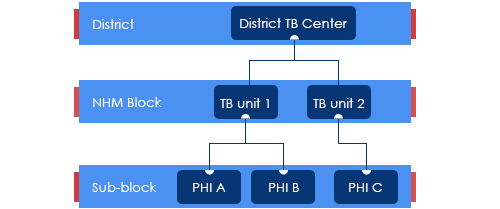
Tuberculosis (TB) unit (TU) is the sub-district level supervisory unit of National TB Elimination Program with the following organogram:

Figure: Organogram of a TB Unit


(PHI: Peripheral Health Institution)

TUs are based mainly on National Health Mission (NHM) health blocks with the aim of aligning with the NHM Block Programme Management Unit (BPMU) for optimum resource utilization and appropriate monitoring.

State TB Demonstration and Training Centre [STDC]: Organogram and Human Resources

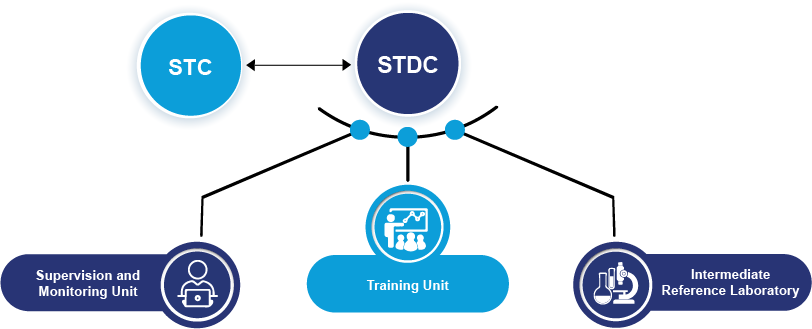
The State Tuberculosis (TB) Cell (STC) is supported by the State TB Training and Demonstration Centre (STDC) in many states through its three units – Training Unit, Supervision and Monitoring Unit and an Intermediate Reference Laboratory (IRL). This relationship is shown in the figure below.

Figure: STDC and its Supporting Units


Targets of End TB Strategy

The End TB (tuberculosis) Strategy targets for 2035 are:

  • 95% reduction in tuberculosis deaths (compared with 2015)
  • 90% reduction in tuberculosis incidence rate (less than 10 tuberculosis cases per 100 000 population)
  • No affected families facing catastrophic costs due to tuberculosis.


Goal of the End TB Strategy Approach

The goal of the End TB (tuberculosis) strategy is to end the global TB epidemic.


Everyone with TB should have access to the innovative tools and services they need for rapid diagnosis, treatment and care. This is a matter of social justice, fundamental to our goal of universal health coverage. Given the prevalence of drug-resistant tuberculosis, ensuring high-quality and complete care will also benefit global health security.


Stop TB Strategy

Vision

The Stop TB Strategy had been developed within the context of an overall vision for Tuberculosis (TB) control – that is, a world free of TB.


Goal

The goal of the Stop TB Strategy was to drastically reduce the global burden of TB by 2015 in line with the Millennium Development Goals (MDGs) and the Stop TB Partnership targets and to achieve major progress in the research and development needed for TB elimination.


Objectives

Subscribe to