
Base Technical Content in text and simple images.

Overcrowding

Overcrowding is the situation where people located within a given space are more than what is considered tolerable from a safety and health perspective. Generally in living/ dwelling areas an measure of 50 square feet is the minimum requirement for space per person; less than this is considered overcrowding.

Calculating the floor space per person: The number of persons in the household divided by the total area of the house gives the floor space per person.
Agent in TB

Mycobacterium tuberculosis (M. tuberculosis) belonging to the family Mycobacteriaceae cause Tuberculosis (TB).

These are rod shaped bacilli and require oxygen to survive (aerobic bacteria).

The following characteristics of these bacilli help them to survive in human body for a long time and resist the action of drugs:

Positive and Negative predictive value for a test

Predictive values are important for a diagnostic test because they tell how truly a test result reflects the truth. Positive predictive value (PPV) and negative predictive value (NPV) are true positive and true negative results of a diagnostic test, respectively. In other words, if someone receives a certain diagnosis by a test, predictive values describe how likely it is for the diagnosis to be correct.


Positive Predictive Value 

PPV is the percentage of patients with a positive test who actually have the disease.

DOTS Strategy

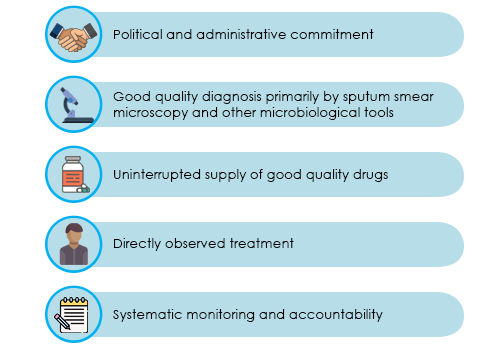
In 1993, the World Health Organisation devised the Directly Observed Treatment Strategy (DOTS) and recommended all countries to adopt it. It called for Nationally coordinated, high-quality TB services, which were priority for improving advancing and sustaining the fight against TB.

The DOTS strategy is based on five components as shown in the below figure.

Figure: Components of the DOTS Strategy


Resources

Subscribe to A0