Management of DR-TB ADR: Hepatitis

Hepatitis is a common adverse drug reaction caused by some Drug-resistance TB (DR-TB) drugs. It is monitored by measuring the Alanine transaminase (ALT) and Aspartate aminotransferase (AST) levels.


If there is jaundice (yellowing of the skin or eyes), field-level health care workers must immediately refer the patient to the nearest higher health centres - District/ Nodal DR-TB Centre/ Sub-district or district hospital, medical college hospitals, etc.


Management of DR-TB ADR: Rash, Allergy and Anaphylaxis Reaction

Hypersensitivity reactions like rashes, allergies and anaphylactic reactions are common Adverse Drug Reactions (ADRs) to any of the second-line anti-TB drugs. 


These ADRs are often reported by patients themselves.


Milder forms of this ADR present with a localised rash that is not associated with mucus membranes. In such cases, patients can be reassured and managed symptomatically at home or at the Peripheral Health Institution (PHI).


Management of DR-TB ADR: QT Prolongation

QT prolongation is a condition in which repolarization of the heart after a heartbeat is affected. 


It results in an increased risk of an irregular heartbeat which can result in shortness of breath or chest pain, fainting, seizures or cardiac arrest. 


If patients experience such signs or symptoms, health workers need to refer such patients to the nearest health facility where Electrocardiogram (ECG) can be done and further management initiated.


Details of Replacement Sequence of Drugs in Longer Oral M/XDR-TB Regimen

Replacement of component(s) drug(s) is required in conditions like adverse drug reaction, poor tolerance, contraindication and resistance detected on baseline Liquid Culture (LC) Drug Susceptibility Testing (DST). 


The replacement sequence of drugs is prepared according to their efficacy, no demonstrable resistance, prior use, side-effect profile and background resistance to replacement drug in the country.

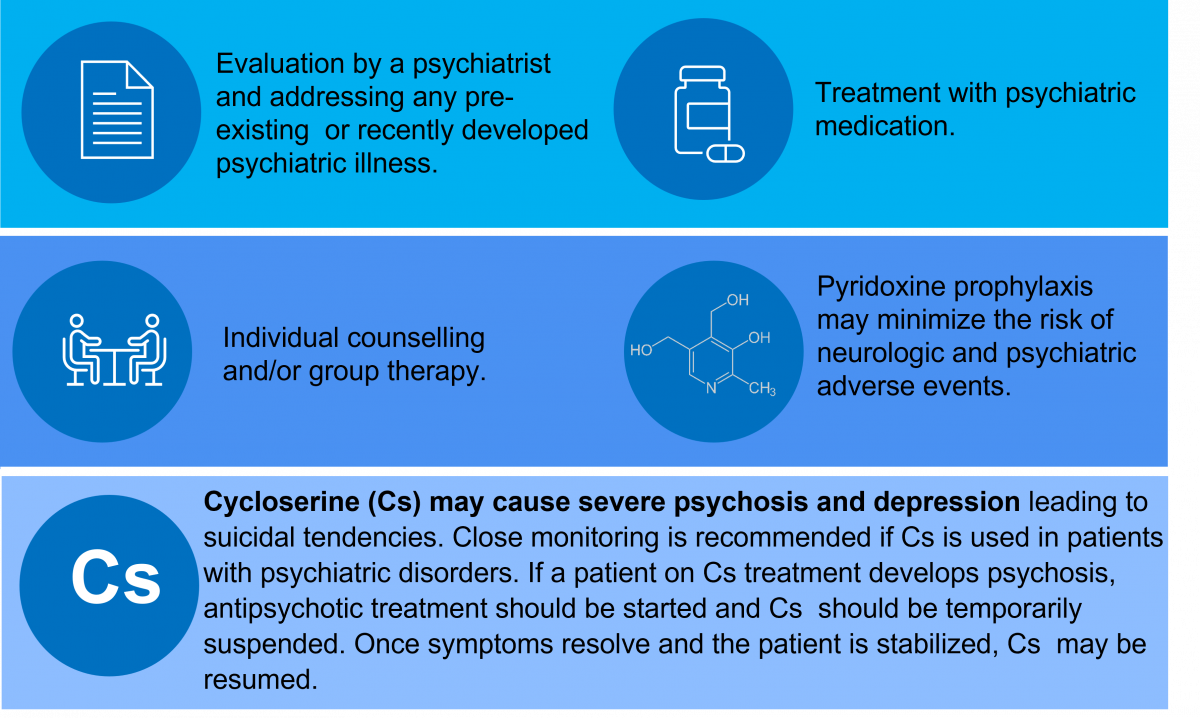
Use of M/XDR-TB Regimen in Patients with Psychiatric Illness

There is a high baseline incidence of depression and anxiety in patients with Multidrug-resistant (MDR)/ Extensively Drug-resistant TB (XDR-TB) patients. Special precautions need to be taken for M/XDR-TB treatment-initiated patients suffering from pre-existing psychiatric illnesses.


Drugs Associated with Psychosis: Cycloserine (Cs), High-dose Isoniazid (Hh), Fluoroquinolone (FQ) and Ethionamide (Eto) 


Use of M/XDR-TB Regimen in Patients with Seizure Disorders

The treating physician should elicit the history of past or present seizure disorders in all Drug-resistant TB (DR-TB) patients.​


If the seizures are not under control, initiation or adjustment of anti-seizure medications will be needed before the start of DR-TB treatment. ​In addition, if other underlying conditions or causes for seizures exist, they should be corrected.​


Subscribe to