
Base Technical Content in text and simple images.

Intermediate Reference Laboratories [IRL] and their role

Some Culture and Drug Susceptibility Test (C&DST) laboratories host an Intermediate Reference Laboratory (IRL) under the National TB Elimination Programme (NTEP). 

There is at least one IRL per state at an identified location, usually in a secondary or tertiary level public health facility. There are 34 IRLs in India.

The IRLs are responsible for:
Global TB Treatment Outcomes

  • Globally, an 86% treatment success rate is reported in people treated for TB with first-line regimens in 2019.
  • The figure below showcases the treatment outcomes for new and relapse TB cases as of 2019 (the latest annual patient cohort for which data are available).
  • Data for people who started treatment in 2020, which will become available in 2021, will be needed to assess the impact of disruptions related to the COVID-19 pandemic.

Reliability of a Test for Diagnosis of DR-TB

Reliability is a measure of a test’s performance. The reliability of a diagnostic test depends on theaccuracy and reproducibility of the test results.


In the context of Drug Resistant (DR) TB, the reliable test  should accurately be able to detect the DR-TB and provide important information that assists in the diagnosis, treatment, or monitoring of a patient with DR-TB, i.e., it should provide accurate Drug Susceptibility pattern of TB.


TB-HIV BURDEN

The interaction between HIV and TB in co-infected persons is bidirectional and synergistic; on the one hand, HIV infection predisposes the development of active TB, and, on the other, the course of HIV-related immunodeficiency is worsened by active TB infection.

False Positivity and False Negativity in Microscopy

False result: It’s a situation where the test result is different from the truth.


Types of False Results

  • False Positive: When the test result is positive but the patient does not have TB.
  • False Negative: When the test result is negative but the patient has TB.


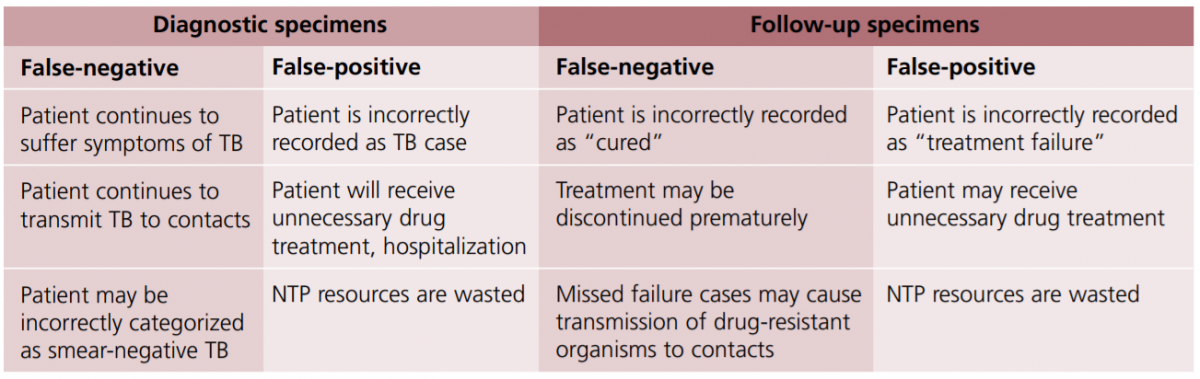
Both cases will lead to wrong categorization and incorrect treatment. The consequences of false results are shown in the figure below:


Reliability of Light Emission Diode [LED] Fluoroscence Microscopy [FM]

The Light Emission Diode Fluorescent Microscopy (LED FM) has the same specificity but increased sensitivity as compared to Ziehl-Neelsen (ZN) microscopy.


Reliability of LED FM in comparison with culture.

VERSUS CULTURE

Sensitivity (95% CI)

Specificity (95% CI)

84%

(76 - 89%)

98%

(85 - 97%)


The LED microscopy was more sensitive compared with ZN microscopy

Designated Microscopy Centre [DMC]

Sputum microscopy diagnostic services under the National TB Elimination Programme (NTEP) are provided by the Designated Microscopy Centres (DMCs) established at the Peripheral Health Institution (PHI) level, where a functional binocular microscope and a trained Laboratory Technician (LT) is available. Light Emission Diode Fluorescent microscopes are provided to high-load PHI-DMCs such as that of the medical colleges. 

Build Pillar of NSP: Digital Information Ecosystem for TB Care

The digital information ecosystem under National TB Elimination Programme (NTEP) has played a crucial role in surveillance and programme monitoring.


It envisages information capture in real-time, processed and visualized, enabling efficient service delivery and responsive program management, driving TB elimination


Nikshay, Nikshay Aushadi, Laboratory Information Management System (LIMS), TB Arogya Sathi and other digital portals have been strengthened during the 2017-20 period.

Subscribe to A0