Follow-up Monitoring of DR-TB Patients
- Read more about Follow-up Monitoring of DR-TB Patients
- Log in to post comments
The following points should be covered in follow-up monitoring of Drug-resistant TB (DR-TB) patients:


Base Technical Content in text and simple images.
The following points should be covered in follow-up monitoring of Drug-resistant TB (DR-TB) patients:
Because of the risk for potential drug-drug interactions, the following medications are not allowed during the 24-week administration of Bedaquiline (Bdq) and up to one month after the last dose of Bdq:
Drug dose administration for shorter/ longer oral Bedaquiline (Bdq)-containing Multidrug-resistant (MDR)/ Rifampicin-resistant (RR)-TB regimen depends on the factors described below.
There are certain inclusion and exclusion criteria for the use of Bedaquiline (Bdq) in TB treatment.
Inclusion Criteria
Exclusion Criteria
To expand access to the Programmatic Management of Drug-resistant TB (PMDT) services, including new regimens and new drugs like Bedaquiline, Delamanid for patients seeking care in the private sector, the following mechanisms are applicable:
Programmatic Management of Drug-resistant TB (PMDT) services for patients seeking care in the private/ other sectors can be accessed from the National TB Elimination Programme (NTEP) at all levels of the health system.
The Difficult-to-treat TB clinic (DT3C) is an initiative to support Drug-resistant TB Centres (DR-TBCs) for better patient management.
The DT3C structure is intended to handhold and mentor District DR-TB centres (DDR-TBCs) for the effective management of Drug-resistant TB (DR-TB) cases.
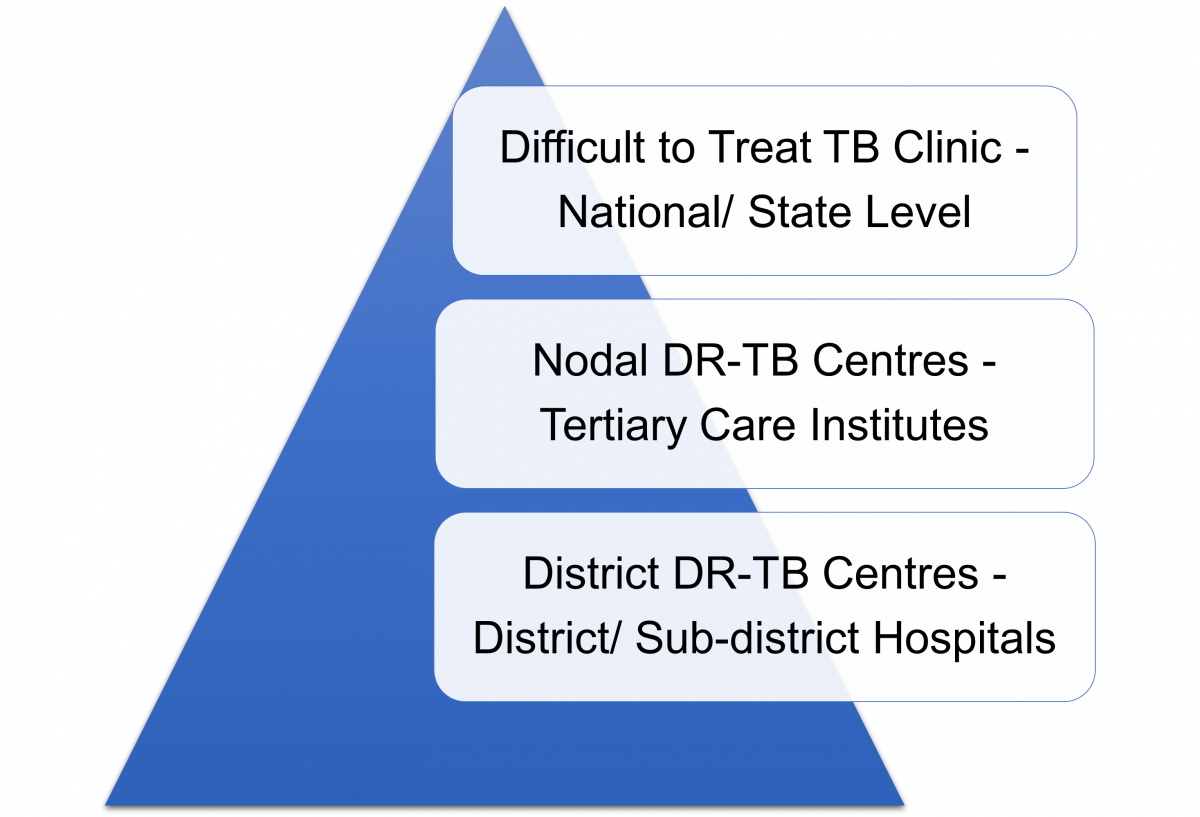
Figure: Difficult-to-treat TB Clinic: Three-tier Structure
The Nodal Drug-resistant Tuberculosis Centre (NDR-TBC) committee is a clinical committee that is responsible for taking decisions regarding the management of DR-TB patients at the NDR-TBC.
The composition of the NDR-TBC committee is provided in the table below.
District Drug-resistant TB Centres (DDR-TBCs) are dedicated centres for providing DR-TB services for patients and can be established at the district or sub-district level.
Nodal Drug-resistant Tuberculosis Centres (NDR-TBCs) are established to manage all forms of DR-TB, including complicated cases. Therefore, the centre should have:
The NDR-TBC is established as per the need and is generally in a tertiary care setting where expertise and facilities for the management of DR-TB are available.