
Content Status where content has been uploaded and published on LMS.

Central Dogma in the Function of DNA: Replication

Deoxyribose Nucleic Acid (DNA) carry genetic information that is transmitted to new cells/off-springs.

The process by which cells maintain their genetic information and convert the genetic information encoded in DNA into gene products is called the Central Dogma.


The central dogma of DNA (Figure 1) are replication, transcription and translation.
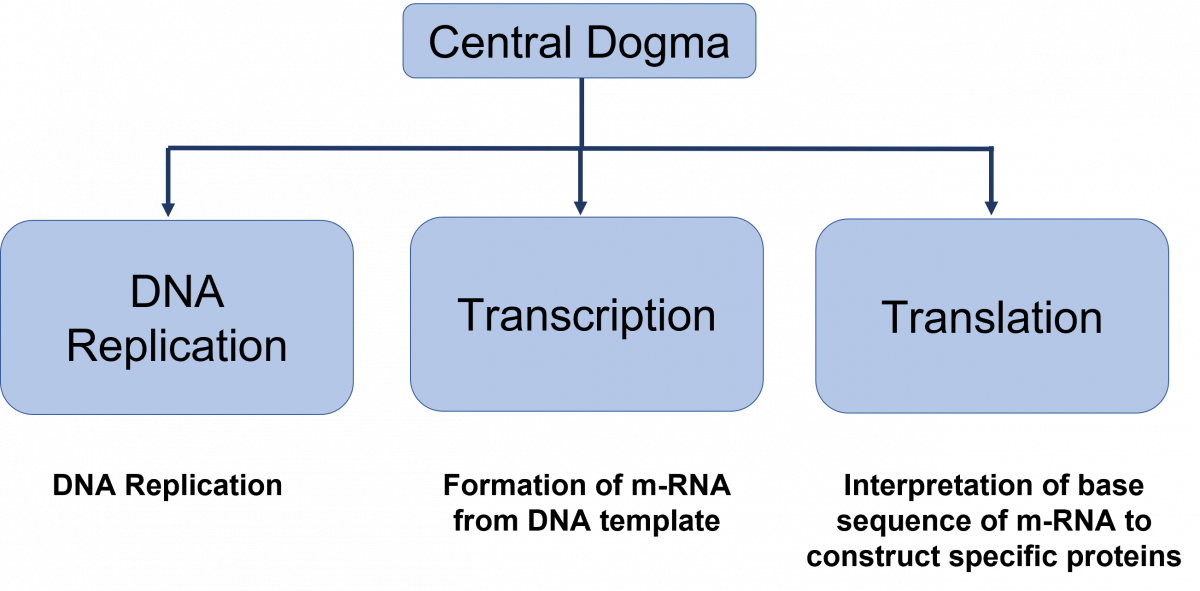
  

Figure: Central dogma of DNA functions


Structure of DNA in a Prokaryotic Cell

  • Deoxyribonucleic acid (DNA) is a molecule that contains genetic information.
  • DNA molecules have two nucleotide strands that wind around one another to form double helix structure.
  • Each nucleotide strand has a backbone made of alternating sugar (deoxyribose) and phosphate groups.
  • Attached to each sugar is one of four nitrogenous bases: adenine (A), cytosine (C), guanine (G), and thymine (T)
  • These bases occur in pairs, where in Adenine is always bonded to Thymine with a 2-H bonds and Cytosine bonded to Guanine with 3-H bonds.

Understanding Key elements of Molecular Biology

To understand Line Probe Assay (LPA), we need to understand key elements of Molecular Biology.


Molecular Biology is the study of living systems at the molecular level, especially DNA, RNA and proteins.


Cell

The cell is the fundamental unit of life and is the building block of all organisms. It has three main components:

  • Cell membrane
  • Nucleus
  • Cytoplasm


Types of Cells

Ensuring Compliance of Truenat Instrument Installation Criteria

Compliance to equipment installation criteria is necessary to/for:

  • Establish accurate and reliable results as claimed by the manufacturer
  • To assure standard/specific requirements are met
  • Provide proof that the process will consistently produce predetermined outcome
  • Equipment safety
  • Improve overall performance of the equipment
  • Decrease work interruptions due to equipment failure
  • Lower repair costs
  • Cover equipment warranty and free maintenance 


Instrument Qualification Documents include:

Prevention of Some Common Issues Encountered During Smear Microscopy at the DMC

Operational conditions, including the safety of the laboratory and personnel, adequate laboratory supplies are important in sputum smear microscopy.

The manpower should be adequately trained to perform sputum smear microscopy.

The designated microscopy centre (DMC) should have quality aspects in place, follow internal quality control measures and should be covered under external quality assurance (EQA) under NTEP.


To avoid common issues, it is important to ensure the following:

Operational aspects:

Management of DR-TB ADR: Metallic Taste

Metallic taste is a minor Adverse Drug Reaction (ADR) that is observed in patients on a regimen with Ethionamide (Eto) and Fluoroquinolones (FQs). It is a non-serious ADR.


It can be easily identified by field-level health care workers and is often reported by patients on their own.


Suspected agent(s): Ethionamide (Eto), Fluoroquinolone (FQ)


Suggested Management Strategies: Encourage the patient to tolerate this side effect.


Preparation of TB Lab Disinfectants

Disinfectants used in lab settings include:


1% Sodium Hypochlorite

  • Broad spectrum antimicrobial action
  • Used to disinfect surfaces
  • Used to disinfect infectious material and disposal of used Truenat consumables (reagent bottles, cartridges, tips, chips) 
  • Hazardous and corrosive, to be used with care
  • Is highly alkaline so can corrode metal
  • Waste soaked in Sodium Hypochlorite should not be discarded by autoclaving. 


70% Alcohol

NAAT Instrument Monthly Data Archive and Data Back-up

Security of laboratory data and confidentiality of TB patient data are important. Hence, it is recommended to archive or take periodic data backup.


The Truelab Analyzer has an internal memory to store 20000 test results. The digital data can be transmitted through connectivity via email, SIM card, Wi-Fi or Bluetooth.


Recommended ways of documenting the results and archiving data are:

Subscribe to Published on LMS