
Supply Chain Management
ContentSupply Chain Management (SCM) is the handing of flow of goods and material from point of origin to point of consumption, with the objective to ensure that the supplies are present for utilization without any interruption. It covers everything from procurement and sourcing of raw materials to delivery of final product to the consumer, along with the related logistics. It will also include the related information systems that enable monitoring and exchange of information.
Effective SCM ensures the following:
- Continuous availability of quality-assured medicines/ products at the right time and at all healthcare levels.
- Minimizes wastage by preventing expiry of drugs at all levels, maintenance of adequate stock levels and accurate records.
- Maximizes patient care by coordination in all departments and by minimizing human errors/ medication errors.
- Economically viable by minimizing monetary loss (e.g., through pilferage) and optimizing cost via bulk purchasing or according to consumption needs.
Robust supply chain management systems have two main components:
- Physical flow: Involved the movement and storage of supplies
- Information flow: Allows the various stakeholders to coordinate and control the flow of supplies
Resources
- NTEP Training Modules 1-4 for Programme Managers & Medical Officers, 2020.
- NTEP Training Modules 5-9 for Programme Managers & Medical Officers, 2020.
- Guidelines for Programmatic Management of Drug-resistant TB, 2021.
Assessment
Question
Answer 1
Answer 2
Answer 3
Answer 4
Correct answer
Correct explanation
Page id
Part of Pre-test
Part of Post-test
Which of the following statements are correct about supply chain management?
It is useful to ensure a continuous supply of good quality medicines.
It is an essential activity that must be undertaken by health programmes.
It helps reduce the cost burden on the healthcare system.
All of the above
4
Effective SCM is an essential activity that ensures a continuous supply of good quality medicines and cost optimization.
Principles of Supply Chain Management
ContentTo ensure successful implementation, sustainability and quality services under the National TB Elimination Programme (NTEP), some guiding principles in Supply Chain Management (SCM) and drug logistics are to be ensured. These are showcased in the figure below.

Figure: Principles of SCM under NTEP
Important Points
- Timely procurement, uninterrupted supply and maintenance of stock and in-time distribution of anti-TB drugs and other consumables are essential for quality services.
- Monitoring of drug supply from the central to peripheral health institute level through web-based real-time software, Nikshay-Aushadhi, is crucial to avoid under-stocking (and delays in treatment initiation) and over-stocking (resulting in wastages).
- Maintaining appropriate storage and stacking norms i.e., different batches of drugs with different dates of manufacture and expiry are stored separately so as to facilitate First-expiry-first-out (FEFO) principles, viz., drug batches with the most recent expiry are issued first.
Under FEFO, the storekeeper at the drug store is responsible for:
- Installing appropriate tools to periodically monitor controls over the expiry position of drugs.
- Exercising prudence in the case of short-expiry drugs, wherein distribution is on a rational basis that considers the utilization pattern. This includes the following:
- The storekeeper marks ‘Expiry Dates’ in Bold Letters 3” to 4” in size, on the drug cartons with a marker pen, for easy identification and control of drugs immediately on their arrival.
- Routine monitoring of the stock position of all drugs.
- Maintaining proper records.
- Analyzing shelf-life analysis of drug stocks at all levels regularly.
Resources
- NTEP Training Modules 1-4 for Programme Managers & Medical Officers, 2020.
- NTEP Training Modules 5-9 for Programme Managers & Medical Officers, 2020.
- Guidelines for Programmatic Management of Drug-resistant TB, 2021.
Assessment
Question
Answer 1
Answer 2
Answer 3
Answer 4
Correct answer
Correct explanation
Page id
Part of Pre-test
Part of Post-test
What is FEFO?
FEFO is the division that manages drug receipts under NTEP.
FEFO is a supply chain principle that is used to forecast consumables that are required by the programme.
FEFO means First-expiry-first-out and it is a principle to be followed when issuing drugs/ consumables.
None of the above
3
FEFO means First-expiry-first-out and it is a principle to be followed when issuing drugs/ consumables.
Drug distribution flow
ContentUnder the National TB Elimination Programme (NTEP), the anti-TB drugs are procured at the centre level by the Central TB Division (CTD), Ministry of Health and Family Welfare (MoHFW), and supplied to the central warehouses.
From the central level warehouses, the drugs are supplied to different State Drug Stores (SDS) and further distributed to District Drug Stores (DDS) and sub-district level (TB Unit (TU) Store and Peripheral Health Institute (PHI)).
This movement of drug flow is monitored in real-time through Ni-kshay Aushadhi.

Figure: Flowchart Showing the Overview of Distribution of Drugs
Abbr: CMSS: Central Medical Services Society; GDF: Global Drug Facility; CTD: Central TB Division; GMSD: Government Medical Store Depot; SDS: State Drug Store; DDS: District Drug Store; TU: TB Unit; PHC: Primary Health Centre; PHI: Peripheral Health Institute.
Resources
Process flow for SCM
ContentRegular, accurate information on consumption, drug stock and supplies at the Peripheral Health Institute (PHI), Tuberculosis Units (TUs), districts and state levels are essential for timely drug stock indenting and distribution at all levels.
The anti-TB drugs are mostly procured centrally, except for very few drugs, and supplied according to a stocking norm to various level stocking units, based on indenting.
These indentings are further dependent on the certain levels of stocks predefined for each level.
The overall idea is to ensure a working and a buffer stock at each level for ensuring uninterrupted drug delivery to the beneficiaries.
Drug Distribution Process
Image
Figure: Drug Distribution Process
Abbr: CTD: Central TB Division; GMSD: Government Medical Supplies Depot; CMSS: Central Medical Services Society; SDS: State Drug Store; DDS: District Drug Store; TU: TB Unit; PHC: Public Health Centre; PHI: Peripheral Health Institute.
Indenting
Indenting is a process in which the requisition for stocks is submitted by the sub-store to the parent store or to the supplier in order to initiate the process of drug supply from the parent store to the sub-store.
The stock management up to the TU level, including transfer to PHI, is handled by Ni-kshay Aushadhi software, while PHI to the patient is handled by Ni-kshay.
Offline Indenting
- The PHIs submit their drug request to the TU through offline indenting modes such as email, phone, etc.
- On receipt of the offline indent, the respective TU releases drugs to the PHI through the TU login in Ni-kshay Aushadhi using "Dispatch without drug request” under the Issue/ Dispatch module.
Online Indenting
- Online indenting is the term used when the indent request is placed through the Ni-kshay Aushadhi software.
- The supply of drugs from the central to the state level and further to districts and TUs is facilitated through online indenting.
Resources
- Standard Operating Procedure Manual Procurement & Supply Chain Management, CTD, MoHFW, India, 2018.
- Procurement, Supply Chain Management & Preventive Maintenance, Module 6, CTD, MoHFW, India.
Assessment
Question
Answer 1
Answer 2
Answer 3
Answer 4
Correct answer
Correct explanation
Page id
Part of Pre-test
Part of Post-test
How is the online indenting process done?
Through Phone
Through e-mail
Through Physical visit
Through Ni-kshay Aushadhi
4
Online indenting is the term used when the indent request is placed through the Ni-kshay Aushadhi software.
Yes
Yes
Procurement- Definition
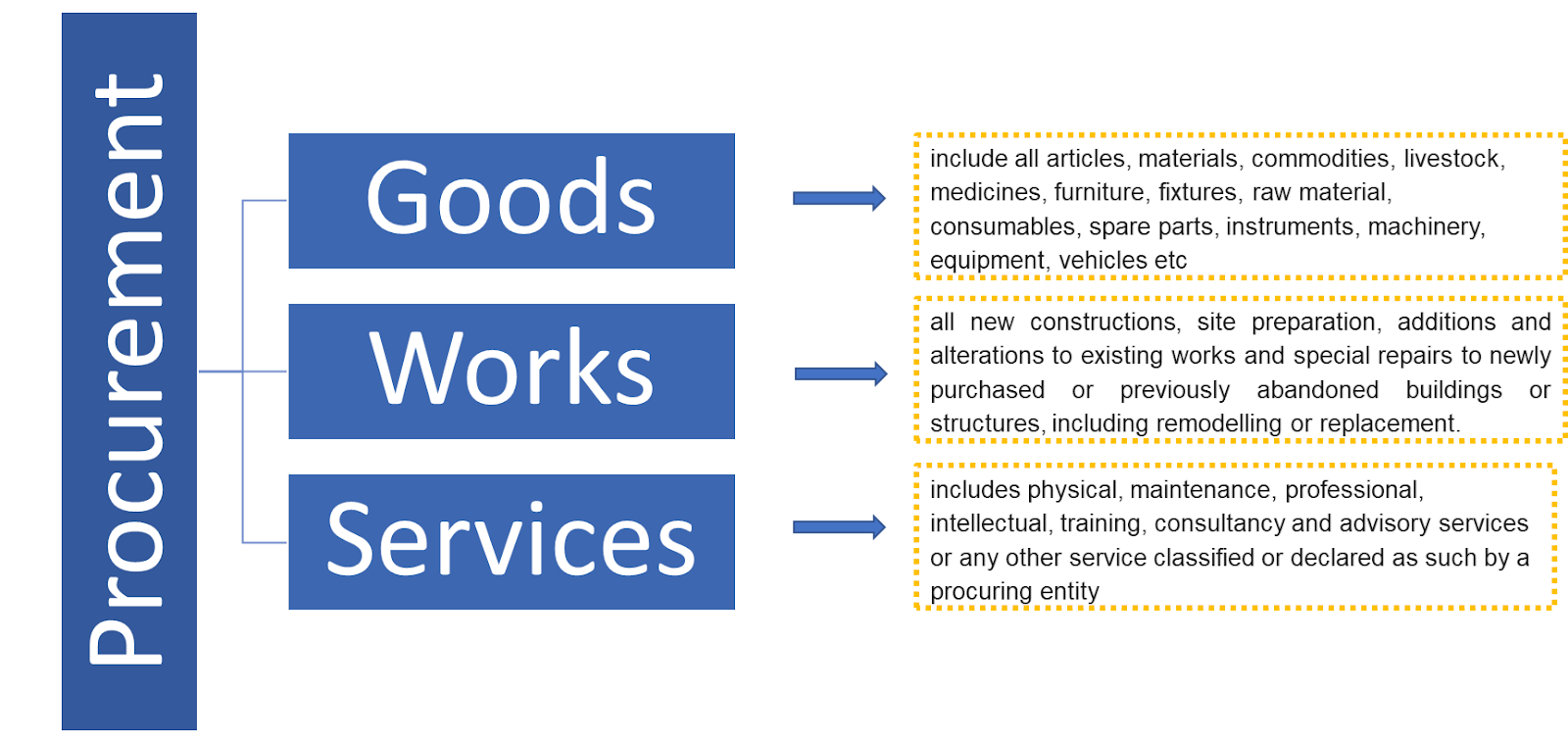
ContentProcurement refers to the process by which governments and state-owned enterprises purchase goods and services from the private sector.
Procurement” means acquisition by way of purchase, lease, license or otherwise, either using public funds or any other source of funds (e.g. grant, loans, gifts, private investment etc.) of goods, works or services or any combination thereof.
Resources
1. Manual for procurement of goods; Ministry of Finance, GoI 2017.
Assessment
Question Answer 1 Answer 2 Answer 3 Answer 4 Correct answer Correct explanation Page id Part of Pre-test Part of Post-test What does procurement include? Buying and process of buying Tendering Acquiring goods from an external source All of the above 4 Procurement refers to the process by which governments and state-owned enterprises purchase goods and services from the private sector. Yes Yes Types of Procurement Processes
ContentFigure: Different types of Procurements
Overview and Process of Procurement
Content
Figure: Procurement Process
Resources
Assessment:
Answer 1
Answer 2
Answer 3
Answer 4
Correct answer
Correct explanation
Page id
Part of Pre-test
Part of Post-test
Procurement process involves Need assessment Bid Invitation
Bid Evaluation
Contract execution& Disposal of scrap
All of the above
Procurement process involves Need assessment
Bid Invitation
Bid Evaluation
Contract execution& Disposal of scrap
Yes
Yes
z
What is GeM
ContentGeM stands for Government e-Market Place. It is the digital eCommerce portal for the procurement and selling of goods and services by the Government of India.

Fig 1: Logo of GeM
Source:https://gem.gov.in
- Government e-Marketplace (GeM) facilitates online procurement of common-use goods & services required by various government departments/organisations / public sector units (PSUs).
- GeM aims to enhance transparency, efficiency and speed in public procurement.
- It provides the tools of e-bidding, reverses e-auction and demand aggregation to facilitate the government users to achieve the best value for their money.
Significance
GeM is a completely paperless, cashless and system driven e-marketplace that enables procurement of common-use goods and services with minimal human interface.
It aims at:
- Instituting a unified procurement policy to encourage behavioural change and drive reform
- Establishing a lean, dynamic organisation capable of continuous innovation and market-driven decision making
- Building an easy-to-use, fully automated platform to ensure transparency and efficiency in procurement
- Demonstrating commitment to delivering value by ensuring the right quality at the right price
- Creating a sustainable ecosystem covering all stakeholders and driving inclusive development in India
Resources
Assessment:
Question Answer 1 Answer 2 Answer 3 Answer 4 Correct answer Correct explanation Page id Part of Pre-test Part of Post-test What are the advantages of GeM? Paperless procurement processes Cashless procurement processes 1& 2 None 3 GeM is a completely paperless, cashless and system-driven eMarketplace that enables procurement of common-use goods and services with minimal human interface.
Yes Yes Processes in GeM
ContentDepending upon the total value of procurement, the GeM platform provides three primary buying modes:

Direct purchase:
Direct purchase enables buyers to buy products of value up to INR 25,000 that meet the requisite quality, specifications, and delivery period without comparison (except automobiles) through any available sellers on GeM.
Direct purchase with L1
The Direct Purchase with L1 is used for mid-value (INR 25,000 to 50,000) transactions and allows the buyer to directly procure from the L1 seller after comparing all available sellers on the platform that meet the requisite quality, specification and delivery period as specified by the buyer. The comparison must be made between goods/services of at least three different manufacturers/Original Equipment Manufacturers (OEMs) and three different sellers.
E-Bid/ Reverse Auction
The E-bid/Reverse Auction mode allows buyers to conduct an electronic bid for the goods and services on the platform. The creation of bid documents as well as system-driven evaluation, are driven through well-defined and standardized technical parameters. The GeM platform shall provide buyers with the option to customize the bid, as per their requirements by way of objective selections.
Proprietary Article Certificate (PAC) Buying
The GeM platform allows buyers to procure on a proprietary basis by using the PAC filter provided on the GeM platform, which allows the selection of a specific model/makes from a particular seller that is available on the platform.
Resources
Assessment
Question Answer 1 Answer 2 Answer 3 Answer 4 Correct answer Correct explanation Page id Part of Pre-test Part of Post-test Who hosts the GeM portal Ministry of Health and Family welfare Central TB Division Directorate General of Supplies and Goods Ministry of commerce 3 GeM portal is hosted by the Directorate General of Supplies and Goods. YES YES Direct Procurement through GeM
ContentDirect purchase enables a buyer to buy services of value up to Rs. 25,000, which meets the requisite quality, specifications and delivery period without comparison(except automobiles), through any of the available sellers on the Government e-Marketplace (GeM) portal.
Steps include:
1.Login to the GeM portal as a buyer

2. Click on Market--> Services

3. Select the service required

4. Check 'Service Level Agreement'

5. Select consignee location and number of resources. Fill in contract dates.

6. Fill in delivery details

7. Can view different service providers

8. Apply filters

9.'Add to Cart' the required one

10. Review cart and proceed

11. Preview Formula

12.

13. Click on 'Direct Purchase' to proceed

14. Click 'Confirm'

15. Enter the 'Reason for Choosing the Seller'

16.

17. Enter 'Financial Details'

18.

19.

20.

21.

22.

Resources
Assessment
Question
Answer 1
Answer 2
Answer 3
Answer 4
Correct answer
Correct explanation
Page id
Part of Pre-test
Part of Post-test
Which service/s are eligible for direct procurement through GeM? Services of value above Rs 1 lakh Services of value up to Rs. 25,000
None of the above
All of the above
2
Direct Purchase enables a buyer to buy services of value up to Rs. 25,000 (except automobiles) through any of the available sellers on GeM.
Floating Tender through GeM
ContentA tender is an invitation to bid for a project or accept a formal offer. Tender is a process on its own; bidding is just a step towards applying for the tender and getting it.
The process of floating a tender through the Government e-Marketplace (GeM) portal has the following steps:
Step 1: Login to the GeM portal using your credentials

Figure 1: Logging into GeM portal
Source: GeM portal
Step 2: Search for the desired product
On logging in, a “Search” option is available at the top section of the same. Click on the “Categories” section of the site and select the product or click on the “search” option and enter the product's name.

Figure 2: Options to search for the desired product
Source: GeM portal
Step 3: Choose the desired product
After searching, product/products will come under the L1 category. If you want to buy items which are made in India, click on the “Made in India” section. However, before you can bid on something, you will need to compare the same with others. This enables you to find the best offering available under the amount of money you are willing to spend.
For this, click on the “Compare” option first. Various other similar options come up on the screen. Compare them side by side.

Figure 3: Comparing products and selecting the desired one
Source: GeM portal
Step 4: Bid on the product
Once the comparison procedure is done, tap on the “Add to Cart” option available under the product. A new window will open; tap on the “Proceed to Checkout” option. Select the “Bidding” option.

Figure 4: Proceed to checkout
Source: GeM portal

Figure 5: Select the‘ Bidding’ option
Source: GeM portal
Step 5: Entering bid details and finalizing
On selecting the “Bidding" option, the bid details page opens. Fill in all details and create the bid.

Figure 6: Bid details page
Source: GeM portal

Figure 7: Create a bid
Source: GeM portal
Review the terms and conditions and click “Finalize Bid”.

Figure 8: Finalizing bid
Source: GeM portal
The bid is generated and details are displayed.

Figure 9: Successful bid creation
Source: GeM portal
On clicking the bid number, you can anytime review the bid- cancel or extend it.

Figure 10: Review of bid
Source: GeM portal
Resources
GeM portal https://gem.gov.in/
Assessment
Question
Answer 1
Answer 2
Answer 3
Answer 4
Correct answer
Correct explanation
Page id
Part of Pre-test
Part of Post-test
GeM portal has the option to select ‘Made in India’ products. True False
1
If you want to buy items which are made in India, click on the “Made in India” section.
Yes
Yes
Buffer Stocks
Storage norms
ContentTo preserve the quality of medicines, good storage practices should be in place at all levels, which requires that staff are appropriately trained and storage conditions adequate.
General Guidelines on Storage of Drugs
Mechanisms to improve TB stock management in central or peripheral drug stores are:
- Stock rotation follows a First-expiry, First-out (FEFO) approach.
- The cleanliness of the area is ensured.
- The environment of the warehouse protects medicines from factors that could inhibit their effectiveness or use, such as sunlight, heat, cold, moisture, pests and theft.
- The stock area is divided into zones for easy location of different products.
- There is a designated area for second-line TB medicines.
Storage Guidelines under the National TB Elimination Programme (NTEP)
Under NTEP, space requirements change at the state, district and peripheral levels according to the NTEP stocking norms, but all other requirements remain the same as shown in the table below. The State TB Officer (STO)/ District TB Officer (DTO) must ensure that the pharmacist/ storekeeper adheres to the following guidelines on the proper storage of drugs.
Table: Guidelines for the Storage of Anti-TB Drugs in NTEP Drug Stores
Space Requirements at the State Drog Store (SDS)
- For every ten lakh population, provision should be made for the storage of about 45 cartons (of 20 boxes each), of Patient-wise Boxes (PWBs) for new cases (PC-1) and PWBs for retreatment cases (PC-2) taken together.
- This is approximately equivalent to 6 months requirement of drugs. For this volume of drugs, the minimum space requirement may be approximated as 50 cubic feet.
- For loose drugs, space provision would be 10% of space allocated to PC-1 and PC-2 PWB cartons. These could alternatively be stored in cupboards/ almirahs where volumes are low and should be kept under lock and key. Do not stack drug cartons on the floor or on top of one another.
Room Requirements
- The store should preferably comprise one large room. Where multiple rooms exist, these should be contiguous or proximate to each other.
- The ceiling must have a height of at least 5 metres.
- There should be a lockable door and at least one window with a grill and wire meshing.
- Properly lit with extra light points for plugging in the required office equipment.
- An even-level, ‘pukka’ floor.
Stacking Requirements
- Ensure that different drug/ consumable items are clearly segregated and stacked on separate racks.
- Different batches of drugs with different dates of manufacture and expiry are stored separately to facilitate FEFO principles (drug batches with the most recent expiry are issued first)
- Mark ‘Expiry Dates’ in Bold Letters 3” to 4” in size, on the drug cartons with a marker pen, for easy identification and control of drugs immediately on their arrival.
- Separate and dispose of damaged or expired products without delay as soon as approval of the same has been received, according to the biomedical waste guidelines.
Temperature and Humidity Control
- To keep humidity levels below the maximum 60% recommended for storage of drugs ensure appropriate ventilation and air circulation, and do not open cartons/ drug boxes unless necessary.
- Hydro thermometers are to be installed up to TB Unit (TU) drug store levels to monitor humidity and temperature regularly.
- Overhead exhaust fan required.
- Plastered walls and ceiling with whitewash without any kind of seepage in the room.
- The store should be clean, dry and well-ventilated.
- Ceiling and sidewalls should preferably be insulated, ensuring that the ambient temperature during peak summer does not result in damage to anti-TB drugs. The ambient temperature may be taken as 15-25°C or depending on climatic conditions, up to 30°C.
- PWBs/ cartons should be placed on shelves ensuring that there is sufficient space between shelves and walls of the storeroom.
- A regular power supply should be available for air conditioning.
Protection from Sunlight
- Shade the windows or use curtains if they are in direct sunlight.
- Keep products in cartons/ drug boxes.
- Do not store or pack products in sunlight.
- Maintain trees around the premises of the drug store to help provide shade and cooling. Check their condition regularly to prevent any untoward incidents.
Fire Safety
Ensure that the fire safety equipment is available and accessible, and that personnel are trained to use it.
Others
- Store medical supplies separately, away from rodents, insecticides, chemicals, old files, office supplies and other materials.
- Stores should not have any odour or indications of contamination and should be sanitised periodically including pest control measures.
Resources
- NTEP Training Modules (5-9) for Programme Managers & Medical Officers, 2020.
- Standard Operating Procedures Manual for State Drug Stores, NTEP, 2012.
Assessment
Question
Answer 1
Answer 2
Answer 3
Answer 4
Correct answer
Correct explanation
Page id
Part of Pre-test
Part of Post-test
Concerning storage of anti-TB drugs, which of the following is correct?
Stock rotation follows a First-expiry, First-out (FEFO) approach.
Store drugs away from direct sunlight.
Hydro thermometers are to be installed up to TU drug store levels to monitor humidity and temperature regularly.
All of the above
4
Appropriate anti-TB drug storage conditions include keeping drugs away from direct sunlight, maintaining appropriate temperature and humidity and following a FEFO approach.
Yes Yes Ni-kshay Aushadhi
ContentNi-kshay Aushadhi is a web-based portal that deals with the management of stocks (anti-TB drugs, consumables and other commodities) across all the stocking points across the National TB Elimination Programme (NTEP), i.e., Government Medical Store Depot (GMSD), Central Medical Services Society (CMSS) warehouses, State Drug Stores (SDS), District Drug Stores (DDS), TB Units (TUs) including Peripheral Health Institutes (PHIs).
Ni-kshay Aushadhi also helps in real-time management of stock position, providing expiry details of commodities, routine/ Additional Drug Request (ADR) Requirements, and patient-wise consumption of drugs at all levels.
Table 1: Nikshay Aushadhi Stakeholders
User Services Central TB Division (CTD)
1. Quantification
2. Purchase Order (PO) generation
3. Quality control
4. State warehouse Drug Transfer Advice (DTA)
5. Monitoring of nation-wide stock & expiry
CMSS warehouse
1. Quantification
2. Purchase request generation
3. Advance shipment details
4. Supplier delivery details
5. Release Order (RO) to SDS
6. Acknowledge desk
7. Transfer of drugs to other warehouses
GMSD
1. Quantification
2. Acknowledge desk
3. Advance shipment details
4. Transfer of drugs to other warehouses
Supplier
1. View Purchase Order (PO) and delivery schedule
2. Enter dispatch details
3. View receipt
4. Demand vs issue
SDS/ DDS/ Drug-resistant TB Centre (DR-TBC)/ TU
1. Routine/ ADR & dispatch to sub-stores
2. Acknowledge desk
3. Transfer of drugs to other warehouses
4. Issue voucher DTA
5. Box preparation, box modification, unpacking and box completion
6. Local purchase
PHI
1. Routine/ ADR
2. Acknowledge the receipt of drugs
3. Issue to patient
4. Return from patient
The Ni-kshay Aushadhi can be used for the following purposes:
- Quantification and forecasting
- Monitoring and distribution
- Data management and analysis
- Recording and reporting of the drugs related data
- Training and capacity building
- Quantification of drugs
- Issue/ dispatch
- Return of drugs
- Drug request management - Routine/ ADR
- Stock management (like drug inventory, Physical Stock Verification (PSV))
- Packaging/ repackaging
- Receive from store/ Acknowledge desk
- Quality control management
Image
Figure: Supply chain management in NTEP through Ni-kshay Aushadhi; Source: Ni-kshay Aushadhi Manual
Resources
Assessment
Question Answer 1 Answer 2 Answer 3 Answer 4 Correct Answer Correct Explanation Page ID Part of Pre-Test Part of Post-Test Ni-kshay Aushadhi can be used for the quantification and forecasting of drug stocks. True False 1 The Ni-kshay Aushadhi can be used for the following purposes:
- Quantification and forecasting
- Monitoring and distribution
- Data management and analysis
- Recording and reporting of the drugs-related data
- Training and capacity building
- Quantification of drugs
- Issue/ dispatch
- Return of drugs
- Drug request management - Routine/ ADR
- Stock management (like drug inventory, PSV)
- Packaging/ Repackaging
- Receive from store/ Acknowledge desk
- Quality control management
- Miscellaneous
Yes Yes Indenting
Receipt of Drugs/consumables
ContentThe process of receipt of drugs is completed through the Ni-kshay Aushadhi application. Once a consignment is dispatched to the receiving unit, the system will display following three options:
- Acknowledge Desk - For acknowledgment of drugs received against CTD-RO/ Issue Voucher
- DTA Receipt - For acknowledgment of drugs received against CTD-DTA: This process is to be used to record receipt of drugs which are received against DTAs issued by CTD/ issued by parent store to correct stock imbalances in sub-stores.
- Received from Third Party :This process is to be used when a store receives any drug or commodity from third party as donation.
- Receipt of 'complete' or 'partial' quantity of drugs can be acknowledged in Ni-kshay Aushadhi, as the case may be. When the user selects a particular consignment and clicks on the ‘Acknowledge’ option, the system shows a list of issued drugs/ items with the following details: Drug Name, Batch Number, Expiry Date, Requested Quantity, Issued Quantity, To be Acknowledged Quantity, Received Quantity, Damaged Quantity, Shortage Quantity.
- In instances where the quantity received is lesser than the issued quantity, the user should enter the same in the ‘Received qty’ column. As the request is partially acknowledged, the system will display it in the orange/ pink colour on the ‘acknowledge desk’. As and when the remaining quantity is received, the user can acknowledge the same by selecting the previous partially acknowledged record and entering the remaining quantity that has been received.
Resources
-
Standard Operating Procedure Manual-Procurement & Supply Chain Management, CTD, MoHFW, India, 2018.
-
Procurement, Supply Chain Management & Preventive Maintenance, Module 6, CTD, MoHFW, India.
-
Receive and Acknowledge, Ni-kshay Aushadhi User Manual, CTD, MoHFW, India.
Assessment
Question Answer 1 Answer 2 Answer 3 Answer 4 Correct answer Correct explanation Page id Part of Pre-test Part of Post-test The partially acknowledged ‘receipt’ will be shown in which colour in the ‘acknowledge desk’ on Ni-kshay Aushadhi? Yellow/ Blue Orange/ Pink Black/ White Green/ Red 2 The partially acknowledged ‘receipt’ will be shown in orange/ pink colour in the ‘acknowledge desk’ on Ni-kshay Aushadhi. Yes Yes Distribution to PHI
Fullscreen