
Base Technical Content in text and simple images.

End TB Strategy Approach

The End TB Strategy is based on 3 pillars underpinned by 4 principles (see figure below). The strategy follows a multi-pronged approach incorporating patient-centred care and prevention, bold policies and supportive systems, and intensified research and innovation.
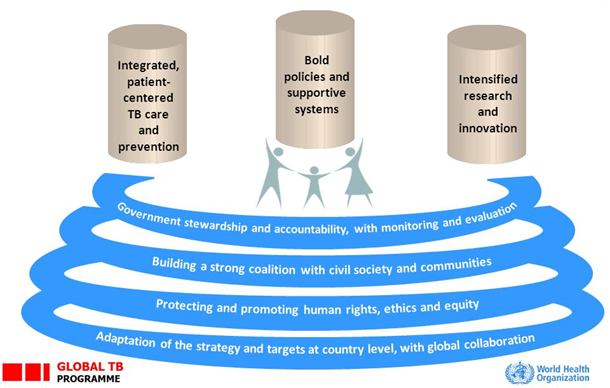
 

Figure: Pillars and Principles of the End TB Strategy; Source: Proposed Post-2015 Global Tuberculosis Strategy and Targets, WHO, 2015


Need for Palliative Care in DR-TB Patients

The current TB treatment strategy is based on a patient-centred approach to treatment and alleviation of patients' suffering that has been restricted mostly to its physical aspects. However, difficulties faced by patients and families affected by life-threatening diseases span across physical, psychological, social and spiritual aspects. Therefore, a more holistic approach to patient treatment requires broadening to a patient-centric care approach with palliative care services.


Palliative care would be necessary for the care of:

Flow Chart of MDR/RR-TB Patients on Shorter Oral Bedaquiline-containing Regimen from Diagnosis to Treatment Outcome

The flow of patients from diagnosis to treatment initiation and follow-up till final treatment outcome submission for Multidrug-resistant (MDR)/ Rifampicin-resistant TB (RR-TB) patients on a shorter oral Bedaquiline (Bdq)-containing regimen is depicted in the figure below.


Figure: Flow of MDR/RR-TB Patients on Shorter Oral Bdq-containing Regimen; Source: Guidelines for PMDT, India, 2021, p107.


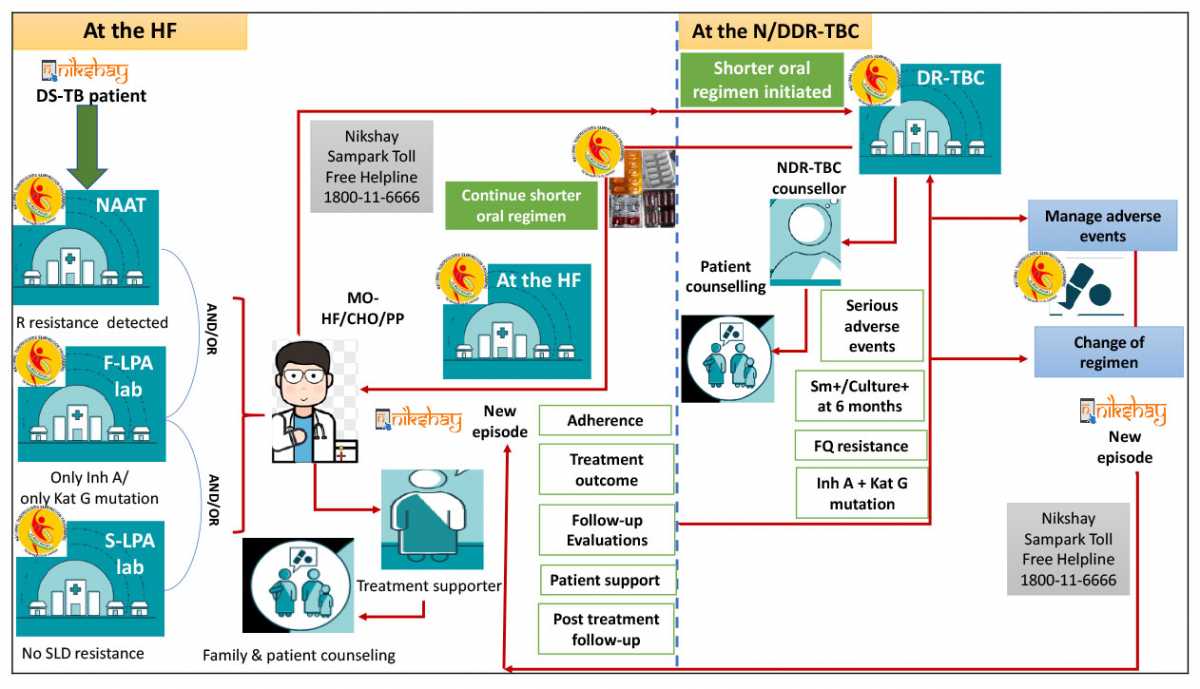
Flow Chart of H Mono/Poly DR-TB Patients from Diagnosis to Treatment Outcome​

The flow of patients from diagnosis to treatment initiation and follow-up till the final treatment outcome submission for Isoniazid (H) mono/ poly Drug-resistant TB (DR-TB) is depicted in the figure below.


Figure: Flow of H Mono/ Poly DR-TB Patients; Source: Guidelines for PMDT, India, 2021, p107.


Interim Treatment Outcomes of DR-TB Cases

There are two main interim treatment outcomes that can occur during Drug-resistant TB (DR-TB) treatment. These are:


Bacteriological Conversion: This occurs after bacteriological confirmation of TB in at least two consecutive cultures (applicable for DR-TB and Drug-sensitive (DS-TB)) or smears (applicable for DS-TB only), taken on different occasions, at least 7 days apart, are found to be negative.


Causality Assessment: WHO-UMC [UPSALA Monitoring Centre] Causality Categories for ADR Reporting

The World Health Organisation-Uppsala Monitoring Centre (WHO-UMC) system has been developed as a practical tool for the assessment of case reports. 


The table below lists the various causality categories and their assessment criteria that have been developed under this system.


Subscribe to A0