
Content Status where content has been uploaded and published on LMS.

Isoniazid [H] Mono/Poly DR-TB Regimen: Pre-treatment Evaluation

Pre-treatment evaluation for any TB patient must include a thorough clinical evaluation by a doctor with:

  • History and physical examination
  • Height/ weight check
  • Random Blood Sugar (RBS) 
  • Chest X-ray 
  • HIV test

No additional investigations (except the basic evaluations mentioned above) are required for Isoniazid (H) mono/ poly Drug-resistant TB (DR-TB) patients unless clinically indicated.
 

Adverse Drug Reactions due to Longer oral M/XDR-TB Regimen

The table below showcases the adverse drug events that may be caused by drugs used for longer oral Multi (M)/ Extensively Drug-resistant TB (XDR-TB) regimen. In these situations, replacement drugs are used instead of these drugs.


Table: Possible Adverse Drug Events in the Longer Oral M/XDR-TB Regimen

ADVERSE DRUG EVENTS

DRUGS

QT prolongation

Use of Longer Oral M/XDR-TB Regimen in Severe Forms of Extrapulmonary TB and TB Meningitis

Longer oral Multi (M)/ Extensively Drug-resistant TB (XDR-TB) regimen can be given to patients with Extrapulmonary (EP) disease. Drug adjustments may be required, depending on the specific location of the disease.


Treatment of Multidrug-resistant (MDR)/ Rifampicin-resistant TB (RR-TB) meningitis is best guided by Drug Susceptibility Testing (DST) of the infecting strain and by the ability of TB medicines to cross the blood-brain barrier

Pre-treatment Evaluation [PTE] in Longer Oral M/XDR-TB Regimen

Pre-treatment evaluation for patients on a longer oral Multi/ Extensively Drug-resistant TB (M/XDR-TB) regimen requires both clinical evaluation and laboratory-based evaluation as given below.


Clinical Evaluation


  • Physical examination​
  • Height​
  • Weight​
  • Psychiatric evaluation if required​
  • Ophthalmologist opinion (for Linezolid)​
  • Surgical evaluation for consideration after culture conversion is achieved​

Laboratory-based Evaluation


Use of M/XDR-TB Regimen in People Living with HIV [PLHIV] ​

The shorter or longer oral Multi/ Extremely Drug-resistant TB (M/XDR-TB) regimens can be used in People Living with Human Immunodeficiency Virus (PLHIV), including those who are receiving Anti-retroviral Treatment (ART). 


The presentation of Multidrug-resistant (MDR)/ Rifampicin-resistant TB (RR-TB) in people living with HIV does not differ from that of Drug-sensitive TB (DR-TB).​ 


Shorter Oral Bedaquiline-containing MDR/RR-TB Regimen: Treatment Extension

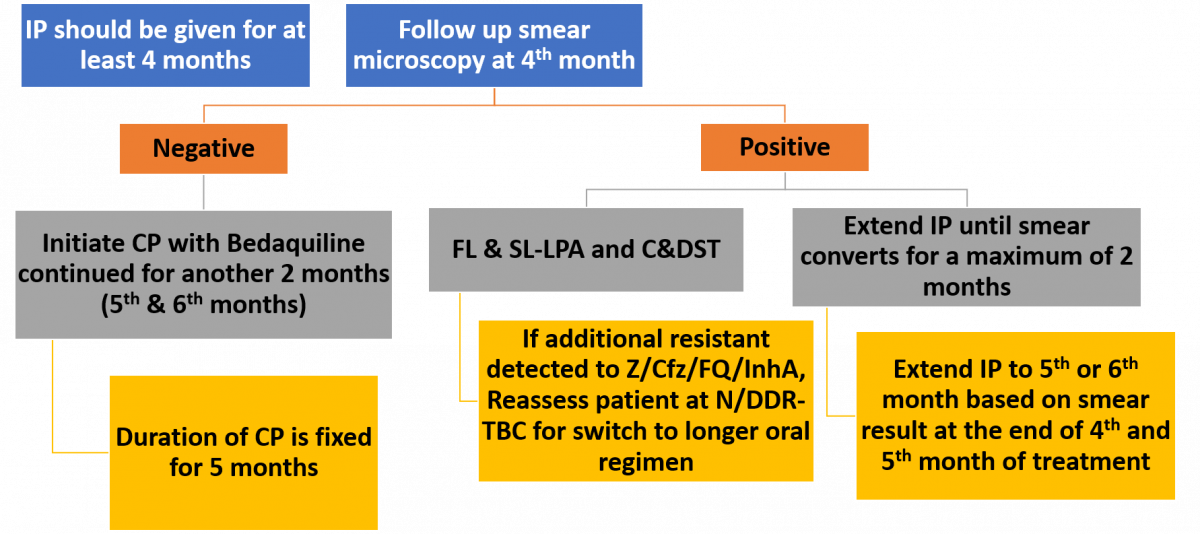
The total duration of treatment in this regimen is 9-11 months with Intensive Phase (IP) at least 4 months and Continuation Phase (CP) for 5 months. Treatment extension of IP is done up to 2 months based on follow-up results and is indicated in the algorithm presented in the figure below.


Figure: Treatment Extension/ Regimen Change Based on Follow up Smear/ Culture/ DST Results


Shorter oral Bedaquiline-containing MDR/RR-TB regimen

Based on the World Health Organization (WHO) treatment guidelines, 2020 recommendations, the National TB Elimination Programme (NTEP) have decided to transition from the current shorter injectable-containing Multi-drug Resistant (MDR)/ Rifampicin-resistant TB (RR-TB) regimen to the shorter oral bedaquiline-containing MDR/RR-TB regimen in the year 2021.​


Salient Features of the Shorter Oral Bedaquiline-containing MDR/RR-TB Regimen


Causes for Drug-resistant Tuberculosis

Drug resistance is caused by a genetic mutation that makes the drug ineffective against the mutant bacilli.

The causes of drug-resistant TB can be enumerated as follows: 

1. Providers/ Programme Related Causes:

  • Inadequate or poorly administered TB treatment regimen
  • Unavailability or poor quality of anti-TB drugs
  • Poor monitoring of TB treatment
  • Delay in detection and management of DR-TB

2. TB Patient/ Host Related Causes:

Subscribe to Published on LMS