Content Status where content has been uploaded and published on LMS.

False Positivity and False Negativity in Microscopy

False result: It’s a situation where the test result is different from the truth.


Types of False Results

  • False Positive: When the test result is positive but the patient does not have TB.
  • False Negative: When the test result is negative but the patient has TB.


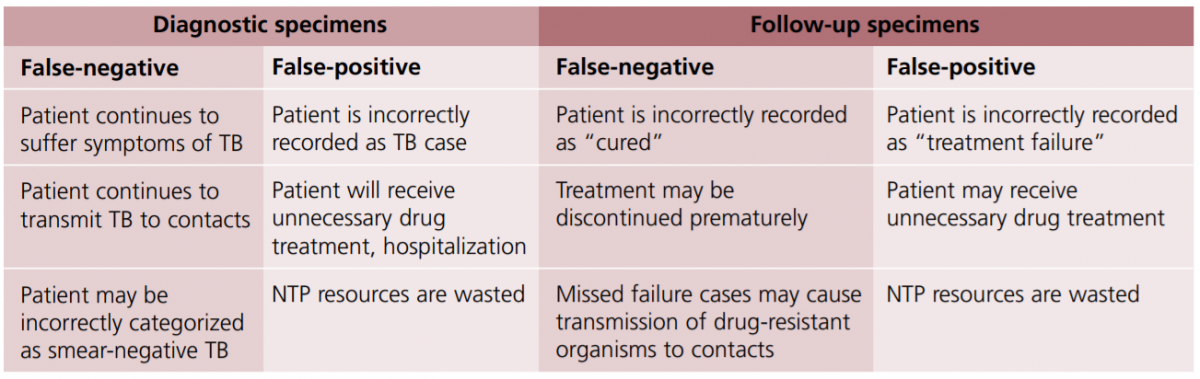
Both cases will lead to wrong categorization and incorrect treatment. The consequences of false results are shown in the figure below:


Reliability of Light Emission Diode [LED] Fluoroscence Microscopy [FM]

The Light Emission Diode Fluorescent Microscopy (LED FM) has the same specificity but increased sensitivity as compared to Ziehl-Neelsen (ZN) microscopy.


Reliability of LED FM in comparison with culture.

VERSUS CULTURE

Sensitivity (95% CI)

Specificity (95% CI)

84%

(76 - 89%)

98%

(85 - 97%)


The LED microscopy was more sensitive compared with ZN microscopy

Designated Microscopy Centre [DMC]

Sputum microscopy diagnostic services under the National TB Elimination Programme (NTEP) are provided by the Designated Microscopy Centres (DMCs) established at the Peripheral Health Institution (PHI) level, where a functional binocular microscope and a trained Laboratory Technician (LT) is available. Light Emission Diode Fluorescent microscopes are provided to high-load PHI-DMCs such as that of the medical colleges. 

Build Pillar of NSP: Digital Information Ecosystem for TB Care

The digital information ecosystem under National TB Elimination Programme (NTEP) has played a crucial role in surveillance and programme monitoring.


It envisages information capture in real-time, processed and visualized, enabling efficient service delivery and responsive program management, driving TB elimination


Nikshay, Nikshay Aushadi, Laboratory Information Management System (LIMS), TB Arogya Sathi and other digital portals have been strengthened during the 2017-20 period.

Source of TB infection

Microbiologically confirmed pulmonary Tuberculosis (TB), is the most common and infectious form of tuberculosis and forms the major source of infection in the community.


Every sputum smear-positive patient has the potential to spread the infection to 10 – 15 persons annually, if untreated.


An infectious TB patient becomes a source of infection for all close contacts (household members, workplace coworkers, students studying in the same class or people coming in close contact with such a case).


Constituents of Monthly Patient-wise Boxes [PWB] for Shorter Oral Bedaquiline-containing MDR/RR-TB Regimen

The patient on shorter oral Bedaquiline-containing multi-drug resistant (MDR)/rifampicin resistant TB (RR-TB) regimen shall be put on Type A and Type B box when initiated on treatment on a monthly patient wise box (PWB). Bedaquiline (Bdq) needs to be issued separately and stopped after 6 months. The patient should be provided with only Type A boxes when started on continuation phase (CP).​

DR-TB Services and Functions of Stakeholders

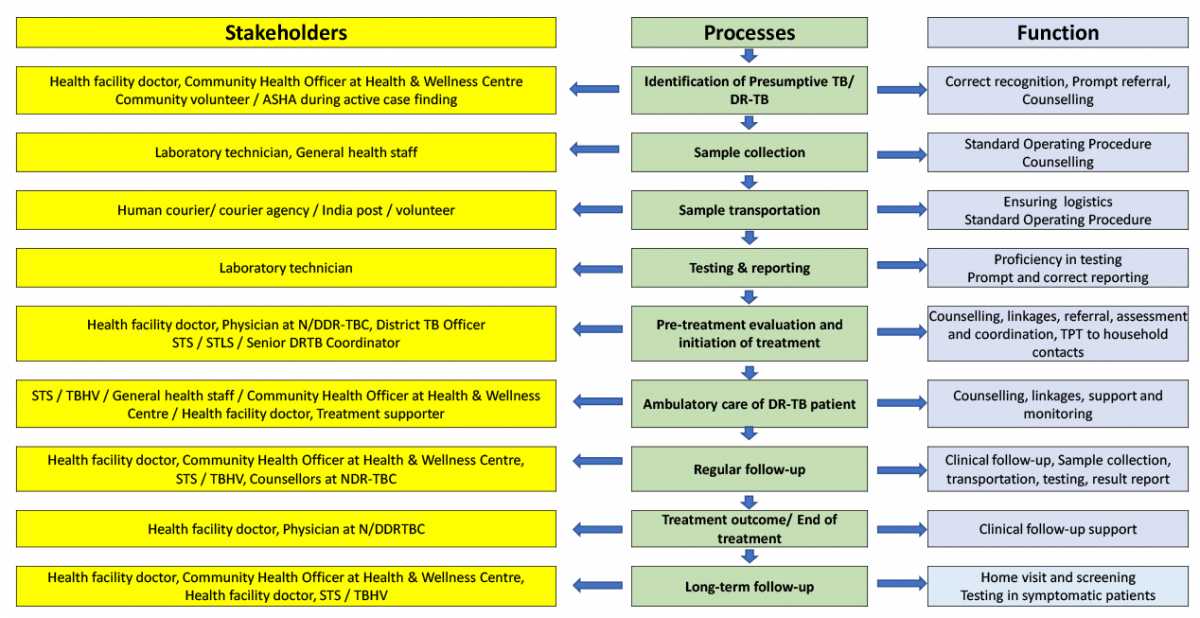
Each of the stakeholder plays important role in DR-TB service delivery and has specific responsibility which is being monitored. 


The flow diagram below depicts the processes involved in the delivery of drug-resistant tuberculosis (DR-TB) services and specific functions of various stakeholders.


Figure 1: Cascade of DR-TB services and functions of various stakeholders
Source: Guidelines for PMDT in India, 2021, p.8


Subscribe to Published on LMS