
Default status of page at the time it is added for creation.

Molecular Beacon Technology for GeneXpert MTB-RIF Assay

The molecular beacons targeting the rpoB gene cover all the mutations found in more than 99.5% of Mycobacterium tuberculosis rifampicin-resistant strains.


The molecular beacon consists of:

  • Loop: 18-30 base pair region of the molecular beacon, which is complementary to the target sequence
  • Stem: 5-7 bp complementary sequence on both the ends of the loop
  • 5’ Fluorophore: Fluorescent dye covalently linked at the 5' end
  • 3’ Quencher: Nonfluorescent dye covalently linked at the 3' end
 

Probe Check Control [PCC] of GeneXpert Technology

Probe Check Control (PCC) of Cartridge Based Nucleic Acid Amplification Test (CBNAAT) Technology tests the fluorescence readings of probes at different temperatures, before the start of thermal cycling.


PCC verifies:

  • Re-hydration of beads
  • Filling of the Polymerase Chain Reaction (PCR) tube
  • Integrity of probes
  • Stability of a dye or the reagents/ quencher.


The results are automatically compared to the pre-established factory settings in the software.


System Check Control [SCC] of GeneXpert Technology

Once the cartridge has been loaded into CBNAAT module, system control checks:

  • The instrument and software readiness
  • Conditions for sample processing
  • The integrity of PCR reagents and PCR efficiency.


Instrument system check control verifies the:

  • Optics
  • Mechanical components
  • Temperature of the module
  • Physical integrity of each cartridge
  • Favourable PCR reaction conditions.


If any aspect of system check control fails, an ERROR is reported.


Sputum Smear Microscopy: Use of Quality Control Slide- QCP and QCN

One of the methods for internal monitoring of the quality of the microscopy process is the use of Quality Control (QC) slides.


QC is a systematic internal monitoring of working practices, technical procedures, equipment and materials, including quality of stains.


Quality Control Positive (QCP) and Quality Control Negative (QCN) slides are used for sputum smear microscopy quality monitoring.


Process for quality control using QCP and QCN is as follows:

Key Points of Health Education and Counselling in DR-TB Care

Providing health education and counselling to each Drug-resistant TB (DR-TB) patient is an essential step in the management of DR-TB patients. 


It is important to consider the long duration of treatment and the multitude of factors that may influence the overall treatment continuation and success. 


The treatment duration of any DR-TB regimen is long enough for the patient who needs multiple sessions of counselling, preferably more frequently in the initial phase of treatment. 


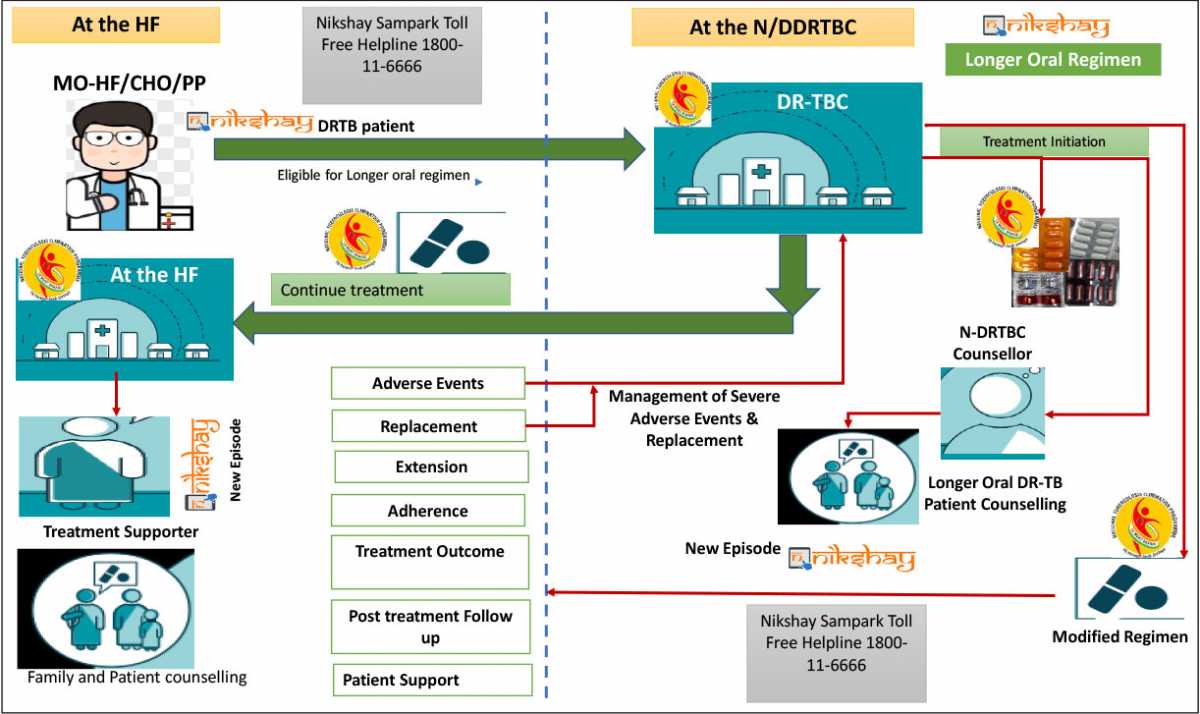
Flow Chart of M/XDR-TB Patients on Longer Oral Regimen from Diagnosis to Treatment Outcome

The following figure depicts the flow of Drug Resistant-TB (DR-TB) patients from diagnosis of DR-TB to treatment initiation and follow-up till final treatment outcome submission for patients on a longer oral regimen. 


Figure: Flow of M/XDR-TB Patients on a Longer Oral Regimen; Source: Guidelines for PMDT, India, 2021, p108.


Dosing of Medicines Used in Second-line MDR-TB Regimens by Weight Band in Patients Under 15 Years

It is important to give proper doses of medicines to patients in second-line Multidrug-resistant TB (MDR-TB) regimens according to their weight band.


The tables below provide information on the dosing of medicines used in MDR-TB regimens by weight band for patients under 15 years.


Table 1: Dosing of Group A medicines used in MDR-TB regimens by weight band for patients under 15 years​;
Source: Annexure 15, PMDT Guidelines, India, 2021.


Subscribe to Page Prioritised