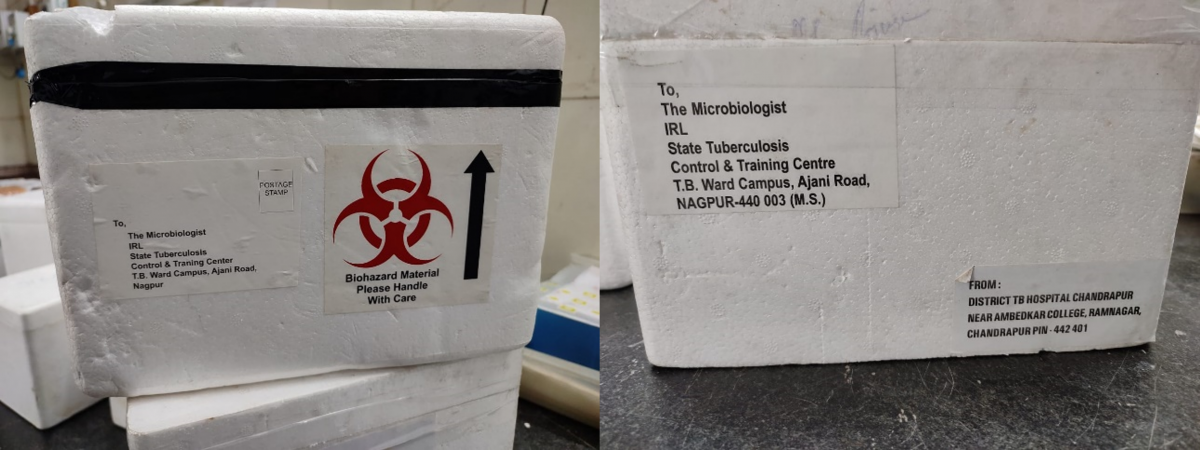
Requirements for Packaging a biological Specimen

Peripheral Laboratories in the NTEP need to send biological samples (such as sputum) to nearby Culture and Drug Susceptibility Testing (CDST) laboratories for advanced testing (eg Drug Resistance Testing). The samples need to be safely packaged and transported such that there is no spillage or contamination.

The items required for safe packaging biological specimens are: 

Technical Specifications for Labelling Specimen Transport Carriers

These are the technical specifications for labelling specimen transport carriers:


  • Specimen containers need to be labelled legibly with details such as the patients’ name, date and time of specimen collection, TB detection centre/ District Tuberculosis Centre (DTC), lab no., specimen A or B.

Figure: Details to be filled on the specimen containers


Universal DST [UDST]

Drug Susceptibility Testing (DST) refers to in-vitro testing using either of the phenotypic methods to determine susceptibility. Drug Resistance Testing (DRT) refers to in-vitro testing using genotypic methods (molecular techniques) to determine resistance.    


Universal Drug Susceptibility Testing (UDST) refers to universal access to rapid DST for at least Rifampicin (R), and further DST for at least Fluoroquinolones (FQs) among all TB patients with rifampicin-resistance.

National Reference Laboratories [NRL]

The National Reference Laboratories (NRLs) constitute the third tier of the National Tuberculosis Elimination Programme (NTEP) laboratory network hierarchy. 


They provide quality assurance and certification services for the Culture and Drug Susceptibility Testing (C&DST) labs and coordinate with the World Health Organisation (WHO) Supranational Reference Laboratory (SNRL) network.


There are six designated NRLs which are delineated in the figure below.

Nutritional Support

Nutrition constitutes an important part of TB Treatment. Undernutrition increases the risk of Tuberculosis (TB), and in turn, TB can lead to malnutrition. It has been demonstrated that undernutrition is a risk factor for progression from TB infection to active TB disease, and undernutrition at the time of diagnosis of active TB is a predictor of increased risk of death and TB relapse.

Nutritional Counselling

Nutritional Counselling begins with the nutritional assessment of TB patients by

  • Nutritional Status: Assessing the height, weight and BMI of the TB patient

  • Diet and Preference food for TB patients

  • Current appetite and food intake of TB patients


Based on the nutritional assessment, following information can be conveyed to TB Patients

TB Arogya Saathi Application

TB Aarogya Sathi empowers Citizens (including TB Patients under NTEP) and to serve as a Direct interface with the national TB program.

Citizen: The App is aimed at  increasing awareness among the citizens. It is available for all Citizens using the App (no login required to access this content)

Receiving a biological specimen at the Laboratory

Biological specimen/ samples collected on reaching a TB testing laboratory needs to be formally received. The sample may be handed over by agents(couriers, health staff/ volunteers, patient representatives) or by patients themselves. The formal receipt of sample enables further processes such as testing and communication of results back to the patient. If the sample is successfully received, the appropriate testing process is initiated using the sample, else it is rejected and a fresh sample requested. 

Subscribe to STLS