Follow-up Monitoring of DR-TB Patients
- Read more about Follow-up Monitoring of DR-TB Patients
- Log in to post comments
The following points should be covered in follow-up monitoring of Drug-resistant TB (DR-TB) patients:


The following points should be covered in follow-up monitoring of Drug-resistant TB (DR-TB) patients:
Drug dose administration for shorter/ longer oral Bedaquiline (Bdq)-containing Multidrug-resistant (MDR)/ Rifampicin-resistant (RR)-TB regimen depends on the factors described below.
Programmatic Management of Drug-resistant TB (PMDT) services for patients seeking care in the private/ other sectors can be accessed from the National TB Elimination Programme (NTEP) at all levels of the health system.
The Difficult-to-treat TB clinic (DT3C) is an initiative to support Drug-resistant TB Centres (DR-TBCs) for better patient management.
The DT3C structure is intended to handhold and mentor District DR-TB centres (DDR-TBCs) for the effective management of Drug-resistant TB (DR-TB) cases.
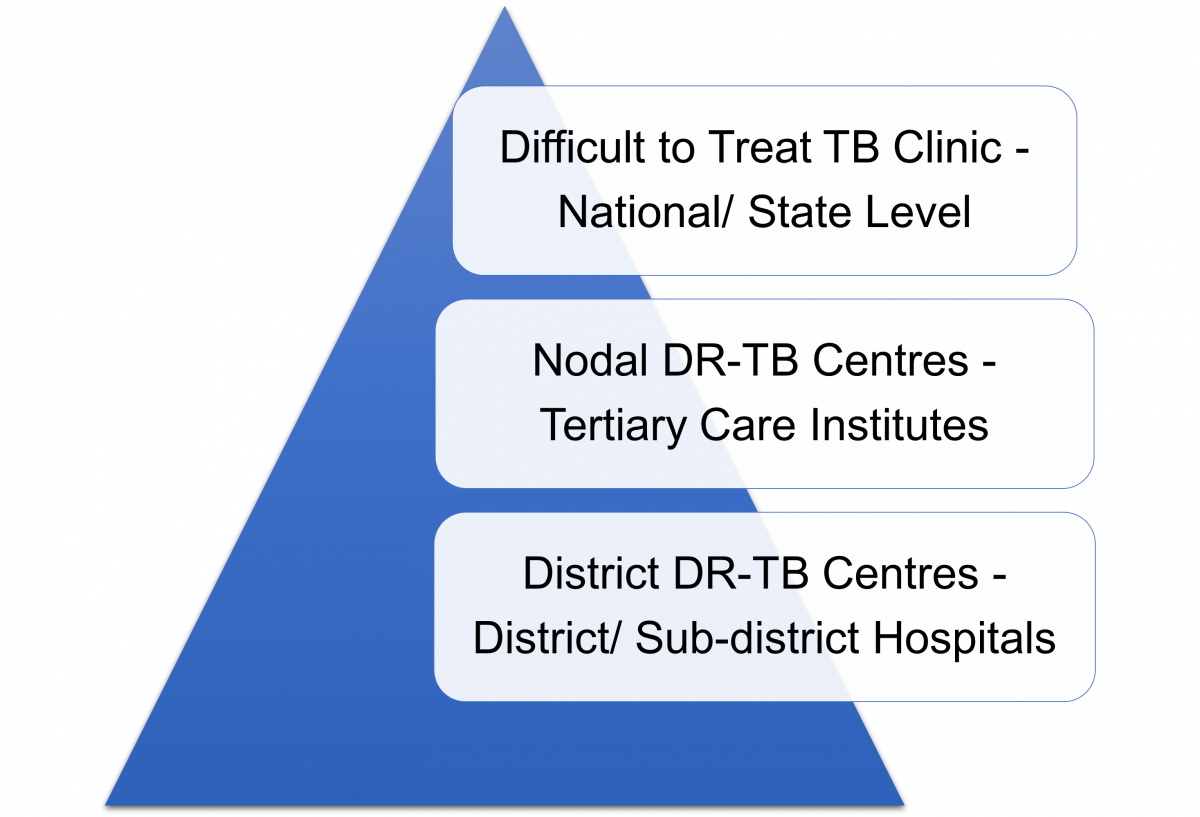
Figure: Difficult-to-treat TB Clinic: Three-tier Structure
The Nodal Drug-resistant Tuberculosis Centre (NDR-TBC) committee is a clinical committee that is responsible for taking decisions regarding the management of DR-TB patients at the NDR-TBC.
The composition of the NDR-TBC committee is provided in the table below.
District Drug-resistant TB Centres (DDR-TBCs) are dedicated centres for providing DR-TB services for patients and can be established at the district or sub-district level.
Nodal Drug-resistant Tuberculosis Centres (NDR-TBCs) are established to manage all forms of DR-TB, including complicated cases. Therefore, the centre should have:
The NDR-TBC is established as per the need and is generally in a tertiary care setting where expertise and facilities for the management of DR-TB are available.
Private sector engagement is a cross-cutting area under the BUILD pillar.
With an estimated 70% of tuberculosis (TB) patients seeking care in the private sector, the private sector involvement is important to ensure TB patients in private setting receive:
The interaction between HIV and TB in co-infected persons is bidirectional and synergistic; on the one hand, HIV infection predisposes the development of active TB, and, on the other, the course of HIV-related immunodeficiency is worsened by active TB infection.
Sputum microscopy diagnostic services under the National TB Elimination Programme (NTEP) are provided by the Designated Microscopy Centres (DMCs) established at the Peripheral Health Institution (PHI) level, where a functional binocular microscope and a trained Laboratory Technician (LT) is available. Light Emission Diode Fluorescent microscopes are provided to high-load PHI-DMCs such as that of the medical colleges.