
TB Treatment Initiation

The Medical Officer (MO) of the referring health facility initiates TB treatment on receipt of the diagnostic test results. All efforts are made to initiate the treatment at the earliest.

The treatment regimen is decided based on the type of patient and TB (based on drug sensitivity pattern, i.e., drug-sensitive TB or H-mono/ poly resistance, history of adverse drug reaction to anti-TB drugs).

Modes of Transportation in SCT

All efforts must be made to have decentralised local arrangements for transporting the specimens to the TB detection centre (TDC). If a proper transport mechanism for collected specimen is in place, it spares the patients from travelling to the laboratory.

The sputum sample is packaged in triple layers in such a manner that it arrives at the destination in good condition and presents no hazard to the transporter.

Transporter/ personnel transporting the sample should be sensitized by the National TB Elimination Programme (NTEP) staff prior to engagement.

Need for Specimen Collection and Transportation [SCT]

The National TB Elimination Programme (NTEP) has strengthened sputum collection and transport for laboratory testing by building capacity for decentralised collection.

  • The provision for sputum collection and transport is used to establish linkages for giving diagnostic access to patients who cannot reach the health facilities. 
  • To increase access and coverage of services, designated sputum collection centres are also established for collecting and transporting sputum to the nearby laboratory.


Process of Reading a Smear

The manner and quality of smear reading has a major impact on the result of sputum smear microscopy and case detection. Each slide needs to be examined for at least 5 full minutes or 100 fields need to be examined. 


The overall process of reading a smear is outlined in the figure below:

Figure: Process of reading a smear


Resources:

Screening and diagnosis for DRTB

Drug-resistant TB (DR-TB) diagnosis is predominantly based on laboratory diagnosis. Presumptive-TB/ DR-TB is identified by the health facility doctor during passive screening or by health staff/ community volunteers during Active Case Finding (ACF). 

The vision of National TB Elimination Programme (NTEP) is to provide early diagnosis to all persons with any form of DR-TB through Universal Drug Susceptibility Testing (UDST).

Intermediate Reference Laboratories [IRL] and their role

Some Culture and Drug Susceptibility Test (C&DST) laboratories host an Intermediate Reference Laboratory (IRL) under the National TB Elimination Programme (NTEP). 

There is at least one IRL per state at an identified location, usually in a secondary or tertiary level public health facility. There are 34 IRLs in India.

The IRLs are responsible for:

False Positivity and False Negativity in Microscopy

False result: It’s a situation where the test result is different from the truth.


Types of False Results

  • False Positive: When the test result is positive but the patient does not have TB.
  • False Negative: When the test result is negative but the patient has TB.


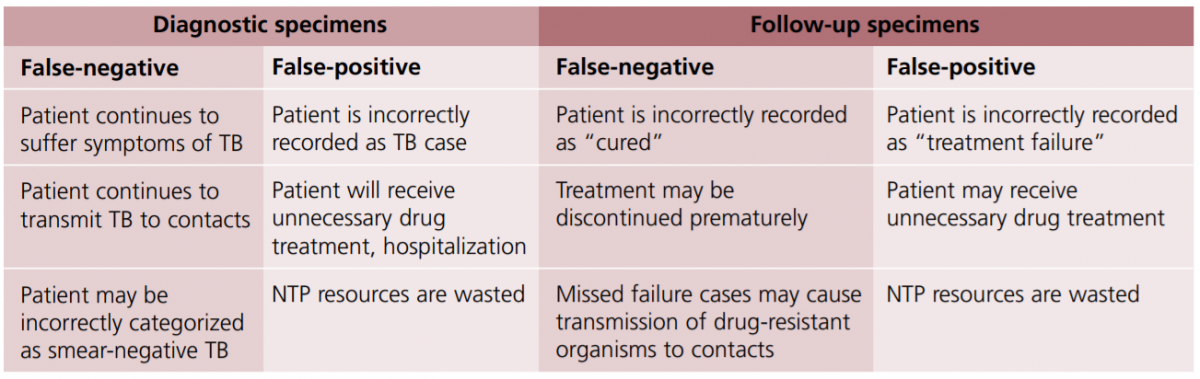
Both cases will lead to wrong categorization and incorrect treatment. The consequences of false results are shown in the figure below:


Subscribe to LT-Microscopy