Screening and diagnosis for DRTB

Drug-resistant TB (DR-TB) diagnosis is predominantly based on laboratory diagnosis. Presumptive-TB/ DR-TB is identified by the health facility doctor during passive screening or by health staff/ community volunteers during Active Case Finding (ACF). 

The vision of National TB Elimination Programme (NTEP) is to provide early diagnosis to all persons with any form of DR-TB through Universal Drug Susceptibility Testing (UDST).

Monitoring Quality Indicators of Truenat

Monitoring of key quality indicators or performance indicators of Truenat is important to assess the functioning of the instrument, calibration/ service requirements of the instrument, competency of the technician performing the assays and inventory management. Overall quality indicators should assess:


  1. Total tests done
  2. Type of samples tested
  3. Test failure
  4. Availability of consumables
  5. Turnaround time
  6. Specimen rejected
  7. External Quality Assurance (EQA) results
  8. Instrument downtime


Processing of Sputum Sample before Truenat Testing

The sputum sample needs to be processed to liquefy and lyse the specimen before Truenat testing. This is because of the following reasons:

  • Sputum samples contain Polymerase Chain Reaction (PCR) inhibitors but PCR amplification requires pure DNA from sputum samples.
  • The sputum sample should be homogenized and pipettable before DNA extraction can begin.
  • Pre-treatment also decontaminates specimen for storage/ transportation/ extraction.


CBNAAT Results Interpretation

On completion of a test run, the Cartridge-based Nucleic Acid Amplification Test (CBNAAT) gives the following results:

  1. MTB DETECTED; Rif Resistance DETECTED
  2. MTB DETECTED; Rif Resistance NOT DETECTED
  3. MTB DETECTED; Rif Resistance INDETERMINATE
  4. MTB NOT DETECTED
  5. Error
  6. Invalid
  7. No result

Conclusive results include: MTB NOT DETECTED, MTB DETECTED with Rif Resistance/ without Rif Resistance.

Intermediate Reference Laboratories [IRL] and their role

Some Culture and Drug Susceptibility Test (C&DST) laboratories host an Intermediate Reference Laboratory (IRL) under the National TB Elimination Programme (NTEP). 

There is at least one IRL per state at an identified location, usually in a secondary or tertiary level public health facility. There are 34 IRLs in India.

The IRLs are responsible for:

False Positivity and False Negativity in Microscopy

False result: It’s a situation where the test result is different from the truth.


Types of False Results

  • False Positive: When the test result is positive but the patient does not have TB.
  • False Negative: When the test result is negative but the patient has TB.


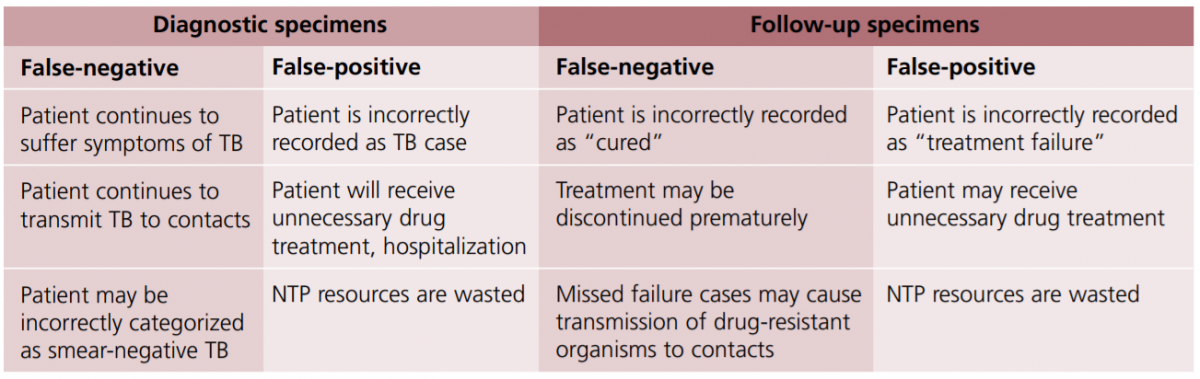
Both cases will lead to wrong categorization and incorrect treatment. The consequences of false results are shown in the figure below:


Designated Microscopy Centre [DMC]

Sputum microscopy diagnostic services under the National TB Elimination Programme (NTEP) are provided by the Designated Microscopy Centres (DMCs) established at the Peripheral Health Institution (PHI) level, where a functional binocular microscope and a trained Laboratory Technician (LT) is available. Light Emission Diode Fluorescent microscopes are provided to high-load PHI-DMCs such as that of the medical colleges. 

Subscribe to LT-Microscopy & NAAT