
-
Pharmacist: Overview of Inventory managament in NTEP
FullscreenEssentials for Inventory Management
ContentInventory Management (IM) is a systematic approach to ordering, receiving, storing, issuing and reordering drugs and other commodities. IM is a critical element in supply chain management which ensures the availability of the right products in the right place at the right time.
Image
Figure: Overview of Inventory Management in NTEP
Abbr: SDS: State Drug Store; DTC: District Tuberculosis Centre, NTEP: National Tuberculosis Elimination Programme.
Under the National TB Elimination Programme (NTEP), IM refers to the activities carried out by the officer-in-charge of logistics and includes the following:
- Determination of Stock Status at the SDS and DTCs/ Subordinate Stocking Points: The pharmacist will determine the drug stock status of their store and of all the sub-units up to PHIs through Ni-kshay Aushadhi.
- Review of Adequacy of Stock: The Pharmacist will analyse the adequacy of stocks on the basis of the available stock and estimated consumption as per the stocking norms.
- Correction of Imbalances through Transfers: Based on the review of drug adequacy, the officer-in-charge will flag all the sub-stores that are significantly under or overstocked.
- The needs of sub-stores flagged as understocked will be addressed through the Additional Drug Request (ADR) or Drug Transfer Advice (DTA) mechanism.
- The stocks at the sub-stores flagged as overstocked or with close to expiry drugs will also be corrected by the DTA mechanism.
- These transfers will only be authorised by the State TB Officer (STO)/ District TB Officer (DTO)/ officer-in-charge and should be recorded in Ni-kshay Aushadhi.
- Replenishment of Stock: The stocks at the stores are replenished on a quarterly basis, pursuant to the review and validation of the reports available in the Ni-kshay Aushadhi.
Resources
Assessment
Answer 1
Answer 2
Answer 3
Answer 4
Correct answer
Correct explanation
Page id
Part of Pre-test
Part of Post-test
Which drug-stocking point/s are required to fill the QRPML?
SDS
DDS
TU
All the above
4
For the purpose of IM, all the drug-stocking points are required to fill and submit Quarterly/ Monthly Report on Programme Management & Logistics (QRPML).
Yes
Yes
Stocking Norms
ContentThe National TB Elimination Programme (NTEP) strives to ensure an uninterrupted supply of drugs, and stocking norms have been developed by the Central TB Division (CTD) to help achieve this goal.
The drug stocks equivalent to 10 months of consumption, shall be maintained with implementing states.
The table shows the quantity of reserve stocks at each level at the start of the quarter (considering the receipt from one higher level).
Table: Stocking norms for First line anti-TB drugs for adults to be followed at each level Level Stock for Utilisation (Months) Reserve Buffer Stock (Months) Drug Requirements State Drug Store (SDS) 0 3 (Quarterly consumption / 3) X 10 – (existing stock in SDS including stocks at all districts at end of the quarter) District Drug Store (DDS) 0 3 (Quarterly consumption / 3) x 7 – (Existing stock in District TB Centre (DTC), TB Unit (TU) and Peripheral Health Institution (PHI) drugstores at end of the quarter) TU Drug Store 0 2 (Quarterly consumption / 3) x 4 – (existing stock in TU including PHI drug stores at end of the quarter) PHI 1 1 (Monthly consumption x 2) – (existing stock in PHI at end of the month) Based on the state stock availability and consumption, the stock is supplied from SDS to the district drug store to its TUs and then to the PHIs. This stocking pattern may be denoted as the 3-3-2-2 (SDS-District-TU-PHI) inventory-stocking norm, aggregating 10 months of inventory at the state level.
- At the start of the quarter, PHIs are supplied with a stock of 2 months (as shown in the table above)
- Every month, they are supplied with stock from the TU based on consumption, which helps to maintain 1 month reserve stock for utilization at the PHI
- This reserve stock helps the PHI to provide drugs if more patients are put on treatment in a particular month and to provide cover for delays in supplies from TU
- Thus, no patient is sent back due to a lack of drugs
- For the TU level to ensure that the PHIs have 1-month utilization stock plus 1-month reserves, it needs to have a reserve stock of 2 months at the beginning of the quarter
- In this way, the continuous supply of drugs is maintained
Paediatric Stocking Norms
Paediatric drug stocks equivalent to 10 months' consumption will also be kept, but paediatric boxes are not expected to be kept at PHI levels. The stocking of paediatric boxes has been limited to the TU level only.
The paediatric stocking pattern may be denoted as the 3-3-4 (SDS-District-TU) inventory stocking norm, aggregating 10 months of inventory at the state level.
Table: Stocking Norms for Second-line Anti-TB Drugs for Adults; to be Followed at Each Level. Level Stock for utilisation Reserve stock Drug requirements SDS 0 Months 3 months (Quarterly consumption/3) X 12 – (existing stock in SDS including stokes at all districts at the end of the quarter) DTC drug store 0 Months 3 months (Quarterly consumption/3) X 9 – (existing stock in DTC drug store including TU & HF drugs stores at the end of the quarter) TU drug store 0 Months 2 months (Quarterly consumption/3) X 6 – (existing stock in TU including HF drugs stores at the end of the quarter) Health facility 0 Months 2 months Reserve stoke in HF at the end of the month Treatment supporter 2 months 0 Months Two-monthly PWB under utilisation Figure: Stocking Norms for Second-line Anti-TB Drugs for Adults; to be Followed at Each Level
Abbr: TU: TB Unit; DTC: District TB Centre; SDS: State Drug Store; PWB: Patient-wise Box; HF: Health Facility.
Level
Stock for utilization
Reserve stock in months of full TPT courses
Drug requirements
Treatment supporter
One full TPT course per beneficiary
0 month
Full TPT course under utilization
HF drug store
0 month
2 month
Reserve stock in HF at end of the month
(2 x total TPT beneficiaries on Full TPT course for HF)
TU drug store
0 month
2 months
(Quarterly consumption/ 3) x 5 – (existing stock in TU including HF drug stores at end of the quarter)
DTC drug store
0 month
3 months
(Quarterly consumption/ 3) x 8 – (existing stock in DTC drug store including TU & HF drug stores at end of the quarter)
SDS
0 month
3 months
(Quarterly consumption/ 3) x 11 – (existing stock in SDS including stocks at all districts at end of the quarter)
Figure: Stocking norms for full TPT courses at various stocking points
Resources:
- NTEP Training Modules 5-9 for Programme Managers & Medical Officers, 2020.
- Standard Operating Procedures Manual for State Drug Stores, NTEP, 2012.
Assessment
Question Answer 1 Answer 2 Answer 3 Answer 4 Correct answer Correct explanation Page id Part of Pre-test Part of Post-test How much stock of first-line anti-TB drugs should be available at a PHI at any given moment? 1 2 3 4 2 2 months' stock of drugs must be available at the PHI level Which of the following stocking norms are implemented by the NTEP? 2-2-3-4 (SDS-District-TU-PHI) inventory-stocking norm 2-3-4 (SDS-TU-PHI) inventory stocking norm 3-3-4 (SDS-District-TU) inventory stocking norm None of the above 3 The paediatric stocking pattern may be denoted as the 3-3-4 (SDS-District-TU) inventory stocking norm, aggregating 10 months of inventory at the state level.
-
Ph-Ch21:Indenting and receipt
FullscreenIndenting in NTEP
ContentAn indent is an official order or requisition for medicine and supplies from a medical store and the process of requesting is called indenting.
Under National Tuberculosis Elimination Programme (NTEP), online indenting of drugs and consumables is done using the Ni-kshay Aushadhi web portal.
There are different types of requests raised through Ni-kshay Aushadhi:
- Quarterly request
- From State to Central TB Division (CTD), District Drug Store (DDS) to State Drug Store (SDS) and Tuberculosis Unit (TU) to District Drug Store (DDS) on a quarterly basis.
- Quarterly replenishment of drug stocks with districts shall be based on the reports submitted by them in NI-kshay Aushadhi, providing complete details of opening and closing stocks, receipts, consumption and anticipated requirement.
- Monthly request
- From Peripheral Health Institution (PHI) to DDS on a monthly basis.
- Additional Drug Request (ADR)
- Supplies to District TB Centres (DTCs) against Additional Drug Requests (ADRs): There are likely to be occasions when the quarterly supply of drugs to DTCs as above, is insufficient to meet the needs of the district and additional drugs are required in advance of the next quarterly shipment. In such cases, the concerned DTC is required to prepare and submit an Additional Drug Request to the State TB Officer (STO), providing details in support of the supplementary requirement.
- The need for an ADR arises only if the more patients put on treatment in the previous month in a quarter goes up, resulting in an insufficient stock in the store. To get the additional supply from CTD/ SDS/ DDS/ TU, an ADR for each item needs to be submitted by the SDS in charge/ District TB Officer (DTO)/ Medical Officer- Tuberculosis Control (MO-TC). Before sending the ADR, one should consider and track the drugs that have been already released and are being transported from central/ state/ district/ TU stores.

Figure: Different Types of Drug Requests as Part of Indenting in NTEP through Ni-kshay Aushadhi Web Portal; Source: Ni-kshay Aushadhi Portal.
Resources
- Standard Operating Procedures Manual for State Drug Stores, Central TB Division, MoHFW, GoI, 2012.
Assessment
Answer 1
Answer 2
Answer 3
Answer 4
Correct answer
Correct explanation
Page id
Part of Pre-test
Part of Post-test
What is the mode of indenting in NTEP?
Through phone call
Through Ni-kshay Aushadhi's web portal
Through letter
Through email
2
Under National Tuberculosis Elimination Programme (NTEP), online indenting of drugs and consumables is done using the Ni-kshay Aushadhi web portal.
Yes
Yes
- Quarterly request
Process of Requesting Supplies
ContentProcess of Requesting Supplies in Ni-kshay Aushadhi
Depending upon the requirement of drugs and other supplies, the following two types of requests are generated through Ni-kshay Aushadhi:
1. Request for routine quarterly supplies
After the analysis of information provided in the QRPML, the pharmacist determines the drug requirements of the district for the next quarter and accordingly generates a request for the supply of the same through Ni-kshay Aushadhi. Such requests are known as the request for routine quarterly supplies.
2. Request for the supply of additional drugs/Additional Drug Requests (ADR)
In case, the quarterly supply of drugs is insufficient to meet the needs of the district, additional drugs are required. A request generated on Ni-kshay Aushadhi for the supply of these requests is known as Additional Drug Requests (ADR).
Process overview

Detailed stepwise procedure:
Step 1: Go to the Ni-kshay Aushadhi website and click on login. Enter your user ID, Password, and then captcha text and click login.
Step 2: Reach the Quarterly/Monthly/ADR Request window following the path Home>Services>Drug request Management> Quarterly/Monthly/ADR Request Advice and select your store. Click on the ‘generate request’ tab to raise a new request.

Figure 1: Creating a new drug request; Source: Ni-kshay Aushadhi Portal.
Step 3: Specify the type of the request (quarterly/monthly requests or ADR), select the indenting store and press the 'go' tab.
Step 4: A list of the drugs will appear in the subsequent window. Choose the drug(s) to be requested either by searching the name in the search tab or by selecting the drug(s) directly from the list. Fill in the average quarterly consumption and the required quantity of the drug in the relevant fields and click save to generate the indent.

Figure 2: Drug requesting window in Ni-kshay Aushadhi; Source: Ni-kshay Aushadhi portal
The indent generated can be viewed, modified, or cancelled from the main menu of ‘Quarterly/ Monthly/ ADR Request Advice, window.

Figure 3: Indent generated
Source: Ni-kshay Aushadhi portal
Resource
Ni-kshay Aushadhi Manual-Central TB Division, Ministry of Health and Family Welfare, Government of India.
Assessment
Answer 1
Answer 2
Answer 3
Answer 4
Correct answer
Correct explanation
Page id
Part of Pre-test
Part of Post-test
The request for drugs is put on which window of Ni-kshay Aushadhi? Quarterly/Monthly/ADR request advice window Acknowledge desk
Dispatch desk
None of the above
1
Reach the Quarterly/Monthly/ADR Request window following the path Home>Services>Drug request Management> Quarterly/ Monthly/ ADR Request Advice and select your store.
Yes
Yes
Procedures following the receipt of supplies
ContentThe State Drug Store (SDS) pharmacist should follow certain procedures after receipt of supplies.

Figure 1: Overview of procedures following receipt of supplies by a State Drug Store (SDS)
Visual Inspection :
- The check shall be limited to visual inspection and count of the number of cartons received and matching the same with the Issue Voucher and Challan. The Storekeeper will not ordinarily open sealed cartons unless the seal and/or exterior suggest damage or shortage or there have been frequent shortages observed in the recent past.
- In case, where the GMSD/CMSS has opted to make part shipments, the Storekeeper shall record details of drugs received and the balance quantity pending supply. The Storekeeper shall follow-up closely with the supplier.
Shortages and/ or transit damages:
- In the case of shortage/ damage determined by the Storekeeper through visual inspection s/he shall take the precaution of opening the seals of all cartons received and carefully checking their contents down to the lowest packaging unit.
- Ideally, SDS should take custody only of undamaged stock from the perspective of the drugs in question being in a good enough condition to be administered to patients. SDS storekeeper shall segregate and preserve damaged stocks till further instructions are received.
Recording and Reporting
- In the case of shortage/ damage/ discrepancy in the quantity of drugs actually received vis-à-vis that indicated as per the transmission/ authorization document, record complete details of the same in the ‘Remarks’ column of the SR & NA and highlight the same.
- In case transmission documents are received prior to receipt of drugs, entry shall not be made in the SR on the basis of such documents viz. RO, Issue Voucher / Challan.
- Alternatively, if drugs are received prior to receipt of transmission documents, entry in SR shall be made only after their receipt and confirmation as to the quantity supplied by respective sending unit.)
Resources
Assessment
Answer 1
Answer 2
Answer 3
Answer 4
Correct answer
Correct explanation
Page id
Part of Pre-test
Part of Post-test
Which document should be received before or along with the consignment from GMSDs?
State Issue Voucher (SIV)
CTD-Release Order (CTD-RO)
District Issue Voucher (DIV)
Quarterly Report on Programme Management & Logistics (QRPML)
2
Upon the receipt of consignment from GMSDs the pharmacist will ensure that a release order from the CTD-Release Order (CTD-RO), issued by the Central TB division is received either before or along with the consignment.
Yes
Yes
-
Ph-Ch22:Issue and consumption
FullscreenIssue of Supplies
ContentThe drugs and consumables procured by Central TB Division (CTD) are issued to States through Central Medical Services Society (CMSS) warehouses/ Government Medical Store Depots (GMSD). Drug requirements, consumption and stock positions, both at State and district levels are monitored at Central TB Division through the reports available in Ni-kshay Aushadhi.
- Dispatch of drugs shall be determined by the STO/DTO or officer in-charge (authorized by the STO/DTO for the purpose), on the basis of analysis of Stock available, stock required and Expiry analysis.
- Transfers to SDSs in other states, if any, shall be made on the basis of instructions (DTA) from CTD.
- Interstate SDS transfers: Between multiple SDSs within the state on the basis of instructions (DTA) of STO.
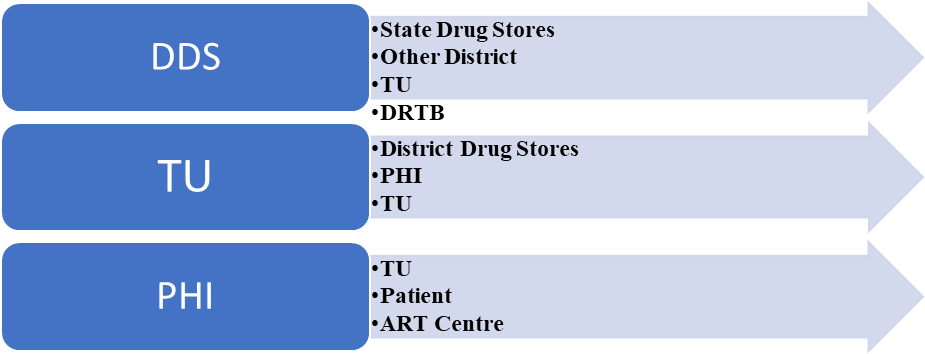
- Implementing DDSs shall be linked to the most convenient SDS (in terms of proximity and transportation arrangements), in the case of TU/ PHI, shall be linked to the most convenient DDS / TU respectively.
Figure 1: Flow of supplies in NTEP

Resources
Assessment
Question Answer 1 Answer 2 Answer 3 Answer 4 Correct answer Correct explanation Page id Part of Pre-test Part of Post-test Quarterly replenishment of drug stocks with districts shall be based on the QRPMLs. True False 1 Quarterly replenishment of drug stocks with districts shall be based on the QRPMLs. Yes Yes Process of Issuing Supplies
ContentProcess of Issuing Supplies
The stores may issue supplies to various sources. Several options are available on Ni-kshay Aushadhi to record the process of supplies to these sources. These options include:
Image
Dispatch on Drug Request:
This process is used to record drugs issued or dispatched to the district drug store in Ni-kshay Aushadhi, against the request generated through Ni-kshay Aushadhi. This includes both requests for routine quarterly supplies and additional drug requests.
Image
Dispatch without Drug Request
This process is used to record drugs issued or dispatched to the district drug store in Ni-kshay Aushadhi, without any request received from sub stores through Ni-kshay Aushadhi.
Image
Drug Transfer Advice (DTA)
This process is used to record the transfer/movement of drugs between two same-level stores, such as State Drug Sores (SDS) to SDS, District Drug Stores (DDS) to DDS or Tuberculosis Unit (TU) to TU level. This process is used to transfer excess drug stocks or near-expiry drugs to another same-level store so they can be consumed on time.
Image
Issue to Third Party
This process is used to record drugs issued to facilities registered as third-party users in Ni-kshay Aushadhi. These include DR-TB Centers, ART Centers, Medical colleges, and other health facilities mapped with the store.
Image
Resources
Nikshay Aushadhi Manual; Central TB Division, Ministry of Health and Family Welfare, Government of India.
Assessment
Answer 1
Answer 2
Answer 3
Answer 4
Correct answer
Correct explanation
Page id
Part of Pre-test
Part of Post-test
Issuing of supplies on routine quarterly and ADR are both on 'dispatch on drug request' window
True
False
1
Reach the ‘Dispatch on drug request’ window following the path Home-menu>services>issue/dispatch>Dispatch on drug request. Select the appropriate options from the drop-down menus to generate the list of requests raised (both quarterly and ADR).
Procedures following the dispatch of supplies
ContentDispatch of drugs shall be determined by the State TB Officer (STO)/District TB Officer (DTO) or officer in charge (authorized by the STO/DTO for the purpose) on the basis of analysis of stocks, consumption and expiry analysis.
The Storekeeper shall perform the following activities for releasing drugs to sub-stores:
Image
Figure 2: Process of releasing drugs to sub-stores
While the storekeeper shall strictly follow FEFO principle, it is also expected from them to exercise due prudence in case of short expiry drugs. The distribution should be rational, keeping in view each district's utilisation pattern with instructions to ensure timely consumption of such close-to-expiry drugs. The same steps are to be followed by sub-stores: District Drug Stores (DDSs) and Tuberculosis Units (TUs).
Resources
1. Standard Operating Procedure Manual- Procurement & Supply Chain Management; RNTCP, MoHFW, GoI 2019.
Assessment
Question Answer 1 Answer 2 Answer 3 Answer 4 Correct Answer Correct Explanation Page ID Pre test Post Test How many copies of the issue voucher (IV) are required during the dispatch of supplies? 5 3 2 1 2 Three copies of issue vouchers (IV) are required during the dispatch of supplies- first and second copies to transporter and the third copy as acknowledgement (consignor's copy) from transporter.
The second copy (consignee's copy) comes back from respective DTCs after receipt of supplies.
yes yes Reporting of dispatch in Nikshay Aushadhi : On Request
ContentReporting of dispatch in Ni-kshay Aushadhi: On Request
This process is used to record drugs issued or dispatched to State Drug store, district drug store, TU, and PHI Stores against the request generated through Ni-kshay Aushadhi.
Process overview:
Image
Detailed stepwise procedure:
Step 1: Go to the Ni-kshay Aushadhi website and click on login. Enter your user ID, Password, captcha text and click login.
Step 2: From the ‘Home menu’, under the services section click on ‘issue dispatch’ tab and then on the ‘dispatch on drug request’ tab.
Step 3: Select the store type to display the list of pending drug requests.
Image
Step 4: Select the request number from the list and click ‘issue’ to open a new window.
ImageStep 5: Fill in the requisite information and click on the ‘save’ tab to generate the issue voucher. The voucher can be saved or printed as per the need.
Image
Resources
Assessment
Question Answer 1 Answer 2 Answer 3 Answer 4 Correct answer Correct explanation Page id Part of Pre-test Part of Post-test Dispatch on drug request option is used to record drugs dispatch to which stores? SDS DDS TU/PHI All of the above 4 This process is used to record drugs issued or dispatched to State Drug store, district drug store, TU, and PHI Stores against the request generated through Ni-kshay Aushadhi. Yes Yes Reporting of dispatch in Nikshay Aushadhi : Without Request
ContentReporting of Dispatch in Ni-kshay Aushadhi: Without Request
This process is used to record drugs issued or dispatched to State Drug Store (SDS), District Drug Store (DDS), TB Unit (TU) and Peripheral Health Institute (PHI) stores without any request through Ni-kshay Aushadhi.
Process Overview
Image
Figure 1: Overview of reporting dispatch without request
Stepwise procedure:
Step 1: Go to the Ni-kshay Aushadhi website and click on login. Enter your User ID, Password, captcha text and click login.
Step 2: From the ‘Home Menu’, under the services section, click on the ‘Issue Dispatch’ tab and then click on the ‘Dispatch without Request’ tab.
Step 3: Fill in the required information of the facility to which the supply is being issued in the ‘Dispatch Without Request’ page.

Figure 2: 'Dispatch without drug request' window in Ni-kshay Aushadhi
Source: Ni-kshay Aushadhi portal
Step 4: Click on the ‘Drug Finder’ tab on the extreme right corner of the page. A popup window will appear where you can select the item/items to be issued. Once selected, click on the ‘Add’ tab to add the items.

Figure 3: Entry of drug details
Source: Ni-kshay Aushadhi portal
Step 5: Click the ‘Save’ tab to generate the issue voucher. The voucher can be saved or printed as per the need.
Resource
Assessment
Answer 1
Answer 2
Answer 3
Answer 4
Correct answer
Correct explanation
Page id
Part of Pre-test
Part of Post-test
Issue without dispatch option is used to record drugs dispatch to which stores?
SDS
DDS
TU/ PHI stores
All the above
4
This process is used to record drugs issued or dispatched to SDS, DDS, TU, and PHI Stores without any request through Ni-kshay Aushadhi.
Yes
Yes
Consumption of supplies
ContentNTEP provides quality drugs to all the diagnosed TB patients without any interruption. Under NTEP, 1st line drugs are being provided in monthly blister strips of Fixed Dosage Combination (FDC) for Drug Sensitive TB patients according to their weight-bands. For drug resistant TB patients, drugs are provided in monthly boxes depending upon their weight-band and resistance pattern (Mono-resistance, poly-drug resistance, Multi Drug Resistance, Extensive Drug Resistance).
Different Supplies are utilized at different locations.
Supplies to patient from PHI
Patients to receive drugs for the treatment of drug sensitive TB or drug resistant TB by DOTS Provider or Treatment Supporter as per the regimen prescribed by the doctor. The DOTS Provider or Treatment Supporter shall receive drugs from Peripheral Health Institution (PHI). PHIs shall issue drugs on monthly basis against the unique Notification ID generated by Nikshay through Nikshay Aushadhi.
Supplies to ART Centre
Drugs which are required to be issued to Anti Retroviral Therapy (ART) Centre for the TB-HIV patient under collaboration of TB and National AIDS Control Organization (NACO), will require to be issued through Nikshay Aushadhi in order to capture the stock being consumed by these ART centres. Programme is in integration NACO and in future Nikshay Aushadhi shall have direct request from ART Centre through their system and accordingly, drug shall be released.
Supplies to Private Sector and Supplies to Lab
Private pharmacies will be involved in dispensation of anti-TB drugs supplied from NTEP to give access to TB patients who seek care in private sector, after consultation with private practitioners. To support the pharmacies for arranging such mechanism for keeping NTEP supplied Fixed Dose Combination (FDC), District TB Officer (DTO) may consider incentives to such pharmacies. NTEP should also arrange for regular uninterrupted drug supply. Monthly PHI report should be used for drug inventory management.
Supplies to Lab
Cartridges/chips are supplied based on the stock availability, consumption and expected cases load. Recording, reporting and monitoring of cartridges/chips is done through Nikshay-Aushadhi.
Supplies to Nodal/District Drug-Resistant TB Centres (N/DDRTBC)
Drugs are issued to the DDSs/NDRTBC based on requirement. At the same time drugs are received from Government Medical Store Depots (GMSDs) .
The drugs are also issued to patients from DR-TB centres, such as Bedaquline or Delamanid. In Nikshay Aushadhi application, the DRTB stores are mapped onto a PHI login id. A DRTB centre which is associated with a PHI, is added on that PHI login id. The user can select the stores either PHI or DRTB, as per the requirement, to use any process.
Medical supplies to Non-TB patents:
The State Drug Store (SDS) shall supply full courses of TB Preventive Therapy (TPT) per person with a buffer stock of 3 months to all the districts on quarterly basis, districts will supply further with a buffer stock of 2 months to all TUs on monthly basis and TUs will supply further with a buffer stock of 2 months to all Health Facility on a monthly basis.
Resources
1. Nikshay Aushadhi User Manual
2. NTEPTrainingModules5to9 Central TB Division, MoHFW, GoI 2020
Assessment
Answer 1
Answer 2
Answer 3
Answer 4
Correct answer
Correct explanation
Page id
Part of Pre-test
Part of Post-test
Consumption of supplies available at PHI store TU store
DDS
NDRTBC
All of the above
Consumption of supplies available at all levels Nikshay - Drug Dispensation Module
ContentThe Drug Dispensation Module in Ni-kshay web allows users to record details of products and the quality of the drugs issued to the patients. This module was launched to replace the existing Prescription Module and to add a variety of features that were missing in the Prescription Module. The user can access the dispensation for a particular patient from the Patient Details page, or directly from the navigation sidebar.
Image
Figure: Access to Drug Dispensation Module from the Navigation Bar or from the Patient Detail Page
The Drug Dispensation Module allows the users to perform the following different processes:
Process
Utility
Add Dispensation
This process allows users to record information on dispensation details, drug issuing facility, and product and refill details.
Print Dispensation
This process allows users to download and print a PDF containing all the information for a dispensation.
Return Dispensation
This process allows users to record events of dispensed drugs being returned back. To return a dispensation, the staff can select the drugs to be returned and add an appropriate reason for returning the drugs.
Copy Dispensation
This process allows users to create a copy of an existing dispensation for a patient thereby saving time by avoiding repetitive data entry.
Refill Due Task list
This process will show the list of patients who have a "Next Refill Due Date" in 2 days or less. It serves as a reminder so that the user can dispense the drugs on time.
Outcome assignment changes
This process automatically extends the “Treatment End Date” in the cases where the “Next Refill Due Date” is greater than the “Treatment End date”. A note for the same is also added.
Adherence linkage
This process allows users to switch on/off the linkage between dispensation and adherence. In case the link is switched on, no manual doses will be registered for the patient's adherence.
Currently, the link is defaulted to "Yes" for Drug-sensitive TB (DS-TB) patients and "No" for Drug-resistant TB (DR-TB) patients.
Resources
Answer 1
Answer 2
Answer 3
Answer 4
Correct answer
Correct explanation
Page id
Part of Pre-test
Part of Post-test
Dispensation for a particular patient can be accessed from the patient details page only.
True False 2 The user can access the dispensation for a particular patient from the Patient details page, or directly from the navigation sidebar. YES Adding and Printing Dispensation
ContentVideo fileReturning Dispensation
ContentVideo fileAdd and view prescription
ContentVideo fileVideo : Add and view prescription
Dispensation Correlation
ContentVideo fileViewing Refill Task List
ContentVideo file
-
Ph-Ch23:Reporting of Stocks
FullscreenForecasting - Meaning and significance
ContentForecasting is a technique of predicting the future based on the results of previous data. It involves a detailed analysis of past and present trends or events to predict future events. It uses statistical tools and techniques. Therefore, it is also called Statistical analysis. Forecasting acts as a planning tool that helps to get ready for the uncertainty that can occur in the future.
Forecasting begins with management's experience and knowledge sharing.
Significance of Forecasting:
- Provides reliable and relevant information about the present and past trends and future predictions that help in planning better.
- Gives the confidence to take important decisions.
- Helps in the handling of uncertainty efficiently
- Optimal utilization
- Managing stock out or surplus stocks
- Helps in managing short expiry
- Minimise Risk of Expiry
- Helps in making the best managerial decisions
Resources
- Standard Operating Procedure Manual, Procurement & Supply Chain Management, Central TB Division, Ministry of Health and Family Welfare, Government of India.
- Companion Handbook to the WHO Guidelines for the Programmatic Management of Drug-resistant Tuberculosis. WHO, 2014.
Assessment
Answer 1
Answer 2
Answer 3
Answer 4
Correct answer
Correct explanation
Page id
Part of Pre-test
Part of Post-test
How often is the quantification process in undertaken at the central level?
Monthly
Quarterly
Annually
Half-yearly
3
As per the current Standard Operating Procedure Manual of Procurement & Supply Chain Management, Central TB Division, the quantification process in done on annual basis at the central level.
Yes
Yes
Forecasting the supply requirement
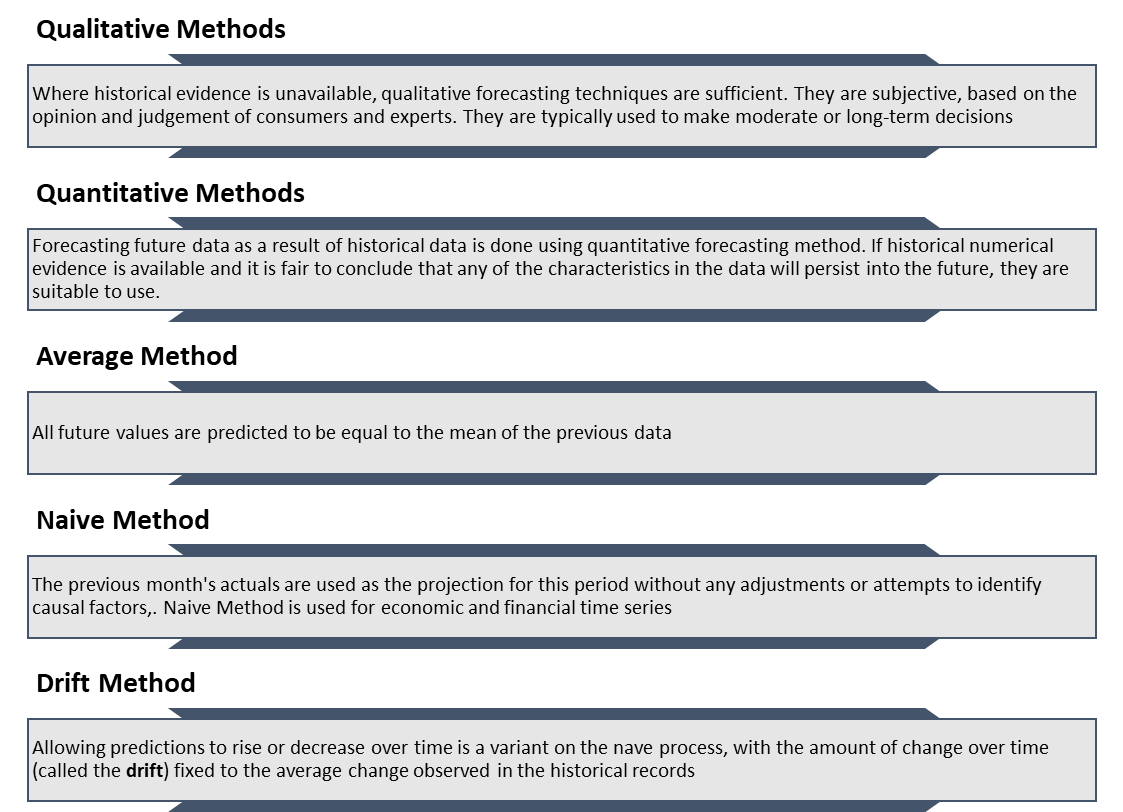
ContentThese methods are used for forecasting the requirements of supplies:
The analysis can be performed by using the below mentioned tool.

Parameters to be Considered for Forecasting:
- Stock in Hand
- Average Consumption
- Stock in pipeline
- Buffer Stock
- Lead time
- Shelf Life of Supplies
Tools available for quantification in the National TB Elimination Programme (NTEP)
Under NTEP, the quantification tool is available on Nikshay Aushadhi portal, and can only be accessed by Central TB Division.
Resources
- Companion Handbook to the WHO Guidelines for the Programmatic Management of Drug-resistant Tuberculosis, WHO.
- Nikshay Aushadhi Manual, Central TB Division, Ministry of Health and Family Welfare, Government of India.
Assessment
Answer 1
Answer 2
Answer 3
Answer 4
Correct answer
Correct explanation
Page id
Part of Pre-test
Part of Post-test
Who can access the quantification tool in Nikshay Aushadhi?
SDS Pharmacist
STO
DTO
CTD
4
The quantification tool available on Nikshay Aushadhi portal can only be accessed by Central TB Division.
Yes
Yes
Follow-up actions to forecasting of supplies
ContentFollow-up Actions for Forecasting of Supplies
Resources:
Assessment
Answer 1
Answer 2
Answer 3
Answer 4
Correct answer
Correct explanation
Page id
Part of Pre-test
Part of Post-test
Excess stock happens when
Forecasted consumption is more than the actual consumption
Forecasted consumption is less than the actual consumption
both
None
Forecasted consumption is more than the actual consumption
Excess stock happens when forecasted consumption is more than the actual consumption
-
Ph-Ch24:Expiry Management
FullscreenOverview of Expiry management of supplies
ContentMeaning and Purpose of Expiry Management
To ensure timely consumption of supplies, the Pharmacist/storekeeper is expected to keep a track of the expiry dates of the drugs and other commodities held in stores. Expiry date reflects the period after which a drug or any other product is known to lose its strength, quality and purity and the time-period ranging from the manufacturing date to the expiry date is referred to as the Shelf-life. The processes involved in ensuring that the supplies are utilized within their shelf life without any wastage is known as the “Expiry Management”.
Supplies that get expired:
Under NTEP following supplies come with an expiry date and must be utilized within their shelf life
S.No.
Supply
Expiry date/shelf-life
1
Anti-TB drugs
2-5 years from the date of manufacturing
2
Xpert MTB/RIF Cartridges
2 years from the date of manufacturing
3
TrueNat MTB chips
2 years from the date of manufacturing
4
TrueNat MTB-RIF Chips
2 years from the date of manufacturing
Resources
Assessment
Answer 1
Answer 2
Answer 3
Answer 4
Correct answer
Correct explanation
Page id
Part of Pre-test
Part of Post-test
What does expiry management ensure?
Timely utilisation of drugs before losing its efficacy.
Reduction in wastage of drugs and lab consumables.
Redirecting drugs to different treatment centres for utilisation before expiry.
All of the above
4
Yes
Yes
Forecasting the expiry of supplies
ContentForecasting the expiry of supplies
In order to ensure the timely consumption of supplies it is important to develop mechanism to periodically monitor control over expiry position of the supplies held in stocks. Reviewing of reports generated by Nikshay Aushadhi can help forecasting the expiry of drugs and taking appropriate actions to ensure consumption of these supplies before their expiry dates. Some of these reports are listed below:
Drug expiry alert: This alert lists out all the drugs from the inventory of the store that are going to expire in the next three months.

Figure 1: Drug expiry alert
Source: Nikshay Aushadhi portal
Stock ledger report and Stock in hand reports: These reports give a list of drugs available at a particular store and details about their available stock and consumption status. These reports will highlight the stores that are overstocked based on their consumption pattern and might not be able to utilize the supplies within their expiry dates.

Figure 2: Stock in hand record
Source: Nikshay Aushadhi portal

Figure 3: Stock ledger report
Source: Nikshay Aushadhi portal
Once the stores having drugs with near expiry dates or those who are overstocked are identified the next step would be to calculate the consumption capacity of these stores based on their existing patient load and anticipated number of new patients to be added. This would help in forecasting drugs in stock that would be consumed before their expiry and those that will not.
Following format can be used for forecasting the consumption of the supplies before expiry:
Table 1: Format for forecasting consumption of supplies
Store
Drug
Expiry Date
Stock in Hand
Anticipated consumption by existing patients
Expected consumption by new patients
Total expected consumption
Excess quantity
Will the consumption happen within the expiry date? Yes/NO
Resources
Standard Operating Procedure Manual Procurement & Supply Chain Management, Ministry of Health and Family Welfare, Government of India 2018
Assessment
Answer 1
Answer 2
Answer 3
Answer 4
Correct answer
Correct explanation
Page id
Part of Pre-test
Part of Post-test
Drug expiry alert lists out drugs which have their expiry date in next:
6 months
3 months
1 month
15 days
2
Drug expiry alert lists out all the drugs from the inventory of the store that are going to expire in the next three months.
Follow-up actions to forecasting of expiry of supplies
ContentFollow-up actions to forecasting of expiry of supplies
Once the pharmacist has forecasted the supplies that may not be consumed within their expiry date, different scenarios may arise in order to manage these supplies efficiently. The scenarios are listed below:
Scenario 1: Supplies will not be consumed at a particular district but may be consumed in other districts of the same state
In this situation, the pharmacist should communicate the details of these supplies to the parent store and State TB Officer (STO). The STO upon receipt of the information will take following actions:
Issue to Sub-stores
After conducting requirement and utilization assessment of each district, STO will identify the needy district where the supplies can be transferred. Drug Transfer Advice (DTA) will be sent to both the stores by the STO.
Note: At least 5 months shelf life should remain before the drugs are diverted from one district to another district.
Other options
The STO can also explore the option of transferring such supplies to facilities outside of NTEP that can utilize these supplies. These facilities may include hospitals, dispensaries, or other facilities within the general health system.
Scenario 2: Supplies may not be consumed by any facility within the state
In this situation information about these supplies should be sent to the Central TB division and the STO with a request to divert these drugs to places where they can be utilized. CTD upon receipt of the information will take following actions:
Transfer to other states
On receipt of requests for diversion, CTD shall identify the States which can utilize these supplies within the given shelf-life. Drug Transfer Advice (DTA) will be sent by CTD to both the States for diversion of drugs.
Resources
Standard Operating Procedure Manual Procurement & Supply Chain Management, Ministry of Health and Family Welfare, Government of India 2018
Assessment
Answer 1
Answer 2
Answer 3
Answer 4
Correct answer
Correct explanation
Page id
Part of Pre-test
Part of Post-test
Minimum shelf-life of the drugs before inter district diversion should be
2 years
3 months
1 year
5 months
4
At least 5 months shelf life should remain before the drugs are diverted from one district to another district.
Disposal of expired supplies
ContentExpiry management of supplies is crucial to avoid financial losses and harm to patients.
If any drug expires due to reasons beyond control, the write-off of expired drugs should be as per the guidelines given in NTEP National Strategic Plan. As per NSP, the State is allowed to write off up to 2% of the cost of the annual supply of drugs on implementation of Drug Sensitivity Testing (DST) guided treatment and 2% cost of rapid molecular test cartridges. The expired stock should be disposed-off as per the Bio-medical Waste (Management and Handling) guidelines of Govt. of India.
Disposal of Expired/Discarded Medicines
Colour of the bag to be used: Yellow
Image
Figure 1: Disposal of expired supplies according to Bio-Medical Waste Management Rules 2016
Updating in Ni-kshay Aushadhi
To dispose of or remove the expired/rejected drugs from the online inventory, follow the steps below:
- Go to the ‘Write-Off/Disposal’ process in Stock Management,
- Click on the ‘Request’ button to generate the disposal request,
- Select the ‘Expired or Rejected’ category, and the system will show the respective drugs
- Select the drug with an expired batch and enter the quantity
- Click on the ‘Save’ button.

Figure 2: Write-off/disposal register in Nikshay Aushadhi Source: Nikshay Aushadhi portal

Figure 3: Entering details of expired drugs in the write-off/disposal register in Nikshay Aushadhi Source: Nikshay Aushadhi portal
Steps to follow
- After saving, select the request and click on the ‘Write-off’ button,
- Verify the drug details and select the type of write-off as ‘Burned/Buried’,
- Enter the ‘Remarks’, and click on the ‘Save’ button,
- System will generate the voucher, and the drug quantity will be deducted from the inventory.

Figure 3: Expired drug details in Nikshay Aushadhi Source: Nikshay Aushadhi portal
Condemnation of laboratory supplies

Figure 4: Process of condemnation of laboratory supplies which are non-functional, obsolete, non-reparable equipment in NTEP’s laboratories
Information is required in below mentioned format to condemn the lab equipment:

Figure 5: Form GFR 10 Source: General Financial Rules 2017, Ministry of Finance, Department of Expenditure, GoI
The request for the replacement of the equipment condemned has to be submitted to State TB Officer (STO)/Central TB Division (CTD) in the below-mentioned format:

Figure 6: Annexure 4 for details of equipment for condemnation Source: Guidelines for the condemnation and replacement of Tuberculosis (TB) laboratory equipment under the Revised National Tuberculosis Control Programme (RNTCP) 2019
Resources
1. Guidelines for Management of Healthcare Waste as per Biomedical Waste Management Rules, 2016
Assessment:
Question Answer 1 Answer 2 Answer 3 Answer 4 Correct answer Correct explanation Page id Part of Pre-test Part of Post-test Disposal of expired supplies is done in which colour bag? Yellow Red White Blue 1 Discarded or expired medicine in yellow coloured non-chlorinated plastic bags
-
Ph-Ch25:Stocking NTEP drugs in Private sector
FullscreenStocking NTEP drugs in private sector-Overview and significance
ContentOverview of National TB Elimination Program (NTEP) Drug Logistics for Private Sector
The partnership option envisioned under NTEP should ensure an uninterrupted supply of anti-TB drugs at the state/ district/ sub-district and facility level for private sector facilities.
- For private practitioners/ medical stores/ other partners registered as Peripheral Health Institute (PHI) under Ni-kshay, drugs will be issued from their concerned TB Units (TUs).
- For non-registered private practitioners/ medical stores/ other partners under Ni-kshay, drugs will be issued as a third-party option and consumption of same should be recorded as ‘Misc. Consumption’ in Ni-kshay Aushadhi.
- The drugs are to be supplied to the private sector not more than twice a month.
Significance of stocking drugs in the private sector
- >40% of the patients in India attend private healthcare facilities initially for TB care and nearly 50% of the retreatment cases notified under NTEP are treated in the private sector before reaching NTEP. This data suggests inadequate TB treatment and could potentially develop drug resistance.
- Additionally, gaps in TB care cascade and subsequent delays in treatment initiation have also been associated with private providers.
- With the implementation of Universal Health Coverage (UHC), India has been working relentlessly to ensure that everyone receives healthcare services with minimum out-of-pocket expenditure.
- With the same motive, the NTEP recommends that all TB patients who seek care in the private sector in India also come under the ambit of the programme and should have access to the same quality of diagnostics, drugs and community-based services as public-sector patients.
- In a vast country like India, exploring partnerships with private sector service providers can strengthen supply chain management and ensure last-mile delivery of drugs.
- Therefore, provision for availing correct TB treatment from the private sector should be a fundamental right of every TB patient and is an important consideration with respect to reducing the incidence of drug-resistant TB in India as well as bettering the TB treatment outcome. Hence, it is also essential to stock NTEP drugs in the private sector.
Resources
- Guidelines on Programmatic Management of Drug-resistant TB (PMDT) in India; CTD, MoHFW, India, 2021.
- Procurement, Supply Chain Management & Preventive Maintenance, Module 6; CTD, MoHFW, India.
- From Where are Tuberculosis Patients Accessing Treatment in India? Results from a Cross-sectional Community-based Survey of 30 Districts;PLoS One, 2011.
- The Number of Privately-treated Tuberculosis Cases in India: An Estimation from Drug Sales Data. Lancet Infectious Disease, 2016.
Assessment
Question
Answer 1
Answer 2
Answer 3
Answer 4
Correct answer
Correct explanation
Page id
Part of Pre-test
Part of Post-test
Which of the following options is incorrect with respect to stocking NTEP drugs in the private sector?
Reduces the gaps in TB care
Reduces treatment outcome
Reduces expenditure for patients
Ensures last mile delivery of anti-TB drugs.
2
Stocking NTEP drugs in the private sector could help reduce the gaps in the TB care cascade, may contribute to better treatment outcomes, helps reduce patient expenditure, and ensures last-mile delivery of anti-TB drugs.
Yes
Yes
Process of stocking drugs in Private Sector
ContentThe private sector is the first point of care for nearly 50% of the patients with Tuberculosis (TB) and even then, the gaps in the TB care cascade and inadequate treatment are reported more in the private sector. The National Strategic Plan (NSP) 2017- 2025 has identified private sector engagement under the National TB Elimination Programme (NTEP) as a key priority in delivering quality ‘Standards for TB Care in India’ (STCI) services to the entire population. NTEP has implemented a policy of free drugs to all TB patients seeking treatment from public/private sectors.
Process of Stocking NTEP Drugs in the Private Sector
NTEP has utilized the partnership option of Patient-Provider Support Agencies (PPSA), where the private sector providers are contracted under the programme for effectively managing TB in the private sector.
The PPSA personnel are responsible for facilitating the process of stocking TB drugs in private sector.
Identifying the patient:
- Once the patients are diagnosed of TB at the private health facilities (HF), they must be notified to the NTEP and registered through Nikshay on a real time basis.
- Following registration, a drug dispensation module is created for each private notified patient on Nikshay by the PPSA user, where in all the details of the drug to be issued to the patient should be added.
Evaluating patient load:
- The drugs are issued to the private sector stocking points based on the number of patients notified and started treatment in the private health facilities, as reported on Nikshay each month as well as the expected number of patients forecasted.
- PPSA is responsible for ensuring real time notification as well as forecasting and regular supply of drugs to private health establishments and logistics management in co-ordination with NTEP.
Location
- PPSA will facilitate identification of health facilities (HF) and chemists for Fixed Drug Combinations (FDC) management and dispensing activities who will then enter into a Letter of Arrangement (LOA) with district NTEP for FDC management and dispensing activities if medicines are stored there.
- 1-2 Chemist shop in each ward (need-based) where FDC could be dispensed should be identified , to ensure patients find it easier to collect medicines nearer to their house.
- Alternately, the sputum collection point for private notified patients i.e., a Urban Primary Health Centre(UPHC) can be used to dispense FDCs to private TB patients.
Treatment regimen an drug requirement
- Currently NTEP’s FDC for Drug Sensitive (DS) TB treatment are available at the private sector facilities free of cost to the patients.
- Once DS TB diagnosis is established, the HF themselves may be encouraged to provide 1 strip of FDC or 3 days loose medicines (as applicable) to the patient.
- For Drug Resistant (DR) TB, initiation of treatment for DR TB will preferably be at the District DR TB sites or NTEP engaged private sector DR-TB site with NTEP DR TB medicines and the PPSA will facilitate the entire process.
Stock availability and expiry management
- PPSA will manage the FDC logistics from the respective Urban TU to the HF / empanelled chemists through Nikshay application which is integrated with the Nikshay Aushadhi through backend APIs (Application Programming Interface) and physical stock register.
- Average of two months stocks with the chemists with monthly replenishment is desired.
- PPSA should ensure that there is no expiry of FDC’s at the chemist. Coordinate with NTEP for forecasting and regular supply of drugs to private health establishments and logistics management.
- PPSA should ensure sleeving the FDC strips with the appropriate 99 DOTS sleeves before delivering to the chemists.
- Prescriptions containing NTEP FDC drugs will have to be honoured by the empanelled Chemists and all private sector consumption points must compulsorily fill the schedule H1 to prevent any indiscriminate use of anti TB drugs.
Resources
- National Strategic Plan for Tuberculosis Elimination 2017–2025, CTD, MoHFW, India.
- Procurement, Supply Chain Management & Preventive Maintenance, Module 6, CTD, MoHFW, India.
- The Number of Privately-treated Tuberculosis Cases in India: An Estimation from Drug Sales Data, Lancet Infectious Diseases, 2016, pii: S1473-309930259-6.
Assessment
Question
Answer 1
Answer 2
Answer 3
Answer 4
Correct answer
Correct explanation
Page id
Part of Pre-test
Part of Post-test
Fill in the blank
The credit/ debit of stock in the private sector is facilitated through ……
Private Provider
Treatment Supporter
Patient
Nikshay
4
The credit/ debit of stock in the private sector is facilitated through Nikshay
Yes
Yes
Monitoring and expiry management of drugs in Private sector
ContentMonitoring the supply chain of anti TB drugs and appropriate management of drug expiry is important:
- to ensure an uninterrupted supply
- to avoid delays in treatment initiation
- to prevent drug stock imbalances.
Monitoring and Expiry Management of National TB Elimination Porgramme (NTEP) Drugs in the Private Sector
1) Personnel
- The monitoring and expiry management of NTEP drug stocks in the private sector is managed by the Patient Provider Support Agency (PPSA) contracted under the NTEP.
- The PPSA identifies the stocking points for the private sector based on their TB notification rate as well as the patient reach.
- The PPSA will be responsible to ensure that sufficient stock is available at the private sector stocking unit and also to manage the transport of the drugs from the district to the empanelled chemists and other providers.
2) Assessment of stock requirement
- The supply of drugs to private sector stocking points should only be undertaken based on the number of regimen-wise new patients initiated on treatment as notified on Nikshay and calculated number of future patients for a particular period.
- Therefore, for smooth monitoring of private drug stocks, they must ensure that all the diagnosed TB patients in the private sector are notified on Nikshay.
- The dispensation of drugs to private sector patients is fulfilled through Ni-kshay which is integrated with Ni-kshay Aushadhi via backend APIs (Application Programming Interface).
3) Stock availability and expiry management
- Fixed Drug Combinations (FDCs) for DS TB treatment are stocked at the private sector health facilities and PPSA personnel should ensure the same.
- Drug inventory records such as the FDC prescriptions/voucher invoice from the private sector stocking points should be reviewed by the PPSA personnel and also cross-checked with Nikshay records.
- The drugs are to be supplied to the private sector stocking points for not more than twice a month.
- The private sector chemist also needs to maintain a separate Schedule H1 register that includes the patient's identity, prescribing doctor's contact information, drug name and dispensed quantity, and date.
- In any case of drugs being returned or drugs that are expiring, the same should be updated on Nikshay using the return dispensation module and should be transferred back to the parent store via the PPSA.
- In no case, more than 60 days of FDC should be issued to a single patient at once.
Resources
- Guidance Document on Partnerships, CTD, MoHFW, India, 2019.
- Guidelines for Programmatic Management of Drug-resistant TB (PMDT) in India, NTEP, CTD, MoHFW, India, 2021.
- Procurement, Supply Chain Management & Preventive Maintenance, Module 6, CTD, MoHFW, India.
Assessment
Question
Answer 1
Answer 2
Answer 3
Answer 4
Correct answer
Correct explanation
Page id
Part of Pre-test
Part of Post-test
How many times a month can the drugs be supplied to the private sector stocking points?
Only once
Maximum twice
Maximum three times
Maximum four times
2
The drugs are to be supplied to the stocking points for not more than twice a month.
Yes
Yes
Fullscreen