

-
DR-TB HIV Coordinator: Overview of Private Sector Engagement
FullscreenPrivate Sector Engagement
ContentPrivate sector engagement is a cross-cutting area under the BUILD pillar.
With an estimated 70% of tuberculosis (TB) patients seeking care in the private sector, the private sector involvement is important to ensure TB patients in private setting receive:
- Timely diagnosis
- Good quality treatment
- Protection from high out-of-pocket expenditure
- Other public health services such as:
- Comorbidity testing
- Contact investigation
- Counselling
- Adherence monitoring
- Nutritional support
- Outcome reporting
Table 1 highlights the successful activities and planned activities to achieve private sector engagement under the NSP 2020-2025.
Table 1: Select private sector engagement interventions deployed or planned under the Build Pillar of the NSP 2020-25;
Source: National Strategic Plan for Tuberculosis Elimination 2020–2025; pp 39; 63-70
Strategic Area 1.4
Strengthen and scale-up the existing private sector engagement mechanisms with new additionalities to enlist greater private sector participation and programme reach
Key Interventions
Specific Activities
1.4.1. Continue to improve Tuberculosis (TB) notification from private healthcare providers
- Penalizing non-notification of TB cases
- Incentives to private providers/ chemists for notification and reporting treatment outcomes
- Expand collaborative effort with the private sector
1.4.2. Strengthen collaboration with corporate hospitals to cover all facets of TB elimination
- Establish nodal centres within corporate hospitals
- Linkage with existing management information systems (MIS) to Nikshay
1.4.3. Ensure patient support till completion of treatment
- Deploying refilling and adherence monitoring system
- Nutritional support via Nikshay Poshan Yojana
- Use of Patient Provider Support Agency (PPSA) support
1.4.4. Improve access to diagnostics for TB patients notified from the private sector
- Establish linkages for giving diagnostic access to patients in the private sector
- Access to rapid diagnostic services
- Use of national free diagnostic scheme in private labs that are collocated with district hospitals
1.4.5. Improve access to drugs for TB patients notified from the private sector
- Access to drugs in local private pharmacies, or Jan-Aushadhi, or online pharmacies
- Establish a scheme for free anti-TB drugs that flow through the private supply chain
1.4.6. Enhance surveillance and quality improvement
- Patient feedback systems
- Strengthening use of Schedule H1 Register
1.4.7. Expand Information and Communications Technology (ICT) support to support the TB patients and private provider
- Enhanced use of Nikshay
- QR coding of TB drugs
- Increase uptake of Digital Adherence Technologies
1.4.8. Involvement of AYUSH Providers
- AYUSH providers will be provided with informant incentives for referring presumptive TB and detection of TB patients
1.4.9. Involvement of Health Establishments under other line Ministries, Public sector undertakings (PSUs), Corporates, etc.
- Engagement with the Private Sector through Indian Medical Association (IMA) and other such associations
Resources
Kindly provide your valuable feedback on the page to the link provided HERE
NTEP Services for Private Notified DR-TB Patients
ContentProgrammatic Management of Drug-resistant TB (PMDT) services for patients seeking care in the private/ other sectors can be accessed from the National TB Elimination Programme (NTEP) at all levels of the health system.
- This includes care offered from the field level, through the network of Health and Wellness Centres (HWCs) under Ayushman Bharat, to tertiary care available in medical colleges/ nodal DR-TB centres and national-level institutions.
- It would be the responsibility of NTEP to reach out to all private providers of the respective area and make them aware of the free-of-cost services including drugs, diagnostics, and patient support available through the public sector.
- The decision to avail these services depends on the willingness of the patient as well as the provider, nevertheless, the availability of these services should always be explained to the private providers.
- Similarly, patients should be made aware of free services through private providers and communities.
Resources
Kindly provide your valuable feedback on the page to the link provided HERE
Increasing Support for Patients in the Private Sector
ContentTo increase support for Tuberculosis (TB) patients coming from the private sector, the National TB Elimination Programme (NTEP) has affirmed that public health response to all TB patients notified from the private sector will be the responsibility of the public health system.
Patients support services like adherence support, drug susceptibility testing, comorbidity detection, recording treatment outcomes, and infection prevention measures are already being extended to patients in the private sector.
Benefits given to TB patients in the public sector have also been extended to patients in the private sector including social welfare support.
As per the National Strategic Plan (NSP) 2017-25, support to patients from the private sector has already increased as follows:
- Nikshay Poshan Yojana (NPY): A nutritional support of 500 INR per month for the entire duration of treatment will be extended to all TB patients irrespective of the sector from which they seek treatment.
- Nikshay Sampark: A National Call Centre will serve as a platform for grievance redressal, notification of TB patients, and for treatment adherence support. This can be particularly useful in the case of private sector notification.
- Expanding the Patient-Provider Support Agency (PPSA) to 45 cities: This scheme comes with several supports for the private sector patients.
- Free diagnosis with public sector Cartridge Based Nucleic Acid Amplification Test (CBNAAT)
- Augmenting private sector notification, bringing them under the ambit of the support scheme
- Free treatment with voucher mechanisms at the chemist shop
- Direct Benefit Transfer (DBT) of NPY.
- Incentives to private providers/ chemists for notification and reporting treatment outcomes: As per NTEP’s recent policy 500 INR would be given at the time of TB notification and another 500 INR at the time of reporting the treatment outcome.
Increasing the reach to private providers and supporting patients under care in the private health sector has been the priority agenda of NTEP under Universal Access to TB Care. There has been much scope for innovations in this area.
Future Priority Areas to Explore
- Extending PPSA initiative to other cities
- Establishing linkage to co-infection management in the private sector
- Establishing linkage to Drug-resistant TB (DR-TB) management in the private sector
- Expanding the scope of standards for TB care in India to be adopted by all practitioners in India (with a formal mechanism to review)
- TB drug sales surveillance to track all the un-notified TB cases
Resources
Kindly provide your valuable feedback on the page to the link provided HERE
Partnership Options for Private sector Engagement
ContentPartnership options refer to the different modalities utilised by stakeholders of the National TB Elimination Programme (NTEP) to engage with a private-sector partner to improve the availability and quality of service delivery for TB patients.
The table below shows the partnership options that are currently available. The programme manager, based on the findings of the needs assessment, can identify the relevant partnership options that they can implement in their region.
Table: Available Partnership Options and their Scope of Services
Partnership Option
Services
Patient Provider Support Agency (PPSA)
- Private provider empanelment and engagement
- Linkages for specimen transportation and diagnostics
- Patient management (public health action, counselling, adherence support)
- Logistics of anti-TB drugs
The PPSA is an example of a “service bundle” that covers a whole range of activities for end-to-end management of the private sector.
Public Health Action
- Counselling and adherence management
- Contact tracing and chemoprophylaxis
- HIV counselling, testing and treatment linkage
- Drug Susceptibility Testing (DST) and linkage for Drug-resistant TB (DR-TB) services
- Blood sugar testing and linkages for diabetic care
- Linkages for Nikshay Poshan Yojana
Specimen Management
- Collection of sputum samples
- Collection of respiratory (excluding sputum) and extrapulmonary specimens
- Transportation of specimens
Diagnostics
- X-ray centres
- Smear Microscopy (ZN/ FM)/ Molecular diagnostics
- Culture (stand-alone)/ Line Probe Assay/ Culture and Drug Susceptibility Testing (CDST)
- Pre-treatment and follow-up investigation
- Latent TB infection (LTBI) test
Treatment Services
- TB management centre
- DR-TB treatment centre (outdoor)
- DR-TB treatment centre (indoor)
- Specialist consultation for DR-TB patients
Drug Access and Delivery Services
- Drug supply chain management
- Improving access to anti-TB drugs for TB patients notified by the private sector
Active TB Case Finding and TB Prevention
- Active TB case finding
- TB prevention package for vulnerability mapping and LTBI management
Advocacy, Communication and Community Empowerment
- Advocacy
- Communication
- Community Empowerment
The partnership options stated above are those which are currently identified and recommended in the NTEP Guidance Document on Partnerships.
A programme manager can innovate new partnership options which suit the local context, e.g., hiring a service provider for airborne infection control, facility-risk assessment, rehabilitation of DR-TB patients, or alcohol de-addiction programmes for people with TB, etc.
In scenarios where multiple systemic gaps have been identified during the needs assessment, the programme manager may consider using more than one partnership option, via bundling. Bundling refers to combining a series of partnership options in a logical and sequential manner to ensure that no patient is left out at any point in the care cascade.
Resources
Assessment
Question
Answer 1
Answer 2
Answer 3
Answer 4
Correct answer
Correct explanation
Page id
Part of Pre-test
Part of Post-test
Which of the following are partnership options available for NTEP to engage with the private sector?
Partnership option for drug access and delivery services
Partnership option for diagnostics and specimen management
Partnership option for treatment services
All of the above
4
All of the options fall under available partnership options designated by NTEP. But programme managers can be innovative and create new options as required.
PHA for patient notified from the private sector
ContentAs a public health responsibility to prevent transmission of TB infection and development of drug resistance it is essential to engage both the public and private sectors for effective TB prevention and control. A total of seven standards related to Public Health Actions (PHA) (Standard 12 to Standard 18) have been mentioned in the Standards for TB Care in India (STCI)-2014. All patients notified from the private sector also need to be offered all public health actions.
This could be achieved in collaboration with the local public health services and/or other agencies.
1) Provide Access to Correct and Complete Diagnosis for Private Sector Patients
- In this regard all private providers must be sensitized, and their capacities must be built with respect to early diagnosis, prompt referral for sputum smear examination to the National TB Elimination Programme (NTEP) diagnostic facilities / NTEP accredited private labs.
- All private providers and chemists/pharmacists must mandatorily notify the TB patients to the local health authorities – District Health Officer / District TB Officer.
2) Provide Support for Treatment Adherence
- A treatment support plan must be developed at the time of treatment initiation for all patients in the private sector too, in mutual consultation with patient and private provider.
- All patients receiving treatment from the private sector must also be eligible to receive counselling services and upon consent, home visit counselling sessions (or at the location convenient to the patient) may be provided to patients and their caregivers under the NTEP’s Public Private Mix (PPM) or in association with partner agencies providing counselling services under NTEP.
- Any instance of treatment interruption must be reported at the earliest through Ni-Kshay.
- The patients may also be linked to Ni-Kshay call-centers for adherence support.
- The NTEP has also partnered with Patient Provider Support Agency (PPSA) / Patient Provider Interface Agency (PPIA) wherein vouchers were provided to private sector TB patients for utilizing subsidized TB diagnostic and follow up investigation services and can be scale up in high burden districts across the country with support from state governments/ Corporate Social Responsibilities (CSR) agencies.
4) Contact Tracing and TB Preventive Treatment
- All private providers must hold a responsibility to ensure that persons in close contact with patients who have infectious tuberculosis are evaluated at the earliest and managed in line with NTEP recommendations. The district health officers and district TB officers must be responsible to ensure this is being done on a regular basis.
- Eligible contacts should also be counselled for initiation of TB preventive treatment.
5) Linkage to Social Welfare and Protection
- Upon notification by the private provider and initiation of appropriate TB treatment, all patients seeking treatment under the private sector become eligible to receive direct benefit transfer (DBT) under the government of India's Nikshay Poshan Yojana (NPY)
- In districts where PPSA is available, PPSA staff may perform the linkage of private sector patients to DBT services and in districts where PPSAs are not available, the TB Health Visitor/ Senior Treatment Supervisor (STS) needs to undertake the public health action under the supervision of the PPM Coordinator.
- The patients may also be guided and linked to various other social protection and welfare schemes available under central and state governments. The partner agencies with expertise in referral linkages shall help the NTEP in achieving this.
6) Liaison with Professional Bodies
- Professional bodies such as Indian Medical Association and Indian Pharmaceutical Association must be involved for advocacy regarding the services available under public health actions of NTEP for the private patients.
Resources
- Guidelines on Programmatic Management of Drug-resistant TB (PMDT) in India, CTD, MoHFW, GoI, 2021.
- Mandatory TB Notification Gazette for Private Practitioners, Chemists and Public Health Staff, RNTCP, 2018.
- Notification of TB Cases: Amendments, MoHFW, GoI, 2015.
- TB Notification Order, MoHFW, GoI, 2012.
- National Strategic Plan for Tuberculosis Elimination 2017-2025, RNTCP, CTD, MoHFW, 2017.
- Standards for TB Care in India, WHO, 2014.
Assessment
Question Answer 1 Answer 2 Answer 3 Answer 4 Correct answer Correct explanation Page id Part of Pre-test Part of Post-test Linkage of private sector TB patients to available social support schemes is a part of public health action. True False 1 Linkage of private sector TB patients to available social support schemes is a part of public health action Yes Yes
-
DR-TB HIV Coordinator: Regulations
FullscreenMandatory Notification of TB Diagnosis
ContentTB is a notifiable disease in India, and TB notification has been made mandatory at the point of diagnosis since May 2012. This means that when a case of TB is diagnosed and/or put on treatment it is to be reported to the NTEP.
- Every healthcare provider, i.e., clinical establishments run or managed by the Government (including local authorities), private or NGO sectors and/or individual practitioners, need to notify diagnosed or treated TB patient’s.
- Reporting is to be done on the online reporting system called Nikshay and should include details of patient identification, and TB diagnosis.
- This, apart from enabling essential public health actions such as Treatment initiation, and Contact Tracing, chemoprophylaxis, but also enables provisions of Direct beneficiary transfer for Nikshay Poshan Yojana
Points to Note:
As per MCI code of ethics a registered medical practitioner giving incorrect information on his name and authority about notification amounts to misconduct and such a medical practitioner is liable for deregistration. It is the duty of the registered medical to divulge this information to the authorized notification official as regards communicable and notifiable diseases.
Resources
Schedule H-1 Regulation
ContentUnder the Drugs & Cosmetics Rules 1945, drugs specified under Schedule H are required to be sold by retail on the prescription of a Registered Medical Practitioner (RMP) only. At present, Schedule H contains 510 drugs.
Recently, a new Schedule H1 has been introduced through gazette notification GSR 588 (E) dated 30-08-2013, which contains certain third and fourth-generation antibiotics, certain habit-forming drugs and anti-TB drugs.
These drugs are required to be sold in the country under the following conditions:
(1) The supply of a drug specified in Schedule H1 shall be recorded in a separate register at the time of the supply giving the name and address of the prescriber, the name of the patient, the name of the drug and the quantity supplied and such records shall be maintained for three years and be open for inspection.
(2) The drug specified in Schedule H1 shall be labelled with the symbol "Rx" which shall be in red and conspicuously displayed on the left top corner of the label, and shall also be labelled with the following words in a box with a red border:
“Schedule H1 Drug Warning:
-It is dangerous to take this preparation except in accordance with the medical advice.
-Not to be sold by retail without the prescription of a Registered Medical Practitioner.”
List of anti-TB drugs included in Schedule H1
- Ethambutol hydrochloride
- Ethionamide
- Isoniazid
- Levofloxacin
- Moxifloxacin
- Pyrazinamide
- Rifabutin
- Rifampicin
Obligations of Chemists with Regard to Sales of Anti-TB Drugs Under Schedule H1
- Mandatorily keep a copy of the prescription of drugs covered under Schedule H1 in a separate record and such record should be maintained for three years and be available for inspection.
- The supply of a drug specified under schedule H1 shall be recorded in a separate register at the time of supply giving the name and address of the prescriber, the name of the patient, the name of the drug and the quantity supplied and such record shall be maintained for three years and be open for inspection (Annexure IV).
Table: Annexure IV – Schedule H1 Drugs Record Format; Source: Frequently Asked Questions on Gazette on Mandatory TB Notification for Chemists/ Pharmacies. tbcindia.gov.in.
Sl No:
Date
Name of doctor/ prescriber
Address & Reg. No:
Name of patient & address
Name of drug
Batch number
Expiry
Quantity sold
Bill no.
Resources
- Rules for Selling of Drugs Under Schedule H1, Press release by MoHFW, 2013.
- The Drugs & Cosmetics Act and Rules, Ministry of Health & Family Welfare, Government of India, 2016.
- Frequently Asked Question on Gazette on Mandatory TB Notification for Chemists/ Pharmacies, Central TB Division.
Assessment
Answer 1
Answer 2
Answer 3
Answer 4
Correct answer
Correct explanation
Page id
Part of Pre-test
Part of Post-test
Schedule H1 drugs can be sold without the prescription of a registered medical practitioner.
True
False
2
Schedule H1 Drug Warning:
-It is dangerous to take this preparation except in accordance with the medical advice.
-Not to be sold by retail without the prescription of a Registered Medical Practitioner.”
Yes
Yes
-
DR-TB HIV Coordinator: Private sector engagement for DR-TB management
FullscreenCascade of Care for DR-TB Patients in the Private Sector
ContentThe Drug-resistant Tuberculosis (DR-TB) care cascade is to be ensured for every patient notified/ referred.
The figure below showcases the flow of care cascade for a patient seeking care in the private sector.
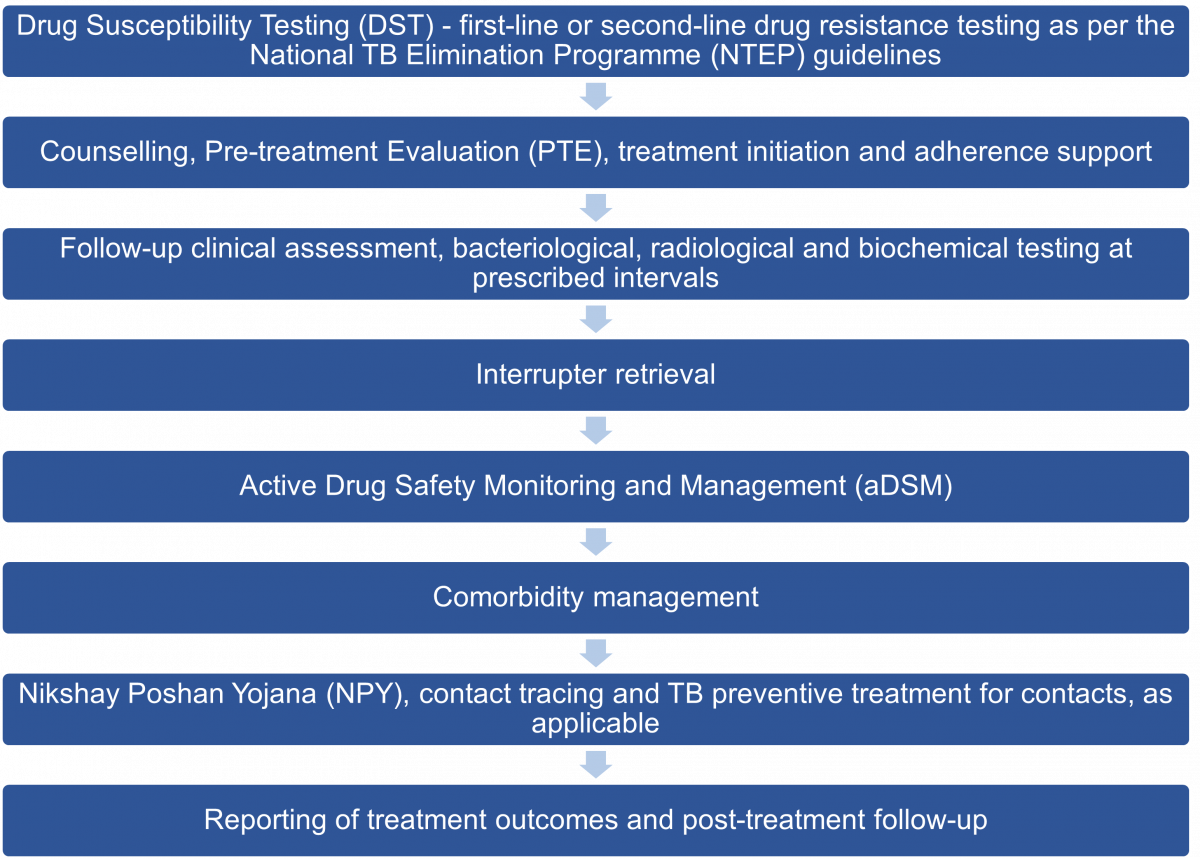
Figure: Flow of Care Cascade for a Patient Seeking Care in the Private Sector
Resources
Kindly provide your valuable feedback on the page to the link provided HERE
Drug-resistant TB Service Linkages to Private Sectors
ContentIt is a well-known fact that although free, quality diagnostic, treatment and patient support services are available in the public health sector, a significant number of patients seek health services from the large, unorganized private health sector.
Reaching out to these patients is important to:
- Deliver essential public health services to prevent the spread of disease and emergence of drug-resistance
- Support TB patients on treatment
- Address co-morbidities that adversely affect treatment outcomes
Additionally, healthcare-seeking is also guided by the willingness on the part of the patient as well as the provider.
A TB patient seeking care in the private sector should come in the purview of the National TB Elimination Programme (NTEP) through notification or referral.
There are at least three different ways that programme officers can expand drug-resistant TB (DR-TB) treatment services using the Guidance Document on Partnerships. They are:
- DR-TB centre inpatient services
- DR-TB centre on an outpatient basis
- Provision of consultation charges for the private specialist to support public sector DR-TB centres in clinical management
Resources
- Guidelines for Programmatic Management of Drug-resistant TB in India, 2021
- Guidance Document on Partnerships, 2019
Kindly provide your valuable feedback on the page to the link provided HERE
DR-TB Services Referral Linkage Scenario 1: Patient Notified from the Private Sector
ContentThe National TB Elimination Program (NTEP) makes an effort to provide Tuberculosis (TB) services to each TB patient, including services to Drug-resistant TB (DR-TB) patients notified/ referred from the private sector.
- It is assumed that a TB/ DR-TB patient who has been notified on Nikshay from the private sector is seeking care from a health facility that is already engaged by the NTEP.
- This engagement could have been established by the NTEP or a public health department directly or through a Patient Provider Support Agency (PPSA) or any other Non-government Organization (NGO)/ partner agency.
- TB patients (diagnosed and treated in the private sector) under the notification act are notified to NTEP from the private Health Facility (HF) using the digital surveillance system - Nikshay.
- It is the responsibility of the local public health and NTEP staff to reach out to the private provider directly or through PPSA and ensure that the TB care cascade is followed for the patient as per the NTEP guidelines or standards of TB care.
Resources
Kindly provide your valuable feedback on the page to the link provided HERE
DR-TB Service Referral Linkages Scenario 3: DR-TB Patient Referred for Treatment from the Private Sector with Bacteriological Confirmation in the Private Sector
ContentMany times, Drug-resistant Tuberculosis (DR-TB) patients diagnosed in the private sector will wish to avail services from the public sector.
The National TB Elimination Programme (NTEP) strongly recommends bacteriological confirmation of any DR-TB patient before initiation of treatment and discourages any empirical treatment.
Drug Susceptibility Testing (DST) results available from private laboratories for such patients will be considered acceptable under the following situations:
- Nucleic Acid Amplification Test (NAAT) results from labs that regularly undertake annual calibration of machines and/or are a part of the External Quality Assurance (EQA) mechanism of quality assurance under NTEP.
- Culture and Drug Susceptibility Test (C&DST) labs that participate in the annual proficiency testing through National Reference Laboratories (NRLs) under NTEP for the respective DST technology.
For patients who do not have results in accordance with the above, DST would be offered under NTEP as per the updated integrated DR-TB algorithm.
Resources
Kindly provide your valuable feedback on the page to the link provided HERE
DR-TB Service Referral Linkages Scenario 5: DR-TB Patient Referred for Treatment from the Private Sector with Treatment Initiated in the Private Sector
ContentIn a situation where Drug-resistant TB (DR-TB) patients may have consumed anti-TB drugs for some duration from the private sector, such prior anti-TB treatment is not likely to be uniformly reliable as far as the quality or quantity and duration of drugs consumed is concerned.
Given that uncertainty, the basic principle is that the duration of the DR-TB regimen under the National Tuberculosis Elimination Programme (NTEP) need not be reduced.
There may be exceptional circumstances that the Drug-resistant Tuberculosis Centres (DR-TBCs) may consider reducing the duration of treatment, where prior treatment is very well-documented, adequate and effective.
The DR-TBC committee can adjust the duration after a detailed patient review, approval and documentation of decisions taken.
If such a referral from the private sector has taken place without notification on Nikshay, the patient needs to be freshly notified after due confirmation of diagnostic results.
Resources
Kindly provide your valuable feedback on the page to the link provided HERE
Joint Effort for Elimination of Tuberculosis [JEET] Model of the Patient Provider Support Agency [PPSA]
ContentStudies have shown that nearly half of all patients with TB in India first seek care in the private sector, where there are significant gaps across the patient-care cascade, notably diagnostic delays, irrational and non-standardized regimens, and under-reporting to authorities. As a result, over a million cases of TB are missed in India every year. In order to address these challenges, project “Joint Effort for Elimination of Tuberculosis” (JEET) was envisaged. The key objective of this project is to set up effective and sustainable structures to strengthen existing systems and seamlessly extend quality TB care to patients in the private sector.
Patient Provider Support Agency (PPSA)
PPSA is one of the implementation Models under JEET Project and is responsible for continuous, end-to-end engagement of private sector to provide quality TB services to patients seeking care in private sector. The PPSA Model has the following key components:
1. Engagement of private providers
-
Network with private sector providers and promotes quality and early diagnosis,
-
Use of rapid diagnostics and Drug Susceptibility Testing (DST), TB notifications, and treatment as per Standards for TB Care in India (STCI)
-
Utilisation of available public sector services under the National TB Elimination Programme (NTEP) for the patients seeking care in the private sector.
2. Support engaged private sector providers for TB notifications in Ni-kshay
-
Through sensitisation
-
By establishing mechanisms/ modalities to support private sector notifications.
3. Linkage to free diagnostics services by the programme
-
All the presumptive TB cases are linked to free TB diagnostics services extended through a sample transport mechanism established under PPSA.
4. Linkage to free treatment services by the NTEP
-
Facilitates issue of NTEP Fixed Dose Combinations (FDCs) through engaged private sector practitioners and chemists
-
Facilitates linking patients to the public sector for initiation of treatment of Drug-sensitive TB (DS-TB) and Drug-resistant TB (DR-TB)
5. Support for treatment adherence
Adherence support is provided to patients through:
-
A team of treatment coordinators
-
NTEP provided Information and Communication Technology (ICT) enabled mechanism/ Call Centre for reminder SMS and phone calls.
6. Incentives to patients and private providers
-
NTEP provisioned incentives as per the National Strategic Plan (NSP) are provided to the engaged private providers and patients seeking care through them.
Image
Figure: The Service Delivery Model for PPSA
Patient Provider Support Agency Lite (PPSA lite)
An alternative model of PPSA called PPSA lite is implemented in 141 cities across seven states. City officers in PPSA lite cities/ districts support:
-
Mapping of private practitioners and identification of TB champions
-
Private sector provider engagement through Continuing Medical Education (CMEs)
-
Capacity building of NTEP staff to undertake private sector engagement.
-
Providing program monitoring support and facilitating reviews.
Resources
Answer 1
Answer 2
Answer 3
Answer 4
Correct answer
Correct explanation
Page id
Part of Pre-test
Part of Post-test
Under PPSA treatment adherence support is provided to patients in the private sector.
True
False
1
Adherence support is provided to patients through a team of treatment coordinators and through NTEP-provided Information and Communication Technology (ICT) enabled mechanism/ Call Centre for reminder SMS and phone calls.
YES
YES
-
Fullscreen