
-
Pharmacist: Key concepts in Procurement
FullscreenProcurement- Definition
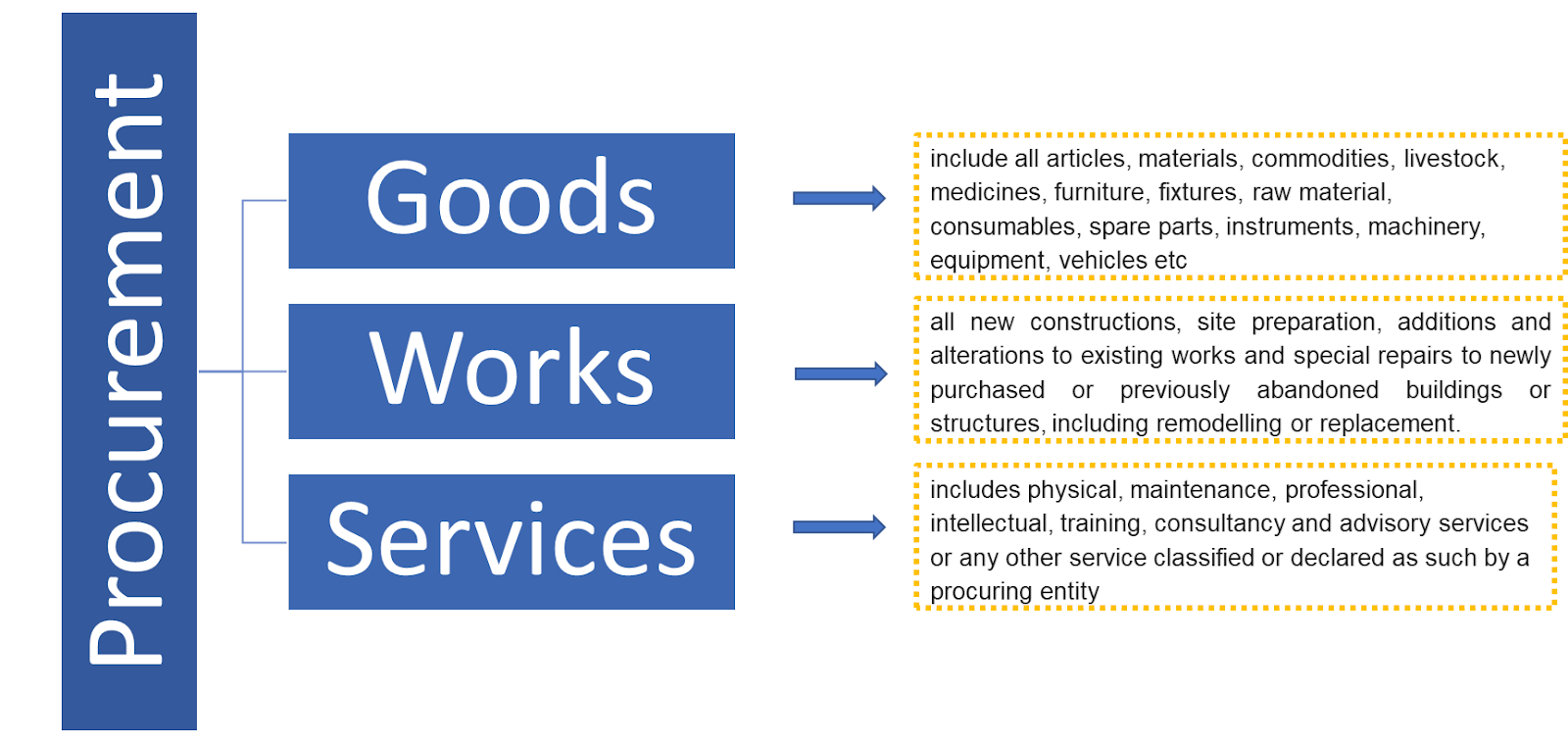
ContentProcurement refers to the process by which governments and state-owned enterprises purchase goods and services from the private sector.
Procurement” means acquisition by way of purchase, lease, license or otherwise, either using public funds or any other source of funds (e.g. grant, loans, gifts, private investment etc.) of goods, works or services or any combination thereof.
Resources
1. Manual for procurement of goods; Ministry of Finance, GoI 2017.
Assessment
Question Answer 1 Answer 2 Answer 3 Answer 4 Correct answer Correct explanation Page id Part of Pre-test Part of Post-test What does procurement include? Buying and process of buying Tendering Acquiring goods from an external source All of the above 4 Procurement refers to the process by which governments and state-owned enterprises purchase goods and services from the private sector. Yes Yes Principles of Procurement
ContentFundamental principles of public buying (for all procurements including procurement of works). Every authority delegated with the financial powers of procuring goods in the public interest shall have the responsibility and accountability to bring efficiency, economy, and transparency in matters relating to public procurement and for fair and equitable treatment of suppliers and promotion of competition in public procurement.
The 5 Rights of Procurement are inter-linked, each having an effect on the other. Therefore, the importance of the five Rights of Procurement is the impact the failure to achieve one Right has on the success of achieving all 5 Procurement Rights and provides a framework for effective purchasing and supply chain management.
Image
- The description of the subject matter of procurement to be objective, functional, generic and measurable and specify technical, qualitative and performance characteristics. Not indicate a requirement for a particular trademark, trade name or brand
- The specifications in terms of quality, type etc., as also quantity of goods to be procured, should be clearly spelt out keeping in view the specific needs of the procuring organisations.
- Care should also be taken to avoid purchasing quantities in excess of the requirement to avoid inventory carrying costs.
- Offers should be invited following a fair, transparent and reasonable procedure.
- The procuring authority should satisfy itself that the price of the selected offer is reasonable and consistent with the quality
Procuring authority must place on record in considerations which weighed with it while taking the procurement decision required.
Resources
- Manual for procurement of goods 2017, Ministry of Finance, GoI
- General Financial Rules 2017, Ministry of Finance, GoI
Assessment:
Question Answer 1 Answer 2 Answer 3 Answer 4 Correct answer Correct explanation Page id Part of Pre-test Part of Post-test What are the principles of procurement? Transparency, specification, evaluation, ethics, confidentiality Transparency, sensitivity, expensive, ethics, confidentiality Timeliness, specification, evaluation, ethics, confidentiality Transparency, specification, evaluation, management, confidentiality 1 Transparency, specification, evaluation, ethics, confidentiality Essentials of Procurement
ContentPolicymakers crafting a sound procurement system must balance a number of goals - transparency, competition and integrity are the most important. If a government’s procurement system reflects all three elements, the system is much more likely to achieve the best value in procurement and maintain political legitimacy.

Figure 1: Essentials of a procurement system
1. Transparency
A transparent procurement system ensures that rules are followed, non-compliance can be identified and addressed and all the stakeholders can monitor the process. A sound procurement system generally involves:
- Publicity of procurement opportunities and the disclosure of the rules to be followed.
- Undertaking procurement processes publicly and visibly, according to prescribed rules and procedures that limit the discretion of officials.
- The provision of a system for monitoring and enforcing applicable rules.
2. Competition
Competition in public procurement usually means that two or more bidders act independently and engage in a contest for the opportunity to secure the procuring entity’s contract by offering the most favourable terms. It is an important driver of innovation and helps achieve the best value-for-money- lower prices and better quality of goods, services and works.
3. Objective criteria in decision-making
Objectivity in decision-making in the context of public procurement refers to striving (as far as possible) to reduce or eliminate biases, prejudices and subjective evaluations.
- Closely linked with the principles of non-discrimination, equal treatment (fairness) for providers and integrity.
- No distinction should be made between providers of goods, services or works except where this is justified based on relevant objective considerations.
- Integrity requires objectivity at all stages of the procurement process and ethical conduct by all parties involved, as well as an independent and effective remedy system
All the purchases should be made in a transparent, competitive and fair manner to secure the best value for money.
Resource
Good Practices in Ensuring Compliance with Article 9 of The United Nations Convention Against Corruption; United Nations Office on Drugs & Crime, 2013.
Assessment
Question Answer 1 Answer 2 Answer 3 Answer 4 Correct answer Correct explanation A sound procurement system balances which three goals? Transparency, competition and objective criteria in decision making Transparency, discrimination, favouritism Subjectivity, time-bound, specific None of the above 1 Policymakers crafting a sound procurement system must balance a number of goals - transparency, competition and integrity are the most important.
-
Pharmacist: Procurement Processes
FullscreenTypes of Procurement Processes
ContentFigure: Different types of Procurements
Overview and Process of Procurement
Content
Figure: Procurement Process
Resources
Assessment:
Answer 1
Answer 2
Answer 3
Answer 4
Correct answer
Correct explanation
Page id
Part of Pre-test
Part of Post-test
Procurement process involves Need assessment Bid Invitation
Bid Evaluation
Contract execution& Disposal of scrap
All of the above
Procurement process involves Need assessment
Bid Invitation
Bid Evaluation
Contract execution& Disposal of scrap
Yes
Yes
z
-
Pharmacist: Government e-Marketplace[GeM]
FullscreenWhat is GeM
ContentGeM stands for Government e-Market Place. It is the digital eCommerce portal for the procurement and selling of goods and services by the Government of India.

Fig 1: Logo of GeM
Source:https://gem.gov.in
- Government e-Marketplace (GeM) facilitates online procurement of common-use goods & services required by various government departments/organisations / public sector units (PSUs).
- GeM aims to enhance transparency, efficiency and speed in public procurement.
- It provides the tools of e-bidding, reverses e-auction and demand aggregation to facilitate the government users to achieve the best value for their money.
Significance
GeM is a completely paperless, cashless and system driven e-marketplace that enables procurement of common-use goods and services with minimal human interface.
It aims at:
- Instituting a unified procurement policy to encourage behavioural change and drive reform
- Establishing a lean, dynamic organisation capable of continuous innovation and market-driven decision making
- Building an easy-to-use, fully automated platform to ensure transparency and efficiency in procurement
- Demonstrating commitment to delivering value by ensuring the right quality at the right price
- Creating a sustainable ecosystem covering all stakeholders and driving inclusive development in India
Resources
Assessment:
Question Answer 1 Answer 2 Answer 3 Answer 4 Correct answer Correct explanation Page id Part of Pre-test Part of Post-test What are the advantages of GeM? Paperless procurement processes Cashless procurement processes 1& 2 None 3 GeM is a completely paperless, cashless and system-driven eMarketplace that enables procurement of common-use goods and services with minimal human interface.
Yes Yes Processes in GeM
ContentDepending upon the total value of procurement, the GeM platform provides three primary buying modes:

Direct purchase:
Direct purchase enables buyers to buy products of value up to INR 25,000 that meet the requisite quality, specifications, and delivery period without comparison (except automobiles) through any available sellers on GeM.
Direct purchase with L1
The Direct Purchase with L1 is used for mid-value (INR 25,000 to 50,000) transactions and allows the buyer to directly procure from the L1 seller after comparing all available sellers on the platform that meet the requisite quality, specification and delivery period as specified by the buyer. The comparison must be made between goods/services of at least three different manufacturers/Original Equipment Manufacturers (OEMs) and three different sellers.
E-Bid/ Reverse Auction
The E-bid/Reverse Auction mode allows buyers to conduct an electronic bid for the goods and services on the platform. The creation of bid documents as well as system-driven evaluation, are driven through well-defined and standardized technical parameters. The GeM platform shall provide buyers with the option to customize the bid, as per their requirements by way of objective selections.
Proprietary Article Certificate (PAC) Buying
The GeM platform allows buyers to procure on a proprietary basis by using the PAC filter provided on the GeM platform, which allows the selection of a specific model/makes from a particular seller that is available on the platform.
Resources
Assessment
Question Answer 1 Answer 2 Answer 3 Answer 4 Correct answer Correct explanation Page id Part of Pre-test Part of Post-test Who hosts the GeM portal Ministry of Health and Family welfare Central TB Division Directorate General of Supplies and Goods Ministry of commerce 3 GeM portal is hosted by the Directorate General of Supplies and Goods. YES YES Direct Procurement through GeM
ContentDirect purchase enables a buyer to buy services of value up to Rs. 25,000, which meets the requisite quality, specifications and delivery period without comparison(except automobiles), through any of the available sellers on the Government e-Marketplace (GeM) portal.
Steps include:
1.Login to the GeM portal as a buyer

2. Click on Market--> Services

3. Select the service required

4. Check 'Service Level Agreement'

5. Select consignee location and number of resources. Fill in contract dates.

6. Fill in delivery details

7. Can view different service providers

8. Apply filters

9.'Add to Cart' the required one

10. Review cart and proceed

11. Preview Formula

12.

13. Click on 'Direct Purchase' to proceed

14. Click 'Confirm'

15. Enter the 'Reason for Choosing the Seller'

16.

17. Enter 'Financial Details'

18.

19.

20.

21.

22.

Resources
Assessment
Question
Answer 1
Answer 2
Answer 3
Answer 4
Correct answer
Correct explanation
Page id
Part of Pre-test
Part of Post-test
Which service/s are eligible for direct procurement through GeM? Services of value above Rs 1 lakh Services of value up to Rs. 25,000
None of the above
All of the above
2
Direct Purchase enables a buyer to buy services of value up to Rs. 25,000 (except automobiles) through any of the available sellers on GeM.
Floating Tender through GeM
ContentA tender is an invitation to bid for a project or accept a formal offer. Tender is a process on its own; bidding is just a step towards applying for the tender and getting it.
The process of floating a tender through the Government e-Marketplace (GeM) portal has the following steps:
Step 1: Login to the GeM portal using your credentials

Figure 1: Logging into GeM portal
Source: GeM portal
Step 2: Search for the desired product
On logging in, a “Search” option is available at the top section of the same. Click on the “Categories” section of the site and select the product or click on the “search” option and enter the product's name.

Figure 2: Options to search for the desired product
Source: GeM portal
Step 3: Choose the desired product
After searching, product/products will come under the L1 category. If you want to buy items which are made in India, click on the “Made in India” section. However, before you can bid on something, you will need to compare the same with others. This enables you to find the best offering available under the amount of money you are willing to spend.
For this, click on the “Compare” option first. Various other similar options come up on the screen. Compare them side by side.

Figure 3: Comparing products and selecting the desired one
Source: GeM portal
Step 4: Bid on the product
Once the comparison procedure is done, tap on the “Add to Cart” option available under the product. A new window will open; tap on the “Proceed to Checkout” option. Select the “Bidding” option.

Figure 4: Proceed to checkout
Source: GeM portal

Figure 5: Select the‘ Bidding’ option
Source: GeM portal
Step 5: Entering bid details and finalizing
On selecting the “Bidding" option, the bid details page opens. Fill in all details and create the bid.

Figure 6: Bid details page
Source: GeM portal

Figure 7: Create a bid
Source: GeM portal
Review the terms and conditions and click “Finalize Bid”.

Figure 8: Finalizing bid
Source: GeM portal
The bid is generated and details are displayed.

Figure 9: Successful bid creation
Source: GeM portal
On clicking the bid number, you can anytime review the bid- cancel or extend it.

Figure 10: Review of bid
Source: GeM portal
Resources
GeM portal https://gem.gov.in/
Assessment
Question
Answer 1
Answer 2
Answer 3
Answer 4
Correct answer
Correct explanation
Page id
Part of Pre-test
Part of Post-test
GeM portal has the option to select ‘Made in India’ products. True False
1
If you want to buy items which are made in India, click on the “Made in India” section.
Yes
Yes
Fullscreen