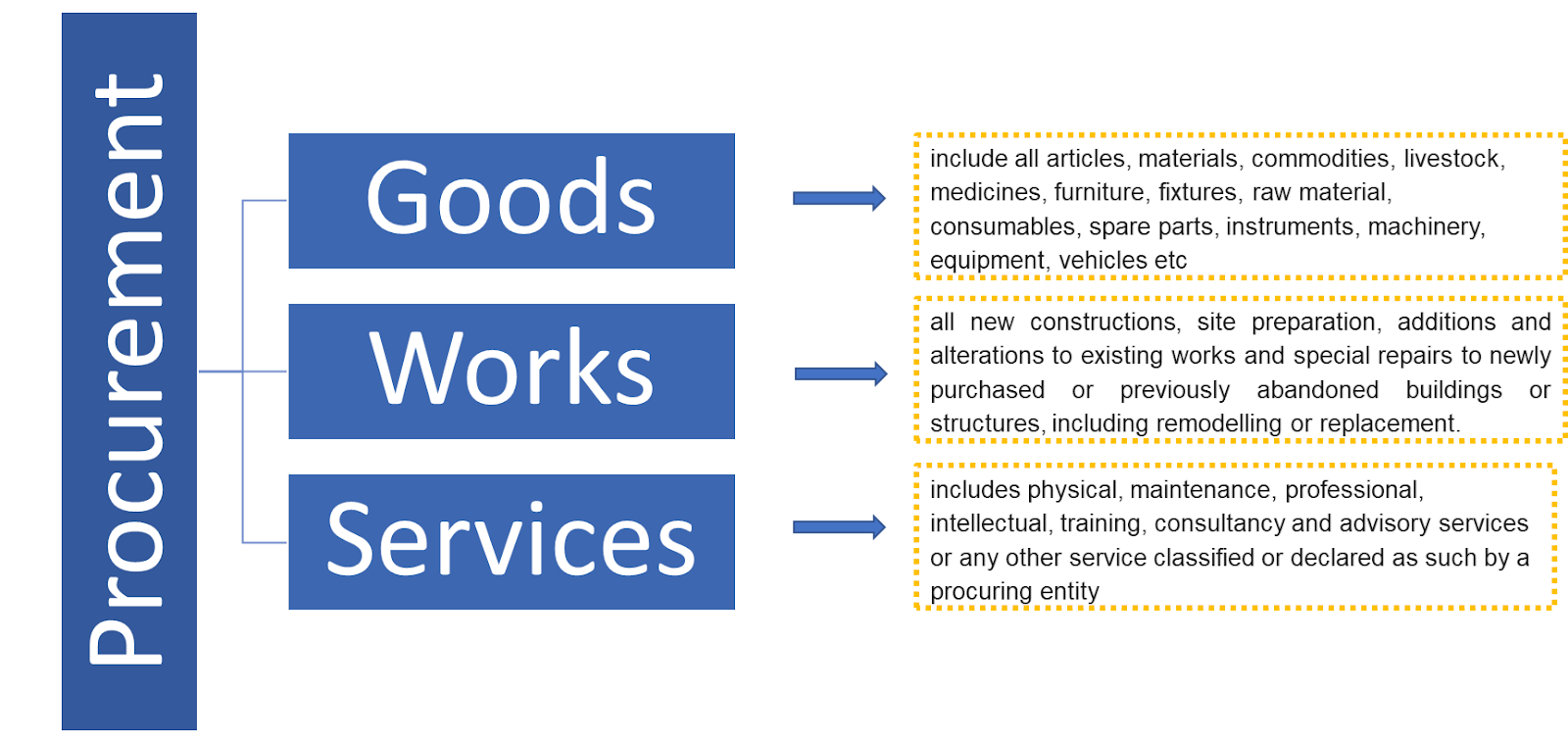

Procurement- Definition
ContentProcurement refers to the process by which governments and state-owned enterprises purchase goods and services from the private sector.
Procurement” means acquisition by way of purchase, lease, license or otherwise, either using public funds or any other source of funds (e.g. grant, loans, gifts, private investment etc.) of goods, works or services or any combination thereof.
Resources
1. Manual for procurement of goods; Ministry of Finance, GoI 2017.
Assessment
Question Answer 1 Answer 2 Answer 3 Answer 4 Correct answer Correct explanation Page id Part of Pre-test Part of Post-test What does procurement include? Buying and process of buying Tendering Acquiring goods from an external source All of the above 4 Procurement refers to the process by which governments and state-owned enterprises purchase goods and services from the private sector. Yes Yes Principles of Procurement
ContentFundamental principles of public buying (for all procurements including procurement of works). Every authority delegated with the financial powers of procuring goods in the public interest shall have the responsibility and accountability to bring efficiency, economy, and transparency in matters relating to public procurement and for fair and equitable treatment of suppliers and promotion of competition in public procurement.
The 5 Rights of Procurement are inter-linked, each having an effect on the other. Therefore, the importance of the five Rights of Procurement is the impact the failure to achieve one Right has on the success of achieving all 5 Procurement Rights and provides a framework for effective purchasing and supply chain management.
Image
- The description of the subject matter of procurement to be objective, functional, generic and measurable and specify technical, qualitative and performance characteristics. Not indicate a requirement for a particular trademark, trade name or brand
- The specifications in terms of quality, type etc., as also quantity of goods to be procured, should be clearly spelt out keeping in view the specific needs of the procuring organisations.
- Care should also be taken to avoid purchasing quantities in excess of the requirement to avoid inventory carrying costs.
- Offers should be invited following a fair, transparent and reasonable procedure.
- The procuring authority should satisfy itself that the price of the selected offer is reasonable and consistent with the quality
Procuring authority must place on record in considerations which weighed with it while taking the procurement decision required.
Resources
- Manual for procurement of goods 2017, Ministry of Finance, GoI
- General Financial Rules 2017, Ministry of Finance, GoI
Assessment:
Question Answer 1 Answer 2 Answer 3 Answer 4 Correct answer Correct explanation Page id Part of Pre-test Part of Post-test What are the principles of procurement? Transparency, specification, evaluation, ethics, confidentiality Transparency, sensitivity, expensive, ethics, confidentiality Timeliness, specification, evaluation, ethics, confidentiality Transparency, specification, evaluation, management, confidentiality 1 Transparency, specification, evaluation, ethics, confidentiality Essentials of Procurement
ContentPolicymakers crafting a sound procurement system must balance a number of goals - transparency, competition and integrity are the most important. If a government’s procurement system reflects all three elements, the system is much more likely to achieve the best value in procurement and maintain political legitimacy.

Figure 1: Essentials of a procurement system
1. Transparency
A transparent procurement system ensures that rules are followed, non-compliance can be identified and addressed and all the stakeholders can monitor the process. A sound procurement system generally involves:
- Publicity of procurement opportunities and the disclosure of the rules to be followed.
- Undertaking procurement processes publicly and visibly, according to prescribed rules and procedures that limit the discretion of officials.
- The provision of a system for monitoring and enforcing applicable rules.
2. Competition
Competition in public procurement usually means that two or more bidders act independently and engage in a contest for the opportunity to secure the procuring entity’s contract by offering the most favourable terms. It is an important driver of innovation and helps achieve the best value-for-money- lower prices and better quality of goods, services and works.
3. Objective criteria in decision-making
Objectivity in decision-making in the context of public procurement refers to striving (as far as possible) to reduce or eliminate biases, prejudices and subjective evaluations.
- Closely linked with the principles of non-discrimination, equal treatment (fairness) for providers and integrity.
- No distinction should be made between providers of goods, services or works except where this is justified based on relevant objective considerations.
- Integrity requires objectivity at all stages of the procurement process and ethical conduct by all parties involved, as well as an independent and effective remedy system
All the purchases should be made in a transparent, competitive and fair manner to secure the best value for money.
Resource
Good Practices in Ensuring Compliance with Article 9 of The United Nations Convention Against Corruption; United Nations Office on Drugs & Crime, 2013.
Assessment
Question Answer 1 Answer 2 Answer 3 Answer 4 Correct answer Correct explanation A sound procurement system balances which three goals? Transparency, competition and objective criteria in decision making Transparency, discrimination, favouritism Subjectivity, time-bound, specific None of the above 1 Policymakers crafting a sound procurement system must balance a number of goals - transparency, competition and integrity are the most important.
Fullscreen