
Community Engagement
ContentCommunity engagement is a process of developing relationships that enable stakeholders to work together to address health-related issues and promote well-being to achieve positive health impact and outcomes.
Mobilize communities to engage them in TB care and to increase ownership of the Programme by communities.
Why Community Engagement?
Figure: Importance of Community Engagement
Importance of Community Engagement in TB
ContentCommunity-based TB activities are conducted outside the premises of formal health facilities (e.g. hospitals and clinics) in community-based structures (e.g. schools and places of worship) and homesteads. Community health workers and community volunteers carry out community-based TB activities. Both can be supported by nongovernmental organizations and/or the government.
Community Engagement is a cost effective intervention to improve health service coverage and deliver accessible and people-centered integrated care.
Figure: Importance of Community Engagement
TB Champion
ContentA TB Champion is a person who has been affected by TB and successfully completed the treatment.
TB Champions, in their capacity as survivors, are role models and can provide valuable support to those with TB and their families.
Figure: Roles of TB Champion
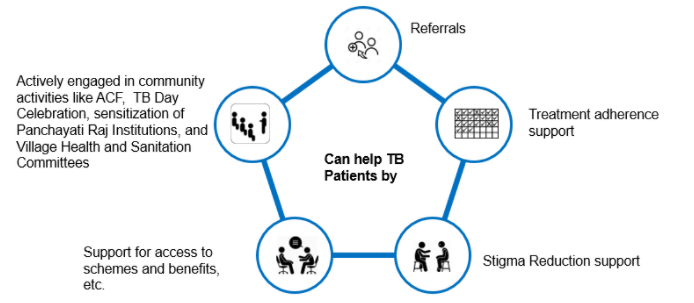
Community Health Volunteers should identify TB Champions and engage them to provide their support to the patient in activities like:
Figure: Help to TB Patients by Community Health Volunteers
Role of Health Volunteers in Community Engagement
ContentInvolve TB Champions: Community Health Volunteers should play a key role in the following aspects
- Identification from TB survivors in the community
- Training in various aspects of TB and role of TB Champions in NTEP activities
- Mentoring and grooming for providing support to TB patients as peer counsellors
- Supporting the formation & functioning of survivor-led networks at various levels
- Recognition and facilitation for good work on occasions like “International TB Day Celebration.”
Engaging community structures at village level: Community Health Volunteers should engage the community for the following:
- Active Case Finding
- TB awareness generation
- Stigma reduction
- Support for TB patients
Psychosocial Support to TB Patients:
- Offer words of encouragement, alleviate anxiety and create awareness.
- Promote kindness, solidarity, compassion; offer to talk to family & community members.
- Connect TB patients to TB community network, TB survivors.
- Have a gender-sensitive approach and ensure gender equality.
- Provide guidance on supportive interventions(e.g., refer to mental health helplines, share information on videos/resources available on MoHFW’s website).
- Choose words carefully while referring to those affected; form treatment support groups.
- Avoid using words like cases, victims, transmitters and suspects.
- Share key messages to prevent stigma; conduct stigma reduction interventions.
Fullscreen